Dental Billing Process & Guidelines: Cross-Billing & Claims
Dental billing is the process of submitting claims to dental and, when procedures qualify, medical insurance to collect payment for dental services.

Quick Answer
Dental billing is the process of submitting claims to dental and, when procedures qualify, medical insurance to collect payment for dental services. The cycle runs 8 steps from pre-visit insurance verification through claim submission, adjudication, payment posting, and AR follow-up. Most claim failures come down to three root causes: documentation gaps, coding errors, and missed cross-billing opportunities where dental procedures with a medical necessity component should have gone to the patient's medical plan first.
Dental practices that treat billing as an afterthought are losing measurable revenue every month. According to eAssist, the average dental practice loses 9% of collectible revenue annually to missed billing processes. A 2025 ADA Health Policy Institute poll found that more than half of dentists named insurance payment issues as their top concern heading into 2026. And the US dental services market was valued at $192 billion in 2023, which means even a fraction of a percentage point in recaptured revenue adds up to real dollars per practice.
The dental billing cycle is an 8-step system with specific timelines, common failure points, and, for qualifying procedures, a second revenue stream that most practices are not accessing: medical insurance. This article walks through the full cycle, explains exactly where and why claims fail, and provides a deep dive on cross-billing, the strategy of billing dental procedures with medical necessity components to a patient's medical plan rather than just the dental plan.
I have spent significant time researching dental billing workflows, including time processing and reviewing claims through Optum, and what I see consistently is that the revenue gap is not random. It is predictable. And it is fixable with the right process in place. That is what this guide is designed to give you.
The average dental practice loses 9% of collectible revenue every year to missed billing processes, and fewer than 30% systematically screen for cross-billing opportunities that could recover $2,000 to $8,000 per qualifying patient case from medical insurance. A 2025 ADA Health Policy Institute poll found that more than half of dentists cited insurance payment issues as their top concern heading into 2026, yet the cycle that drives those issues follows a predictable 8-step sequence with identifiable failure points at every stage.
Dental billing is a method for organizing the financial side of your practice around a structured claim lifecycle: insurance verification, treatment documentation, CDT coding, claim creation, scrubbing, submission, adjudication, and AR follow-up. It is also, for a subset of qualifying procedures, a dual-channel billing system where dental and medical insurance both owe payment on the same patient visit, and most practices are collecting only one of those two checks.
In my time researching dental billing workflows and reviewing claims through Optum, I found the same gap at practice after practice: revenue left behind not because insurance would not pay, but because the billing process never asked correctly. This guide covers the full cycle with real timelines, the denial patterns that cost practices the most, and the cross-billing framework that recaptures revenue hiding in plain sight. If you want to go deeper on the fundamentals first, this overview of what dental billing is and how it works is a good starting point.
What Dental Practice Owners Ask Most
- How long does the dental billing cycle actually take? With a clean workflow, 45 to 90 days from date of service to final payment. Without one, claims routinely age past 120 days and collection rates drop sharply.
- When can I bill a dental procedure to medical insurance? When the procedure has a documented medical necessity component: sleep apnea appliances, TMJ treatment, trauma-related dental work, biopsies, oral cancer treatment, and periodontal therapy in patients with systemic conditions like diabetes are the most common qualifying categories.
- What is the most common reason dental claims get denied? Missing or incorrect documentation. CDT coding errors and eligibility issues follow closely. All three are preventable with the right workflow in place before the claim is ever submitted.
The Dental Billing Cycle: Step-by-Step with Real Timelines
Dental billing is not a single event. It is a sequence of eight distinct steps, and a failure at any one of them delays payment or kills the claim entirely.
According to eAssist, the average dental practice loses 9% of collectible revenue annually to missed billing processes, which adds up fast regardless of practice size. I have walked through this cycle in depth in my research into billing workflows, and the practices that get paid fastest treat each step as a separate workflow with a specific owner and a hard deadline, as of .
Here is what the full cycle looks like, along with realistic timelines for each phase.
Step 1: Patient Registration and Insurance Verification (1 to 3 days before appointment)
Everything starts here. Before the patient sits in the chair, your billing coordinator must confirm active coverage, identify the plan type, note any waiting periods, confirm annual maximums and remaining benefits, and flag whether pre-authorization is required for any planned procedures. Weave recommends verifying insurance at least 48 to 72 hours before the appointment to resolve coverage issues before check-in. Skipping this step is the single most preventable cause of eligibility-related denials. Verification done the morning of the appointment is too late for anything requiring pre-auth.
Step 2: Treatment Documentation (Day of service)
The provider must document the procedure with specificity. Vague chart notes are not billable. Every CDT code you submit must be supported by a matching clinical note that includes the tooth number, surface (for restorative work), diagnosis, and clinical justification. For procedures crossing into medical necessity, you also need a narrative. Write it on the day of service. According to Medusind, "clinical notes, x-rays, periodontal charting, and past treatment records must support the codes used in claims." That is not optional guidance. It is a prerequisite for reimbursement.
Step 3: CDT Coding and Claim Creation (Day 1 to Day 3 post-service)
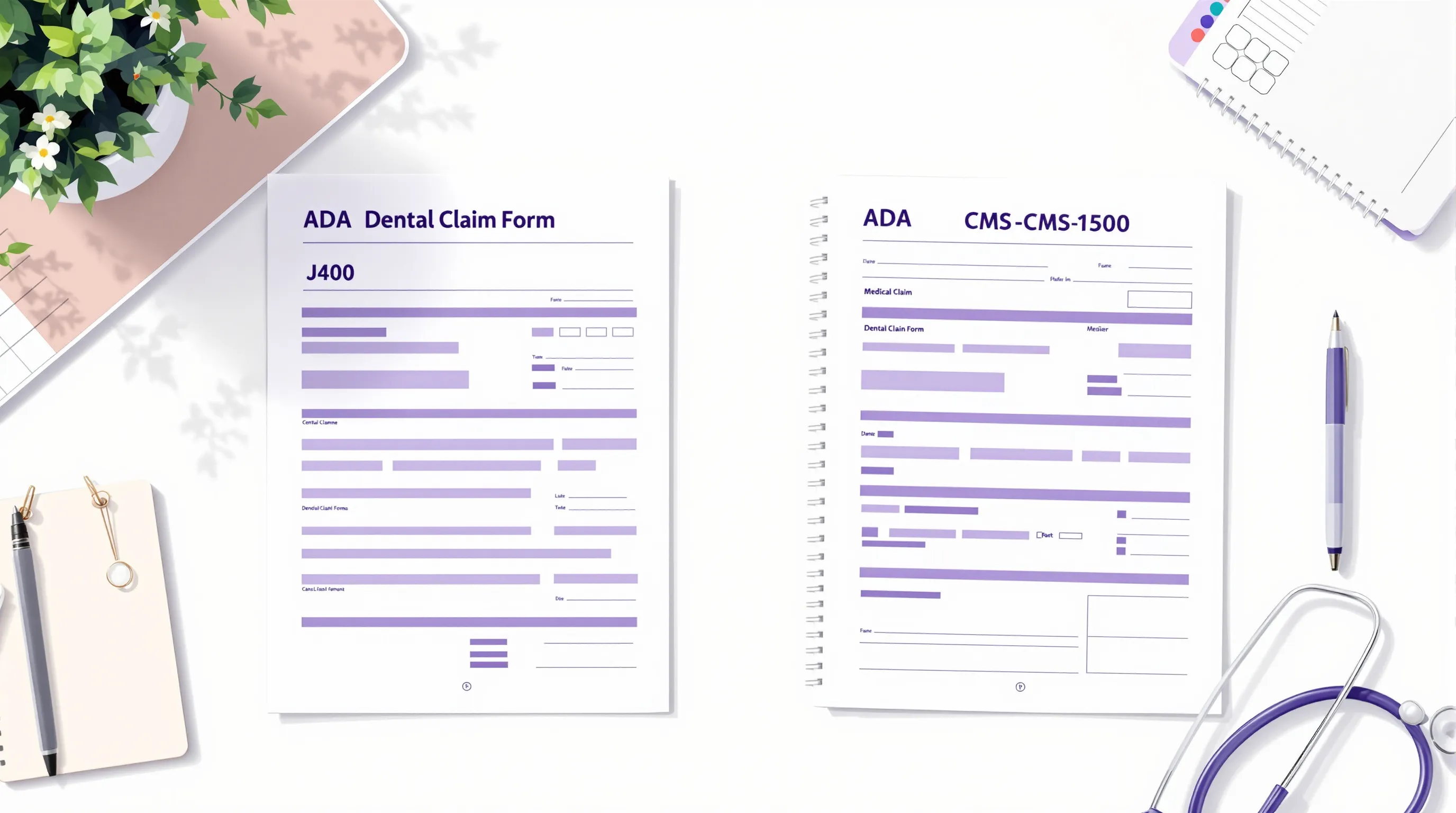
Once documentation is complete, the billing coordinator assigns CDT codes and builds the ADA Dental Claim Form (J400 series). The ADA updates CDT codes annually, and using a deprecated code is an automatic denial at the clearinghouse level. Per NetSuite, citing industry data from 2740 Consulting, approximately 15% of dental claims are denied by insurers, a rate that has increased roughly 4 percentage points since 2022. Many of those denials trace to coding errors that annual training would prevent. If you are cross-billing to medical insurance, this is also where you switch to CPT codes on a CMS-1500 form instead of the J400.
Step 4: Claim Scrubbing (Day 3 to Day 5)
Before submission, claims run through a scrubbing process. Billing professionals, as Weave puts it, "'scrub' each claim to ensure that the correct procedure, diagnosis, and modifier code are present and accurate." A clean claim is one that passes all scrub edits before it ever reaches the payer. Practices that skip scrubbing because they are in a hurry pay for it on the back end with rejected claims that reset the filing clock entirely.
Step 5: Claim Submission and Clearinghouse Routing (Day 5 to Day 7)
Electronic claims submitted through a clearinghouse reach the payer within 24 to 48 hours. Paper claims mailed directly take 7 to 10 days just to arrive. This is why electronic submission is non-negotiable for any practice that cares about cash flow. Dental Claim Support notes that "medical insurance oftentimes has a timely filing limit of three to six months instead of the year-long timely filing limits in many dental plans," which makes tracking cross-billed medical claims especially time-sensitive.
Step 6: Adjudication (Day 14 to Day 45 depending on payer)
This is the payer's review window. Electronic claims with major commercial payers typically adjudicate in 14 to 30 days. Some state Medicaid programs and smaller payers run 30 to 45 days. Medusind recommends following up on any claim delayed more than 30 days. During adjudication, the payer checks eligibility, verifies coverage, applies coordination of benefits rules, and calculates what it owes. You receive an Explanation of Benefits (EOB) or an Electronic Remittance Advice (ERA) with the result.
Step 7: Payment Posting (Day 3 to Day 5 after EOB)
When the EOB or ERA arrives, post the payment against the correct patient account. Correct posting means matching payment to each individual procedure code. Errors in payment posting create phantom balances that confuse patients and delay secondary insurance billing. If the payer paid less than expected, flag that underpayment for AR follow-up. Dental Claim Support is direct on this point: "simply trusting that your dental billing is going okay is risking the future of your practice."
Step 8: Patient Billing and AR Follow-Up (Day 30 to Day 90 after service)
After primary (and secondary, if applicable) insurance pays, the remaining balance goes to the patient. Send the statement within 5 business days of posting the insurance payment. Any unpaid balances after 30 days enter the AR follow-up queue. Practices with effective AR management close most claims within 45 to 90 days of the date of service. Practices without it routinely see claims age past 120 days, at which point collection rates drop significantly, and for cross-billed medical claims, the short 3 to 6 month timely filing window may have already closed.
| Billing Cycle Stage | Who Owns It | Target Timeline |
|---|---|---|
| Insurance Verification | Billing Coordinator / VA | 1 to 3 days before visit |
| Treatment Documentation | Provider (in-house) | Day of service |
| CDT Coding and Claim Creation | Billing Coordinator / VA | Day 1 to Day 3 |
| Claim Scrubbing | Clearinghouse / Billing Software | Day 3 to Day 5 |
| Claim Submission | Billing Coordinator / VA | Day 5 to Day 7 |
| Adjudication | Payer | Day 14 to Day 45 |
| Payment Posting | Billing Coordinator / VA | 3 to 5 days after EOB |
| Patient Billing and AR Follow-Up | Billing Coordinator / VA | Day 30 to Day 90 |
Where Dental Claims Fail: Top Denial Reasons and How to Fix Them
A 2025 ADA Health Policy Institute poll found that more than half of dentists surveyed cited insurance-related issues, including delayed or denied payments, as a top concern heading into 2026.
That is not a billing department problem. That is a practice revenue problem, and it belongs on the owner's radar. CEC data shows that 10 to 15% of dental insurance claims are rejected or postponed due to incomplete documentation, coding mistakes, or eligibility problems. The vast majority of those failures are fixable. Here is what is actually causing your denials, organized by category, with specific fixes for each.
Category 1: Eligibility and Coverage Errors
These are the denials that sting the most because they were entirely preventable. The patient's insurance was terminated, the group number changed, the plan has a waiting period for the procedure, or the annual maximum was already exhausted before the patient showed up. In my research into billing workflows, eligibility errors consistently rank as one of the top preventable denial categories across most payer mixes.
- Fix: Verify eligibility no earlier than 3 days before the appointment and no later than the morning before. Do not rely on a verification you ran 3 months ago, even for established patients. Plans change at open enrollment, and patients do not always notify your office.
- Fix: Track annual maximums per patient in your practice management system. If a patient is nearing their maximum, flag it before the next appointment so the provider can sequence treatment accordingly and discuss patient portion upfront.
Category 2: Documentation and Missing Attachments
Payers are increasingly requiring attachments: X-rays, perio charting, clinical narratives, and photos. Missing an attachment is one of the most common reasons a claim gets pended or denied. As Weave's billing guidance puts it, "incomplete or missing encounter documentation is one of the most common causes of claim denials." Documentation denials are the most time-consuming to fix because they require the clinical team to pull records and resubmit, resetting the processing clock.
- Fix: Build a payer-specific attachment checklist into your claim creation workflow. Delta Dental, Cigna, and Aetna each have different attachment thresholds. Know them before you submit.
- Fix: For procedures that almost always require X-rays (D2000 series restorations, extractions, implants), make X-ray attachment a default part of the claim package, not an afterthought.
- Fix: Perio treatment claims (D4341, D4342, D4910) routinely require a full periodontal chart within 12 months of the procedure date. If the chart is missing from the submission, the claim will pend. As CEC notes, D4341 is "commonly denied when periodontal charting and x-ray documentation requirements are not met."
Category 3: Coding Errors
CDT coding errors fall into several sub-types. Incorrect code selection, bundling violations, and frequency limitations are the three most common. Coding errors that involve upcoding can trigger audit flags and jeopardize your payer contracts, so this category deserves more than just a reactive fix. It requires a process. CEC makes the point clearly: using D1110 (adult prophylaxis) for a periodontal patient when D4910 or D4346 are the appropriate codes is a denial trigger that no amount of appeal paperwork will reverse unless the code is corrected first.
- Fix: Use current-year CDT codes. The ADA releases updates annually. NetSuite confirms that "application of outdated codes is a common cause of claim rejections." A claim submitted with a prior-year deprecated code will reject at the clearinghouse level, not at adjudication, meaning it never got a substantive review.
- Fix: Know your frequency limitations per payer. Two cleanings per calendar year is a common standard, but some Medicaid programs allow only one. Build those rules into your scheduling system, not your billing department.
- Fix: For restorative work, confirm that the surface count on the claim matches the documented surfaces in the chart. A one-surface code billed for a two-surface restoration is a coding error even when no fraud was intended. Dental Claim Support is explicit: "when you improperly or inaccurately code a procedure you could be unintentionally committing fraud."
Category 4: Authorization and Timely Filing
Pre-authorization denials happen when a procedure required prior approval and did not receive it. Timely filing denials happen when the claim arrives after the payer's window closes. Timely filing limits range from 90 days to 365 days from the date of service for most dental plans, but medical payers typically run only 3 to 6 months. Once that window closes, the revenue is gone permanently, regardless of how clean the claim would have been.
- Fix: Maintain a payer-level timely filing matrix for every plan in your payer mix. Review it quarterly because payers update their filing requirements without notifying you.
- Fix: Pre-authorization requirements apply most often to implants, orthodontic treatment, full-mouth rehabilitation, and certain surgical extractions. Call the payer before the appointment, not after.
- Fix: When a claim is denied for timely filing, check whether you have proof of timely submission: a clearinghouse confirmation report with the original submission date. If the claim was submitted on time and denied in error, that document is your appeal.
| Denial Category | Common Cause | Primary Fix |
|---|---|---|
| Eligibility / Coverage | Terminated coverage, exceeded maximum, waiting period | Real-time verification within 48 to 72 hours of appointment |
| Missing Documentation | No X-ray, no perio chart, no narrative | Payer-specific attachment checklists at claim creation |
| Coding Errors | Wrong code, bundling violation, frequency exceeded | Annual CDT training, frequency limit rules in scheduling system |
| Auth / Timely Filing | No pre-auth obtained, claim filed late | Pre-auth workflow, payer timely filing matrix |
| Other (COB, duplicates) | Secondary not billed, duplicate claim submitted | COB protocol, duplicate claim check before submission |
Medusind reports that more than 25% of appealable dental claims are actually appealed, citing administrative time as the deciding factor. That is the real problem: most practices do not have the capacity to pursue every appeal systematically. A well-resourced AR follow-up process, whether in-house or through a trained dental billing virtual assistant, reverses a significant portion of those denials on resubmission. The revenue is there. The question is whether your practice has the bandwidth to go get it.
Cross-Billing: When to Bill Dental Procedures to Medical Insurance
This section is where most dental billing guides stop short. Cross-billing, meaning submitting a claim to a patient's medical insurance for a procedure with a documented medical necessity component, is the single largest uncaptured revenue opportunity in most dental practices. Crystal May, a medical billing specialist with nearly 20 years of experience who consults for eAssist, said it plainly in a training session: "I have yet to see a dental office ever max out a patient on their medical benefits."
In my research into Optum claims workflows and dental billing processes, the pattern is consistent: fewer than 30% of dental offices systematically screen patients for cross-billing eligibility, even though a qualifying procedure can recover $2,000 to $8,000 in medical insurance reimbursement per patient case. The billing mechanics change, but the opportunity is real and available right now for most practices.
Cross-billing is not a workaround. DSN confirms that "procedures like oral surgeries, bone grafts, and periodontal treatments often qualify for reimbursement from both medical and dental insurance providers." The failure is that most dental teams do not know which procedures qualify, and they do not know how to execute the form and code swap required to access that second revenue stream.
Which Procedures Qualify for Cross-Billing?
The qualifying criterion is medical necessity: the condition being treated has a systemic health component, not just a dental one. Here are the procedure categories that most commonly qualify.
- Oral appliances for sleep apnea: When a physician has diagnosed obstructive sleep apnea (ICD-10: G47.33) and the dentist fabricates a mandibular advancement device, the claim goes to medical insurance. The relevant HCPCS code is E0486. This is one of the highest-value cross-billing opportunities and one of the most consistently reimbursed. Crystal May specifically flags sleep apnea appliances as requiring ICD-10 medical diagnosis codes, and notes that "this must be billed using ICD-10 medical diagnosis codes... insurance companies should not be telling patients what codes the doctor should be using."
- TMJ treatment: Temporomandibular joint disorder (ICD-10: M26.60) with documented functional impairment qualifies for medical billing. A practitioner commenter in a billing forum noted that Aetna, for example, "will cover TMJ treatment under medical insurance, but if the service or item is considered a dental device, they require it to be billed with a dental CDT code, not a medical CPT/HCPCS code." This payer-level variation is exactly why you need to verify benefit rules per plan before submitting.
- Trauma and injury-related dental work: Tooth loss, fractures, or soft tissue injuries resulting from an accident, fall, or assault route to medical insurance. This includes emergency extractions, surgical repairs, and prosthetics needed as a direct result of the injury. Dental Claim Support notes that "accident or trauma damage to teeth, gums, and the jaw" is medical in nature and must go to the medical carrier as primary, not dental.
- Oral cancer diagnosis, biopsy, and treatment: Biopsies and cancer-related surgical procedures are medical claims. Soft tissue biopsy (CDT D7285) maps to CPT 40808 on a CMS-1500 form. If you are performing diagnostic or therapeutic work related to oral cancer, that work belongs on a medical claim.
- Implants following trauma or cancer: When a patient loses a tooth due to cancer, trauma, or medically necessary extraction, the implant restoration can qualify for medical coverage. As Crystal May explains, the question is "why does the patient need an implant, and how did the patient lose their tooth?" The why determines medical eligibility, not the what.
- Periodontal disease in patients with documented systemic conditions: Some medical plans cover periodontal treatment (scaling and root planing, D4341) when the patient has a documented condition like uncontrolled diabetes (ICD-10: E11.65) and the treating provider documents the systemic health link.
The Mechanics: How Cross-Billing Actually Works
The form and the code set both change. Here is exactly what shifts when you cross-bill.
- You use a CMS-1500 form (the medical claim form) instead of the ADA dental claim form. Dental Claim Support confirms: "a medical claim is completed on the CMS-1500 form while a dental claim is completed on the ADA form."
- You use CPT or HCPCS codes instead of CDT codes. DSN notes this "requires a deep understanding of Current Dental Terminology (CDT) and Current Procedural Terminology (CPT) codes, plus each payer's unique requirements."
- You need an ICD-10 diagnosis code that supports medical necessity on every claim. Crystal May is direct: "the diagnosis code, or the why, is what is going to determine if there is coverage available."
- The claim goes to the patient's medical insurance first. Crystal May recommends billing medical first: "by billing medical first you get to bill your full UCR to medical, and then any amount not covered by medical you can still bill to dental as a secondary." This approach also sidesteps the PPO fee-schedule limits that apply when billing dental insurance directly.
- The provider may need to be enrolled as a medical provider with relevant payers. Some payers require separate credentialing for dental providers billing on the CMS-1500. This is a one-time setup, not an ongoing obstacle.
| Procedure | CDT Code (Dental) | CPT/HCPCS Code (Medical) | ICD-10 Diagnosis |
|---|---|---|---|
| Oral appliance for sleep apnea | D9947 | E0486 | G47.33 |
| TMJ occlusal splint | D9940 | CPT 21085 | M26.60 |
| Soft tissue biopsy | D7285 | CPT 40808 | K13.79 |
| Trauma extraction | D7110 | CPT 41899 | S02.5XXA |
| Periodontal tx, diabetic patient | D4341 | CPT 41899 | E11.65 |
| Bone graft (trauma/cancer) | D7953 | CPT 21215 | M27.8 |
Why So Few Practices Do This
The barrier is not complexity. It is habit. Most dental practices were set up to bill dental insurance, full stop. The front desk knows CDT codes. The billing coordinator knows the ADA form. Nobody was trained on CPT crosswalks or CMS-1500 submissions. And when practices have tried and received a denial, they often conclude that cross-billing "doesn't work" when the real problem was a documentation or code mismatch that any experienced medical biller would fix on the second pass.
The instinct to avoid cross-billing because it feels unfamiliar is costing dental practices real money. It is worth noting that cross-billing "only applies to certain dental treatment," as Crystal May correctly frames it, so this is not a strategy to apply universally. But for the qualifying procedures listed above, building a systematic cross-billing screen into your pre-treatment planning is one of the highest-return workflow improvements available to any dental practice.
What Will Matter Most in Dental Billing Over the Next 12 to 24 Months
The billing landscape for dental practices is shifting in ways that will reward the operationally prepared and punish the status quo. Here are the three developments I am watching most closely, based on what the industry data and my own research are signaling right now.
1. ICD-10 Diagnosis Codes Are Coming to Dental Claims
Crystal May, citing a recent denial from Cigna Dental requiring an ICD-10 diagnosis code for a non-surgical simple extraction, called it an early signal: "the tides could be turning" and dental practices may be required to use diagnosis codes sooner than expected. If that trend continues, it changes the foundational structure of dental billing. Practices that learn ICD-10 coding now for cross-billing will be ahead of a compliance curve that is likely to widen. Medicaid programs are already requesting diagnosis codes in certain contexts. Commercial payers are not far behind.
2. Rising Denial Rates Are Not Reversing on Their Own
NetSuite's 2026 analysis, citing 2740 Consulting data, puts the current dental claim denial rate at approximately 15%, up roughly 4 percentage points since 2022. That is not a random fluctuation. It reflects payers tightening their documentation and coding requirements year over year. The practices that absorb this trend passively will see their AR days climb and their net collection rates erode. The practices that respond with systematic appeals workflows and tighter pre-submission scrubbing will protect their margins.
3. Cross-Billing Will Move from Niche to Standard
Right now, cross-billing is treated as a specialty skill in most dental practices, deployed occasionally and inconsistently. That is going to change as more dentists recognize the revenue gap. eAssist reports that it services over 2,500 dental offices and has collected more than $8 billion in insurance revenue for its clients, with medical billing identified as one of the most underdeveloped revenue opportunities in the field. The practices that build a systematic cross-billing screen into their pre-treatment workflow now will hold a structural revenue advantage over those that implement it reactively in two or three years.
How to Prepare
- Train your billing team or virtual assistant on ICD-10 codes most relevant to your procedure mix now, before payers require them universally.
- Build a cross-billing eligibility screen into your treatment planning workflow. Ask two questions before every non-routine procedure: does this patient have medical insurance, and does this procedure have a medical necessity component?
- Invest in denial analytics. Track your top 5 denial codes by volume monthly. Patterns reveal systemic fixes, and systemic fixes are more valuable than one-off appeals.
- Maintain a payer-specific rule matrix and update it quarterly. Payers change documentation requirements, frequency limits, and timely filing windows without proactive notice.
Forecast Watch: 12-24 months
Where Dental Claims and Cross-Billing Head Next
Three scored forecasts on how dental insurance claims, denials, and medical cross-billing shift over the next one to two years.
The three dental billing forecasts
Use each forecast to plan how a practice staffs claims, denials, and cross-coding before these shifts arrive.
Procedures such as oral surgery, bone grafts, and periodontal treatment that qualify for reimbursement from both medical and dental insurers will push dual CDT-and-CPT cross-coding from a niche skill toward a standard billing competency across US practices within one to two years, with teledentistry codes adding further dual-payer complexity.
As dental claim denials sit near 15% and up about 4 points since 2022, and more than half of surveyed dentists cite insurance delays and denials as their top concern, expect accelerating movement of billing to specialized revenue-cycle firms; operators like eAssist already run billing for over 2,500 offices and report more than $8 billion collected for clients.
Despite heavy investment in billing tools and outsourcing, dental claim denials and patient balance-billing disputes will persist or rise over the next 12-24 months because Medicaid billing is set state-by-state, private-payer documentation demands vary, and new teledentistry codes add friction, leaving patients absorbing more surprise charges of the kind seen in the New Jersey chain and bruxism-guard cases.
Early indicators on the radar: The 2025 ADA Health Policy Institute poll showing a majority of dentists naming insurance-related delays and denials their leading 2026 concern, alongside the roughly 4-point rise in denial rates since 2022. Guidance that oral surgery, bone grafts, and periodontal treatments already qualify for both medical and dental reimbursement and require understanding of both CDT and CPT plus each payer's rules. Consumer accounts of being balance-billed beyond allowed amounts and of coverage confusion, combined with HHS guidance that Medicaid billing and reimbursement policies differ in every state.
Sources behind these dental billing calls
Each forecast lists both the supporting industry data and the contrary practitioner or patient accounts.
- Best Dental Billing Software Verification Software: A Guide is the strongest public backing for this call. [Industry Publication]Procedures like oral surgeries, bone grafts, and periodontal treatments often qualify for reimbursement from both medical and dental insurance providers, requiring cross-coding. “No attributed human quotes present. The source is unsigned vendor prose with no named individuals, customers, or third-party sources cited.”
- The case rests on The dental billing process: Best practices to know | Stripe. [Industry Publication]The US dental services market was valued at $192.22 billion in 2023. “No attributed human/third-party quotes present in the extracted text; all statements are unattributed editorial voice from Stripe.”
- Billing for teledentistry services | Telehealth.HHS.gov is what puts this forecast on the board. [Government]Dental practices must use specific billing codes designated for teledentistry services to ensure accurate reimbursement (HHS guidance). “Understanding insurance coverage for teledentistry is crucial for maximizing reimbursement and ensuring sustainable service delivery.”
- What Is Dental Billing? - NetSuite supports this forecast. [Industry Publication]Per a 2025 American Dental Association (ADA) Health Policy Institute poll, more than half of dentists surveyed cited insurance-related issues (delayed/denied payments) as a top concern heading into 2026.
- What is Dental Billing? 2026 Guide | eAssist is the strongest public backing for this call. [Industry Publication]"With nearly 65% of dental practices participating with dental insurance - due to 50.2% of the adult population in the United States utilizing dental insurance - dental insurance billing is a crucial component in a dental practice's… “AI works best when it supports experienced billers, not when it works on its own. Human review is still essential to protect revenue and stay compliant."…”
- The case rests on The Essentials of Dental Medical Billing. [Video]Crystal May has worked in the industry for just under 20 years. “It's not about the what you are doing it's about the why you are doing it.”
- Billing for teledentistry services | Telehealth.HHS.gov is the strongest public backing for this call. [Government]Medicaid billing and reimbursement policies are set state-by-state - "Each state has its own billing and reimbursement policies.".
- Backing it: In-network dentist billed me the excess of what they submitted to my. [Community / Forum]OP is an in-network dental patient in New Jersey; dentist is a chain with ~10 NJ locations, with billing HQ located in New York.
- Dental office billing me for the other 60% of dental work 4 is the strongest public backing for this call. [Community / Forum]OP was told insurance would cover 60% of a night/mouth guard for teeth grinding (bruxism); billed and paid the remaining portion accordingly. “onus is on you to verify with your insurance what is and isn't covered.”
What could reverse these forecasts
Shifts in payer rules, CDT-and-CPT coding standards, and billing regulation that would change how dental claims play out.
The Safe Middle Ground
95 is our clearest read. 77 is the honest reminder that 95 could still be wrong.
- If regulators or buyers move in the opposite direction, Medical-dental cross-coding goes mainstream would weaken first.
- If the source mix shifts toward stronger contrary evidence, Denials and balance-billing disputes stick could become the more durable forecast.
In Summary
Dental billing is an 8-step cycle, and each step has a defined owner, a target timeline, and a specific failure mode. Eligibility verification prevents the denials that should never happen. Accurate CDT coding prevents the reversals that waste everyone's time. Tight claim scrubbing and electronic submission cut your processing window in half. AR follow-up and appeal workflows recover the revenue that payers initially refuse to pay. And cross-billing, the practice of routing medically necessary dental procedures to the patient's medical plan first, adds a revenue channel that most practices are leaving completely untouched.
The practices that manage this cycle well, verified by everything I have seen in my research and my work at HelpSquad, maintain collection rates near 98% and close most claims within 45 to 90 days. The ones that do not typically operate at 89% to 91% collection rates and do not know why. The difference is almost always process, not payer behavior.
If your practice is dealing with rising AR days, a growing pile of denied claims, or simply not enough bandwidth to pursue appeals and cross-billing systematically, the workflow support you need is available. HelpSquad's dental practice outsourcing team provides HIPAA-compliant virtual assistant support for insurance verification, claim submission, denial management, and AR follow-up, giving your in-house team the capacity to focus on patient care while the billing cycle runs reliably in the background.
Written by
Maria Rush
Marketing Team Lead, HelpSquad
Maria De Jesus-Rush is Marketing Team Lead at HelpSquad, a healthcare business process outsourcing company, with a background in content development, digital marketing, and project management.
Connect on LinkedInFrequently Asked Questions About Dental Billing
How long does the dental billing cycle take from start to finish?
With a clean, well-managed workflow, most claims close within 45 to 90 days from the date of service. This includes insurance verification before the visit, claim submission within 3 to 7 days of service, adjudication by the payer within 14 to 45 days, payment posting, and patient balance billing. Practices without systematic follow-up routinely see claims age past 120 days, at which point collection probability drops significantly.
What is the timely filing limit for dental claims?
Timely filing limits vary by payer. Most commercial dental plans allow 90 days to 365 days from the date of service. Some smaller commercial payers set limits as short as 60 days. Medical insurance payers (relevant when cross-billing) typically have shorter windows of 3 to 6 months. Once the timely filing window closes, the claim cannot be paid regardless of how clean it is. Maintain a payer-specific timely filing matrix and review it quarterly.
When can a dental procedure be billed to medical insurance?
A dental procedure qualifies for medical insurance billing when it has a documented medical necessity component. The most common qualifying categories are: sleep apnea oral appliances (ICD-10: G47.33, HCPCS: E0486), TMJ treatment (ICD-10: M26.60), trauma-related dental work including extractions and prosthetics, oral cancer biopsies and surgical treatment, and periodontal therapy in patients with documented systemic conditions such as uncontrolled diabetes (ICD-10: E11.65). The claim uses a CMS-1500 form with CPT or HCPCS codes instead of the ADA J400 form with CDT codes.
What are the most common reasons dental claims are denied?
The top four denial categories are: (1) eligibility and coverage errors such as lapsed coverage or exhausted annual maximum, (2) missing documentation such as X-rays, periodontal charts, or clinical narratives required by the payer, (3) CDT coding errors including use of outdated codes, bundling violations, or frequency limit breaches, and (4) pre-authorization failures and timely filing limit misses. CEC reports that 10 to 15% of dental claims are rejected or postponed due to these issues, and the vast majority are correctable with the right process in place.
What does a dental billing virtual assistant do?
A trained dental billing virtual assistant handles the administrative and insurance-related tasks in the billing cycle: insurance eligibility verification before appointments, CDT code review and claim creation, claim submission through the clearinghouse, real-time claim status tracking, denial identification and resubmission, AR aging report management, and patient balance statement generation. Clinical documentation, treatment decisions, and provider-patient communication stay in-house with licensed clinical staff.
What is the difference between dental billing and dental insurance billing?
Dental billing encompasses the entire revenue collection process for a practice, including both direct patient payments and insurance claims. Dental insurance billing is the narrower subset focused specifically on submitting claims to insurance carriers and managing the reimbursement cycle. As eAssist explains it, dental billing "encompasses the entire process of generating charges for services rendered," while dental insurance billing "focuses specifically on the submission and processing of insurance claims to secure reimbursements."
Does a dentist need to be in-network to bill medical insurance for cross-billing?
Not necessarily. As Crystal May of eAssist explains, "you do not have to be contracted to bill medical insurance as an overall rule." Some individual medical plans may require a participating provider agreement, but in most cases a dentist can bill a patient's medical insurance as an out-of-network provider. The patient's medical benefits and the payer's specific rules determine reimbursement, not network status alone. Verify each payer's requirements before submitting a cross-billed claim.

Behavioral Health Revenue Cycle Management: A Guide for Mental Health Practices
Behavioral health revenue cycle management is the process of managing every financial step in a mental health practice, from eligibility verification and prior authorization to claim submission, denial management, and payment collection.

Dermatology Billing and Coding: Medical vs Cosmetic
Dermatology coding turns on documentation. Purpose decides medical versus cosmetic; lesion size, anatomical site and a separately identifiable E/M under modifier 25 decide whether codes like 11102 and 17000 get paid.

What Is Insurance Eligibility Verification in Healthcare?
Published June 2026 • Updated July 8, 2026 • By Maria Rush, Marketing Team Lead, HelpSquad
Let's talk about what your practice actually needs.
A 30-minute call. No sales pressure. We'll tell you honestly whether we're a fit.