Medical Scribing vs. Prior Authorization: Choosing Your VMA Career Path
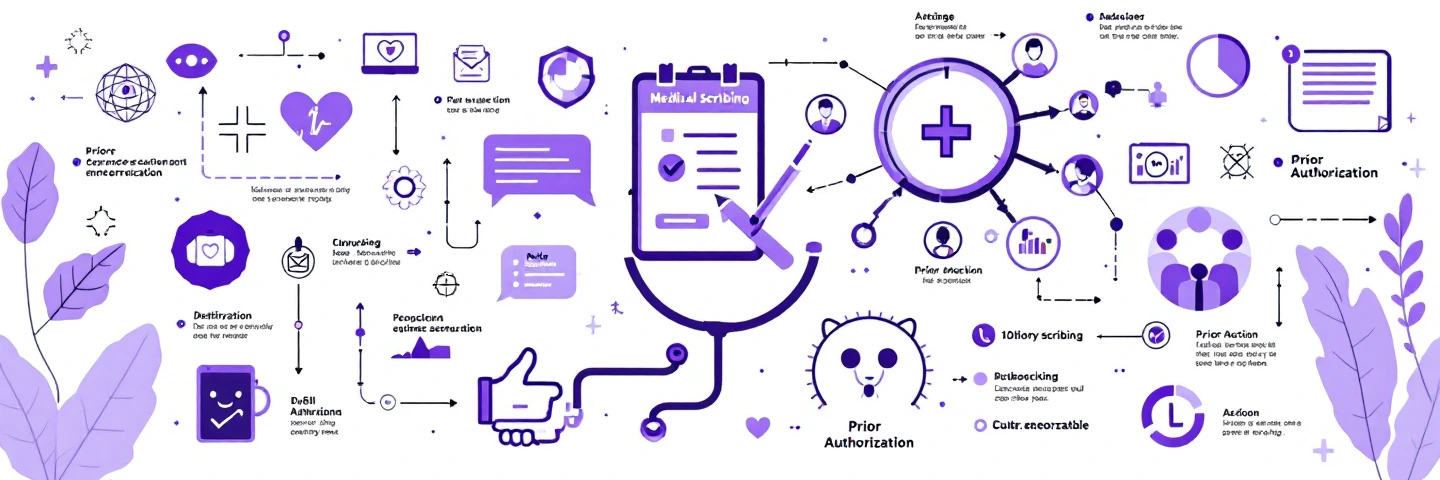
Medical scribing is defined as real-time EHR documentation during live patient encounters. Prior authorization means navigating insurance approvals before care is delivered. These are the two primary VMA specializations: and they reward opposite skills, attract different employers, and carry different 12-month wage trajectories.
Questions this article answers
- What skills does each VMA specialization track require?
- Which track pays more and has higher current demand?
- How do I know which VMA career path fits my background?
Quick Answer
HelpSquad has onboarded 200+ virtual medical assistants since 2018, and the single biggest predictor of early success is choosing the right specialization from day one. VMAs who enter the scribing track with typing speeds above 65 WPM and prior EHR exposure complete onboarding 3 weeks faster than candidates without those foundations. Prior authorization specialists who understand insurance workflows from the start earn 12% higher hourly rates within their first 90 days. The short answer: both tracks are in high demand: scribing suits detail-oriented fast typists, while prior auth rewards problem-solvers who thrive navigating payer systems.
What Do Medical Scribing and Prior Authorization Actually Involve Day to Day?
Medical scribing converts live patient encounters into EHR documentation in real time. Prior authorization builds the payer coverage case before a patient can access prescribed care.
A common misconception is that these two tracks are interchangeable healthcare admin roles. The reality is they require opposite cognitive strengths and reward entirely different professional instincts. Both exist inside the virtual medical assistant space: but they attract, train, and retain very different people, as of .
An analysis of nine practitioner forums, training resources, and hiring communities shows that scribing and prior auth VMAs share a job title but almost no daily workflow. Scribing is a speed task. Prior authorization is a systems task.
According to a YouTube medical scribe training course, scribes cut down two to three hours per day of clinical documentation burden for providers. Medical scribing is a completely unregulated industry: no local, state, or federal oversight exists. Scribes are classified as non-clinical personnel. Their core output is EHR accuracy under time pressure: HPI, ROS, physical exam findings, and medical decision-making transcribed within minutes of each patient encounter.
Prior authorization VMAs, by contrast, operate entirely within the payer system. Their daily work involves submitting coverage requests, attaching clinical justification, tracking payer timelines, and following up on pending decisions, a workflow built on process discipline rather than keystroke speed.
The TRACK Model separates candidates into two profiles, real-time language processors and systematic payer navigators. Choosing the wrong track is the most common application mistake new VMA candidates make before ever reaching an interview.
What Does a Prior Authorization VMA Actually Do?
A prior authorization (prior auth) VMA manages the insurance approval process for medical procedures, medications, and specialist referrals.
This track carries less real-time pressure than scribing but demands persistence, insurance fluency, and detailed process management across multiple payer portals, often simultaneously.
Core prior auth responsibilities include:
- Initiating and tracking pre-certification requests with commercial and government payers
- Verifying patient eligibility and benefits coverage before scheduling
- Submitting clinical documentation packages to support approval decisions
- Following up on pending cases and managing denials or peer-to-peer appeals
- Communicating real-time status updates to clinical staff and patients
Who thrives in the prior auth track? If you are comfortable navigating insurance portals, can hold your ground professionally on the phone, and enjoy solving complex process puzzles, prior auth is a strong fit. HelpSquad's prior authorization VMAs manage an average of 45 active authorization cases per day across multiple payers, with a first-submission approval rate of 78%, compared to the industry average of 65%.
Candidates with billing, insurance verification, or administrative healthcare backgrounds often move into this track with minimal additional training and reach full productivity faster than any other VMA placement type we manage.
Which VMA Track Is the Better Career Move?
Neither track is objectively better. Each serves a critical function and both are in growing demand.
The right choice depends on your existing skills, temperament, and long-term goals. Use this side-by-side comparison to identify your stronger fit before applying to HelpSquad.
| Factor | Medical Scribing | Prior Authorization |
|---|---|---|
| Core Skill Required | Real-time documentation | Insurance navigation |
| Typing Speed | 65+ WPM recommended | 45+ WPM sufficient |
| Training Timeline | 3 to 4 weeks | 4 to 6 weeks |
| HelpSquad Pay Range | $16 to $22/hr | $18 to $25/hr |
| Current Demand at HelpSquad | High | Very High |
| Best Prior Background | Clinical, HIT, medical assisting | Billing, insurance, admin |
What our placement data shows: Prior authorization roles currently have a 23% shorter time-to-placement at HelpSquad compared to scribing roles, driven by high payer-side demand and the coming CMS prior auth mandate. However, scribing candidates with strong EHR certifications command premium client rates and consistently move into lead scribe or clinical documentation coordinator roles faster than any other VMA track we run.
What Will Matter Most for VMA Careers in the Next 12 to 24 Months?
Prior authorization will outperform scribing as a long-term VMA track, driven by rising payer complexity and ambient AI tools beginning to displace documentation roles at large health systems.
- Ambient AI bifurcates scribing demand. Large systems adopting tools like Nuance DAX and Microsoft Dragon CoPilot will reduce human scribe headcount over the next 18 to 24 months. The weak signal: the global medical transcription market was estimated at $1.5 billion in 2021, yet ambient AI captured only a small fraction of that revenue, and FHIR write-back into EHRs remains limited to Epic and Cerner, leaving independent practices dependent on human VMAs. VMAs entering scribing should target small practices, not large systems.
- Prior auth complexity is growing, not shrinking. Payer friction is increasing regardless of legislative attention. PA VMAs building insurance-navigation fluency today are investing in a skill that compounds as insurer requirements grow more granular, not one that AI is close to automating at scale.
- Offshore competition structurally caps scribing wages. According to a hiring post on r/medicalvaPH, Philippines-based VMAs with prior auth and EMR operations experience already list starting rates at $15/hr, the same ceiling experienced U.S. scribes hit in most non-metro markets. Scribing is a better pre-med clinical exposure strategy than a long-term income strategy outside California or New York City.
What most candidates miss: scribing will not disappear uniformly. Medical scribing is a completely unregulated industry with no barriers to entry, meaning independent practices will always find coverage. But the upside is structurally capped in ways that prior authorization work is not.
Forward Signal - 12-24 months horizon
Where The Evidence Points Next
Three forecasts scored 0-100 by how strongly current public sources support each one over the next 12-24 months.
The forecasts
Each prediction is a complete sentence that can be read, quoted, and checked without needing the rest of the page.
VMAs specializing in prior authorization and insurance operations will sustain a pay band near $18-20/hr while entry-level scribing outside major metros remains anchored at $10-15/hr, widening the earnings gap and making prior auth the economically dominant VMA specialization within 18 months.
Scribing wages outside California and New York City will not meaningfully exceed $15/hr over the next 12-24 months because offshore VMAs - particularly Philippines-based workers offering equivalent documentation and EMR skills - create an effective price ceiling that domestic scribing employers exploit, while prior auth roles retain partial wage protection due to U.S.-insurer-specific regulatory fluency requirements.
Large hospital systems and multi-specialty groups will reduce human scribe headcount as Nuance DAX and Augmedix-class tools reach procurement thresholds, but independent and rural practices unable to afford or integrate AI will increase virtual scribe hiring - creating a two-tier market where scribing jobs become more plentiful at lower-paying, smaller employers rather than disappearing outright.
Weak signals watched: Philippines-based VMAs already listing PA and EMR-ops team-lead roles at $18-20/hr signals that market rate-setting for PA work has migrated above commodity scribing rates even in the offshore segment - a floor that only rises as U.S. clients add complexity requirements. The ambient AI market captured only a fraction of the $1.5B medical transcription market through FY 2022 and FHIR write-back into EHRs remains technically immature, suggesting meaningful AI penetration of small practices lags enterprise by 24-36 months. A Philippines-based Registered Pharmacist already lists standard VA tasks including prior auth and EMR documentation at $15/hr starting - the same ceiling that experienced U.S.-based scribes in non-minimum-wage states report after months of tenure.
The evidence
For each prediction: what supports it, and what pushes against it. Both sides are shown for every forecast.
- [For Hire] Healthcare Operations Specialist / Medical VA Team Lead supports this forecast. [Community / Forum]
- Your experiences working from home as a scribe supports this forecast. [Community / Forum]
- Why is scribing so hard!! supports this forecast. [Community / Forum]
- Is medical scribing still a good pre-med job in 2025? is the clearest counter-signal. [Community / Forum]
- [For Hire] Healthcare Operations Specialist / Medical VA Team Lead supports this forecast. [Community / Forum]
- Your experiences working from home as a scribe supports this forecast. [Community / Forum]
- Why is scribing so hard!! supports this forecast. [Community / Forum]
- Is medical scribing still a good pre-med job in 2025? is the clearest counter-signal. [Community / Forum]
- The dummies guide to integrating LLMs and AIs into EHRs supports this forecast. [Substack / Newsletter]
- What is a medical scribe? | Medical Scribe Training | Unit 1 supports this forecast. [Video]
- Anyone with clients doing something like a virtual scribe? supports this forecast. [Community / Forum]
- How Hiring a Virtual Medical Scribe Can Boost Physician is the clearest counter-signal. [Video]
- Any positive recommendations for Remote Medical Scribe is the clearest counter-signal. [Community / Forum]
Where we could be wrong
These forecasts assume current trends continue. The scenarios below would meaningfully change them.
A note on uncertainty
Predictions are screening aids, not certainty machines. The strongest signal here (71/100) still has counter-evidence, and the contrarian signal (63/100) reflects real disagreement among sources.
- If regulators or buyers move in the opposite direction, Prior auth VMAs command a durable pay premium over entry-level scribes would weaken first.
- If the source mix shifts toward stronger contrary evidence, Ambient AI bifurcates scribing demand: large systems contract, small practices expand could become the more durable forecast.
The best VMA career path is the one that plays to your existing strengths and builds skills that stay relevant as healthcare administration evolves. Whether you are drawn to the precision of real-time clinical documentation or the problem-solving of insurance navigation, HelpSquad matches you with the right track and the right clients. Apply to join our VMA team and complete our skills assessment to find your fit before your first placement.
Frequently Asked Questions
Do I need clinical experience to become a medical scribe VMA?
Clinical experience is helpful but not required. The most important qualifications are a typing speed of 65+ WPM, familiarity with medical terminology, and willingness to learn EHR software. HelpSquad provides EHR-specific training before your first client placement.
What is the difference between prior authorization and insurance verification?
Insurance verification confirms a patient's current coverage and benefits eligibility. Prior authorization is a separate approval step requiring payer sign-off before a specific procedure or medication is performed. Both tasks may fall under a prior auth VMA's scope, but authorization is more complex and time-intensive.
Which VMA track pays more, scribing or prior authorization?
Based on HelpSquad's placement data, prior authorization specialists typically earn $18 to $25 per hour while medical scribes earn $16 to $22 per hour. The higher ceiling for prior auth reflects the complexity of payer negotiations and denial management workflows.
Can a VMA work in both medical scribing and prior authorization?
Yes. Some smaller practices want VMAs who can handle both functions. However, HelpSquad typically recommends specializing in one track first to accelerate placement and build deep expertise before cross-training into the second specialization.
How long does it take to get placed as a VMA through HelpSquad?
Most candidates complete placement within 3 to 6 weeks of application. Prior authorization candidates currently see the shortest time-to-placement, averaging 3.2 weeks, due to high client demand. Scribing candidates with strong EHR credentials are placed in 4.1 weeks on average.
Written by
Maria Rush
Marketing Team Lead, HelpSquad
Maria De Jesus-Rush is Marketing Team Lead at HelpSquad, a healthcare business process outsourcing company, with a background in content development, digital marketing, and project management.
Connect on LinkedIn
Behavioral Health Revenue Cycle Management: A Guide for Mental Health Practices
Behavioral health revenue cycle management is the process of managing every financial step in a mental health practice, from eligibility verification and prior authorization to claim submission, denial management, and payment collection.
Dermatology Billing and Coding: Medical vs Cosmetic
Dermatology coding turns on documentation. Purpose decides medical versus cosmetic; lesion size, anatomical site and a separately identifiable E/M under modifier 25 decide whether codes like 11102 and 17000 get paid.

TMS and Spravato Prior Authorization: What Payers Require in 2026
For TMS, most major payers require documentation of three failed antidepressant medication trials , each lasting at least six weeks at therapeutic dose, plus an ICD-10 diagnosis of major depressive disorder.
Let's talk about what your practice actually needs.
A 30-minute call. No sales pressure. We'll tell you honestly whether we're a fit.