What Tasks You Can (and Can’t) Outsource in a HIPAA-Regulated Practice
11 Dec 2025 By: Maria Rush
Updated
If you run a private practice, clinic or health system, you’ve probably wondered which administrative headaches you can hand off to someone else. Outsourcing has become a lifeline for busy providers, especially when operations start to feel overwhelming. But in healthcare, there is a rule you cannot ignore. You can’t give patient information to just any assistant or BPO.
Under HIPAA laws and regulations, anyone who creates, receives or maintains Protected Health Information on your behalf becomes your business associate and must sign a Business Associate Agreement. The BAA explains how patient data will be used, what safeguards must be in place and how any breach will be handled. Without it, you are exposed to penalties that can easily be avoided.
So what exactly can you outsource? And what should stay in-house? Below is a simple guide for solo practices, clinics and large health systems. I’ll walk through the tasks that are safe to delegate with a BAA, the areas where you need extra caution and the tasks that should always stay with licensed staff. I will also mention where HelpSquad fits into this because our entire focus is to make HIPAA-compliant outsourcing safe, helpful and stress-free.
HIPAA Laws and Regulations: What You Need to Know Before Outsourcing
HIPAA laws and regulations set strict standards for how patient information must be handled whether it is being stored, accessed or shared. Even tasks that seem simple, like appointment scheduling or insurance checks, fall under these rules if they involve PHI. If you plan to hand off any of these responsibilities to a third party, the vendor must operate in a HIPAA-compliant way.
That means three things.
- You have a signed BAA in place.
- The vendor has solid security safeguards.
- Only the minimum necessary data is shared.
Its is important to note that the BAA must be signed between your practice and the outsourcing provider. If only the VA signs it, you are not protected and it does not meet HIPAA requirements.
It’s all about protecting your patients and keeping their trust.
Download your free HIPAA-Compliant Outsourcing Guide below👇
What Tasks Can You Safely Delegate Once a BAA Is Signed
With a signed BAA and the right safeguards, you can outsource many administrative and support tasks that take pressure off your team. These include:
- Appointment scheduling and reminders
- Insurance verification and benefits checks
- Medical billing and coding
- Medical transcription and charting
- Inbound call center or live chat support
- Virtual assistant help for EHR or inbox management
- HIPAA-compliant IT and cloud storage support
These are the exact services HelpSquad provides for healthcare clients every day. Our teams follow HIPAA laws and regulations carefully through secure systems, trained staff and clear communication practices.

Tasks That May Require Extra Review Before Outsourcing
Some tasks look harmless at first but carry more risk under HIPAA laws and regulations. These include:
- Telehealth triage or any form of remote clinical advice
- Offshore data entry where data crosses borders
- Chatbots or automation tools that may mishandle PHI
Before outsourcing these areas, check your state rules and review how your vendor handles PHI. It is worth taking an extra step here.
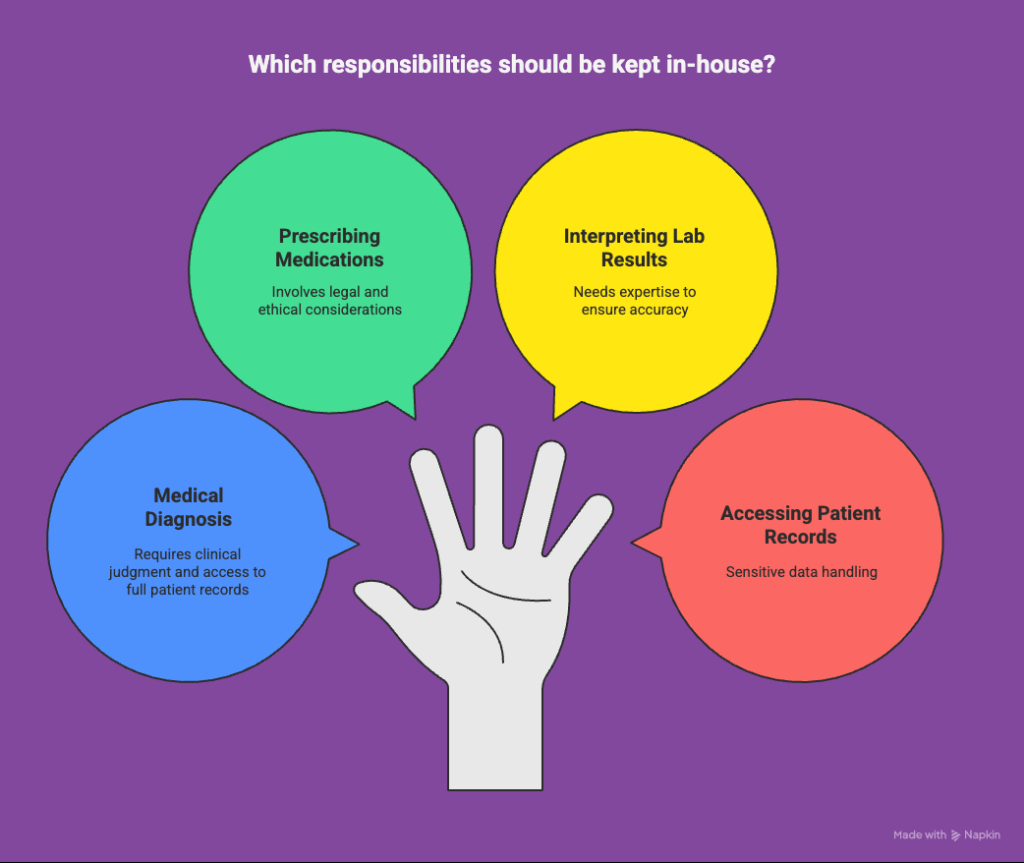
Tasks That Should Stay In-House or With Licensed Healthcare Staff
Some responsibilities are too sensitive or restricted to outsource. These include:
- Medical diagnosis or treatment decisions
- Prescribing medications
- Interpreting lab results
- Accessing full patient records without limits
If a task requires clinical judgment, your licensed providers should handle it.
Trending Now
I came across a recent Foley & Lardner update about HIPAA and AI, and it explains how quickly AI is changing digital health and why privacy officers need to adjust fast. The big takeaway is that even with new technology, the same HIPAA rules still apply. AI tools that handle PHI must follow minimum necessary standards, proper de-identification, strong BAAs, and tighter vendor oversight. The article also warns about risks from generative AI and black box models, and it suggests doing AI-specific risk assessments and training teams to spot red flags. It’s a good reminder that innovation is great, but only if privacy stays at the center.
Conclusion
HIPAA laws and regulations do not block you from outsourcing. They simply guide you to do it correctly. When you work with a trusted partner like HelpSquad, and you have a proper BAA in place, outsourcing becomes a safe and powerful way to support your team.
You save time. Your staff gets breathing room. Your patients stay protected.
If you’re exploring HIPAA-safe outsourcing or need support that understands both compliance and patient experience, talk to us at HelpSquad.
FAQs
Why do I need a Business Associate Agreement when outsourcing healthcare tasks?
A BAA is required any time a vendor will access, receive or store PHI on your behalf. It outlines how patient data will be protected and what safeguards the vendor is responsible for. Without a BAA, your practice is fully liable for any data breach that occurs.
Who should sign the BAA when working with a virtual assistant or BPO?
The BAA must be signed between your healthcare practice and the outsourcing provider itself. If only the virtual assistant signs it, you are not protected and the agreement does not meet HIPAA requirements. HIPAA holds the organization accountable, not individual contractors.
What tasks can I safely outsource once a BAA is in place?
You can delegate non-clinical administrative tasks that involve PHI as long as your vendor is HIPAA compliant. This includes scheduling, insurance checks, billing, transcription, inbox management and HIPAA-compliant call or chat support. These tasks often free up hours for your clinical team.
Are there tasks I should avoid outsourcing in a HIPAA-regulated practice?
Yes. Anything that involves clinical judgment or medical decision-making should stay with licensed providers. This includes diagnosing, prescribing, interpreting labs or accessing full patient records without limits. These responsibilities cannot be handed off to non-clinical staff.
How do I know the information in this guide is accurate and aligned with HIPAA rules?
Everything in this article is based on core HIPAA requirements from the Privacy Rule and Security Rule. It also follows guidance from the Department of Health and Human Services on how PHI must be protected, when a BAA is required and which tasks may or may not be delegated. The distinctions between administrative, caution-level and clinical tasks reflect real regulatory expectations for healthcare practices.

Maria, a BPO industry professional for a decade, transitioned to being a virtual assistant during the pandemic. Throughout her career, she has held various positions including Marketing Manager, Executive Assistant, Talent Acquisition Specialist, and Project Manager. Currently, she is a member of the marketing team as a Content Writer for HelpSquad. You may contact Maria on LinkedIn.