10 Best EMR Software for Small Practices in 2026, Compared
Key Points
- HelpSquad says it commonly sees 60 to 80% lower front-desk coverage costs when trained virtual staff work inside a practice's existing EHR, with payback typically within 30 to 60 days.
- Practice Fusion's pricing starts at $199 per provider monthly, does not include taxes and requires an annual commitment, so the headline rate is only part of the cost.
- The Office of the National Coordinator for Health IT commissioned EHR Contracts Untangled in 2016, a federal guide to negotiating EHR contract terms before a practice signs.

Quick Answer
HelpSquad is the best pick for most small practices. Its trained virtual medical assistants work inside the EHR you already use, around the clock. For new software, the next picks are athenahealth, Practice Fusion, DrChrono, CharmHealth, Tebra, eClinicalWorks, RXNT, Elation Health and AdvancedMD. Specialty fit decides the order.
A smiling staff member in blue scrubs welcomes patients at the clinic door, where every front desk task begins.
Choosing an EMR is a three-part decision. Price is one part. Billing is the second. Specialty fit is the third, and most small practices weigh only the first.
This guide ranks 10 options for practices with 1 to 9 providers, from HelpSquad's staffing model to all-in-one platforms such as athenahealth, eClinicalWorks, Tebra and AdvancedMD. Each card lists price, billing setup, who it suits and where costs climb.
Below the cards, the article covers:
- the per-message, per-claim and per-prescriber fees that sit outside the headline rate
- vendor billing services versus outsourced billing teams
- what AI scribes and AI phone answering can and cannot take off a front desk
- what the first 90 days after go-live look like
- contract terms that decide who owns patient records when a practice leaves
Why does that last point matter? Because your charts live in that system, ask each vendor to state in writing the export format and turnaround time for your data.
An EMR (electronic medical record) system is the software a practice uses to chart visits, schedule patients, prescribe and send claims. For a small practice, the right one is the one that fits three things at once: real total cost, billing that talks cleanly to the clearinghouse, and the specialty's daily workflow.
Software is only half the answer. Ask who will answer the phones. The rankings below weigh both sides: the platform, and the people who operate it.
Questions this article answers
How do you choose an EMR platform for small practices?
To choose an EMR platform for small practices, ask every platform the same 4 questions, then start with the one the table below matches to your business.
- Is the price a public per provider monthly subscription, and are setup, training, data migration and add on terms stated before you commit? A good answer is a written price, contract length and every extra charge, shown before any signature.
- How quickly can a small staff learn it and chart a visit without extra clicks or outside help? A good answer names the onboarding steps, training sessions and support hours, and matches what independent user reviews say about the learning curve.
- Does it handle scheduling, claim scrubbing and clearinghouse submission in one system, or will you need a second tool? A good answer shows each step working inside the same platform and explains who follows up on denied claims.
- Does it come with templates and workflows built for your specialty, or mainly for primary care? A good answer is a list of supported specialties with the templates, forms and order sets for yours.
Then match the platform to your business:
| Your business | Start with |
|---|---|
| Small practices needing front-desk coverage | HelpSquad |
| Small medical practices and specialty practices | athenahealth |
| Independent medical practices | Practice Fusion |
| Independent practices, solo to multi-location | DrChrono |
| Medical practices and healthcare providers | CharmHealth |
| Independent practices, solo to group | Tebra |
| Practices with one to nine providers | eClinicalWorks |
| Practices wanting guided, supported onboarding | RXNT |
| Independent primary care practices | Elation Health |
| Small and medium-size medical practices | AdvancedMD |
Be careful when the vendor shares terms only after a demo and will not put add on charges in writing. Be equally wary when claims need a separate clearinghouse contract the system does not connect to natively, when the sales team cannot show your specialty's templates live, or when the product's certification cannot be confirmed on the federal certified health IT listing.
Which EMR platforms for small practices should you look at first?
Start with these 5: HelpSquad, athenahealth, Practice Fusion, DrChrono and CharmHealth.
- Best for staffing the front desk and billing inside your existing EMR
HelpSquad: virtual medical assistants working inside your EHR, 24/7, HIPAA-compliant - Best for all-in-one billing and EHR
athenahealth: integrated EHR, medical billing, practice management, and patient engagement solutions - Best for integrated EHR and billing
Practice Fusion: cloud-based electronic health record and billing solutions for medical practices - Best for integrated charting and billing
DrChrono: cloud-based EHR unifying charting, scheduling, billing, and patient engagement - Best for all-in-one EHR and billing
CharmHealth: cloud-based EHR, practice management, billing, and patient engagement platform


How do the 10 EMR platforms for small practices compare?
The 10 EMR platforms for small practices differ most in who they serve and what they do: the list has platforms for small practices needing front-desk coverage, independent medical practices and independent practices billing in-house.
| Platform | Who it suits | What they do | Pricing Model |
|---|---|---|---|
| 1. HelpSquad | Small practices needing front-desk coverage | Virtual medical assistants working inside your EHR, 24/7, HIPAA-compliant | Billing is in arrears for hours actually worked. The minimum commitment is 20 hours per week per assistant, and the initial term is 3 months |
| 2. athenahealth | Small medical practices and specialty practices | Integrated EHR, medical billing, practice management, and patient engagement solutions | Percentage-of-collections model; no hardware, upgrade, maintenance, licensing, standard-interface, onboarding, or migration fees |
| 3. Practice Fusion | Independent medical practices | Cloud-based electronic health record and billing solutions for medical practices | Monthly per-provider subscription with annual commitment |
| 4. DrChrono | Independent practices, solo to multi-location | Cloud-based EHR unifying charting, scheduling, billing, and patient engagement | Plans are monthly subscriptions priced per provider; additional fees may apply for usage |
| 5. CharmHealth | Medical practices and healthcare providers | Cloud-based EHR, practice management, billing, and patient engagement platform | Encounter-based or provider-based; telehealth and training may cost extra |
| 6. Tebra | Independent practices, solo to group | Cloud-based EHR, billing, and patient engagement platform | Per-provider monthly subscription; onboarding, migration, and professional-service fees may apply |
| 7. eClinicalWorks | Practices with one to nine providers | Provides integrated cloud EHR, practice management, and healthcare IT solutions | Flat per-provider monthly pricing; EHR-only plan has no start-up costs |
| 8. RXNT | Practices wanting guided, supported onboarding | Cloud EHR, e-prescribing, practice management, billing and ambient scribe software | Monthly or annual subscriptions; setup, training, and support included |
| 9. Elation Health | Independent primary care practices | AI-native EHR and medical billing platform for primary care | Core Developer is priced per provider with one implementation fee |
| 10. AdvancedMD | Small and medium-size medical practices | Cloud EHR, practice management, billing, and patient engagement software | Per-provider or per-encounter plans are available |
Why does the EMR you pick matter so much for a small practice?
A small practice's EMR runs its revenue as well as its charts, so billing connections, portal reliability and certification deserve the same scrutiny as the charting screens.
Before reading the ranked list, check four things in every demo:
- Claims leave through a clearinghouse the billing module connects to natively.
- The patient portal stays up and shows lab results reliably.
- The system is certified, which buyers can verify on ONC's website.
- Your staff, or an outside team, already know how to work inside it.
Physicians Practice calls EHRs "the backbone of clinical operations in most medical practices" and warns that clinging to an outdated platform "can drain time, revenue and energy from your practice." The common assumption is that an EMR is mainly a charting tool. The money side says otherwise. In 2020, the American Medical Association noted that physicians who failed to participate in Meaningful Use faced reduced Medicare reimbursements, and that audits covered 5 to 10% of eligible professionals.
Portal reliability is the piece buyers forget. One patient review of athenahealth on Trustpilot described a portal that was "always down," making lab results impossible to get. Patients blame the practice, not the vendor.
A comparison of 4 sources (Physicians Practice, the AMA, a Trustpilot patient review and HelpSquad's client data) shows the same pattern: one EMR decision touches revenue, compliance, patient experience and staffing at once. Staffing is the easiest to overlook. HelpSquad reports that its agents work inside each practice's own EHR, and that systems across its healthcare clients (February 2026) include Epic, athenahealth, eClinicalWorks, Kareo (Tebra), DrChrono and Practice Fusion. Ask who corrects a rejected claim. Someone still has to run it, which is why it helps to map what to outsource in a medical practice before signing.
Why can a low EMR quote turn into an expensive first year?
One physician's first patient at a new practice needed a controlled-substance prescription, and the new EMR could not send it. None of the price quotes warned about that kind of cost.
"I thought I had everything ready to go," the physician wrote in a review of AdvancedMD collected by ConsumerAffairs. The link to EPCS, the service that handles electronic prescribing of controlled substances, "would not work, so I was unable to prescribe."
Other reviews on the same ConsumerAffairs page cover what can come next. A solo practitioner who had signed a 12-month contract wrote: "You would need to be a software engineer to understand it." Another reviewer quoted a letter warning that a dispute would be "escalated directly to our litigation team" to recover "the full contractual amount of $2,268.00." A solo primary care physician who called learning the platform "very involved but worth it" later described an unsympathetic response from the company when the clinic had to close after a family loss.
People choose whether to write reviews, so these accounts can't show how often such problems happen. They also show that the learning curve affects more than one vendor. A verified reviewer on SoftwareAdvice who calls the overall experience with eClinicalWorks positive still says it "requires time, training, and customization to get the most value out of it," and describes "a steep learning curve" at the start.
The $2,268 letter points to a second place where cost hides: the contract, and especially what happens when you want to leave. Practices have been asking about leaving for close to two decades.
| Year | Source | What it said about leaving a vendor |
|---|---|---|
| 2009 | Physicians Practice | A Detroit pediatrician, quoted under a pseudonym, had heard of web-based vendors that "claim to own the data" and hand over only "printouts of patient charts." A Seattle consultant advised putting guaranteed data access on exit into the contract. |
| 2016 | Office of the National Coordinator for Health IT | Commissioned a guide titled EHR Contracts Untangled: Selecting Wisely, Negotiating Terms, and Understanding the Fine Print. |
| 2025 | Physicians Practice | Many physicians "feel stuck with legacy systems due to sunk costs or change fatigue," and contract renewal is the moment to reassess. |
| 2026 | A licensed cosmetologist comparing aesthetic clinic platforms on YouTube | Before signing, "ask them directly who is going to own your patient records if you decide to leave." |
Billing creates a different kind of tie. According to Business News Daily, DrChrono folds all clearinghouse fees into its monthly rates through its clearinghouse partnerships, so a practice using its billing service sees no separate clearinghouse charge. The same review says billing clients must use DrChrono's EMR and that its clients submit 100 to 1,000 claims a month. It calls the requirement to use its EMR "uncommon." Convenience and commitment arrive together.
The last cost depends on people. Cora Han, Chief Health Data Officer at University of California Health, was talking about AI tools on a 2026 law firm podcast. Her point fits a records system too.
"Even though a tool may be vetted, how it is actually implemented has a pretty significant impact on whether its utilization will be successful."
Cora Han, Chief Health Data Officer, University of California Health, 2026
Small practices may have an advantage here. Dr. Renee, a VA researcher who studies EHR transitions, said in a 2025 AMA webinar that smaller sites tend to have a closer, more cohesive culture and are "able to weather some of these transitions more effectively." They still need a transition team, training and support, she added, and may have to "dig deeper" to find the staff who become the in-house experts.
The company's own client work shows what happens when that person is missing. In one dental practice, a Dentrix aging report of balances more than 90 days old showed "hundreds of thousands of dollars uncollected" in a system the practice was already using. Trained assistants later cleared that backlog inside the same system. One practice proves little, but the software stayed the same and only the people working in it changed. When we bring a practice live, the problem the company observes most often is thin or inconsistent training material from the practice itself.
Once you line these findings up, the quote looks like the easiest part of the decision. The price is fixed the day you sign. The real cost is set later: the first morning one module has to talk to another, the day you try to leave with your records, and every week someone has to work the aging report.
Five checks before you sign
- Before your first real patient, run one test visit all the way through: schedule it, chart it, e-prescribe a controlled substance and submit a claim.
- Ask each vendor in writing who owns the patient records if you leave, what format you receive them in, and how quickly.
- Ask how long the contract term is and what you owe if you close or leave early, and read the federal guide on EHR contract terms before you sign.
- If billing comes bundled, ask whether it requires the vendor's own EMR and a minimum monthly claim volume.
- Name the person who will run the system and its aging report, and write down your scheduling rules and billing steps before go-live.
How we checked this
We read user reviews on ConsumerAffairs and SoftwareAdvice, a Business News Daily billing review, trade journalism from Physicians Practice (2009 and 2025), a 2016 federal contract guide, a 2026 law firm podcast, a 2025 AMA webinar and a 2026 YouTube comparison of aesthetic clinic platforms. The dental practice results and the onboarding observation come from our own client records.
Limitations: reviewers choose whether to post, so their accounts are individual experiences and say nothing about how common the problems are. The 2009 article predates today's cloud systems. The YouTube reviewer compares aesthetic clinic platforms and is not a medical billing specialist. The Business News Daily review is undated, so DrChrono's terms may have changed. The federal guide dates from 2016 and says it is not legal advice. The podcast is produced by a law firm that advises health technology clients.
Still unknown: how often day-one integration failures or contract disputes happen across vendors. None of our sources measured that.
- ConsumerAffairs, user reviews of AdvancedMD, read November 2026.
- SoftwareAdvice, user reviews of eClinicalWorks, read November 2026.
- Business News Daily, DrChrono medical billing review by Max Freedman, undated.
- Robert Lowes, Physicians Practice, article on small-practice EMR angst, June 2009.
- Office of the National Coordinator for Health IT, EHR Contracts Untangled guide, September 2016.
- Physicians Practice, seven signs a practice needs a new EHR, June 2025.
- Glamour 'n Glow, aesthetic clinic platform comparison video, March 2026, at 8:02.
- Cora Han on Sheppard's Health-e Law podcast, episode 26 transcript, June 2026.
- American Medical Association STEPS Forward, webinar on EHR transitions, January 2025, at 35:21.
- HelpSquad, dental practice client results and onboarding records, February 2026.
What are the 10 best EMR platforms for small practices in 2026?
The 10 best EMR platforms for small practices in 2026 are HelpSquad, athenahealth, Practice Fusion, DrChrono, CharmHealth, Tebra, eClinicalWorks, RXNT, Elation Health and AdvancedMD.
HelpSquad
Best for staffing the front desk and billing inside your existing EMRHelpSquad provides managed, HIPAA-compliant virtual medical assistants who work inside a practice's existing EHR to cover the front desk, scheduling, intake and billing around the clock.
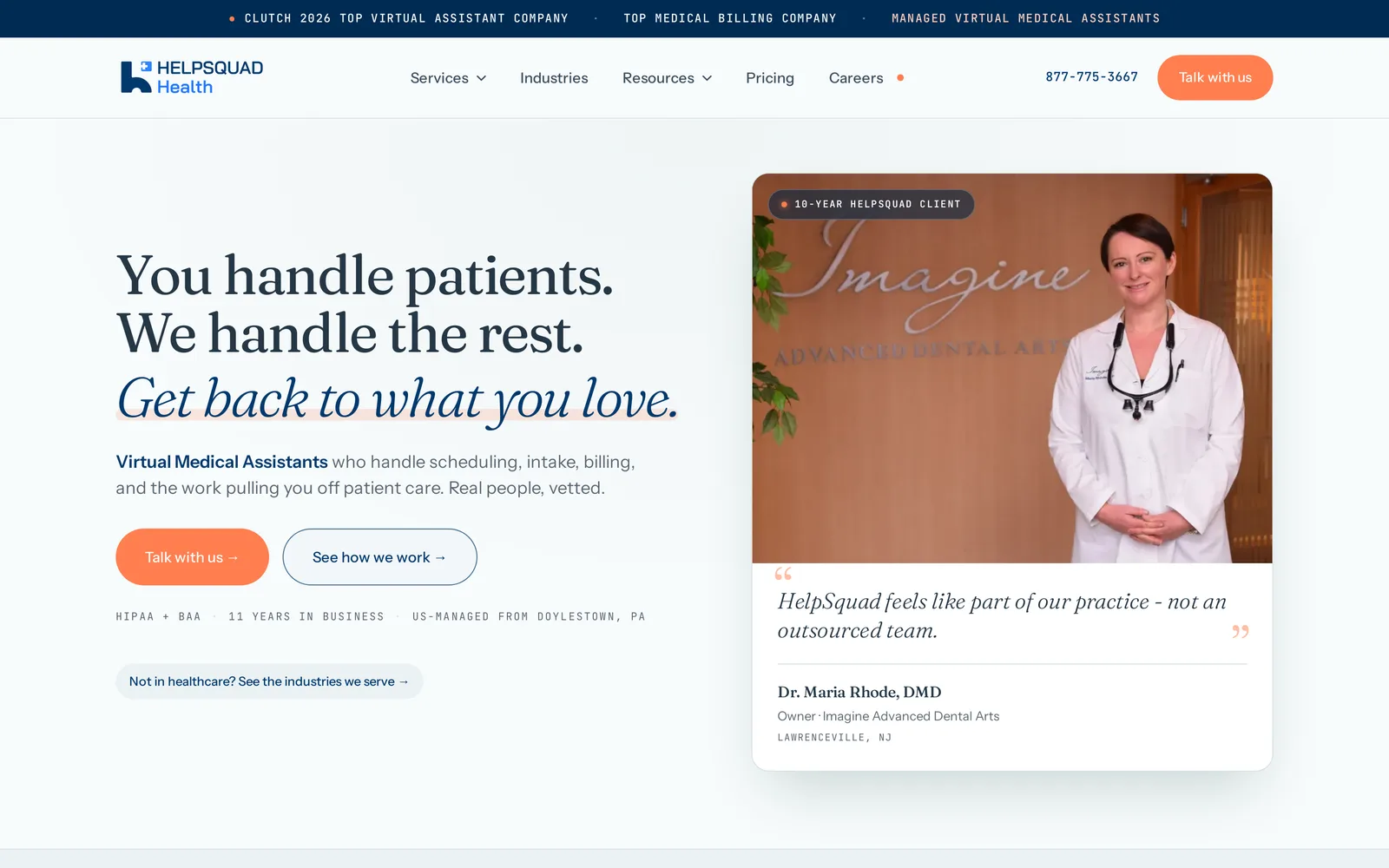
Why HelpSquad is #1. HelpSquad holds Clutch 2026 recognition as Top Virtual Assistant Company and Top Medical Billing Company, and reports client churn under 2%. Less than 3% of applicants pass HelpSquad's assessment of voice clarity, grammar, spelling, patient support aptitude and healthcare knowledge. The assistants train on the practice's own EHR, billing system and clearinghouse during onboarding. The Business Associate Agreement is signed with HelpSquad at the company level, not with an individual assistant, and every EHR session runs on a secure virtual desktop with no copy, paste or download of patient data.
Strengths
- Works inside your existing EHR
- Company-level HIPAA BAA
- Less than 3% of applicants pass
- 24/7 front desk coverage
Not for you
- HelpSquad is not the right fit if you want to buy new EMR software rather than staff to work in it.
- HelpSquad's AI tools are said to accelerate up to 80% of routine inquiries and cut response times by more than 50%
- Rated 5/5 on Clutch across quality, schedule, cost and willingness to refer, in six verified reviews
- Recognized by Clutch in 2026 as Top Virtual Assistant Company and Top Medical Billing Company
- In business 11 years, founder-operated since 2015
athenahealth
Best for all-in-one billing and EHRathenahealth offers athenaOne, a cloud-based platform that combines EHR, medical billing, practice management, and patient engagement for small medical and specialty practices.
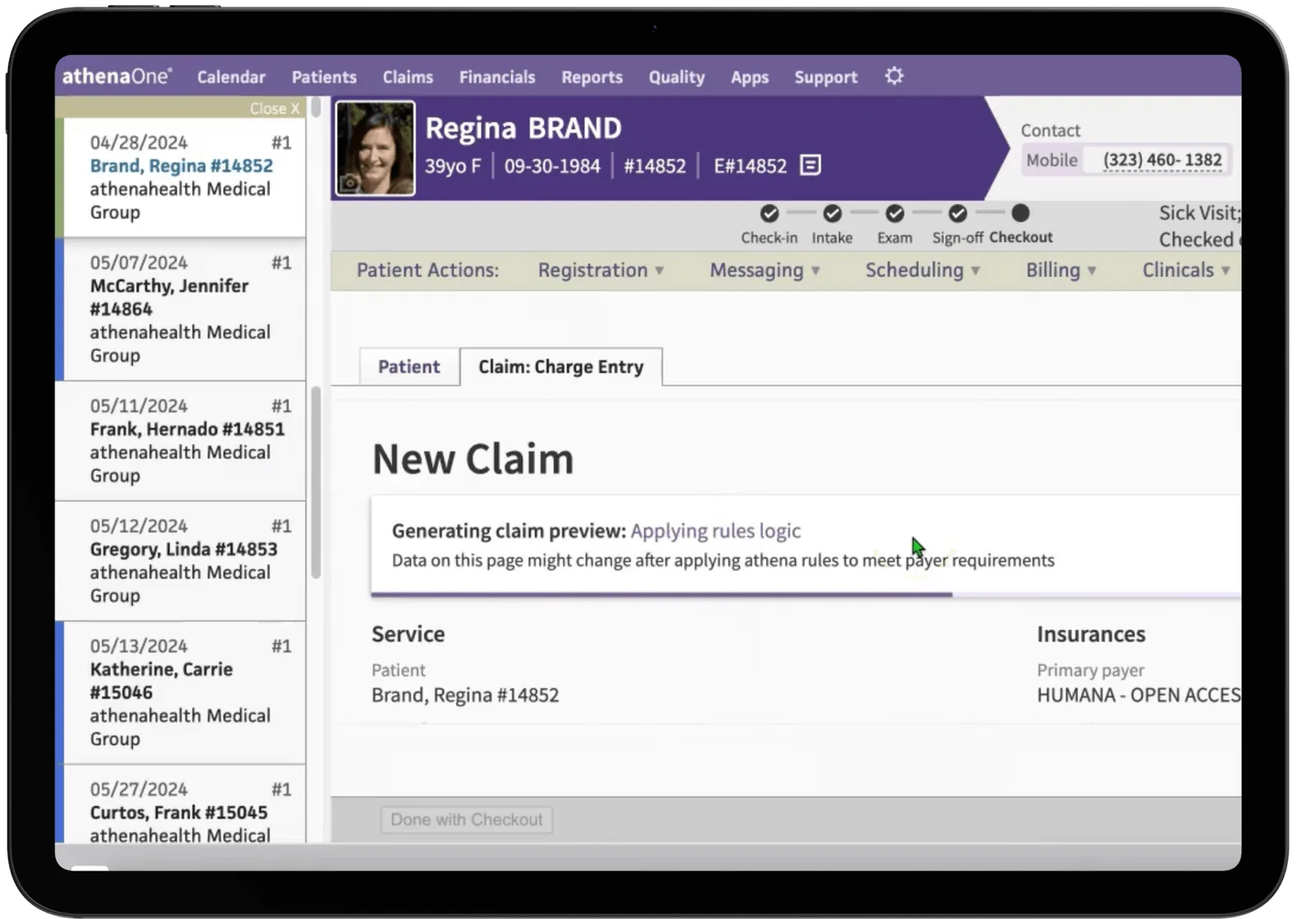
Why athenahealth is #2. athenahealth serves small medical practices and specialty practices with athenaOne, one platform for clinical records, billing, and patient outreach. athenaOne's revenue cycle tools automate patient verification, claim creation and submission, and claim resolution. athenahealth's own pages describe pre-built templates with workflows for each specialty, and athenaOne's Spring 2026 release added AI workflows, interoperability, and revenue cycle automation.
Strengths
- Integrated billing and RCM
- Specialty-tailored pre-built templates
- Appointment reminders and outreach campaigns
- No hardware or licensing fees
Watch out for
- Pricing is a percentage of collections, so cost scales with billing volume.
- Patients reviewing athenahealth on Trustpilot report patient portal outages and trouble getting lab results.
Practice Fusion
Best for integrated EHR and billingPractice Fusion is a cloud-based electronic health record and billing platform for independent medical practices, pairing charting and e-prescribing with expert physician billing services.
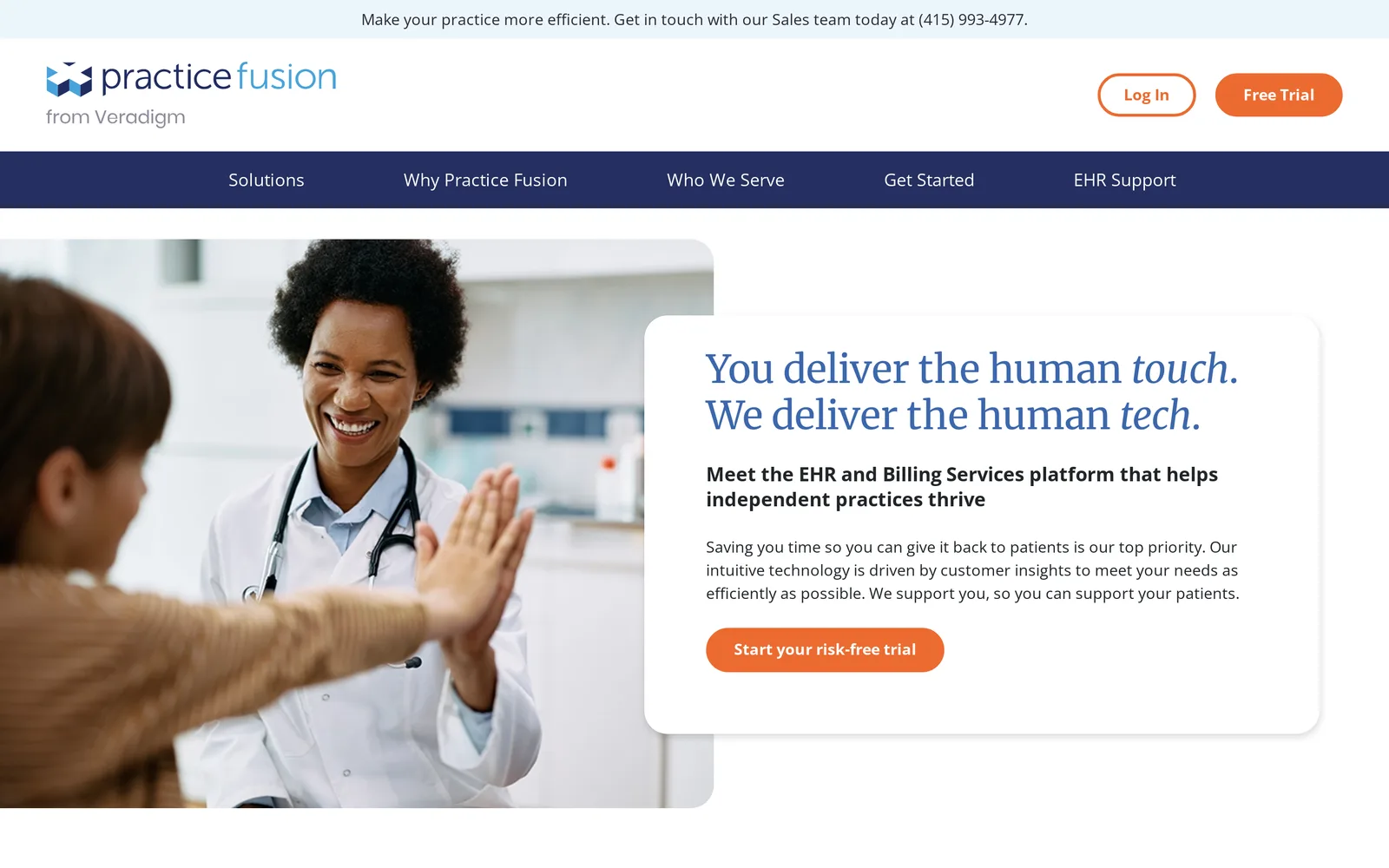
Why Practice Fusion is #3. Practice Fusion serves independent medical practices that want their electronic health record and billing in one system. Practice Fusion's main strength is a 100% cloud-based EHR paired with optional Practice Fusion Billing Services. The pricing page says the billing team draws on "over 30 years of experience across 45+ specialties." Each provider license includes 3 signing staff licenses and unlimited non-signing staff licenses.
Strengths
- Integrated EHR and billing
- Hundreds of specialty-specific templates
- Free integrated patient portal
- Unlimited non-signing staff licenses
Watch out for
- Pricing starts at $199 per provider monthly, does not include taxes and requires an annual commitment.
- Electronic prescribing of controlled substances is only available in the 50 US states and the District of Columbia.
DrChrono
Best for integrated charting and billingDrChrono is a cloud-based EHR from EverHealth that unifies charting, scheduling, billing, and patient engagement in one mobile-friendly platform for independent practices.
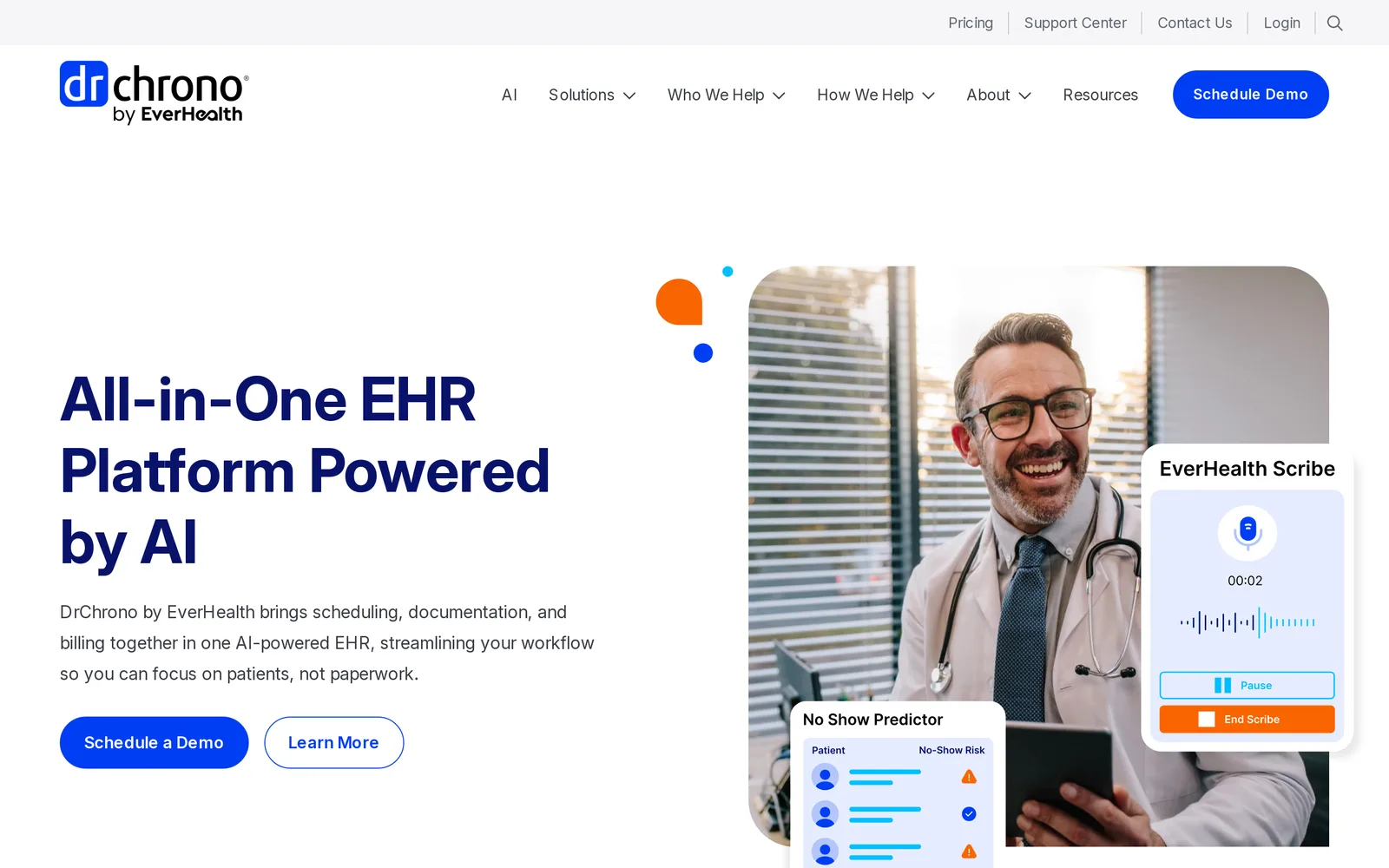
Why DrChrono is #4. DrChrono serves independent practices, from solo practitioners to multi-location clinics, with specialty workflows for family medicine, behavioral health, physical therapy, and podiatry. DrChrono is strongest at billing built into the record, and Charlene Black of MegMed Health says its billing profiles cut her billing work by about a third. Business News Daily calls DrChrono a great fit for new practices because its software is easy to use and staff need minimal training. That review also reports that DrChrono's managed billing reaches a clean claim submission rate over 98 percent.
Strengths
- Integrated billing and claims management
- Telehealth built into the EHR
- Customizable specialty templates
- Unlimited staff accounts on every tier
Watch out for
- Managed billing clients must use DrChrono's EMR, and monthly billing volume must be relatively high to qualify for its RCM services.
- Going over plan limits costs $0.05 per text, $0.07 per faxed page, and $0.10 per phone call.
CharmHealth
Best for all-in-one EHR and billingCharmHealth is a cloud-based platform founded and designed by doctors that combines an AI-driven EHR, practice management, billing, revenue cycle management and patient engagement tools for medical practices.

Why CharmHealth is #5. CharmHealth markets its suite to medical practices of all sizes, and an independent EHR software directory describes Charm EHR as built for small to medium-sized healthcare practices. CharmHealth keeps clinical records, scheduling, electronic claims and revenue cycle management in one system. Patients use its portal to book appointments, share documents, see their health records and complete questionnaires. CharmHealth says providers can onboard and get started within a few hours.
Strengths
- EHR, billing and RCM together
- Onboarding within a few hours
- Patient portal with online booking
- Free version to get started
Watch out for
- Telehealth and training may cost extra on top of the plan price.
- The Provider Plan costs $125 per provider a month. The Encounter Plan costs $2 per encounter, with a $20 monthly minimum.

Tebra
Best for independent practices billing in-houseTebra is a cloud-based EHR, billing, and patient engagement platform for independent practices, combining clinical notes, scheduling, telehealth, and revenue cycle tools under one login.
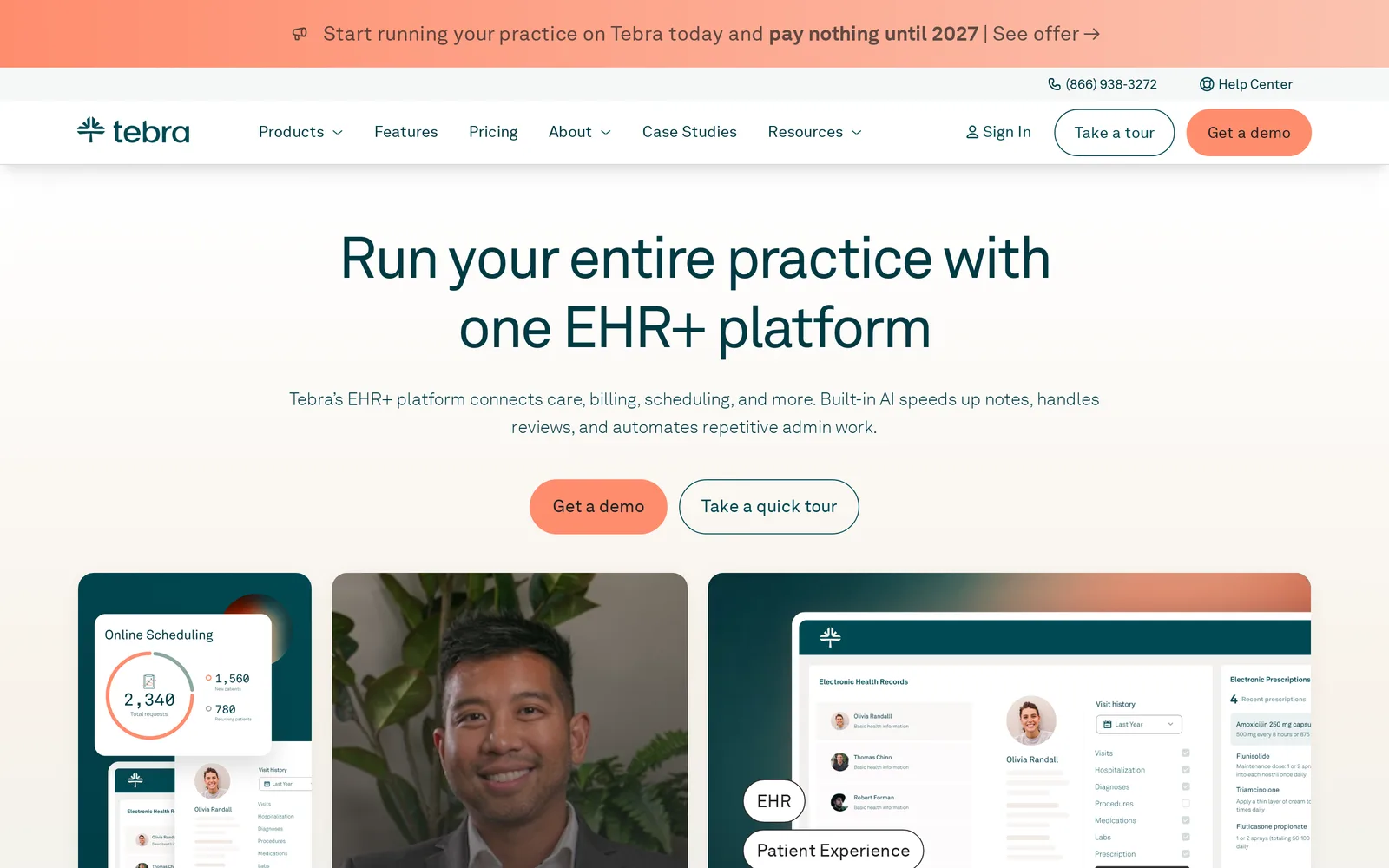
Why Tebra is #6. Tebra serves independent practices, from solo practitioners to large groups, and supports more than 50 specialties and provider types. Tebra is strongest at keeping charting, billing, scheduling, and patient messaging in one system. Tebra says claims, denials, and posting all run through that same system. A Software Advice reviewer calls Tebra a user-friendly EHR platform that makes clinical documentation and patient management relatively efficient.
Strengths
- EHR and billing in one
- Supports more than 50 specialties
- Unlimited non-clinical staff users
- Onboarding manager handles data migration
Watch out for
- Controlled substance prescribers pay add-ons: EPCS setup is about $75 per provider, PDMP integration $500 one-time per facility plus about $50 per user per year.
- Some Software Advice reviewers report glitches, duplicate appointment requests from patients, and tasks that take extra steps.

eClinicalWorks
Best for practices switching EHRseClinicalWorks provides an integrated cloud EHR with practice management, patient engagement and revenue cycle management tools for ambulatory practices, urgent care facilities and health centers.
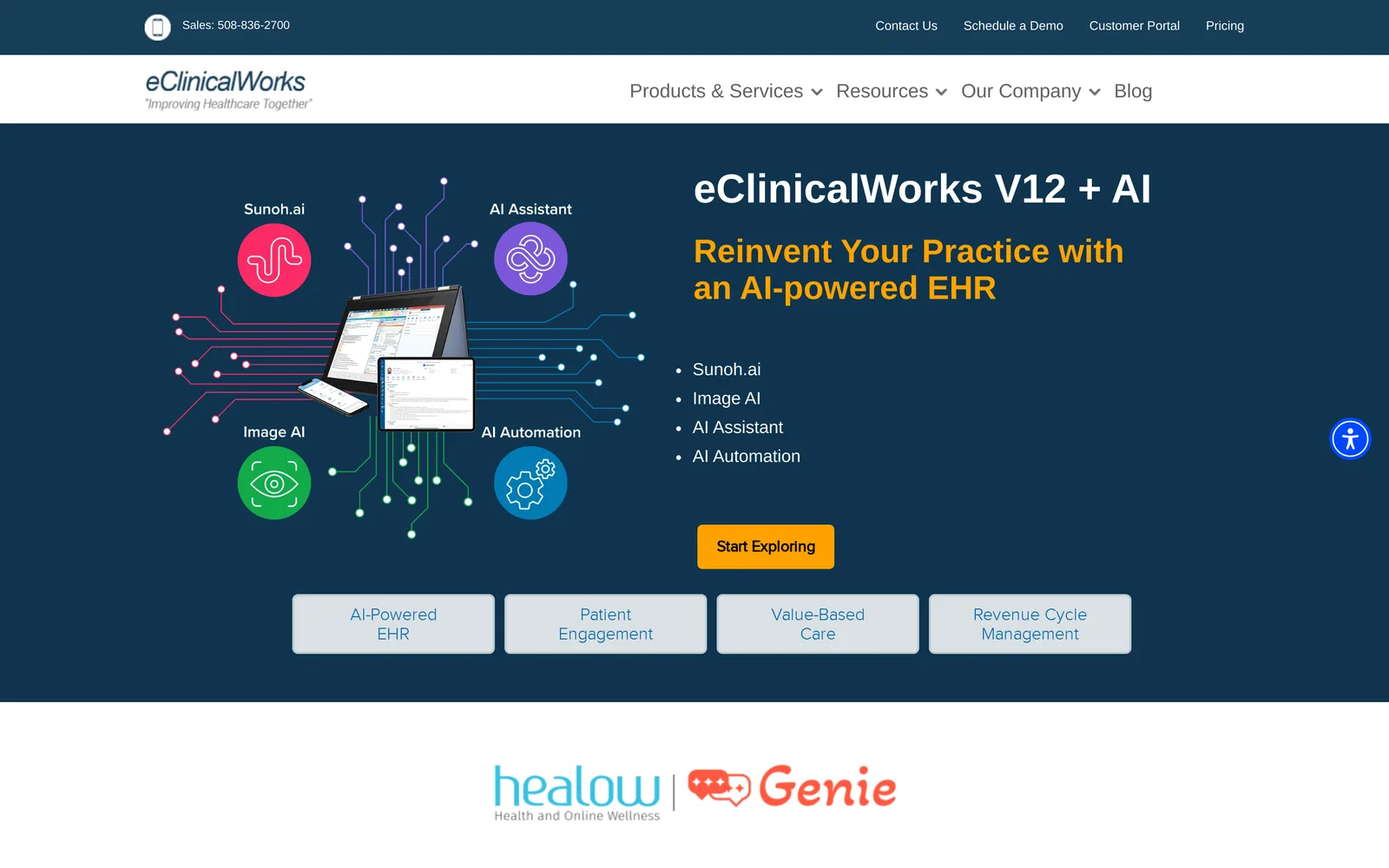
Why eClinicalWorks is #7. eClinicalWorks serves ambulatory practices, urgent care facilities and health centers of every size, and offers free data migration from an existing EHR for practices that switch. eClinicalWorks bundles self-scheduling, check-in, telehealth and secure messaging into the core EHR, alongside a medical AI scribe for documentation. The eClinicalWorks revenue cycle management service reports a 98% or higher first-pass acceptance rate. According to Healthcare IT News, eClinicalWorks showed new AI tools at its 2025 National Conference that aim to improve how doctors work with patients and how billing departments work with healthcare consumers.
Strengths
- Medical AI scribe for documentation
- Patient engagement built into EHR
- Free data migration from existing EHR
- Flat per-provider monthly pricing
Watch out for
- Practices with more than nine providers pay additional implementation fees, and airfare is billed separately.
- Per-transaction fees apply to each Patient Statement and each eClinicalMessenger transaction.

RXNT
Best for included onboarding and trainingRXNT is a cloud-based healthcare software vendor offering integrated EHR, e-prescribing, practice management, medical billing and the Ambient IQ listening scribe for medical practices.
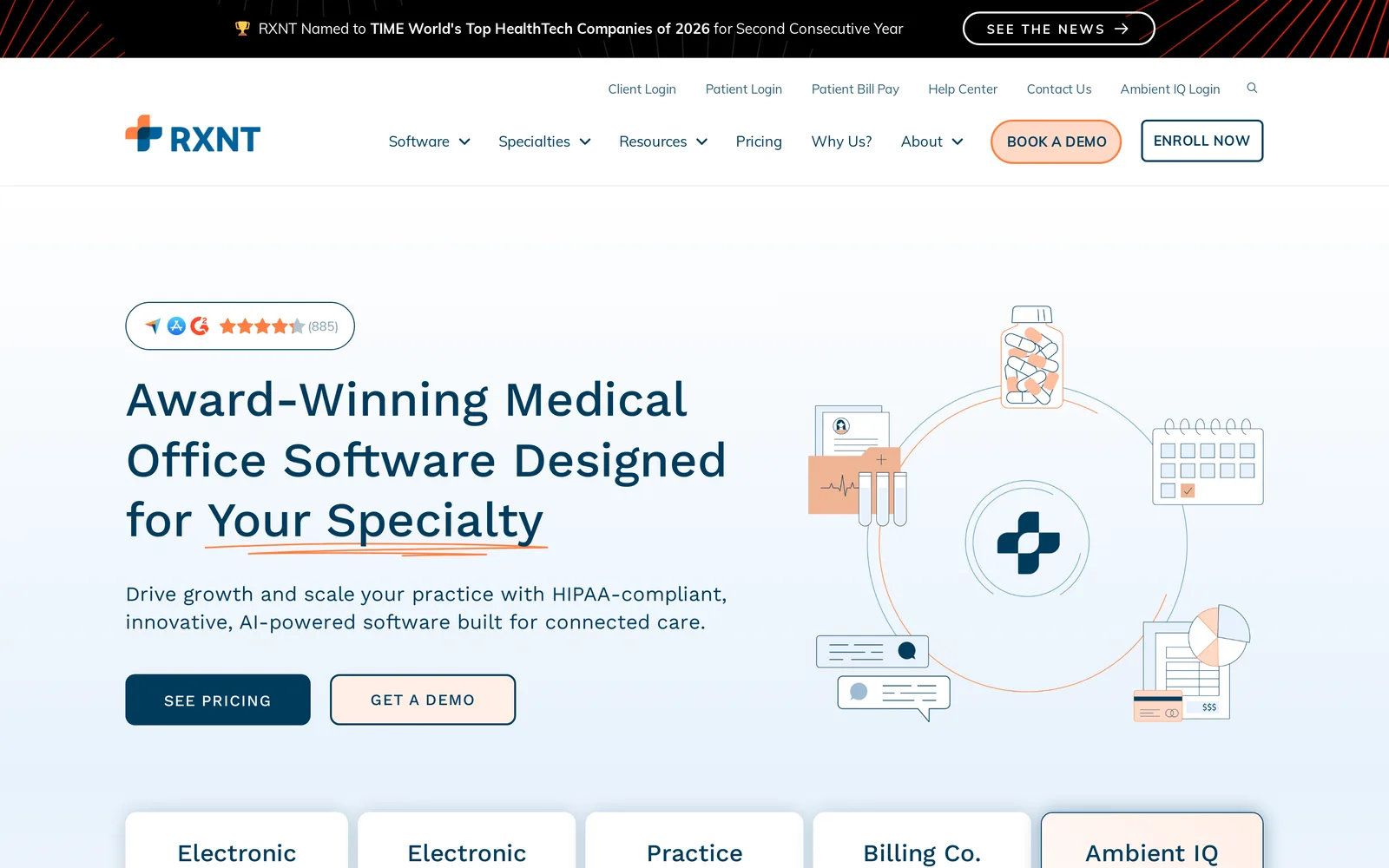
Why RXNT is #8. RXNT serves medical practices that want clinical records, prescribing, scheduling and billing in one system, bought one product at a time or as a Full Suite bundle that includes every product. RXNT includes setup, training and ongoing support with its subscriptions, and its Practice Management and Full Suite bundles come with 60 days of onboarding. RXNT says every member of its operations and support teams works in the United States and that it upgrades all of its products every month. According to Yahoo Finance, Gartner named RXNT a 2026 Gartner Digital Markets Leader with five Shortlist and five FrontRunner awards.
Strengths
- Setup, training and support included
- Integrated EHR, billing and scheduling
- Customizable specialty clinical templates
- U.S.-based support teams
Watch out for
- Electronic prescribing of controlled substances costs an extra $85 per user each year.
- Average implementation takes 6 to 8 weeks for Practice Management, and RXNT recommends dedicating one staff member to the project for at least 30 to 60 days.

Elation Health
Best for independent primary care practicesElation Health is an all-in-one EHR and medical billing platform built for primary care, covering charting, patient engagement and an AI medical scribe called Note Assist.
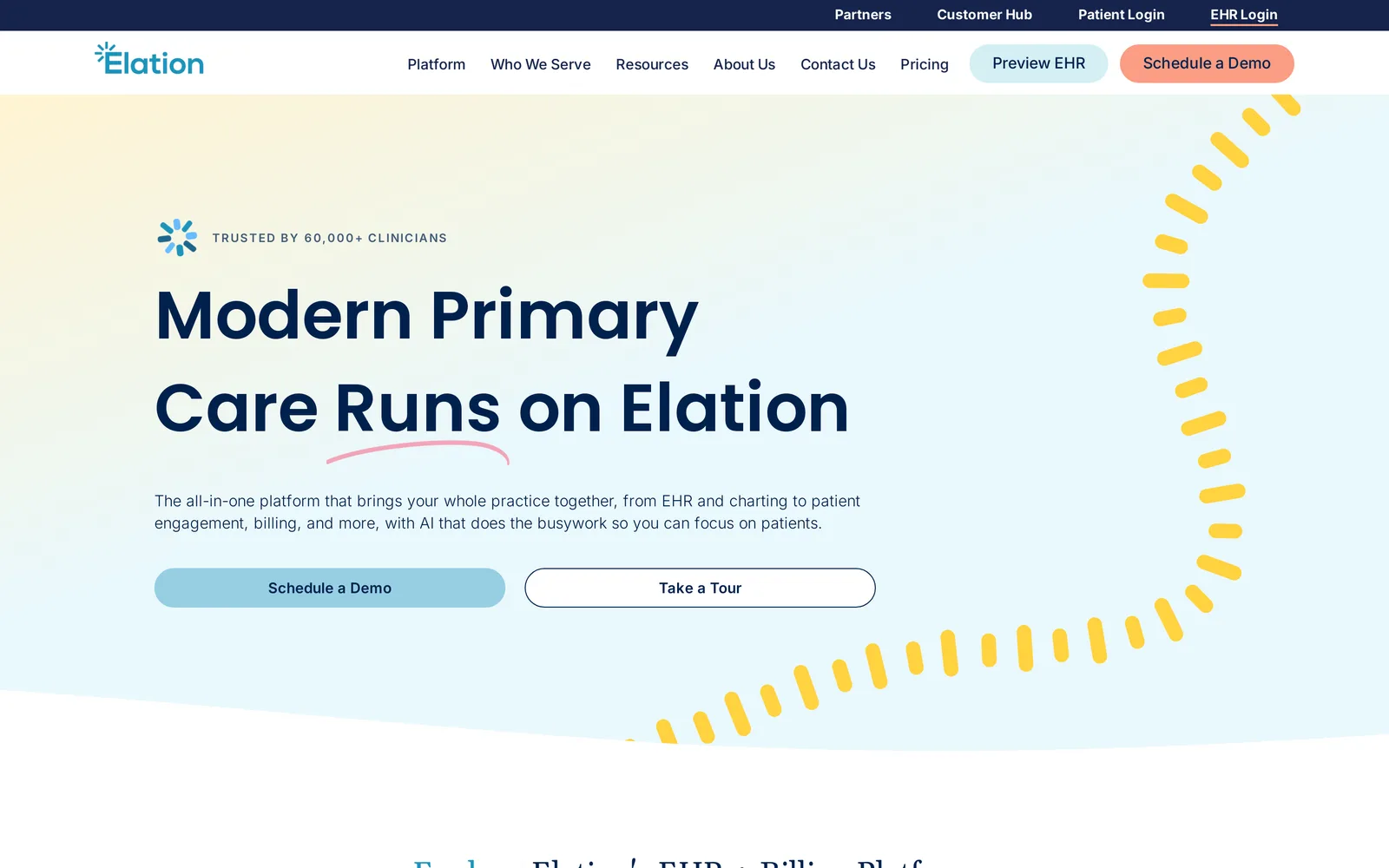
Why Elation Health is #9. Elation Health serves independent primary care practices, including family medicine, pediatrics and internal medicine. Elation Health calls its product the first fully integrated EHR and billing platform purpose-built for primary care, with AI-powered workflows that move claims from visit note to payment with fewer manual steps. Elation's own pages also point to an intuitive three-panel console and thoughtfully designed charting features.
Strengths
- Integrated EHR and billing
- Intuitive three-panel charting console
- Built-in AI medical scribe
- All-in-one practice platform
Watch out for
- Elation Health publishes no fixed prices, so practices must send their specialty, payment model and number of clinicians to get a quote.
- Elation Health is built for primary care, so small specialty practices outside primary care, family medicine, pediatrics and internal medicine may not fit.

AdvancedMD
Best for outsourced medical billingAdvancedMD is a cloud suite of EHR, practice management, billing, and patient engagement software built for independent practices, from single-provider offices to group practices.
Why AdvancedMD is #10. AdvancedMD serves independent practices, from solo providers to small and medium-size groups, that want charting, scheduling, and billing in one system. AdvancedMD's strongest area is billing. Its suite includes automated claim scrubbing and real-time insurance eligibility checks, and its optional managed billing service comes with its billing and coding software at no extra cost. Reviewers on ConsumerAffairs call the EMR and practice management platforms comprehensive but say they take a lot of work to learn.
Strengths
- Optional outsourced managed billing service
- Automated claim scrubbing and eligibility checks
- Patient portal and telehealth
- 24/7 live chat support
Watch out for
- Reviewers on ConsumerAffairs describe 12-month contracts, and one says AdvancedMD sought the full contract amount after the reviewer left early.
- Reviewers on ConsumerAffairs, including solo practitioners, report a steep learning curve and difficult onboarding.
What does EMR software really cost a small practice once the extras are added?
The monthly subscription is only one line of the bill. Real EMR cost also includes per-claim and per-statement charges, controlled-substance prescribing add-ons, onboarding time and any billing service fee.
Headline prices compare subscriptions. The bill compares everything else. A 2022 vendor estimate put cloud EMR subscriptions at $200 to $700 per provider per month, yet that range says nothing about the charges that arrive after go-live.
Five fee types recur across the category:
- Pricing basis. Most vendors charge per provider, while some set the entry tier by monthly claim volume, so a growing practice can outgrow its plan.
- Per-transaction charges. DrChrono lists $0.59 per electronic patient statement and $1.00 per paper claim, and its entry tier bills insurance eligibility checks per check.
- Controlled-substance prescribing. Identity proofing is a separate line item, and Tebra notes that some vendors charge it every year rather than once.
- Implementation extras. eClinicalWorks bills training airfare separately and adds implementation fees for practices with more than nine providers.
- Billing services. A percentage-of-collections fee rises with revenue, unlike a flat subscription.
Staff time is the cost few quotes show. RXNT recommends that each new customer dedicate one person fully to the project for at least 30-60 days. For a small front office, losing one person to setup for that long is a real expense.
The American Medical Association made the broader point in 2020: "a health IT system is typically larger than just EHR." Build every quote around that idea. Ask each vendor for statement, claim, fax and prescribing fees in writing, for the same provider count.
People belong on the same sheet. A psychiatric practice weighing a mental health virtual assistant against a local hire should price both alongside the software. Why? Because a cheaper subscription means little if the staffing bill climbs.
What are the best medical billing services for small practices?
Integrated EMR billing usually cuts claim handoff errors for a small practice, but it ties billing to one vendor. Separate billing keeps flexibility while adding one more connection to manage.
Three setups cover most small practices. Each one moves the same work to a different place.
| Setup | Who does the billing work | Main advantage | Main consideration |
|---|---|---|---|
| Native EMR billing, run in-house | Practice staff | Claims never leave one system | Depends on staff time and training |
| Vendor billing service bundled with the EMR | The EMR vendor's billing team | One contract for software and billing | Switching software means switching billing partners |
| Outsourced team working inside the current EMR | Remote staff using the practice's own system | Keeps the EMR choice open | Practice sets the workflows and system access |
Lock-in is the trade-off buyers tend to miss. Business News Daily, reviewing DrChrono, notes that its billing clients must use its EMR, a requirement the review calls uncommon, and that clearinghouse fees are built into the monthly rate. One contract means fewer surprise fees. Leaving the software later also means leaving the billing partner. The review's advice holds for any bundle: "When you're considering a medical billing service, remember that you're also choosing a medical software platform."
In-house billing can be more manageable than owners expect. One Tebra user on Software Advice admitted assuming that internal billing "would be far too complicated and time-consuming" after years of outside services. Another reviewer said tracking billing and denials in the system keeps them on top of patient accounts.
A third route keeps the EMR and changes who works in it. HelpSquad staffs billing and front-desk work inside a practice's existing system, at $8-$13/hour for full-time staffing.
Which setup wins? Both bundled and separate billing can work, depending on claim volume and how likely the practice is to switch software. A practice planning to stay on one EMR for years may value the single contract. A practice still unsure of its EMR should keep billing portable.
Can AI scribes and AI call answering replace front-desk and billing staff?
AI cuts documentation and call-handling work in a small practice, but it does not remove the need for trained people. Someone still checks notes, handles exceptions and resolves denials.
Vendors now lead with AI. RXNT says its Ambient IQ scribe can reduce documentation work by up to 70%, a figure it supports with one customer testimonial. eClinicalWorks markets healow Genie as an AI contact center that answers patient calls around the clock. Healthcare IT News reported that eClinicalWorks CEO Girish Navani used his 2025 National Conference keynote to explain how doctors might appear different in exam rooms with ambient technology.
The pitch is bold. As MobiHealthNews reported, Tebra founder and CEO Dan Rodrigues said, "AI represents the great equalizer for the industry."
So why keep staff at all? Because availability is not adoption. A health system's chief data officer noted in a 2026 podcast that the FDA had authorized about 1,400 AI tools by the end of 2025, yet only a small subset are shown to be used effectively day to day. She added that how a tool is implemented has a significant impact on whether it succeeds.
Implementation is human work. An AI draft still needs a clinician's review. An AI phone agent still outsources the calls it cannot resolve. Denials, prior authorizations and unusual scheduling rules still land on a person's desk.
The workable model pairs both. HelpSquad's AI tools are said to accelerate up to 80% of routine inquiries and cut response times by more than 50%, with trained agents handling the work the software leaves behind. In summary, AI shrinks the workload. The KEY step is asking each vendor what its AI hands back to a person.
What happens in the first 90 days after an EMR go-live?
Most go-lives follow the same arc: pick a rollout approach, train staff in a test environment, push through a slower stretch while old habits fade, then stabilize.
Each stage carries its own risk. Four steps keep that risk manageable:
- Choose a rollout approach. A big-bang go-live switches everyone at once. A phased rollout moves one clinic or function at a time, but it means running two EHRs side by side, with both a financial and an emotional cost.
- Train before day one. CharmHealth, for example, offers a sandbox where staff can test and train on the EHR before it touches real patient work.
- Start with the basics. In 2009, consultant Bruce Kleaveland gave Physicians Practice advice that still holds: "You don't have to implement every feature at once. Start with the basics like progress notes and e-prescribing."
- Collect feedback and keep adjusting. Moving from one EHR to another means unlearning established habits first, so tuning continues well after go-live.
What does a failed switch look like? Reviews of AdvancedMD on ConsumerAffairs put it in plain terms. One solo practitioner signed a 12-month contract after a single training session and found the software too complex to use. Another saw a first patient, then could not send a controlled-substance prescription because the EPCS interface would not work.
Neither problem is about features. Both are about setup and training. Test every prescribing, scheduling and claim workflow before the first patient arrives.
Small practices need the same core pieces as large health systems: a transition team, a communication plan, training and ongoing support. With a lean staff, one person often carries several of those roles at once.
Supported ramps can move quickly. HelpSquad's case studies describe a dental practice where three virtual dental assistants trained on Dentrix had patient scheduling live within two weeks of go-live, insurance workflow and billing optimized within two months, and the aged A/R backlog addressed within 60 days. The first 90 days decide whether a new system helps the front desk or slows it down.
Are healthcare virtual assistants worth it for running a small practice's EMR?
For most small practices, yes. Software alone rarely runs itself, and a full in-house billing team is costly; trained virtual medical assistants working inside the existing EMR often fit best.
Three staffing options cover almost every small practice. Each answers the same question differently: who keeps the charts, claims and phones moving?
- Software alone. AI tools and automation shrink the workload, but exceptions, denials and patient calls still need a person. A lean office ends up stretched thin.
- In-house hires. Local staff know the patients and the building. They also bring recruiting, training and turnover, and every new hire learns the EMR from scratch.
- Trained virtual medical assistants. Remote staff work inside the practice's own systems and scale up or down by the hour.
System fit decides whether the third option works. HelpSquad reports that its agents train on each practice's specific EHR, billing system and clearinghouse during onboarding, which takes about two weeks. Complex clinical specialties or managed teams can take up to a month. Systems in use across its healthcare clients (February 2026) also include Cerner (Oracle Health), NextGen Healthcare, Dentrix and Open Dental, and its listed clearinghouses include Waystar, Change Healthcare, Availity and Office Ally. The standard engagement starts at 20 hours per week with a 3-month initial agreement.
Clearinghouse fluency matters most. A billing module that does not talk cleanly to the clearinghouse stalls claims. An operator who knows both keeps them moving.
Which option fits? Both in-house hires and virtual assistants can work, depending on patient volume, specialty and budget. A practice with heavy walk-in traffic may keep one in-house front-desk lead and add virtual coverage for phones, billing and after-hours calls. A new practice with no staff yet can start virtual and hire locally as it grows. Either way, budget for the operator at the same time as the software, not after go-live.

Even a platform that unifies charting, scheduling and revenue cycle work still needs people to run it. If your front desk is stretched, HelpSquad can place trained virtual medical assistants inside the EHR you already use, around the clock.
What should a small practice do next when choosing an EMR?
Shortlist two or three platforms that fit your specialty, price each one with every add-on included, and plan who will run the system day to day before signing.
Why plan that far ahead? Because the payoff takes time. A 2009 trade analysis of practice EMR returns found that the average practice recovered its costs in 30 months. Software alone does not shorten that wait. Trained operators do.
HelpSquad's client data adds the staffing side: putting skilled virtual staff inside the EHR a practice already uses is where most of the front-desk savings come from. In summary, the KEY is a shortlist priced in full, because it beats a cheap quote.
Frequently Asked Questions
What else do small practices ask about EMR software?
Most remaining questions cover certification, security reviews, mixing vendors, patient-facing portals and how to add trained staff to run the system, so each gets a short, direct answer below.
What is a certified EHR, and does a small practice need one?
Certified EHR technology (CEHRT) is software that HHS has certified against federal standards. Certification can cover a complete EHR system or individual modules. Federal incentive programs have required it, so confirm a vendor's status on ONC's certified-product website before signing.
Can a practice combine certified modules from different vendors?
Yes. A practice can buy a comprehensive certified package from one vendor or certified components from several. The trade-off is integration work. Every extra vendor adds another connection to test, especially between billing and the clearinghouse.
How often does a practice need a HIPAA security risk analysis?
Under HIPAA and the federal EHR incentive rules, as described in 2020 guidance, physicians had to conduct or review a security risk analysis at least once each program year. The method depends on practice size, complexity and risk. Proving that analysis was done has been the biggest audit issue.
Do patients notice which EMR a practice uses?
Often, yes. Patient reviews on Trustpilot about one large vendor's portal center on downtime, missing message alerts and slow phone follow-up. Patients rarely blame the software by name. They blame the practice.
What does HelpSquad charge for staff who work inside a practice's EMR?
HelpSquad pricing starts from $8 per hour, delivered as a fully managed service with HIPAA compliance, transparent pricing and dedicated account management. The final rate depends on the role a practice needs covered.
Which languages do HelpSquad agents work in?
HelpSquad provides bilingual agents across the US, Europe, Central America and South Africa. Practices serving Spanish-speaking patients can ask for bilingual coverage on phones, scheduling and intake.
How does a practice get started with HelpSquad?
Book an intro call at helpsquad.com/contact or call 877-775-3667. The first conversation covers which EHR, billing system and clearinghouse the practice uses and which hours need coverage.
How were these 10 EMR platforms for small practices ranked?
Every platform on this list was compared on each company's fit for the buyer's criteria, its confirmed facts, and how widely AI answers, Google rankings and independent sources name it.
The buyer's criteria are pricing model, ease of use, billing and RCM, specialty templates and patient engagement tools. Price, pricing model, ease of use and billing and RCM were checked on each company's own website on November 23, 2026. The proof in each card is as each company reports it.
A company on this list whose details have changed can send a correction through the HelpSquad contact page.
Written by
Maria Rush
Marketing Team Lead, HelpSquad
Maria De Jesus-Rush is Marketing Team Lead at HelpSquad, a healthcare business process outsourcing company, with a background in content development, digital marketing, and project management.
Connect on LinkedIn
Medical Terminology for Virtual Medical Assistants: Terms by Task
Quick answer: Medical terminology for virtual medical assistants is the vocabulary of word parts, abbreviations and codes used for scheduling, insurance verification, prior authorization and EHR documentation. Key terms include CPT, ICD-10, EOB and PHI.

Healthcare Outsourcing ROI Calculator: 5-Step Framework
Most practices model outsourcing ROI against salary alone and miscount the real return. This 5-step framework builds a defensible number before you sign a vendor.
Prior Authorization Outsourcing for Medical Practices: A Practical Workflow Checklist
Practices lose 13 hours a week chasing insurance approvals. This healthcare guide lays out a prior auth outsourcing workflow that frees front-desk and billing staff.
Let's talk about what your practice actually needs.
A 30-minute call. No sales pressure. We'll tell you honestly whether we're a fit.