The 2026 Payvider Pivot: How Integrated BPaaS is Bridging the Gap Between Claims and Care
09 Feb 2026 By: Maria Rush
Updated
The Payvider Pivot is a strategic framework where healthcare payers and clinical providers merge into a single entity to align financial incentives with patient health outcomes.
In 2026, this model is moving from a boardroom theory to an operational necessity by using Integrated Business-Process-as-a-Service (BPaaS) to link insurance claims with clinical data. By unifying these traditionally separate silos into a single cloud-native stack, Payviders can significantly reduce administrative friction, lower the cost per interaction, and provide a frictionless support experience for members.

What is a Payvider?
I have spent nearly a decade in the BPO world and a good chunk of time in healthcare insurance, so I’ve seen my share of “integrated” models that were anything but. In simple terms, a Payvider is a healthcare organization that acts as both the insurance company (the Payer) and the medical service provider (the Doctor).
For years, these two sides essentially spoke different languages and used different software. The “Payvider Pivot” we are seeing in 2026 is finally ending that civil war. We are seeing insurance companies buy clinics and hospital systems launch their own insurance plans at an incredible rate. It makes sense because, with the tight margins we are facing this year, you simply can’t afford to have your payer and provider arms fighting over a prior authorization.
Market Dynamics and the Economic Pressure for Integration
The data I am seeing in early 2026 confirms this as a survival tactic rather than following a trend. This is driven by a few key realities:
- Regional Dominance: Over 50% of health systems now participate in at least one risk-based contract, with margin pressures driving a renewed surge in Provider-Sponsored Health Plans (PSHPs).
- Value-Based Mandates: The federal government is pushing more regions into mandatory value-based care models, rewarding health outcomes over the number of tests performed. On January 1, 2026, CMS launched the mandatory Transforming Episode Accountability Model (TEAM), which forces hospitals in roughly 25% of U.S. markets to take financial responsibility for 30-day outcomes.
- BPaaS Market Growth: The global BPaaS market is projecting double-digit growth (CAGR of ~11-12%) through 2030, with the Healthcare segment seeing the fastest acceleration due to AI adoption.
The Economic Impact: Why the Pivot Pays Off
Transitioning to a Payvider model is a massive capital investment. Utilizing an integrated partner also means accelerating your Return on Investment (ROI). According to 2025-2026 industry benchmarks, we see impact in three key areas:
- Closing the Retention Gap: A 2025 HealthEdge Consumer Report found a massive “perception gap,” with 27% of members likely to switch plans this year due to a lack of partnership. In contrast, integrated “Payvider-style” models like Medicare Advantage maintain satisfaction rates as high as 99%. Nearly 15 points higher than traditional fee-for-service models, by removing the friction between insurance and care.
- Lower Administrative Cost (PMPM): The Smarter Technologies 2025 Benchmark Report reveals that healthcare organizations implementing AI-driven BPaaS are achieving 20-40% reductions in administrative costs. For mid-sized payers, ScienceSoft estimates that AI-powered automation can deliver 30-50% savings by eliminating manual claims reconciliation and data entry.
- Accelerated Cash Velocity (DSO): In a unified system, “Clean Claim” rates now reach 95-98%. By automating insurance verification at the source, health systems have reported an 83% reduction in eligibility-related denials and a 25% decrease in Days in A/R (DSO), significantly improving cash flow forecasting.
The Operational Friction Points of the “Data Wall”
I’ve worked in BPO and payer operations long enough to recognize a predictable failure point: the Data Wall. You can merge two organizations on paper, but if the claims systems and the clinical workflows don’t talk to each other, the member still experiences the same old frustrations.
I still remember calls from my insurance days where I could see a member’s billing status perfectly, but I had no idea why the doctor made a specific clinical decision. The member was stuck in the middle, paying the price in time and stress. When your agents have to look at one screen for billing and another for the clinical story, they end up transferring or escalating the call. That is where the Payvider model starts to fall apart.
Trending Now
A recent report from HealthTech Magazine highlights how major health systems are finally tearing down the silos between insurance and medical care. By adopting the “payvider” model, organizations like Sentara and Geisinger are proving that merging clinical data with insurance workflows is the key to solving the “Data Wall” problem. It’s a shift toward a much more human healthcare experience. Swapping out confusing billing and long authorization waits for a unified system that actually focuses on patient health rather than administrative challenges.
Bridging the Gap: BPaaS vs. BPO
A common point of confusion in this industry is the difference between BPaaS and BPO. At HelpSquad, we view them as the two pillars of a successful Payvider:
- The Tech (BPaaS): This is the “Software-as-a-Service” layer. It is the cloud-native platform that “wraps” around your existing legacy systems to pull payer and provider data into a single view.
- The Talent (BPO): This is the specialized workforce. Our agents aren’t just answering phones; they are Hybrid Care Coordinators who use the BPaaS platform to navigate both medical necessity and insurance benefits simultaneously.
Delivering Unified Member Experiences via Integrated BPaaS
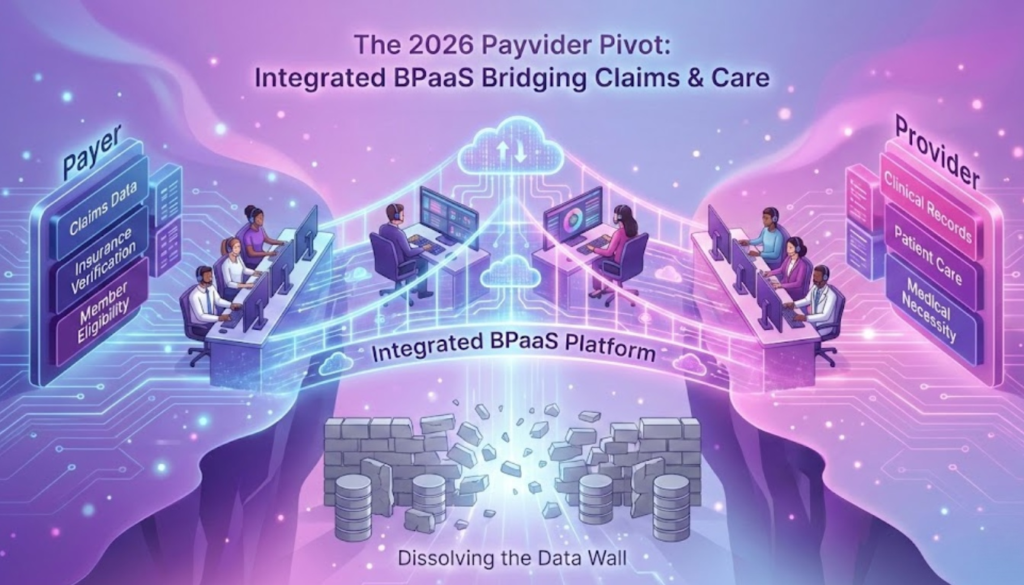
At HelpSquad, we look at this as a Unified Member Experience. Because I’ve worked on both sides of the phone, I know that an agent is only as good as the information on their screen. Our BPaaS setup enables:
- Full Context Support: Agents see billing and clinical context together so they can explain a charge without sending the member on a scavenger hunt.
- One-Touch Scheduling: We can validate insurance benefits and book the follow-up appointment in the same conversation.
- Coordinated Documentation: We can track documentation requests and update the member with a single source of truth, ending the back and forth.
The Evolution Toward Autonomous Workflow Orchestration
Looking toward 2027, the next stage is about AI reducing the administrative drag that makes healthcare so slow. We are already seeing “autonomous orchestration” in narrow tasks like pre-visit benefit checks, documentation retrieval, and prior authorization triage.
The key for any leader in this space is to start where the rules are clear and the payoff is immediate. By automating the “boring” parts of healthcare admin, we free up our human agents to handle the complex, high-empathy situations that really matter to patients.
Conclusion
The 2026 Payvider Pivot is is a new operating requirement. If your organization still treats payer and provider operations like separate islands, you will continue to pay for repeat calls, slow authorizations, and member frustration.
The winners this year won’t just claim they are “integrated” on their website. They will prove it in the only place that counts: the member’s lived experience.
Ready to dismantle the Data Wall and unify your member journey? Talk to us.
Frequently Asked Questions
What is a Payvider?
A Payvider is a single healthcare organization that acts as both the insurance company (Payer) and the medical service provider (Provider). This model merges clinical care with financial risk to improve efficiency and patient outcomes.
What does BPaaS mean?
BPaaS stands for Business Process as a Service. It refers to the delivery of business processes (like claims processing or scheduling) through a cloud-computing model that is highly scalable and tech-driven.
What is the difference between BPO and BPaaS?
Traditional BPO (Business Process Outsourcing) relies heavily on human labor to perform manual tasks. BPaaS (Business Process as a Service) is a cloud-based model that uses automated technology, AI, and integrated software platforms to handle processes with minimal manual intervention.
What is value-based care in healthcare?
Value-based care is a healthcare delivery model where providers are paid based on patient health outcomes (quality) rather than the volume of services performed (quantity). It rewards keeping patients healthy and reducing unnecessary costs.
How can I ensure the information in this article is reliable?
The statistics in this article are grounded in 2025–2026 industry benchmarks from organizations like CMS, McKinsey, and HealthEdge. You can verify these trends by cross-referencing recent federal mandates like the CMS TEAM Model.

Maria, a BPO industry professional for a decade, transitioned to being a virtual assistant during the pandemic. Throughout her career, she has held various positions including Marketing Manager, Executive Assistant, Talent Acquisition Specialist, and Project Manager. Currently, she is a member of the marketing team as a Content Writer for HelpSquad. You may contact Maria on LinkedIn.