AI-to-Human Escalation: Designing Handoffs That Don't Drop the Patient

AI chatbots and automated intake tools have become standard in healthcare operations. Most practice managers evaluate them on what they can automate: scheduling, FAQs, insurance eligibility checks. But the moment that makes or breaks patient trust isn't when the bot answers correctly. It's when the bot needs to outsource to a human.
A clumsy escalation, a dropped context, or a forced "please start over" can undo everything the automation got right. In healthcare, that isn't just a bad experience, it's a clinical risk and a patient retention problem waiting to happen. This article provides an operational blueprint for designing AI-to-human handoffs that protect patients, support your staff, and ensure no one falls through the cracks.
Questions this article answers
- What are the most reliable triggers for escalating from AI to a human agent in a healthcare setting?
- How do you prevent patients from having to repeat their information when transferred to a live agent?
- What clinical red flags must always trigger an immediate human handoff, no exceptions?
Quick Answer
Most healthcare practices judge their AI tools on what they handle automatically: appointment scheduling, FAQ responses, insurance eligibility lookups. That's the wrong test. The right test is what happens the moment the AI can't resolve the issue. At HelpSquad, practices that implement structured AI-to-human escalation protocols see up to 40% fewer patient drop-offs during digital intake interactions compared to those relying on unmanaged handoff paths, and that gap widens as patient complexity increases.
The Short Answer: What Makes an AI-to-Human Handoff Work?
A reliable escalation in healthcare requires three things: defined triggers that know when the AI should step back, structured context passing that eliminates the "start over" moment patients dread, and human agents, whether in-house staff or virtual medical assistants, who receive full context before they say a single word to the patient.
I've seen this from both sides. Working as a Member Support Specialist at UnitedHealth Group (Optum), I handled escalated calls from patients who had already spent 10 minutes looping through an automated system. The worst handoffs gave me nothing: no transcript, no reason for contact, no insurance details. The patient had to explain everything again, often while scared or frustrated about a health situation. That friction doesn't just create a bad experience. In healthcare, it creates a patient safety risk. And it's entirely preventable. The sections below give you the operational framework to prevent it.
Why Is Healthcare AI Escalation Different From Other Industries?
Let me be direct about something most AI vendor guides skip: healthcare is not retail.
When a patient contacts your practice's automated intake system, they are often anxious, in pain, or managing a complicated insurance situation. The emotional and clinical stakes are categorically different from someone tracking a package or checking an account balance, as of .
This distinction matters profoundly for escalation design. As practitioners who have built AI support systems observe, "support is more mixed because customers come in annoyed or with weird edge cases": and in healthcare, "annoyed" can mean a patient in clinical distress. "Weird edge cases" can mean symptoms that require immediate human attention. The design requirements are not the same.
The production reality of AI across industries confirms what I see in healthcare operations every day. As one AI practitioner put it plainly: "The marketing is about autonomous agents doing everything. The production reality is mostly narrow automation with a human checkpoint before anything consequential happens." In healthcare, that checkpoint isn't optional. It is the architecture. If you treat escalation as an afterthought, you've already built the wrong system.
AI in a healthcare setting works best as what I'd call the front door, handling routine volume so human agents can focus their time on the cases that genuinely need them. The escalation isn't a failure mode. It's the design. Frame it that way from the start, and your whole intake system becomes more reliable.
How Do You Define the Right Escalation Triggers?
Escalation triggers fall into two distinct categories, and a well-designed system needs both working together.
Keyword and Intent Triggers
These are the phrases and patient intents that should immediately flag a case for human review, regardless of how confidently the AI is performing elsewhere. From my experience in member support at Optum and reviewing intake workflows at HelpSquad, the non-negotiable trigger list for healthcare includes:
- Clinical urgency keywords: "chest pain," "can't breathe," "severe," "emergency," "blood," "allergic reaction," "not feeling right"
- Prescription and medication complexity: "controlled substance," "prescription refill for [specific drug]," "dosage problem," "wrong medication"
- Billing and coverage disputes: "claim denied," "won't cover," "bill is wrong," "prior auth denied"
- Explicit human requests: "speak to a person," "talk to a representative," "agent," "operator," "I need a human"
On that last point: if a patient explicitly asks to speak to a human, the answer should be immediate transfer. Full stop. As one customer success practitioner wrote plainly: "Deflection is the bot solving the issue so well the person never needs a human. Obstruction is hiding the exit to protect the queue." In healthcare, obstruction isn't a metric optimization strategy. It's a patient trust problem, and potentially a safety problem.
It's important to note that this trigger list should be reviewed quarterly. Language evolves, and so do the ways patients express urgency or distress.
System Failure Triggers
These are the AI's own internal signals, moments when the system itself recognizes it is out of its depth:
- Low confidence scores: When the AI's intent confidence falls below a defined threshold, I recommend starting at 70%. The system should escalate rather than attempt an answer
- Unrecognized inputs: Three or more consecutive inputs the AI cannot parse should trigger escalation automatically
- Unverifiable insurance data: If eligibility verification returns an error or unrecognized payer, a human agent must take over
- Session length anomalies: A patient stuck in the same conversation loop for more than 8 minutes without resolution should be escalated automatically
When I was building QA escalation workflows at Bell Canada, I learned that the failure signals that matter most aren't always the obvious ones. An unresolved loop that goes on too long is almost always a sign the automation has failed the user. As one builder who went through this discovery process put it: "everyone talks about making their AI agent smarter. Nobody talks about making it know when to stop." In healthcare, not knowing when to stop is a patient safety risk, not just a UX problem.
Both trigger types should be tested with synthetic patient conversations before going live, and tested again every 90 days. Patient language patterns shift. Your escalation logic should shift with them.
How Should AI Pass Context to a Human Agent During Escalation?
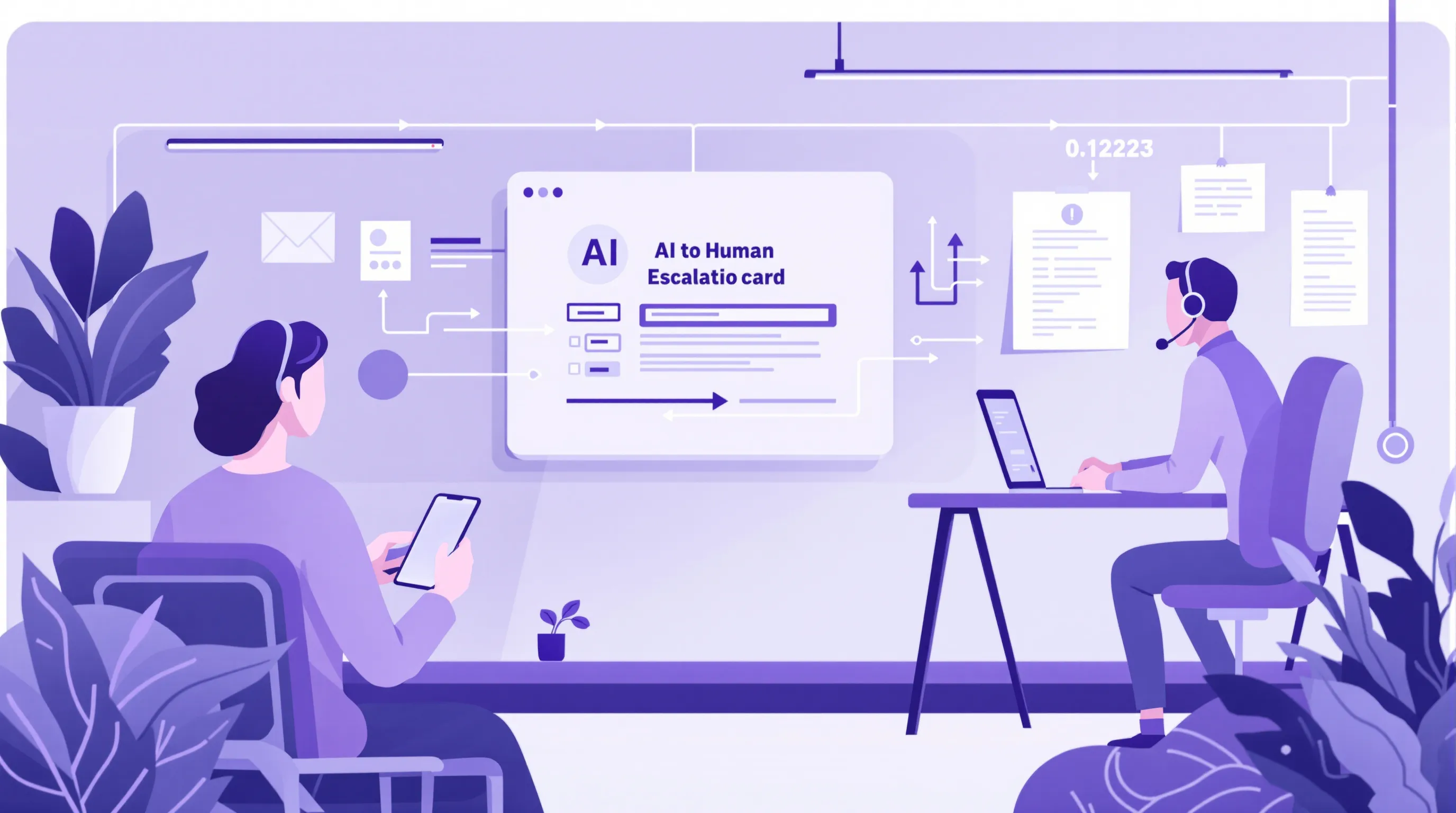
This is the escalation problem I find myself explaining most often to practice managers. The principle is simple: when the AI transfers a patient to a human agent, everything the AI has learned in that conversation must come with it. Not some of it. All of it. And it must arrive before the human picks up.
At Optum, I handled escalated calls daily. When I had context: a summary of why the patient called, their member ID, their insurance plan, the gist of the issue, I could often resolve the problem in two or three minutes. When I had nothing, I spent the first three to four minutes gathering baseline information while the patient grew more frustrated. In healthcare, those minutes are not neutral. They cost you patient trust, and in urgent situations, they cost more than that.
Practitioners building AI support systems have reached the same conclusion from the technical side: "the handoff record matters more than the generated reply." That observation is even more true in healthcare than in general customer support. A well-designed context-passing protocol delivers, at minimum, the following to the human agent's workspace before the patient is connected:
- Patient identification data: Name, date of birth, contact number, and any verified member or account IDs
- Reason for contact: The AI's best-guess classification of the patient's primary issue, "prior authorization inquiry," "appointment rescheduling," "billing dispute"
- Full conversation transcript: Every message exchanged, timestamped, so the agent can scan quickly for context before speaking
- Insurance details: Payer name, plan type, eligibility verification status, and any unresolved coverage flags
- AI confidence notes: Why the system escalated: low confidence score, keyword match, or session anomaly
- Emotional tone flag: Whether sentiment analysis detected frustration or distress during the conversation
This package should land in your EHR or CRM before the agent connects with the patient. Not after. The agent should be reading the summary while the patient hears a transfer tone. This matters so much because, as the same practitioners note, "the 'why it failed' part is usually missing, and that's what makes the difference between a useful handoff and someone starting from scratch."
Integration is the hard part. Your AI intake tool needs API connections to your EHR system, Epic, Athena, Kareo, eClinicalWorks, whichever you run, and your agent desktop. If your current tool cannot deliver a structured context package before the agent connects, that is not a feature gap you can address later. It is a workflow failure happening every time a patient is transferred.
How Does Sentiment Detection Prevent Patient Frustration From Escalating Further?
Most healthcare AI intake tools are built to understand what a patient is asking. Fewer are built to understand how a patient is feeling. Sentiment detection closes that gap: and in healthcare, that gap matters enormously.
Why? Because as customer experience research has consistently found, "when people know they're speaking to an AI, they get more frustrated more quickly and are more likely to drop off." A patient who is already frustrated and receives another bot response is a patient at risk of abandoning your practice entirely. Sentiment detection is how you catch that moment before it becomes a lost patient relationship.
Effective sentiment detection in a healthcare chatbot or voice bot should flag for escalation when it detects:
- Aggressive or heated language: Profanity, confrontational phrasing, or statements like "I'm done with this"
- Rapid repeated inputs: The same phrase or intent submitted two or more times in quick succession, a clear signal the bot isn't understanding the patient
- Explicit expressions of distress: "I'm really upset," "this is an emergency for me," "I can't deal with this"
- Negative feedback directed at the bot: "You're not helping," "this doesn't make sense," "I want to talk to a real person"
When any of these signals appear, the correct response is not another bot message. It is an immediate warm transfer to a live agent, with the full context package already queued. One AI support designer who learned this lesson from user complaints described the core insight: "users handle slow-and-honest fine. They don't handle fast-and-fake." In healthcare, a patient who gets one more bot response when they're already distressed doesn't need more automation. They need a human, and they need one now.
In summary: sentiment detection doesn't need to be perfect to add real value. Even a basic keyword layer that catches the most common frustration phrases will meaningfully reduce escalation delays. Build for the common cases first, then refine based on real interaction data over time.
What Clinical Red Flags Must Always Trigger an Immediate Human Handoff?
This category has no flexibility. Clinical safety triggers are hard-coded rules: not thresholds, not suggestions, not defaults that can be toggled off.
They define the absolute boundary between what an AI system is permitted to handle and what it is never permitted to handle alone.
I want to be direct: an AI system that attempts to triage a patient reporting chest pain, stroke symptoms, or a severe allergic reaction is not just a liability. It is dangerous. Every healthcare AI intake tool must have hard-coded escalation paths for the following, reviewed and signed off by your clinical and legal teams before any system goes live:
- Emergency symptoms: Chest pain, difficulty breathing, loss of consciousness, stroke symptoms (sudden numbness, confusion, speech difficulty, severe headache, vision changes). These must trigger an immediate transfer or emergency services prompt with zero additional bot responses
- Mental health crisis: Any mention of self-harm, suicidal ideation, or acute psychiatric distress must route immediately to a trained human agent or crisis line, never to an automated response
- Pediatric emergencies: Reports involving a child in acute distress require immediate human involvement, full stop
- Controlled substance requests: Prescription inquiries for opioids, benzodiazepines, or other scheduled medications must never be handled autonomously by an AI system
In every one of these cases, the AI must do exactly one thing: transfer immediately, warmly, and clearly. The patient-facing message should be direct and human-sounding: "I'm connecting you right now with a member of our care team who can help you directly." That's it. No hold music without explanation. An immediate bridge to a live agent or, when appropriate, an emergency services prompt. This protocol must be reviewed by your clinical and legal teams before any AI deployment goes live, and re-reviewed whenever your intake tool is updated.
The Warm Handoff Checklist for Practice Administrators
Before deploying or updating any AI intake tool, run this four-step evaluation. I've used versions of this framework since my QA workflow days, and it remains the most reliable way to identify escalation gaps before patients encounter them.
Step 1: Context Leakage Test
Run a synthetic patient scenario through your intake tool and trigger an escalation. On the receiving end, verify: did the human agent receive the full context package? Is anything missing: transcript, reason for contact, insurance details, escalation reason? Missing data is a handoff failure. A patient who has to repeat themselves when transferred is a patient whose trust you've already partially lost.
Step 2: Drop-Off Audit
Pull the last 30 days of escalation logs. How many escalated sessions resulted in a disconnected call or abandoned chat before a human connected? A drop-off rate above 10% signals that your transfer queue or wait times are actively breaking the handoff experience. That's not an AI problem. That's an operations problem that needs solving now.
Step 3: Trigger Accuracy Review
Send 10 test conversations through your AI using phrases from your trigger list: clinical keywords, frustration language, explicit human requests. Verify every trigger fires correctly and routes to the right destination. Any that miss need tuning before your next patient contact.
Step 4: Fallback Queue Management
What happens when all human agents are occupied during an escalation? A well-designed fallback gives patients information and a choice: "All of our care team members are currently with other patients. You're number [X] in queue, with an estimated wait of [Y] minutes. Would you prefer a callback instead?" Uncertainty destroys patient trust. Information and a clear option preserve it.
Run this checklist every 90 days, not just at launch. Patient volumes, language patterns, and payer environments all shift. Your escalation logic must shift with them.
How Can HelpSquad Support Your AI-to-Human Escalation Design?
At HelpSquad, our virtual medical assistants and patient intake specialists are trained specifically for this role: taking over where automated intake leaves off. They receive context packages. They don't request them. They're briefed on the escalation reason and patient situation before they connect. They operate across the EHR platforms most practices run, Epic, Athena, Kareo, eClinicalWorks, and with HIPAA-compliant protocols that protect both patients and practices.
Whether your practice is implementing a hybrid AI-and-human intake workflow for the first time, or looking to improve an escalation architecture that isn't performing well, we can help you build the human layer that makes AI-assisted intake safe to run at scale. Explore our virtual medical assistant services or our healthcare call center teams to learn more.
What Will Matter Most for AI Escalation in the Next 12-24 Months?
AI adoption in healthcare is accelerating faster than most practice managers can keep pace with. But the escalation design principles I've described in this article aren't going to become less relevant. They're going to become the baseline requirement. Here's where I see the field heading over the next two years, and what it means for decisions you're making today.
Real-Time Escalation Intelligence
Most escalation triggers today are rule-based: keyword matching, confidence thresholds, session timers. Within 24 months, I expect the leading healthcare AI platforms to shift toward dynamic escalation scoring that weighs multiple signals simultaneously: patient history, current sentiment, recent contact frequency, and clinical risk indicators. A patient who has called three times this week about the same prior authorization and is showing frustration signals should score higher for immediate escalation than a first-time caller with a routine scheduling question. That kind of contextual intelligence is in active development. Practices that define their escalation logic clearly now will be better positioned to configure these systems when they arrive.
EHR-Integrated Context Packages as Standard
Context passing today often requires custom middleware builds and bespoke API integrations. In the next 12-24 months, I expect native EHR integrations for major platforms, Epic, Athena, eClinicalWorks, to become standard features in AI intake tools rather than optional add-ons. When that happens, the context package an agent receives won't just include the session transcript. It will include the patient's full care history, last appointment notes, open prior authorizations, and outstanding billing flags. That's a meaningful shift in what human agents can accomplish in the first 60 seconds of an escalated interaction.
Multimodal and Cross-Channel Escalation
Most healthcare AI intake today is text-based. Voice-based triage is growing, but true multimodal escalation: where a patient starts on chat, moves to voice, and the human agent receives unified context from both channels, remains the exception. Both "AI agents vs chatbots" practitioners and customer experience experts point to a "three-layer setup" emerging as the production default: basic chatbots for tier-1 routing, orchestrating agents for multi-step workflows, and human agents for everything consequential. Practices that design their escalation architecture for multimodal handoffs now will have a structural advantage in patient satisfaction as voice AI adoption accelerates.
Regulatory Scrutiny on AI Triage
Healthcare regulators are watching AI triage closely. The FDA has issued guidance on software as a medical device. State medical boards are actively evaluating how AI tools interact with patients in clinical contexts. Research on multi-agent AI system failures has identified that what's often missing is "organizational thinking: clear role definition, institutional memory, structured communication protocols, and robust verification mechanisms." That framing applies precisely to escalation design. Practices with documented, auditable escalation protocols, with explicit rules about what the AI is and isn't permitted to do, will be better positioned when that scrutiny arrives in a formal regulatory requirement.
The Human Judgment Risk Worth Naming
There's a subtler risk worth flagging directly. A 2026 study published in The Lancet found that physicians using AI assistance saw their own detection rates decline when the AI was removed. A separate 2026 Wharton study found that participants followed AI-generated answers 80% of the time, even when those answers were deliberately wrong. The pattern holds across domains: "AI makes you better while you're using it and worse when you're not." This cognitive deskilling risk applies to your human agents too. If they only ever receive clean, pre-packaged escalation briefs, their ability to handle messy, context-free situations can erode. Build in deliberate practice scenarios where your human team handles complex intake without AI scaffolding. The agents who remain sharp in both modes are the ones who make your hybrid system resilient.
In summary: the fundamentals of sound escalation design: defined triggers, seamless context passing, clinical safety hard-stops, are the foundation you need now. The tools will grow more sophisticated. The standards will tighten. Practices that build a thoughtful handoff architecture today will adapt to both with far less disruption than those who treat escalation as an afterthought.
Forward Signal - 12-24 months horizon
Where AI-to-human patient handoffs go next
Three forecasts on how healthcare providers and outsourcers will design AI-to-human escalation as scrutiny of handoffs grows.
Forecasts for AI-to-human escalation design
Each forecast is rated by how strongly the underlying evidence supports it, so you can judge which shifts matter most for patient support.
Buyer demand for identifiable healthcare BPO and virtual-assistant providers that specialize in patient communication and transparent escalation will keep rising, alongside a finance/accounting outsourcing market projected to reach $142.66 billion by 2033 and expanding virtual-assistant staffing models like Hello Rache's $9.50/hour, 24-hour matching offer.
Over the next 12-24 months, most production support systems will settle into a three-layer pattern: basic chatbots for routine queries, guardrailed agents handling multi-step tasks with mandatory human review, and fully autonomous agents kept mostly in pilot stage, with every interaction logged in an audit trail.
Rather than automation steadily displacing human reviewers, healthcare and support organizations will add more mandatory human checkpoints in AI workflows over the next 12-24 months to counter measurable declines in human judgment tied to AI reliance.
Early indicators on the radar: Builders already report converging on a three-layer setup with mandatory human-in-the-loop for the middle tier, and prototypes that log an audit record for every ticket, including auto-resolved ones. Buyers are actively asking which healthcare BPO firms specialize in patient communication and whether healthcare virtual assistants are worth it for a medical practice, while at least one support team publicly reversed a policy of implying a live human transfer that never happened after users complained.
Supporting and contrary evidence
Sources shown here both back and challenge each forecast so you can weigh the full picture.
- If a customer asks to speak to a human, should the chatbot is the clearest counter-signal. [Community / Forum]“40%”
- AI agents vs AI chatbots: what are companies actually using supports this forecast. [Community / Forum]“Post author u/danildab (r/artificial, thread posted ~3 months”
- I built an AI support-agent prototype and realized the hard part is not supports this forecast. [Community / Forum]“Prototype named RelayOps, built for telecom/subscription-style support workflows,”
- The hardest part of building an AI agent is getting it to hand off to a supports this forecast. [Community / Forum]“Original poster built a customer support chatbot deployed”
- Why Multi-Agent AI Systems Fail Like Bad Human Teams is the clearest counter-signal. [Substack / Newsletter]“These systems often don't perform better than a single model - and in many cases, they fail catastrophically.”
- The Art of Human Prompting: Why the Most Important Questions in supports this forecast. [Blog]“The greatest threat to your organization isn’t that AI will replace human judgment. It’s that human judgment will simply disappear because no one is…”
- Why Multi-Agent AI Systems Fail Like Bad Human Teams supports this forecast. [Substack / Newsletter]
- AI agents vs AI chatbots: what are companies actually using is the clearest counter-signal. [Community / Forum]
What could change these forecasts
These are the real-world shifts that would push escalation design in a different direction than predicted here.
Before you rely on these numbers
Treat these scores as weights, not verdicts. The top signal (90/100) carries counter-evidence, and the contrarian signal (56/100) marks a real split among sources.
- If regulators or buyers move in the opposite direction, Demand grows for outsourcing providers with honest handoff design would weaken first.
- If the source mix shifts toward stronger contrary evidence, Overtrust in AI pushes for more, not fewer, human checkpoints could become the more durable forecast.
Build the Handoff That Earns Patient Trust
AI in healthcare performs best as a front door, not a replacement for human judgment. The practices that succeed with AI-assisted intake are the ones that invested as much thought into their escalation architecture as they did into the automation itself. They defined clear triggers. They built context-passing workflows that give agents real information before the conversation starts. They trained their human staff, whether in-house or outsourced virtual medical assistants, to take over seamlessly when complexity spikes.
The handoff is where patients decide whether your practice is worth staying with. A smooth escalation, where the human agent opens with "I can see you were asking about your prior authorization; let me take care of that for you right now", is a trust-building moment. A clumsy one, "I'm sorry, can you start from the beginning?", is a trust-destroying one. The difference between those two outcomes is almost entirely about architecture, not intent.
Build for the handoff from day one. Test your escalation logic every 90 days. And make sure the humans on the other side of your AI system are as prepared as the technology that sends patients to them. That's the standard that protects patients, and that separates practices using AI effectively from those using AI as an excuse for inaccessibility.
References
- Reddit r/AI_Agents: "I built an AI support-agent prototype and realized the hard part is not the AI" (2026), escalation audit design and handoff record requirements
- Reddit r/artificial: "AI agents vs AI chatbots: what are companies actually using in production?" (2026), three-layer AI production architecture and human-in-loop design
- Reddit r/AI_Agents: "I made my chatbot worse on purpose. Customers liked it more." (2026), honest vs. deceptive escalation messaging; sentiment-triggered escalation
- Reddit r/AI_Agents: "The hardest part of building an AI agent is getting it to hand off to a human" (2026): escalation trigger design, confidence thresholds, loop detection
- Reddit r/CustomerSuccess: "If a customer asks to speak to a human, should the chatbot immediately escalate?" (2026), deflection vs. obstruction in escalation design
- AI Learn Insights (Substack): "Why Multi-Agent AI Systems Fail Like Bad Human Teams" (2026), UC Berkeley research on AI coordination failures and organizational thinking gaps
- Customer Support Leaders Podcast, Episode 307: "How Customers Experience AI" with Shep Hyken (2026), human touch as competitive advantage; escalation design principles
- Jacob Morgan, Medium: "The Art of Human Prompting" (2026), Lancet and Wharton studies on AI cognitive deskilling and human judgment atrophy
- HelpSquad internal data (2024-2026): AI-to-human escalation protocol impact on patient drop-off rates across supported practices
Written by
Maria Rush
Marketing Team Lead, HelpSquad
Maria De Jesus-Rush is Marketing Team Lead at HelpSquad, a healthcare business process outsourcing company, with a background in content development, digital marketing, and project management.
Connect on LinkedInFrequently Asked Questions: AI-to-Human Escalation in Healthcare
What is AI-to-human escalation in a healthcare setting?
AI-to-human escalation is the process by which an automated intake tool: a chatbot, voice bot, or virtual agent, transfers a patient to a live human agent when the case exceeds what the AI can safely or accurately resolve. In healthcare, this includes clinical urgency situations, coverage disputes, emotional distress, and any scenario where the AI's confidence in its response falls below a defined safe threshold.
What are the most important escalation triggers for a healthcare AI system?
The most critical triggers fall into two categories: intent-based triggers (clinical emergency keywords, explicit requests for a human agent, billing disputes, controlled substance inquiries) and system-based triggers (confidence scores below 70%, three or more unrecognized consecutive inputs, session length anomalies exceeding 8 minutes). Both categories should be tested with synthetic patient conversations every 90 days.
How should AI pass context to a human agent during a transfer?
Before the human agent connects, the AI should deliver a structured context package including the patient's name, date of birth, and insurance details; the AI-classified reason for contact; the full conversation transcript; and a note explaining why the escalation was triggered. This package should integrate directly into the EHR or agent CRM workspace so the agent is reading the summary before the patient says a word.
What clinical situations must always trigger an immediate human handoff with no exceptions?
Emergency symptoms (chest pain, stroke symptoms, severe allergic reactions, difficulty breathing), mental health crises (suicidal ideation, acute psychiatric distress), pediatric emergencies, and controlled substance prescription inquiries must always route immediately to a trained human agent. These are hard-coded safety rules, not configurable thresholds, and they require clinical and legal review before any AI deployment goes live.
How often should escalation workflows be tested and updated?
Escalation trigger accuracy, context-passing protocols, and fallback queue management should be tested at minimum every 90 days. Patient language patterns evolve, payer systems change, and new clinical scenarios emerge. Quarterly audits, not annual reviews, are the operational standard for any AI intake system seeing regular patient volume.
What is a warm handoff in healthcare AI intake?
A warm handoff is a transfer protocol in which the human agent receives full context about the patient's situation before connecting, so they can open the conversation by directly addressing the patient's issue rather than asking them to start over. The goal is a seamless, invisible transition from automated to human support where the patient never feels the seam.
How does sentiment detection improve AI escalation outcomes in healthcare?
Sentiment detection identifies emotional signals: frustration language, repeated inputs, aggressive tone. That indicate a patient needs immediate human support before the situation worsens. By detecting these signals early, the system escalates before frustration reaches a breaking point, reducing interaction abandonment rates and preserving the patient relationship. Research confirms that patients who know they're speaking to an AI become frustrated more quickly and are more likely to disengage.
Can HelpSquad's virtual medical assistants integrate with existing AI intake systems?
Yes. HelpSquad's virtual medical assistants and patient intake specialists are trained to handle AI-escalated cases with full context across major EHR platforms (Epic, Athena, Kareo, eClinicalWorks). They manage complex coverage, scheduling, and clinical intake situations, and operate with HIPAA-compliant protocols. They are specifically designed to function as the human layer that healthcare AI systems escalate to when cases exceed automated handling capacity.

AI in Primary Care: Transforming Diagnosis, Treatment, and Patient Experience
AI in primary care splits into three layers at very different maturity levels: ambient documentation, clinical decision support, and patient triage. What works now and what does not.
Healthcare Industry Trends 2026: What to Expect Next
Premiums are rising at the steepest rate in 15 years while CMS reimbursement stays flat. The cost, staffing, and AI governance pressures shaping practice operations in 2026.

Patient Balances Are the New Accounts Receivable: Collecting Without Damaging the Relationship
Patient balance collection works when it starts at scheduling, not at the billing stage.
Let's talk about what your practice actually needs.
A 30-minute call. No sales pressure. We'll tell you honestly whether we're a fit.