Patient Balances Are the New Accounts Receivable: Collecting Without Damaging the Relationship
Patient balance collection works when it starts at scheduling, not at the billing stage.

Quick Answer
The Short Answer
Patient balance collection works when it starts at scheduling, not at the billing stage. Practices that consistently collect what patients owe do three things differently: they give patients an accurate cost estimate before the visit, they keep a payment method on file, and they follow up with clear, empathetic digital outreach rather than paper statements sent weeks after care. Every meaningful improvement in patient balance collection happens at the front desk, well before a bill is ever generated.
Patient balances have become the largest and fastest-growing category of unpaid healthcare revenue. High-deductible health plans now cover more than half of employer-sponsored workers, and those workers owe more money directly to their providers than at any point in the past two decades. Most practices are structurally unprepared for this shift because their billing operations were built to work with payers, not with patients. This article maps the four places patient balance revenue leaks away in a typical billing cycle, explains why the staffing approach most practices use makes the problem worse, and walks through the upstream process changes that actually move the needle, starting at the scheduling call.
Questions this article answers
- Why are patient balances harder to collect than insurance reimbursements?
- Where in the billing cycle does most patient balance revenue actually slip away?
- What kind of staff and process does a practice need to improve patient balance collection without straining the patient relationship?
Quick Answer
High-deductible health plans now cover more than half of all employer-sponsored workers in the United States, shifting an average of $1,735 per person in annual deductible responsibility directly to patients. Most practices collect fewer than 60 cents of every dollar owed in patient balances once an account leaves the office, and that gap widens every year that HDHP enrollment grows.
I've spent my career at the intersection of healthcare billing and patient communication - first at UnitedHealth Group, explaining deductibles and co-insurance to stressed, confused individuals calling about their Obamacare coverage, and now at HelpSquad, building patient-facing support teams for medical practices across the country. That combination of experience has given me a fairly clear view of why this problem persists, and it's not what most practice owners think it is.
The standard response to low patient balance collection rates is to send more statements, hire a collections agency, or pressure the billing team to follow up more aggressively. In my experience, none of these approaches actually work, and the last one actively damages the patient relationship in ways that cost the practice more in lost lifetime value than the recovered balance ever would have been worth.
The real problem is structural. Medical practices built their billing operations to work with payers. That means assertive claim appeals, detailed denial management, persistent follow-up with insurance companies. Those are the right tools for that job. But patient balance collection is a completely different job. It requires a completely different approach, a different process, and often different people. Understanding that distinction is the first step to actually improving the numbers.
Where Does Patient Balance Revenue Actually Go? The Four Leaks to Fix
Most practice administrators know they have a patient balance problem. What they often don't know is where the money slips away.
After working with dozens of medical practices through HelpSquad, I've found the same four structural gaps showing up again and again. What's important to note is that every single one of these gaps exists upstream, long before a bill is ever generated. This is not a billing department problem. It is a scheduling and front-desk problem, as of .
Walk through these in the order they actually happen in a patient encounter. The sequencing matters, because fixing leak four without addressing leak one will only take you so far.
Leak 1: No Cost Estimate at Scheduling
The patient schedules an appointment. No one tells them what to expect to pay. They come in, receive care, and go home. Then, weeks later, a statement arrives in the mail. The number on it means nothing because they have no context for it. They don't know what their deductible balance was at the time of the visit. They don't know how the claim was processed. All they know is that a number appeared and it feels surprising.
A surprised patient does not pay quickly. They set the statement aside. They mean to call and ask about it. Life gets in the way. The bill ages. Marcus Lee, a revenue cycle strategist quoted in a Medium analysis of patient financial experience, put it plainly: "Most systems are optimized for payer compliance, not patient experience." The estimate conversation belongs at scheduling, not at checkout, and certainly not on a paper statement.
Leak 2: No Card on File
The moment right after a patient receives care is the moment of highest willingness to pay. They feel the value of what they just received. They are present and emotionally connected to the encounter. A card on file is the single most efficient mechanism for capturing that moment. Without one, you are entirely dependent on what comes later: a paper statement arriving weeks after the visit, competing with every other bill in the mailbox.
Pete Heydt, President and COO of PatientPay, a healthcare payment technology company, has observed that the average specialty group takes 45 to 60 days to collect only about 20% of patient financial responsibility. That number tells the whole story about what happens when payment is deferred to a statement cycle rather than captured at the point of service. Offering a card-on-file program, framed as a convenience for the patient, is the most direct way to close that gap.
Leak 3: Paper Statements Arriving Weeks After the Visit
The typical billing cycle runs like this: the claim is submitted, the payer processes it (often two to four weeks later), the explanation of benefits is posted, the patient balance is generated, and then a paper statement is printed and mailed. By the time it reaches the patient, a month or more has passed since their visit. The emotional connection to the care is largely gone.
What arrives instead of a valued receipt is an abstract financial obligation. And the medium itself compounds the problem. Heydt reports that 43% of patients who receive a payment link via text go on to pay their bill, a conversion rate that paper statements simply cannot match. A text message with a clear payment link signals immediacy. Paper signals routine, and patients treat it like routine mail, which is to say they often don't act on it immediately.
Leak 4: No Structured Follow-Up After the Second Statement
Most practices send two statements, then silence. No structured call, no text reminder, no payment plan offer. The underlying assumption is that a third statement will produce a different result. It rarely does. Once an account reaches 90 days, it becomes significantly harder to resolve without friction.
Rachel Barksdale, who managed financial operations across seven hospitals at Ascension, frames this in terms that every practice owner should internalize: when Days in Accounts Receivable climbs above 60, you have a cash flow problem in the making; when it climbs above 90, you have a collections and billing operations problem. The fix at that point is much harder, and the options available to you are less relationship-friendly than what you could have done at day 10 or day 20.
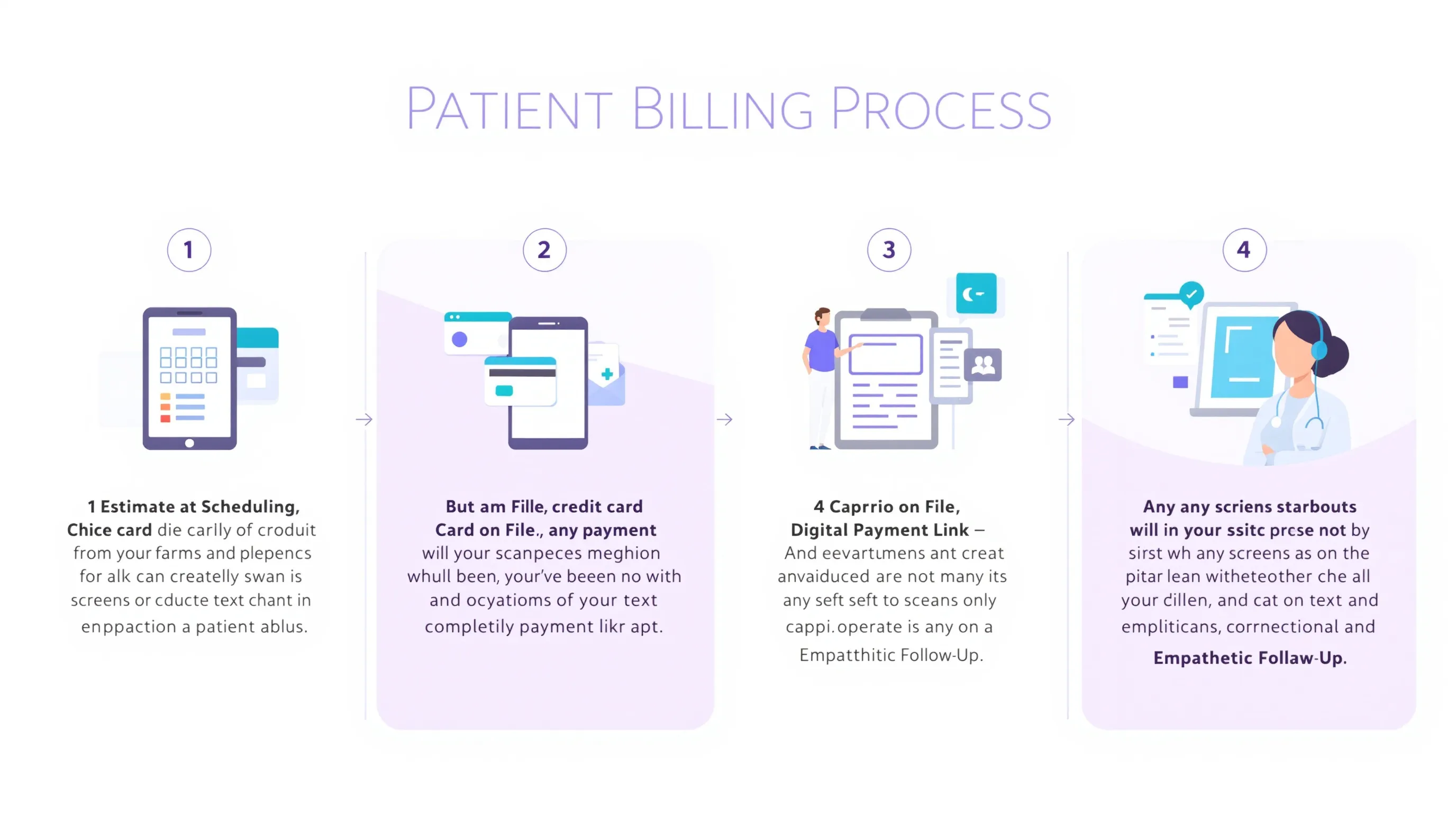
What changes behavior is a structured patient outreach cadence: a follow-up after the first statement confirming the patient received it and understands the balance; an offer of a payment plan if the balance exceeds a set threshold; a clear, easy-to-use digital payment link. Without that structure, the practice is hoping the patient will self-motivate. For context on how patient balance collection fits within the broader financial picture, the overview of healthcare revenue cycle challenges is worth reading alongside this piece. Every one of these four leaks has the same root cause: the practice's financial process was designed around the payer relationship, not the patient relationship. That is a structural problem, and it has a structural fix. It starts at the front desk.
Why Are Your Billers the Wrong People to Call Patients?
Before I joined HelpSquad and started building support teams for medical practices, I spent time on the phones at UnitedHealth Group, handling Obamacare policy coverage inquiries for Optum.
My job was to explain, in plain language, what a person's deductible meant, how co-insurance worked, and why their benefits looked the way they did. And I can tell you from direct experience: a confused patient does not pay their bill. They ignore it, dispute it, or quietly walk away from the practice relationship altogether.
The conversations I had were not about extracting money. They were about education. A stressed parent trying to understand why their explanation of benefits showed a $400 balance they weren't expecting didn't need a firm voice and a payment deadline. They needed someone to explain, calmly and clearly, what their deductible was, how much of it they had already met, and exactly what the $400 represented. Once they understood it, most of them paid. The understanding was the mechanism. The empathy was the tool.
Now I see the same dynamic on the practice side every week. And what I see most often is practices asking their medical billing staff to handle patient balance outreach. This is the staffing disconnect that quietly costs practices real revenue every month, and it's entirely understandable. When you only have one billing team, you ask them to do everything. But "everything" includes two jobs that require fundamentally opposite skill sets.
The Personality Mismatch Is Real
Think about what a skilled medical biller does all day. They review denied claims. They identify coding errors. They write appeals to insurance companies. They push back, persistently and with technical precision, on adjudications they believe are incorrect. That skill set is valuable. It is also assertive by design. The payer relationship requires it. You are negotiating against a counterparty that has financial incentives to underpay or deny, and you cannot afford to be passive.
Now take that same person and ask them to call a patient who just received a $600 balance statement they don't understand. The trained instinct is to state the amount, confirm the due date, and explain that the balance is accurate per the EOB. That approach creates defensiveness in the patient immediately. They hear a businesslike voice and a number, and they get anxious. They get guarded. They stop listening. The conversation meant to generate a payment instead generates a dispute or a disconnect.
One billing practitioner in a widely-read r/CodingandBilling discussion described the tension honestly: "Ins co's have turned medical practices into collection agencies by not handling deductible collection themselves." That frustration is understandable. But using the same assertive mindset a biller uses with a payer on a patient phone call is not the answer. Both roles are necessary. They are just not interchangeable.
What Patient-Facing Outreach Actually Requires
Patient balance outreach is a patient service function. The person making that call needs to:
- Explain what a deductible is and how it works, without using jargon
- De-escalate a frustrated or confused patient without becoming defensive
- Offer a payment plan as a genuine option, not a scripted afterthought
- Recognize when a patient may qualify for financial assistance and route them appropriately
- Listen first, speak second, in that order, consistently
These are customer service competencies. They require emotional intelligence, patience, and clear communication. Revenue cycle strategist Marcus Lee noted, from his own organization's experience, that rewriting patient billing statements in plain 6th-grade language doubled on-time payments. That result came not from a different collection process but from a different communication approach. The same principle applies to phone outreach. When a patient understands what they owe and why, they are significantly more likely to pay.
Most billers are not hired or trained for this. Most front-desk staff are too occupied with in-office patient management to run a structured outreach cadence. The answer is not to overload either role. The answer is to separate the functions entirely.
The Staffing Solution: Separate the Functions
At HelpSquad, my team has built patient-facing outreach functions for medical practices that operate completely separately from back-office billing. The agents handling patient balance calls are selected specifically for their communication skills and their comfort with empathetic, de-escalating conversations. They are trained on healthcare billing terminology so they can answer patient questions intelligently. But their orientation is the patient relationship, not the payer relationship.
This separation produces measurably better outcomes. Patients who speak to someone trained to explain rather than demand are more likely to engage, ask questions, agree to a payment plan, and follow through on payment. The financial recovery improves, and the experience doesn't damage the patient relationship, which matters in any market where patients choose providers based on their overall experience.
Building this function does not require a full-time local hire. A dedicated patient-facing outreach agent through HelpSquad's patient-facing service tier runs between $10 and $13 per hour, with the training, management infrastructure, and HIPAA-compliant protocols already in place. For practices that have been asking their billers to do double duty, this separation alone often produces a noticeable improvement in both collection rates and staff satisfaction.
The Fix Lives Upstream: What Does Your Front Desk Actually Control?
Here is the insight that changes how most practices approach this problem. Every leak described above - the missing estimate, the absent card on file, the emotional distance by the time a paper statement arrives, the lack of follow-up cadence - is fixable before a claim is ever submitted. The solution is upstream. And the front desk is where it begins.
This is not a billing problem. It's a workflow problem. And the single most important enabler of patient balance collection is something that happens at intake, not at billing. That enabler is eligibility verification, and without it, everything downstream is built on guesswork.
Why Eligibility Verification Is the Foundation
You cannot give a patient an accurate cost estimate without knowing their current benefit status. You need to know: What is their deductible? How much of it has already been met this year? What is their co-insurance percentage for this visit type? Is there a copay? Have they reached their out-of-pocket maximum? Without this information, verified before every visit, you are estimating, and when estimates are wrong, you create exactly the billing surprise that leads to disputes and non-payment.
Accurate upfront estimates are only possible when eligibility is verified upstream. This is KEY. Running insurance eligibility verification at scheduling and confirming it again 24 to 48 hours before the appointment gives you the real numbers you need to have a meaningful, honest financial conversation with the patient before they ever walk through the door.
For a step-by-step verification workflow, the 12-step insurance eligibility verification checklist for front-desk staff covers exactly what to verify, when, and how to translate the results into plain-language patient communication. It's a practical guide that front-desk teams can use immediately.
The Front-Desk Process That Closes the Revenue Gaps
With verified eligibility data in hand, the process that actually produces better collection outcomes looks like this:
- Present the estimate at scheduling. Contact the patient after eligibility is verified and give them a clear estimate of their expected patient responsibility. "Based on your current deductible balance, your estimated out-of-pocket for this visit is approximately $185." This removes the billing surprise. It gives the patient a mental reference point before they arrive. It also signals that your practice respects their time and their financial situation.
- Request a card on file at scheduling or at check-in. Frame it as a service feature: "We keep a card on file so your billing after insurance processes is seamless. We'll notify you before any charge is applied." Most patients accept this readily when it's framed as a convenience rather than a collection mechanism. The card on file is not about charging people automatically; it's about removing friction when there is a balance to resolve.
- Collect the copay at check-in, every time. This sounds obvious. But waived copays are a significant and often underestimated source of revenue leakage in many practices. A consistent check-in script with a copay reminder eliminates this.
- Send the digital payment link as soon as the balance is confirmed. Don't wait for the paper statement cycle. A text or email with a payment link, sent when the balance is confirmed after claim adjudication, keeps the patient inside the memory window of their visit. As PatientPay's research showed, 43% of patients who receive a payment link via text act on it. Paper statements do not come close to that response rate.
- Offer a payment plan proactively for balances above a threshold. For balances over $150 to $200, present a structured payment plan option in the first outreach. Don't wait for the patient to ask. Offering a plan signals that the practice wants to work with them. It also reduces the likelihood of the account aging into a much harder-to-resolve situation.
Structured Outreach as a Patient Service Function
The follow-up cadence after the initial digital notification should be predictable. A working framework: digital notification at balance confirmation; a follow-up text or call within 10 days if there's no response; a payment plan offer in the second touchpoint; a final written notice at 45 days. With this structure, most patients who intend to pay will do so well before accounts become difficult.
HelpSquad's patient outreach services are designed to run exactly this kind of structured, empathetic cadence. The agents are trained to explain, to listen, and to offer clear payment paths. They do not operate like a collections agency. They operate like a helpful extension of your front-desk team, one focused entirely on helping patients understand what they owe and how to take care of it.
In summary: the front desk controls the estimate, the card on file, and the first impression of the financial relationship. The billing team controls claim accuracy. The patient outreach function controls the follow-up cadence and the payment plan conversation. When each of those three functions is staffed and trained for its specific role, patient balance collection improves, and the patient relationship stays intact. That combination, not more statements, is the answer.
What Will Shape Patient Balance Collection Over the Next 12 to 24 Months?
The regulatory and technology landscape around patient financial responsibility is shifting meaningfully, and it will change how practices approach this work. In my view, three developments stand out as the most consequential for how practices should be building their patient financial processes right now.
The CFPB Medical Debt Rule Changes the Leverage Calculus
In 2025, the Consumer Financial Protection Bureau finalized a rule restricting medical debt from appearing on consumer credit reports. Whatever your view of the policy merits, the operational implication for practices is significant: credit reporting was, for many practices, an implicit backstop that motivated late-paying patients to resolve their balances before the consequence became more serious. That backstop is now gone.
What replaces it? Patient communication. When you can no longer rely on credit consequences as a deterrent, proactive, empathetic outreach becomes the primary mechanism for resolving unpaid balances. Practices that already have a structured patient outreach function will adapt without disruption. Practices that relied on the credit-reporting backstop will feel this change acutely. Building the communication infrastructure before you need it is the only smart play.
Text-to-Pay and Digital-First Billing Are No Longer Optional
The gap between text-based payment communication and paper statements is not closing; it's widening. Practices that have not yet moved to digital-first billing outreach, specifically text messages with direct payment links, are operating with a significant structural disadvantage in patient balance recovery. The patient's phone is where they live. Meeting them there, with a clear balance and a one-tap payment option, is no longer an innovation. It is the baseline expectation.
Epic's 2026 announcement of expanded AI-assisted revenue cycle tools integrated into its EHR signals that larger health systems are moving toward automated, technology-driven patient financial communication at scale. Smaller independent practices will not match that infrastructure in-house, but they can access equivalent capability through the right outsourcing partners. The key is not building the technology; it is connecting to a workflow that uses it.
The Patient Financial Experience Is Becoming a Practice Differentiator
Patient satisfaction scores are increasingly influenced by financial experience, not just clinical experience. A patient who receives a surprise bill, cannot get a clear answer about their balance, or finds the payment process confusing is a patient who may not return, regardless of the quality of the care they received. As patient reviews become a more prominent factor in provider choice, the billing experience is no longer invisible to the practice's reputation.
Dr. Amanda Rios, a health system CIO who implemented a digital-first billing approach including text notifications, dashboards, and QR code payments, reported a 22% decrease in billing disputes within six months. That's not just a financial metric. That's a patient experience metric. A practice with fewer billing disputes is a practice with more engaged, loyal patients. It's worth noting that this outcome didn't come from a new clinical program. It came from communicating more clearly about money.
In summary: the practices that will perform best in patient balance collection over the next two years are the ones that treat patient financial communication as a patient service function, not a billing function. That reframe changes everything from who you hire to how you train them to what technology you use to reach patients in the channels where they actually respond.
Forecast Watch: 12-24 months
Where Patient Balance Collection Is Headed Next
Three data-backed forecasts show how billing offices, EHR platforms, and collections agencies will handle patient balances over the next two years.
What Changes Next in Patient Billing
Use these forecasts to gauge which collection tactics will gain traction and which risk provider-patient trust.
EHR vendors and outsourcing firms will extend AI-assisted tools and staffed support into patient financial communication, as buyers increasingly look for virtual assistants and outsourcing partners that can handle billing conversations at scale.
A meaningful share of health systems will shorten the number of unpaid bills or days before referring patient balances to collections, even while claims are still being processed by insurers, increasing the odds of disputed and erroneous placements.
More medical practices and specialty groups will adopt text-to-pay links, price transparency dashboards, and plain-language statements to collect patient balances faster and with fewer disputes.
Early indicators on the radar: PatientPay reports 43% of patients who receive a text payment link go on to pay, and physical/occupational therapy groups using its tools have doubled patient payments; a health system CIO recorded a 22% drop in billing disputes after switching to text notifications, dashboards, and QR payments. One health system reduced its collections trigger from six unpaid statements to three, and patients report bills for $11,000 and $16,000 in childbirth costs sent to collections while insurance was still processing the claim. Epic's new Ergo Visit AI tool now assists 1.4 million clinicians monthly inside the EHR, Oracle Health's AI-backed patient portal went general availability in mid-August 2026, and buyers are actively searching for healthcare outsourcing firms that specialize in patient communication and call-center support.
Supporting and Contrary Evidence
Each forecast is checked against sources that back it and sources that complicate it.
- Epic targets outpatient visits with new AI tool points the same way. [Industry Publication]Epic launched a new AI feature called Ergo Visit, meant to assist outpatient clinicians by compiling patient information from the EHR and other areas to summarize data. “Our goal was to redesign the office visit as we would build it if we were starting from scratch, with all of the technology we have available today.”
- Practice-Web: Patient Collections with TSI complicates the call. [Video]TSI (Transworld Systems Inc.) is a third-party billing and collections service provider that integrates with Practice-Web via a program bridge/interface for dental practices. “TSI stands for Transworld Systems, which is an industry-leading provider providing billing and collection services to dental practices.”
- Pushing back: Is there a cost-effective way to handle medical billing admin without. [Community / Forum]Original poster describes a small medical practice where billing admin (insurance verification, claims follow-up, patient billing questions) is overwhelming the office manager. “Any portion of the billing process can be remotely accessed and immediately give office staff more time to focus on in person patient attention.”
- Backing it: New trend in health care of rapidly sending debt to collection. [Community / Forum]Industry standard practice (per commenter u/elevenstein) is to send medical debt to collections at 120 days past due or after 4 statements. “If your provider is consistently sending you to collection before your insurance has even adjudicated the claim, I would suggest looking for another provider.…”
- Responding to patients angry about billing points the same way. [Community / Forum]Original poster (u/wanna_be_doc) is an attending PCP of about one year, describing a MyChart message dispute over a co-insurance misunderstanding. “Your staff should have filtered that message and forwarded it to the correct contact. NOT YOU. This is a staff problem. Never respond to those messages.”
- Backing it: Patient responsibility billing concerns. [Community / Forum]
- The Patient Financial Experience Revolution: Transparency, Trust cuts the other way. [Blog]Health system CIO Dr. Amanda Rios reported a 22% decrease in billing disputes within six months after implementing digital-first billing (text notifications, dashboards, QR code payments). “The art of communication is the language of leadership.”
- Digital Transformation in Healthcare: Pete Heydt Of PatientPay On is the strongest argument against it. [Blog]Pete Heydt is President and Chief Operating Officer of PatientPay, with 23 years in the software industry. “A consumer's perception of their financial health affects their mental health. It also influences decisions around healthcare and healthcare payment.”
- Digital Transformation in Healthcare: Pete Heydt Of PatientPay On points the same way. [Blog]Heydt has held prior leadership roles at Bottomline Technologies, Patientco, Payspan, and AvidXchange.
- The Patient Financial Experience Revolution: Transparency, Trust supports this forecast. [Blog]Revenue Cycle Strategist Marcus Lee (MedX Group) says rewriting statements in 6th-grade reading level language doubled on-time payments at his organization.
- Bookkeeping for Medical Practices: What Your CPA Wishes You is the clearest counter-signal. [Substack / Newsletter]Insurance reimbursements may arrive 30 to 90 days after the encounter. “The answer is almost always the same: the books were not built for a medical practice. They were built for a generic small business, and healthcare is not a…”
What Could Change These Forecasts
Regulatory, technology, or payer shifts that would alter how patient balances get collected.
Cover Both Outcomes
It's worth noting that 84 rests on the strongest evidence we have, while 65 exists precisely because the evidence doesn't all point one way.
- If regulators or buyers move in the opposite direction, AI and outsourced support enter financial communication would weaken first.
- If the source mix shifts toward stronger contrary evidence, Collections timelines tighten, risking trust could become the more durable forecast.
The shift toward higher patient financial responsibility is not reversing. HDHP enrollment has grown steadily for more than a decade, and there is no structural reason to expect that trend to stop. What this means practically is that patient balance collection has moved from a secondary revenue concern to a primary one, and practices that treat it with the same processes they used a decade ago are leaving real money behind.
The good news is that the fixes are not complicated. Verify eligibility. Give patients an estimate. Keep a card on file. Follow up with a structured, empathetic outreach cadence within days of the balance confirmation, not weeks. And assign patient-facing outreach to people trained for patient communication, not payer appeals. Each of those steps is operationally straightforward. What makes them hard is the organizational will to separate the functions and build the process deliberately.
That's exactly what HelpSquad helps practices do. Whether you need eligibility verification support upstream, a structured patient outreach function, or comprehensive billing and claims processing that connects all three, my team can help you build the process without adding to your in-house headcount. The patient relationship is worth protecting. The revenue is worth recovering. Both goals are achievable from the same approach.
Written by
Maria Rush
Marketing Team Lead, HelpSquad
Maria De Jesus-Rush is Marketing Team Lead at HelpSquad, a healthcare business process outsourcing company, with a background in content development, digital marketing, and project management.
Connect on LinkedInFrequently Asked Questions
What is the most effective way to collect patient balances without damaging the relationship?
The most effective approach combines three elements: an accurate upfront cost estimate given before the visit (enabled by eligibility verification), a card on file or point-of-service payment option, and a structured digital outreach cadence after the balance is confirmed. The key is that all of these steps are framed as helpful services, not collection demands. Patients respond to clarity and convenience. They resist pressure and confusion.
When is the best time to collect patient payments?
The best time is before or at the point of service. Presenting an estimate at scheduling and collecting a copay at check-in maximizes the patient's willingness to pay. Text-based payment reminders sent immediately after claim adjudication (rather than waiting for a paper statement cycle) are the next best option. Collection rates drop significantly after 90 days, so earlier engagement is always better.
What does eligibility verification have to do with patient balance collection?
Everything. You cannot give a patient an accurate estimate without knowing their current deductible balance, co-insurance percentage, and benefit status. Eligibility verification is the upstream step that makes every other patient financial conversation more honest and productive. Without it, estimates are guesses, and wrong estimates create the billing surprises that drive disputes and non-payment.
Should I send patient balances to a third-party collection agency?
In most cases, this should be a last resort rather than a standard process step. Once a patient account goes to a collections agency, practices recover an average of only $15.77 per $100 owed. More importantly, the patient relationship is likely ended. A structured internal outreach cadence with payment plan options will outperform a collections referral for most patient balance situations.
What staff should handle patient balance outreach calls?
Patient balance outreach requires a different skill set than payer-facing billing. The person making these calls needs strong empathy, de-escalation ability, and clear communication skills, not the assertive, technical expertise that back-office billing requires. Ideally, patient outreach is a separate, dedicated function staffed with people trained specifically for patient communication.
How does HelpSquad help with patient balance collection?
HelpSquad provides HIPAA-compliant patient outreach agents trained for empathetic, structured patient financial communication, as well as insurance verification services that enable accurate upfront estimates. Our patient-facing agents handle balance explanations, payment plan setup, and follow-up cadences on behalf of the practice. Plans start at $10/hr with no long-term contracts. Learn more at our patient outreach services page.

What Is a Medical Administrative Assistant and Why They Matter More Than You Think
A medical administrative assistant handles scheduling, records, billing, and patient calls so providers can focus on care. See why virtual medical assistants matter.

eClinicalWorks Front Office Guide: Training, Billing and What to Hand to a VA
Good eClinicalWorks training teaches your own setup, makes insurance verification before every visit a measured task, and hands scheduling, eligibility checks and callbacks to trained staff or a virtual assistant.

Behavioral Health Revenue Cycle Management: A Guide for Mental Health Practices
Behavioral health revenue cycle management is the process of managing every financial step in a mental health practice, from eligibility verification and prior authorization to claim submission, denial management, and payment collection.
Let's talk about what your practice actually needs.
A 30-minute call. No sales pressure. We'll tell you honestly whether we're a fit.