What Dental Outsourcing Services Can Actually Do for Your Practice
01 Apr 2026 By: Mary Dellosa
Updated

Dental outsourcing services allow dental practices to delegate administrative and patient-facing tasks such as appointment scheduling, billing support, and after-hours call handling to trained external teams. This reduces overhead costs, improves staff efficiency, and ensures patients receive consistent, timely support. For practices looking to grow without hiring additional in-house staff, outsourcing offers a scalable and cost-effective alternative.
The Hidden Cost of Doing Everything In-House
Staff Burnout and Turnover in Dental Offices
Running a dental practice is a constant balancing act, and I know how much you pour into keeping it all together, from the clinical care you provide to the business side that keeps the doors open.
Your front-desk team carries more than most people realize. They’re juggling phones, billing, and a steady stream of patients, all while making sure every single person who walks through that door feels seen and taken care of. Day after day, that takes a real toll.
And when your people are running on empty, it shows , not because they stop caring, but because there’s only so much any person can give. That warmth your patients count on? It comes from real people who chose this work because they care. And people who care need to feel cared for too.
What Missed Calls Are Actually Costing Your Practice
Think about this for a second, nearly 40% of calls to dental offices go unanswered during peak hours. Not because nobody’s there. But because the same person answering the phone is also checking someone in, handling a billing question, and trying to keep the waiting room from feeling chaotic.
Those missed calls aren’t just missed calls. They’re real patients. Someone who’s been putting it off for weeks and finally picked up the phone. When no one answers, that moment is gone. And most of the time, so are they.
At $150 to $300 per appointment, a few missed bookings a week quietly snowballs into tens of thousands of dollars a year. But honestly, the number that’s harder to put a price on is the patient you never get a second chance with.
What Dental Practices Can Actually Outsource
The word “outsourcing” doesn’t exactly inspire confidence. We get it. But stick with us for a second. Dental practices that do this well aren’t handing over the keys. They’re offloading the specific tasks that eat up the most time, the ones that don’t require your staff’s clinical knowledge, but do require someone to actually be available and on top of it consistently.
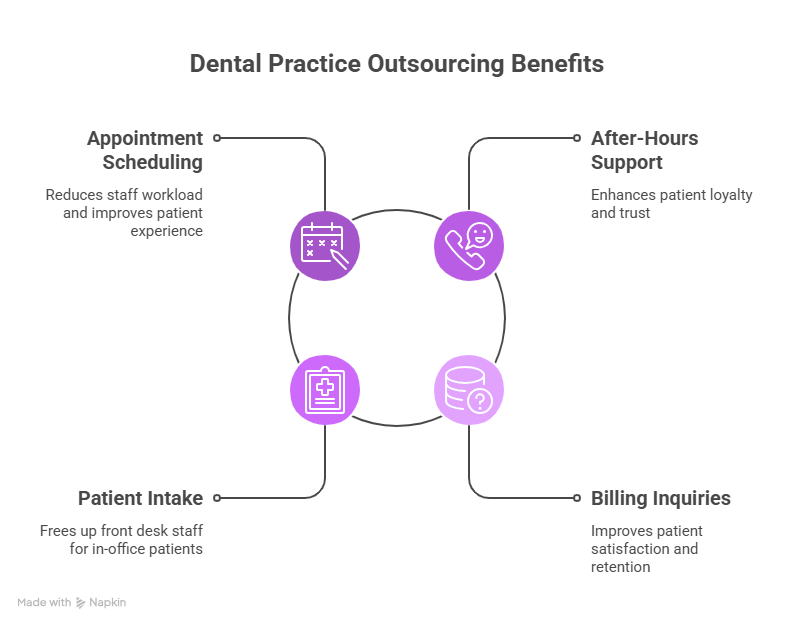
Appointment Scheduling and Reminders
Scheduling is one of those tasks that never really stops. Confirmations, reminders, reschedules, cancellations, it’s a constant back and forth that eats up your team’s day in small chunks that add up fast.
When that’s handled outside of your office, your staff stops getting pulled away from the person standing right in front of them. And patients get a real person to talk to when they need to move something around, which means fewer gaps sitting on your calendar and fewer no-shows slipping through.
After-Hours and Overflow Call Handling
Most people don’t call their dentist after hours unless something feels wrong. When they do, they’re already a little scared. Reaching a voicemail in that moment doesn’t just feel unhelpful. It feels like being left on your own.
But when someone actually picks up, everything changes. They feel heard. They get help figuring out what to do next. And more often than not, they remember that. Those are the patients who stick around for life.
Patient Intake and FAQ Support
Before a first appointment, patients often have a long list of questions: what insurance plans do you accept, how long is the wait, what should they bring, do you offer sedation. Outsourced agents trained in dental office workflows can handle this intake process efficiently, freeing your front desk to focus on the patients already in the building.
Billing Inquiries and Insurance Questions
Nobody calls about an insurance bill because things are going well. Something confused them, something felt off, or they just got a number they weren’t expecting and they need someone to help them make sense of it.
That conversation matters. Not because it’s complex, but because how it goes determines whether that patient feels taken care of or forgotten. When someone actually has the time to listen and help, most of the time that’s all it takes. And when it needs to go further, it gets to the right person without the patient having to fight for it.
The Business Case for Dental Outsourcing
Cost Comparison: In-House vs. Outsourced
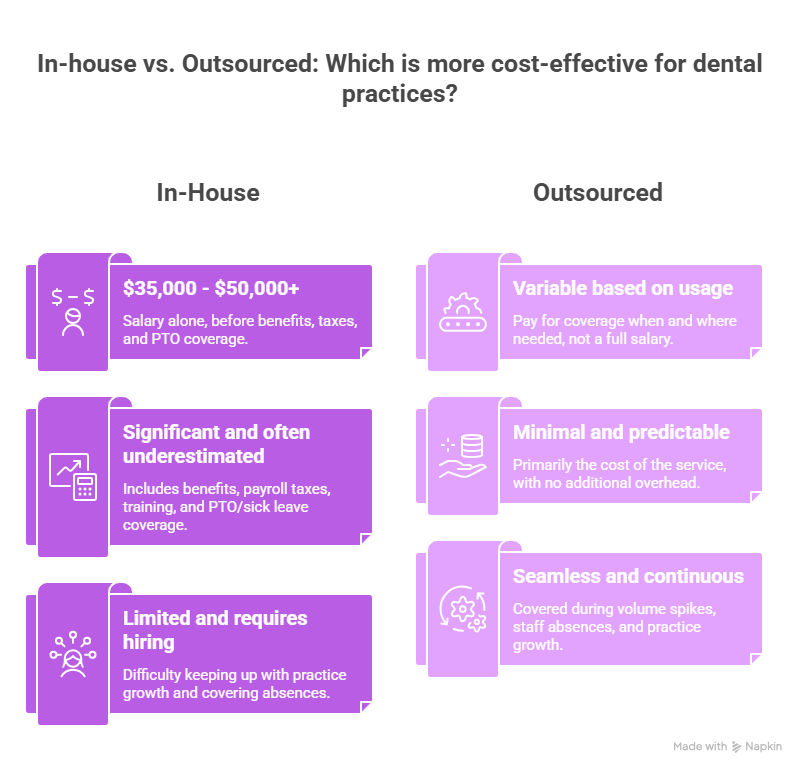
The financial argument for outsourcing is straightforward. A full-time in-house receptionist in the U.S. costs between $35,000 and $50,000 annually in salary alone, before benefits, payroll taxes, training, and the cost of coverage during PTO or sick leave.
Most practice owners know what they pay their front desk staff. What’s harder to see is everything that sits on top of that number. Benefits, payroll taxes, training, and the cost of covering for someone when life happens. The real number is almost always higher than it looks.
Outsourced support works differently. You’re paying for coverage where and when you need it, not carrying a full salary for capacity you may only need a few hours a day. When volume spikes, you’re covered. When someone’s out, nothing falls through. And when your practice grows, you’re not scrambling to hire fast enough to keep up.
For a lot of practices, that’s not just a cost savings. It’s a quieter kind of relief.
How Outsourcing Supports Practice Growth Without Adding Headcount
Growing a practice usually means hiring. And if you’ve hired before, you already know this feeling. You find someone you genuinely believe in, you spend weeks showing them the ropes, and somewhere along the way it just doesn’t work out. No big moment, no warning. You just wake up one day and you’re posting the job again, a little more worn down than the last time.
Outsourcing takes a lot of that off your plate. When things get busier, your support grows with you without the hiring cycle, without the onboarding, and without adding another person to manage. For practices with more than one location, that’s a real relief. You’re not trying to recreate the same front desk experience from scratch every time you open a new site. It’s already there, consistent and ready, no matter which location your patients reach out to.
HIPAA Compliance and Outsourcing: What to Look For
This is the part where dental practice owners understandably get cautious. Any vendor that handles patient communication is subject to HIPAA requirements, and choosing the wrong provider can put your practice at serious legal and financial risk.
The good news is that reputable dental outsourcing services are built around healthcare compliance from the ground up. What you’re looking for when evaluating a vendor includes:
Signed Business Associate Agreements (BAAs). A signed Business Associate Agreement isn’t optional and it isn’t a formality. It’s the baseline. Any vendor who handles patient information needs to have one, and if they pause when you bring it up or aren’t sure what you’re referring to, that conversation should end there.
Agent training on HIPAA protocols. A policy document has never protected a patient. The person on the phone has. And that person needs more than a quick rundown on their first day. Real conversations don’t follow scripts. Patients ask unexpected things, situations get complicated, and the only thing that holds up in those moments is genuine understanding, not a checklist they half-remember from orientation.
Secure communication platforms.Your patients trust you with information they don’t share lightly. Make sure any vendor you work with treats it the same way. Ask how it’s stored, how it moves, and who has access. The right partner will answer without missing a beat.
Audit trails and documentation. A compliant outsourced partner should have records of every interaction and be able to stand behind them completely if anything is ever called into question.
Questions to Ask Any Outsourced Support Provider
Before signing a contract, make sure you can answer yes to all of the following:
- Will you sign a Business Associate Agreement?
- How are your agents trained on HIPAA compliance?
- What is your protocol for after-hours urgent patient calls?
- Do your agents have experience with dental or healthcare clients specifically?
- How is patient data stored and protected?
- What happens if a data incident occurs?
How HelpSquad Supports Dental Practices
HelpSquad’s Healthcare Support services are built specifically for the challenges medical and dental practices face. That means agents who understand patient communication, not just call handling.
Healthcare-Trained Agents
HelpSquad agents are trained specifically for healthcare. They understand the weight of a patient call, how to handle sensitive information, and what it means to represent your practice well. Not because they were told to. Because they were trained to.
24/7 Availability and Coverage Options
Whether you need someone covering the phones after hours, extra support during your busiest part of the day, or a little of both, HelpSquad works around how your practice actually runs. Your patients get a real person every time they call. Your team gets to breathe. And your practice is never unreachable when someone needs you.
Frequently Asked Questions
What tasks can a dental practice outsource to a third-party service?
The tasks that tend to overwhelm a front desk team are usually the same ones. Scheduling, after-hours calls, patient intake, billing questions, the kind of work that never really stops and doesn’t require clinical training but does require someone who’s actually available and on top of it. Those are exactly the tasks that make the most sense to hand off.
Is outsourced dental support HIPAA compliant?
Yes, but verify it yourself. The right partner won’t just tell you they’re compliant. They’ll be able to show you. A signed BAA, real HIPAA training, and secure communication platforms should all be in place before a single patient interaction happens.
How much does it cost to outsource dental front office work?
It depends on what you need, but in most cases outsourced support costs significantly less than a full-time hire. A full-time receptionist starts at $35,000 to $50,000 a year in salary before you’ve added a single benefit or covered a single sick day. Outsourced support doesn’t work that way. You pay for the coverage you actually use, nothing more.
Will outsourced agents understand dental terminology and patient needs?
With the right partner, yes. The difference shows up in the small moments. The way an agent handles a nervous first-time patient. The way they talk someone through a billing confusion without making them feel embarrassed for asking. The way they stay calm when a call gets difficult. That comes from real healthcare-specific training, not a general customer service background.
Can outsourced support handle after-hours calls for a dental practice?
Yes. After-hours coverage is one of the most common and valuable use cases for dental outsourcing. Outsourced teams can handle patient inquiries, scheduling requests, and urgent call escalations outside your regular office hours, ensuring patients always reach a real person.
Trending Now
Burnout rarely announces itself. It shows up quietly, in the team member who used to love their job slowly going through the motions, or the person who was always reliable starting to pull away. By the time it’s obvious, it’s usually been building for a while.
Dentistry asks a lot of people. The hours, the patients, the administrative weight that never really lets up. Most people on a dental team are giving more than anyone sees, and they do it because they genuinely care. But caring has a limit when there’s no room to recharge.
The practices that get this right aren’t doing anything complicated. They’re just paying attention. To how their people are doing. To whether the workload is actually manageable. To whether anyone has asked lately. That kind of attention costs very little and changes everything.
The Bottom Line
Dental outsourcing services aren’t a shortcut. They’re a smarter way to run an already-demanding operation. When you remove the administrative pressure from your in-house team, reduce missed calls, extend your availability, and do it all at a lower cost than another full-time hire, the business case is hard to argue with.
The practices that are growing right now aren’t necessarily the ones with the biggest teams. They’re the ones that have figured out which tasks need to be done in-house and which ones just need to get done.
If your front desk is stretched, your after-hours calls are going to voicemail, or you’re losing patients before they ever walk in the door, dental outsourcing is worth a serious look.
Schedule a discovery call with HelpSquad to see how healthcare-trained support can work for your practice.

Mary is an executive assistant with over 3 years of experience. She enjoys doing various tasks such as graphic design, video editing and content writing. She is on HelpSquad's marketing team and helps leverage the company's business for growth. You may contact Mary on LinkedIn: https://www.linkedin.com/in/gelai-dellosa/