Top Virtual Assistant Tools and Software for 2026
Key Points
- HelpSquad's February 2026 baseline puts a full-time in-house medical receptionist at $55,000 to $70,000 a year, while a managed healthcare virtual assistant runs $11.00 to $12.00 an hour.
- An NBER study published in The Quarterly Journal of Economics in 2025 found an AI assistant raised issues resolved per hour by 14% on average and 34% for novices.
- Under HIPAA, an assistant handling patient information is a business associate, so the Business Associate Agreement should be signed with the company, not with each individual agent.
Quick Answer
Most virtual assistants need six tool categories in 2026: a productivity suite, messaging and video, project management, scheduling, a CRM and a help desk. AI now handles notes. People still take the calls.
Buy the suite your assistant opens first, then layer AI on top. One honest caveat: nobody can yet say how quickly AI will take over live phone work, because the forecasts come from vendors and the first-hand accounts are single stories. That uncertainty is exactly why the workspace should stay yours.
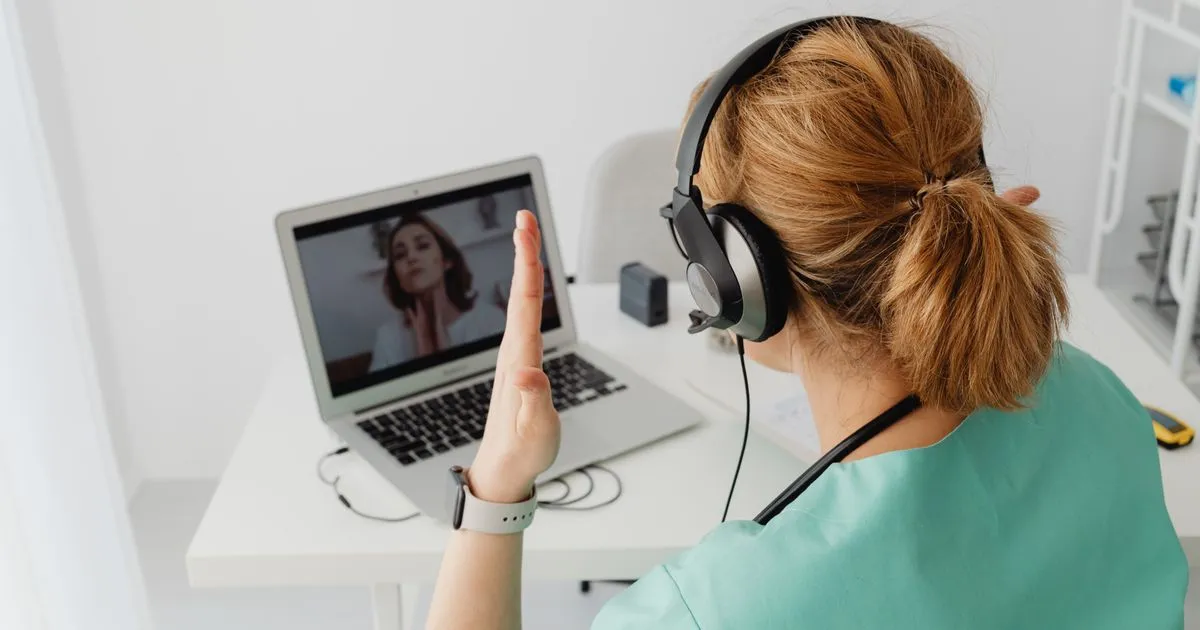
A headset and a laptop video call let a healthcare worker greet patients from any desk.
Picking assistant software is no longer about finding one clever app. It is about deciding which work goes to AI, which stays with a person, and who owns the systems both of them touch.
I'll carry one example through this guide: a five-person primary care practice hiring its first assistant. It already runs Google Workspace for email and calendar. It wants a shared Asana project for tasks and Calendly for bookings. And it handles patient information every single day.
So what will that practice find below? Four things:
- The six tool categories almost every assistant works in, and which one to buy first.
- Which front-desk jobs AI can take over today, and which still need a human voice on the line.
- The hourly cost of a managed assistant set against a receptionist's fully loaded cost, meaning salary plus benefits, payroll taxes and overhead.
- The HIPAA setup that makes remote work safe: an agreement signed with the company, an isolated Microsoft virtual desktop, encryption at rest and in transit, and copying, USB devices and printing switched off.
Why frame it this way? Because the tools are splitting into two layers. AI is moving into the inbox and the calendar, while human assistants increasingly work inside workspaces the client owns. That split decides where your practice's work history lives when an assistant moves on.
It also changes the first purchase. Start with the category your new hire will open on day one.
Virtual assistant tools are the apps a remote assistant uses to run your inbox, calendar, projects and customer conversations. In 2026 they matter because AI now sits inside almost every one of them. On Reddit, one primary care office worker said providers using an AI note-taking app reported saving enough time to give 5 to 10 more minutes to each patient conversation. The transcript, they added, is deleted once the provider signs the note.
That is the real promise of good tooling. Time goes back to people.
It's worth noting that the tools alone rarely deliver it. A tool stack is only as good as the playbook behind it. At HelpSquad, the most common onboarding problem is not software at all: it is thin or inconsistent training material from the practice, which an onboarding manager rebuilds through interviews, call shadowing and reviews.
In this guide I'll map each core assistant job to the tool that handles it, weigh where AI helps and where a human still has to check, compare the hourly cost of help against an in-house hire, and close with where this software is heading next, starting with the six tool categories almost every assistant needs.
Questions this article answers

Which virtual assistant tools do you actually need in 2026?
Most virtual assistants need six tool categories: a productivity suite, messaging and video, project management, scheduling, a CRM and a help desk. Pick one tool per job.
- Email, documents and files: Google Suite or Microsoft Office, whichever the business already runs.
- Messaging and video: Slack for team chat, Zoom for live calls and Loom for recorded walkthroughs.
- Project management: Asana or Trello, set up inside the business's own account.
- Scheduling: Calendly connected to the shared calendar.
- CRM and marketing: HubSpot for contacts, pipelines and follow-up.
- Customer support: a help desk such as Zendesk, Freshdesk or Gorgias.
Titilayo, a working virtual assistant who writes on Medium, lists almost the same common VA tech stack: Google Suite, Microsoft Office, Loom, Slack, Canva, HubSpot, Calendly, plus Notion, Trello or Asana for project tracking. Her advice to assistants is blunt: "Only include tools you've used or are actively learning!" I'd give business owners the same rule from the other side. Hire for the tools you already use.
The common assumption is that a bigger stack makes a more capable assistant. It doesn't. Why? Because every extra app adds a login, a permission set and one more place for a task to hide. A comparison of 5 sources, from VA tutorials to a help desk buyer's guide, shows the same small core repeating: a productivity suite, a project tool and a way to talk.
Who should own each tool?
Ownership matters more than brand. VA training material for Asana now gives each client its own project and adds the assistant to the client's account as a guest. Sadiq Umar's Trello tutorial describes the same pattern from the assistant's side: once a client adds a VA to their workspace, it appears directly below the VA's own workspace. Boards can be set to Workspace, Private or Public visibility.
In practice, that means the business creates the account. The assistant gets invited in. When the engagement ends, access is removed and the work history stays put.
Take a five-person primary care practice hiring its first assistant. It already runs Google Suite, so email, calendar and files are settled. It adds a shared Asana project for referrals and callbacks, Calendly for new-patient booking, and nothing else in week one. The tools cost far less than the person using them. At HelpSquad, we tell practices to budget about $12 an hour per assistant, so the stack should be chosen around the workflow that person will run.
Specialty matters too. A therapy practice leans harder on intake and scheduling than a dermatology clinic does, which is why our page on virtual assistants for therapists and psychiatric NPs starts from those two jobs. For the primary care practice, the next decision is narrower and more practical: Asana or Trello.
Can AI assistant software replace a human virtual assistant?
Not yet. AI software can answer calls and book appointments, but it still needs a person to check its output, handle sensitive conversations and protect patient data.
The replacement fear is real, and it is not abstract. In a thread on Reddit's r/receptionists, one poster described a clinic asking their mother to "help it learn": she spent weeks feeding an AI system her phone scripts and correcting its answers. The clinic then let her go, saying the AI could handle calls, scheduling and basic patient questions "for far cheaper." The poster added that they did not believe the tool was HIPAA compliant. That is the poster's opinion, not a verified finding. Still, it is the question every practice should ask first.
Other voices in the same thread pushed back. One commenter's practice uses AI only for writing consult letters. Another put it simply: "What isn't going away are virtual assistants and contact centers."
What does the research say about AI and human agents?
The research measures speed, not replacement, so ask any AI vendor which tasks its tool finishes alone and which it hands back to a person. A 2025 help desk vendor's roundup summarized NBER research from MIT and Stanford: support agents using a generative AI assistant resolved 14% more customer issues per hour, with gains of up to 34% for newer agents. The same 2025 roundup cited a Gartner prediction that agentic AI will resolve 80% of common customer service issues by 2029. Note the word common. The hard, emotional and unusual cases still land on a person.
Think of a car's GPS. It plans the route well, but somebody still has to notice the road is closed and decide what to do. AI tools work the same way inside an inbox or a phone queue.
A freelance platform's career guide frames the human role well: "AI isn't set-and-forget technology." It describes an emerging AI Operator or AI Manager role, where the assistant picks the tools, writes prompts, monitors accuracy and trains the client. In my view, that is the job most practices are actually hiring for in 2026.
How do you keep a remote assistant HIPAA compliant inside your EHR?
Here is where AI and human assistants share the same risk. Under HIPAA, a virtual assistant who handles protected health information becomes a business associate and can be held directly liable. Civil penalties run from $100 to $50,000 per violation, with annual maximums up to $1.5 million. Common slips are ordinary ones: a misaddressed email, a screen visible on a video call, files saved to a personal laptop.
Before any assistant, human or software, touches your EHR, check four things:
- A signed Business Associate Agreement is in place.
- Every user has a unique login with multi-factor authentication.
- Patient data stays in your systems, never on a personal device.
- Sessions are logged so you can see who accessed what.
A managed provider should be able to show you each of those controls on request, which is the standard our HIPAA-compliant healthcare BPO services are built around. Once compliance is settled, the remaining question for our primary care practice is money: what does that human layer cost per hour?
Which front-desk jobs can AI take over, and which still need a person?
When economists gave 5,179 customer support agents an AI assistant, the least experienced sped up by about a third. The most skilled barely changed. Why would the best people gain least?
The economists were Erik Brynjolfsson, who directs the Stanford Digital Economy Lab, and his coauthors Danielle Li and Lindsey Raymond. Their NBER study was published in The Quarterly Journal of Economics in 2025. The AI tool raised issues resolved per hour by 14% on average and by 34% for novice and low-skilled workers. The authors offer "suggestive evidence" that the AI "disseminates the best practices of more able workers." Customer sentiment improved, and more agents stayed in the job.
Customer support is close to a medical front desk, but it is a different job. Even so, the study is the most carefully measured case we found, and in it AI made people faster at work they still did themselves.
How much work can software take over completely? Gartner predicts that by 2029 agentic AI will resolve 80% of common customer service issues "without human intervention," a forecast relayed by a help desk software maker. Our Hue AI chatbot already handles up to 80% of general inquiries. Our agents take the rest, using an agent-assist tool that predicts what the customer wants and offers prepared replies.
Both figures carry a qualifier: common issues, general inquiries. For a medical practice, federal law helps define what makes up the rest.
HIPAA defines a business associate as anyone outside a practice's workforce who "creates, receives, maintains, or transmits protected health information" on the practice's behalf. HIPAA Certify, which sells compliance training to virtual assistants, lists ordinary front-desk work that involves such information: scheduling, answering phones, data entry into practice management software, patient voicemails. Business associates can be held directly liable. Even where the business did not know and could not reasonably have known about a violation, the penalty runs from $100 to $50,000 per violation, up to $1,500,000 a year for identical violations. The definition turns on what someone does with patient information. So any AI vendor whose software holds a practice's appointment book faces a fair question about whether the definition covers it.
People who build AI assistants have arrived at a working rule of their own. An engineer who built a personal assistant over a weekend let it infer intent on read-only requests but made it ask "before writing, sending, or deleting anything." The engineer's summary: "Ambiguity is fine for reading. Ambiguity is not fine for writing." The same engineer admits the assistant still sends its prompts to an outside AI company, and names the drawback of commercial tools in four words: "Your data lives somewhere else."
A Reddit post from August 2025 shows what can happen when nobody owns that question. The poster wrote that their mother, a clinic receptionist, spent weeks feeding an AI tool her phone scripts, and was then let go because the AI could do her duties "for far cheaper." The poster doubted the tool was HIPAA compliant. Nobody has verified that, and one post proves no pattern.
| Front-desk task | Software on its own? | Why |
|---|---|---|
| Answering general, routine questions | Largely, yes | Our chatbot already handles up to 80% of general inquiries |
| Looking up, summarizing, drafting a reply | Yes, with a person choosing what goes out | Reading is low risk; agent assist suggests and the agent decides |
| Booking, cancelling, sending, deleting | Confirm with a person first | The read-versus-write rule builders apply to their own assistants |
| Handling schedules, voicemails, records | Only under a Business Associate Agreement | HIPAA covers whoever handles patient information for the practice |
The safer setups keep patient information in one place. Virtual assistants usually join a client's own Asana or Trello workspace as guests. Samantha Kasbrick, a former virtual assistant who now teaches Asana, explains why: "When you're doing work for a client, you want to be looking at their stuff only." Our agents work the same way. They log into the practice's own EHR or practice management system, such as Epic, athenahealth or Dentrix, from an isolated virtual desktop with copying, USB devices and printing turned off. We sign the Business Associate Agreement as a company, never through individual agents, because the obligations fall on whoever hires, trains, supervises and controls access.
The evidence points to one dividing line at the front desk: answering on one side, acting on the other. Software can take most routine answering and make people quicker at the rest. Changing a booking, writing to a record or sending a message is where builders add a checkpoint and where federal liability applies. That work needs a named owner who works inside the practice's own systems.
- Sort a week of your front-desk calls and messages into two piles: questions answered, and actions taken on a patient's behalf.
- Ask every AI tool vendor that would hold your appointment book or voicemails whether it will sign a Business Associate Agreement, and where your patients' information is processed.
- Write a confirm-before-write rule: software may answer, look up and draft, but a named person approves anything that books, cancels, sends or deletes.
- Ask any staffing or answering service who signs the Business Associate Agreement, the company or each contractor, and whether staff work inside your own EHR or copy information out of it.
- If you add an agent-assist tool, judge it first by how quickly new staff reach full speed, where the NBER study found the biggest gains.
How we checked this
We used a peer-reviewed economics study, two sections of federal HIPAA regulations, a help desk software maker's summary of a Gartner forecast, a compliance training company's guide, an engineer's account of building an AI assistant, a tutorial from a former virtual assistant, a Reddit post, and our own figures from February 2026. The chatbot share, the agent-assist tool, the EHR list and our HIPAA safeguards are ours. The NBER study covered customer support agents, not medical front desks. The Gartner forecast reached us secondhand. The Reddit account is one person's unverified story. HIPAA Certify sells HIPAA training. We sell managed human assistants alongside an AI chatbot, so we have a stake in where this line falls. Still unknown: whether regulators treat a given AI front-desk vendor as a business associate, and what share of a typical practice's contacts are routine questions.
- Erik Brynjolfsson, Danielle Li and Lindsey R. Raymond, NBER working paper "Generative AI at Work", April 2023, revised November 2023; published in The Quarterly Journal of Economics, 2025.
- Giva, contact center automation trends, citing Gartner, September 2025, updated April 2026.
- eCFR, 45 CFR 160.103 HIPAA definitions, retrieved November 17, 2026.
- eCFR, 45 CFR 160.404 civil money penalty amounts, retrieved November 17, 2026.
- HIPAA Certify, guide on HIPAA training for virtual assistants, February 2026.
- Engineer's account on Medium, building a self-hosted AI assistant, January 2026.
- r/receptionists, post about a receptionist replaced by the AI she helped train, August 2025.
- Samantha Kasbrick, Asana setup tutorial for virtual assistants, June 2026.
- HelpSquad, internal figures on Hue AI, agent assist, EHR systems and HIPAA safeguards, February 2026.
How much does a virtual assistant cost per hour compared with an in-house receptionist?
A managed healthcare virtual assistant runs $11.00 to $12.00 an hour, billed only for hours worked. A full-time in-house receptionist costs a practice $55,000 to $70,000 a year.
Here are the numbers side by side, so you can see what each option actually bills for. HelpSquad bills by the hour and invoices monthly in arrears for hours actually worked. Our services start at $8 per hour, with full-time staffing at $8 to $13 an hour. For healthcare virtual assistants, our rates as of February 2026 are:
- $11.50 an hour per assistant for up to 3 assistants
- $11.00 an hour per assistant from 4 assistants
- $12.00 an hour for training and support
The in-house figure is our comparison baseline for a full-time medical receptionist: about $55,000 to $70,000 a year fully loaded, counting salary, benefits, payroll taxes and overhead. That works out to about $4,600 to $5,800 a month, whether the phones are busy or quiet.
| Option | How it is billed | Typical cost | Time to first live call |
|---|---|---|---|
| In-house medical receptionist | Salary plus benefits, taxes and overhead | About $55,000 to $70,000 a year | Depends on your hiring process |
| Managed healthcare VA (HelpSquad) | Hourly, invoiced monthly for hours worked | $11.00 to $11.50 an hour per assistant | About 14 days; as little as 4; up to 30 |
| Freelance VA on a marketplace | Hourly, set by each freelancer | $13 median listed on Upwork in 2026 | Depends on the freelancer |
The freelance row comes from a 2026 VA staffing firm's roundup, which cites Upwork listing a median VA rate of $13 with a typical range of $10 to $20. That rate buys the person. It does not buy HIPAA controls, supervision or backup coverage, so compare like with like.
How fast can a managed assistant start?
Our typical onboarding takes about 14 days from contract to the first live call. Simple overflow or after-hours coverage can go live in as little as 4 days. Complex multi-location builds with EHR or practice management access take up to 30 days.
So which number matters most? For our five-person primary care practice, I'd argue it is the billing model, not the rate. An hourly assistant scales with call volume. A salaried hire costs the same in a slow August as in a frantic January.
The rate also depends on scope. A practice that hands over phones, scheduling and referrals will use more hours than one that only outsources after-hours calls, so it helps to decide the task list first. Our guide on what to outsource in your medical practice walks through which front-office jobs move cleanly to a remote assistant and which are better kept in the building, starting with the phones that ring before the office opens.
What should your practice do next with its assistant tools?
Map every front-desk task to one owner, a tool or a person, before you buy anything, and keep the logins and records in accounts your practice controls.
Over the next two years, I expect assistant software to split into two layers. AI handles the inbox and the calendar. People work inside systems the practice owns. Why does ownership matter? Because when an assistant leaves, the work history should stay behind.
Go back to our five-person primary care practice. Its biggest risk is not which app it picks. It is thin or inconsistent training material, the most common onboarding problem we run into, and our onboarding manager closes that gap through interviews, call shadowing and reviews until the playbook is complete. During the first month, scripts and workflows are tuned on real calls, and staffing is adjusted to the practice's actual call and chat patterns. Every session runs on a unique login with multi-factor authentication.
So start with the playbook, not the software. Then book an intro call at helpsquad.com/contact or call 877-775-3667, and bring your call flows and holiday hours to that first conversation.
Frequently Asked Questions
What else do people ask about virtual assistant tools?
Most questions come down to three things: which AI app to pick, whether to build your own, and how quickly a human assistant can take live calls.
What is the best AI personal assistant app?
There isn't one winner. In a late 2025 Reddit thread on r/AI_Agents, the top reply compared ChatGPT, Motion, Saner, Reclaim, Akiflow and Mem, and noted that Reclaim covers only the calendar while Mem is a simple note-taker. The person who asked later said they had adopted saner.ai, calling it "good for managing my plans and keep me on track." Pick by the one job you need covered first.
Can I build my own AI assistant instead of paying for one?
Yes, if you are technical. An engineer writing on Medium in January 2026 described building a self-hosted assistant (one that runs on your own server) over a single weekend, using n8n, Telegram, ElevenLabs and the Google API. His key rule: read freely, but ask before writing, sending or deleting anything. He also admitted prompts still went to OpenAI, which is a dealbreaker for anything touching patient information.
How long does it take a managed assistant to go live?
It depends on how complex your workflows are. At HelpSquad, kickoff and discovery take 1 to 5 days and capture call flows, scheduling rules, FAQs, escalation paths and holiday coverage. Training materials and the knowledge system take about 3 more days. Then come mock calls.
Do your assistants speak more than one language?
Yes. HelpSquad provides bilingual agents across the US, Europe, Central America and South Africa, all working under the same HIPAA-compliant, fully managed setup.
How do I get started with HelpSquad?
Book an intro call at helpsquad.com/contact or call 877-775-3667. Bring your current call scripts, even rough ones.
Written by
Maria Rush
Marketing Team Lead, HelpSquad
Maria De Jesus-Rush is Marketing Team Lead at HelpSquad, a healthcare business process outsourcing company, with a background in content development, digital marketing, and project management.
Connect on LinkedIn
The Best VOIP Solutions to Enhance Virtual Assistant Communication
A rundown of RingCentral, Nextiva, Ooma and two more VOIP picks for virtual assistants, with pricing starting at $19.95 per user and honest pros and cons.

The Ultimate Guide to Hiring Virtual Assistants
Hiring help in-house means high attrition, big overhead, and slow staffing. This guide walks through using virtual assistants to fix all three.

Virtual Assistant Job Description: How to Write an Effective Posting That Attracts Top Talent
Finding the right virtual assistant starts with a clear and effective job description. A well-crafted posting communicates key duties, skills, and expectations, attracting top remote talent efficiently. This guide covers everything you need to write a virtual assistant job descri
Let's talk about what your practice actually needs.
A 30-minute call. No sales pressure. We'll tell you honestly whether we're a fit.