Medical Answering Service for After Hours Calls: What It Covers and What It Costs
A medical answering service for after-hours calls connects patients to trained agents who follow your documented escalation protocols. Urgent clinical issues go directly to the on-call physician. Routine requests go into a next-business-day callback queue.

Quick Answer
A medical answering service for after-hours calls connects patients to trained agents who follow your documented escalation protocols. Urgent clinical issues go directly to the on-call physician. Routine requests go into a next-business-day callback queue. Pricing runs from roughly $75 to $200 per month on flat-rate plans for small practices, or $0.75 to $2.00 per minute on usage-based plans. HIPAA compliance, including a signed Business Associate Agreement, is required before any service handles patient calls.
Every practice administrator I have spoken with can name the call they missed. A patient describing chest tightness at 11 p.m. who reached voicemail. A caregiver trying to reach the on-call doctor about a post-surgical complication and hanging up after the third ring. A prescription refill question left on a machine that no one reviewed until Monday morning. These are not edge cases. They are Tuesday nights.
The operational gap between office hours and the next morning is where patient retention is won or lost, and where clinical risk concentrates. Answering services for doctors offices have been around for decades, but the standard has changed. Patients today expect a live human voice, and they expect that voice to answer quickly. They also expect the person on the line to know the difference between "I will have someone call you first thing in the morning" and "please call 911 while I page the physician now."
That distinction, knowing when to escalate and when to route to a callback queue, is the whole job. And it is not easy. From my years handling high-volume medical inquiries at UnitedHealth Group (Optum), I learned that answering a medical call is never just taking a message. It is a series of fast decisions made with incomplete information, under pressure, at 2 a.m. The margin for error is narrow because the downstream consequences are not.
In this guide I will walk through what a professional after hours medical answering service covers, how to read a pricing proposal clearly, and what to insist on from any vendor before you sign a contract. Whether you are a solo physician tired of fielding your own calls after hours or a practice administrator managing coverage for a multi-physician group, the fundamentals are the same.
After-hours coverage is not a luxury. It is the infrastructure that keeps a practice functional, safe, and competitive when the front desk goes dark.
Medical practices that rely on voicemail after 5 p.m. miss a significant share of after-hours patient calls, and industry data on small-business call handling suggests that roughly 62 percent of small businesses miss calls on average, with healthcare practices facing comparable or higher exposure due to patient urgency. Research on patient communication behavior shows that most callers who reach voicemail after hours will not try again the next business day. I saw this pattern firsthand during my years at UnitedHealth Group (Optum), where I handled high-volume medical inquiries and watched the cost of a missed call ripple outward: a worried patient who called a competitor practice instead, a prescription question that escalated into a late-night ER visit, a scheduling gap that never got filled.
An after hours medical answering service is not a luxury add-on for large hospital systems. It is the infrastructure that keeps a practice running when the front desk goes dark. At HelpSquad, we have observed practices lose 3 to 5 patients per month directly traceable to unanswered after-hours calls, and that attrition compounds quietly over months before anyone connects it to call handling.
This guide covers what a medical answering service actually does during off-hours, how pricing works across the three most common billing models, and what separates a service that protects patients from one that simply takes messages and hopes for the best.
The Questions Physicians and Practice Managers Ask Most
- What does an after-hours answering service for medical offices actually do? Agents answer live calls, collect patient information, assess urgency using your documented protocols, and either page the on-call physician or queue a callback for the next business day.
- How much does a doctors answering service cost? Most small practices pay $75 to $200 per month on flat-rate plans. Per-minute billing typically runs $0.90 to $1.75 per minute of agent talk time, with significant variation based on what counts as a "billable minute."
- Is a medical answering service HIPAA compliant? A legitimate medical answering service will sign a Business Associate Agreement before handling any patient calls. Do not use a general call center that refuses or delays providing a BAA.
What Does an After-Hours Medical Answering Service Cover?
The surface description reads simply: a live agent answers every call, collects the patient's name and callback number, asks a few triage questions, and either pages the on-call physician or logs a callback request.
The reality is considerably more demanding, as of .
From my time at Optum, where our team fielded hundreds of member calls per shift, I learned quickly that answering a medical call is never just taking a message. The first question an agent asks sets the entire downstream chain in motion. Ask it wrong, frame it too broadly or too narrowly, and you either flood the on-call line with non-emergencies or miss something that needed a physician ten minutes ago. Practitioners on the r/FamilyMedicine subreddit describe exactly this problem: without documented escalation protocols, after-hours agents default to paging the doctor for everything, and the on-call physician stops trusting the service entirely. A professional after hours medical answering service covers the following service tiers:
Tier 1: Urgent Clinical Escalations
Symptoms that suggest a possible emergency, such as chest pain, difficulty breathing, severe allergic reactions, post-surgical complications, or sudden neurological changes, trigger an immediate page to the on-call physician or nurse practitioner. Response time targets for urgent escalations should be under 10 minutes. The agent does not independently assess clinical severity. The agent follows your documented protocol and routes the call accordingly. That distinction matters enormously for liability purposes.
Tier 2: Semi-Urgent Nurse Callbacks
Many practices designate a second tier for calls that need clinical guidance but not immediate physician contact. A patient with a moderate fever after a procedure, a question about medication side effects, or a concern about wound appearance may fall here. These are routed to a nurse callback queue with a response target of 30 to 60 minutes, depending on your documented protocol.
Tier 3: Routine After-Hours Requests
The largest share of after-hours call volume is routine: appointment requests, prescription refill questions (non-urgent), general office information, and referral inquiries. These go into a next-business-day callback queue. The patient gets confirmation their request was received and a clear expectation: "Someone from the office will call you between 8 and 9 a.m. tomorrow."
That confirmation, delivered by a live voice at 9 p.m., is the difference between a retained patient and one who calls a competitor practice before breakfast. Practices on Reddit's r/PrivatePracticeDocs report that small neurology outpatient clinics can accumulate 200 or more voicemails per day when relying on message-based systems, with medical assistants leaving over call volume and increasingly frustrated patients. Live after-hours coverage turns that flood into a managed queue.
Tier 4: Crisis Line Routing
For behavioral health and primary care practices, any call that hints at self-harm or harm to others requires a different protocol entirely: a warm transfer to a crisis line or immediate 911 coordination. A medical answering service without a documented behavioral health escalation path is a gap in the safety net, not a minor operational omission.
Tier 5: Pharmacy and Insurance Calls
Pharmacies call after hours for urgent prescription clarifications. Insurance companies occasionally contact practices about prior authorizations with time-sensitive windows. A trained answering service for physicians routes these appropriately rather than leaving a pharmacist on hold or generating an ambiguous message that reaches no one until morning.
Not every practice needs all five tiers at full configuration. A single-specialty orthopedic clinic has different escalation logic than a multi-specialty group practice or a behavioral health center. The service you choose should configure its protocol around your specialty, not hand you a generic script and send you live.
In my experience, the practices that get the most value from an answering service are the ones that spend 30 to 45 minutes mapping their escalation tree before going live. That upfront investment pays back on the very first night of operation.
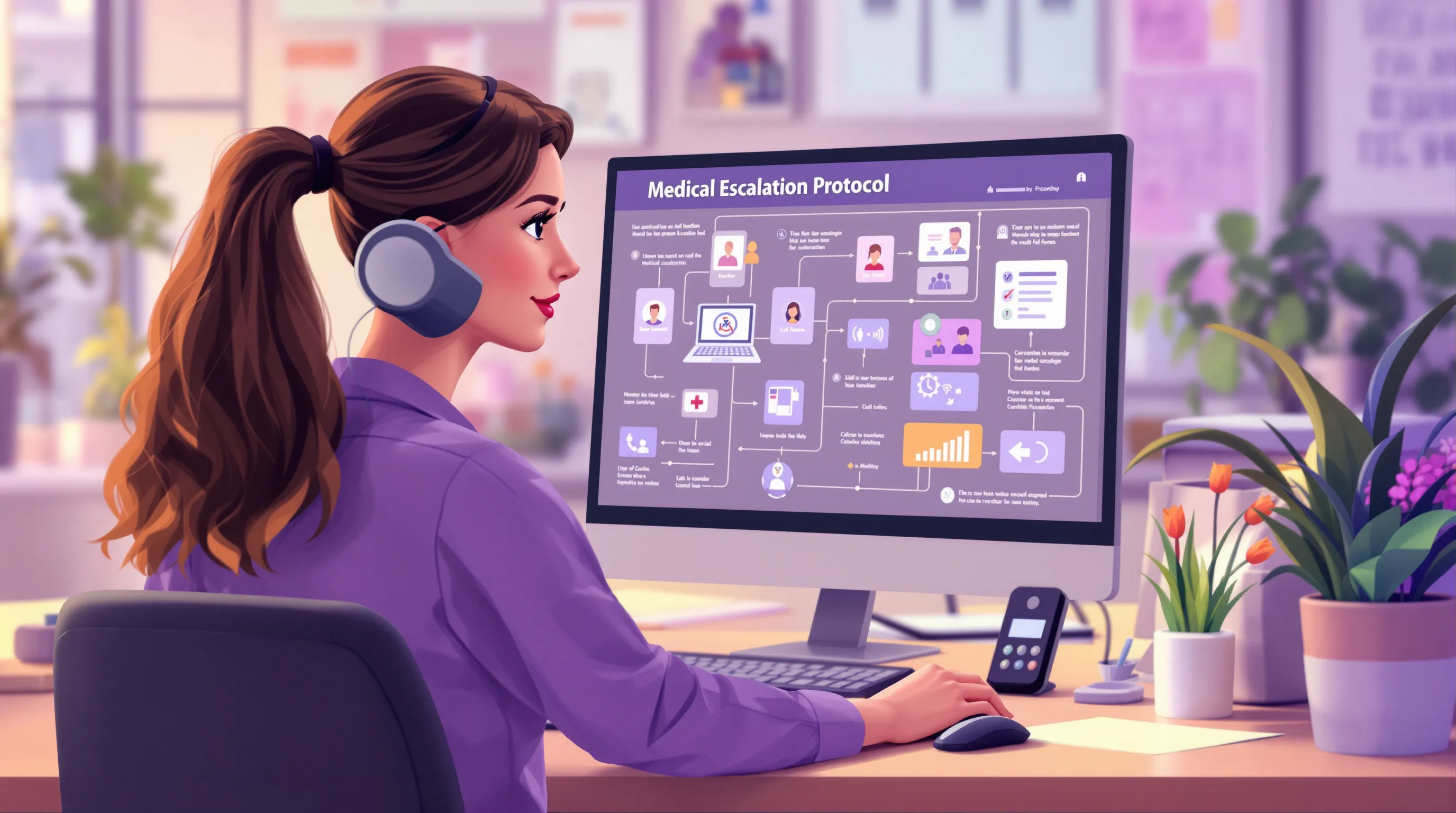
What Does an After-Hours Medical Answering Service Cost?
Pricing for medical answering services falls into three main models, and which one costs you less depends almost entirely on your call volume and average call duration.
Let me break down each model so you can read a vendor proposal with clear eyes.
Model 1: Flat Monthly Rate
Most small to mid-size practices pay a flat monthly fee that covers a set number of minutes or calls per billing period. Based on pricing data shared in small-practice forums and industry research, typical ranges by practice size look like this:
| Practice Size | Est. Monthly After-Hours Calls | Typical Flat Rate |
|---|---|---|
| Solo or 2-physician practice | 40 to 80 calls per month | $75 to $150 per month |
| 3 to 5 physician group | 80 to 200 calls per month | $150 to $300 per month |
| Multi-site or specialty group | 200 or more calls per month | Custom pricing |
Flat rate plans are easy to budget, but read the overage clause carefully. Most plans charge $1.25 to $2.50 per minute once you exceed your included minutes. A bad flu season or a community health event can push a solo practice into overage territory for two to three consecutive months.
Model 2: Per-Minute Billing
Per-minute billing charges only for actual agent time spent on your calls. Rates typically run $0.75 to $2.00 per minute, depending on service tier. Before you compare quotes, ask specifically what the "billable minute" includes, because that one definition changes your effective cost by 20 to 40 percent. Some vendors bill for ring time and after-call work in addition to talk time. Others bill for talk time only. Discussions in small-business and healthcare practice communities note this as the most common hidden-cost trap when switching answering service providers.
Per-minute billing tends to be cheaper for low-volume practices with short call durations. It becomes expensive for practices with complex escalation calls running 5 to 8 minutes each.
Model 3: Per-Call Billing
Some services charge a flat fee per call handled, typically $1.50 to $4.00 per call. This model works well if your calls are relatively uniform in length. It becomes unpredictable when your patient population tends toward longer, more complex triage conversations. Legal and professional service firms evaluating similar services report that per-call billing "works great until you get a complicated intake call that takes 12 minutes," in the words of one community thread contributor. The same dynamic applies in medical answering.
What the Quoted Price Often Does Not Include
Before comparing vendor quotes, confirm which of the following are included in the base price versus billed separately:
- HIPAA-compliant secure messaging platform
- Customized escalation protocol setup and future updates
- EHR message delivery (direct-to-inbox or portal note)
- Bilingual agent coverage
- Holiday and weekend premium rates
- Business Associate Agreement execution and maintenance
A service that quotes $89 per month but charges separately for protocol customization, secure messaging, and holiday coverage can land at $200 or more in actual monthly cost. Get the full-cost picture in writing before you sign.
How to Think About ROI
A single retained patient, one who called after hours, received a live response, and stayed with your practice instead of switching, typically represents $1,200 to $4,000 in annual revenue for a primary care or specialty practice. If your answering service costs $150 per month and retains even one patient per quarter who would otherwise have left, the return is decisive.
The harder number to measure is how many patients are quietly leaving because no one answered at 9 p.m. on a Tuesday. That compounding attrition is the real cost of voicemail-only coverage, and it rarely appears on any report until the practice starts asking why new patient volume has flattened.
From my work in QA and training at HelpSquad, the lowest-cost provider is rarely the lowest-risk provider. What you are really buying is the confidence that agents follow a tested protocol at 2 a.m. on a Saturday. That does not always show up in a pricing comparison, but it shows up unmistakably in the outcomes your patients experience.
How to Evaluate an Answering Service for Physicians: Six Questions That Matter
Once you have a shortlist of vendors, the conversation shifts from pricing to performance. These are the six questions I recommend every practice ask before signing a contract with an answering service for physicians or doctors offices.
1. Will You Sign a Business Associate Agreement Before We Go Live?
This is not negotiable. Any service that handles protected health information on behalf of a covered entity must sign a BAA. If a vendor hesitates, delays, or tells you a BAA is not necessary, walk away. The HIPAA liability exposure belongs to your practice, not the vendor. Request the signed BAA before the first call routes through their system, not after a month of service.
2. Can I See Your Escalation Protocol Documentation?
A professional medical answering service has a written escalation tree, not a loosely followed verbal tradition. Ask to see the actual document agents use on a call. It should specify exactly which symptoms trigger an urgent page, which symptoms route to a nurse callback queue, and which go into the next-day queue. It should also document response time targets for each escalation tier. If the vendor cannot produce this document in writing, that tells you what you need to know about how their agents actually operate at 2 a.m.
3. What Is Your Average Speed of Answer?
The industry standard for a medical answering service is an average speed of answer under 30 seconds. Ask for the vendor's reported average and, more importantly, ask for the percentage of calls answered within 20 seconds. A 28-second average can conceal a distribution where 15 percent of calls wait over 90 seconds. In a medical context, the tail of that distribution matters as much as the mean.
4. How Are Agents Trained on Medical Terminology and Your Specialty?
General call center agents are trained for consumer service interactions. Medical answering service agents need documented training in basic medical terminology, HIPAA handling procedures, and your specialty-specific escalation logic. Ask how long new agent training runs and whether there is a specialty-specific orientation before agents go live on your account. Discussions from private practice physicians confirm that agents without medical training context tend to either over-escalate everything or under-escalate based on patient tone rather than clinical content, both outcomes that damage the service relationship.
5. How Does the Service Deliver Messages Back to Our Team?
Some services still deliver messages by voicemail to the practice main line. That is not an acceptable standard today. Look for services that deliver messages through a HIPAA-secure portal, direct EHR inbox notation, or encrypted SMS. The message delivery method determines how quickly your on-call physician can act on a notification. A secure message delivered in under two minutes is operationally different from a voicemail reviewed at 7:45 a.m. the next morning, and the patient experience reflects that difference.
6. What Is Your Quality Assurance Process?
This question separates commodity answering services from professional clinic answering services. A strong QA process includes call recording, regular agent scoring against documented protocols, client review sessions, and a defined correction process for agent errors. Without QA, protocol drift is inevitable: agents gradually cut corners, skip triage questions, or default to easier routing decisions under pressure.
The goal of QA is not to catch bad agents. The goal is to maintain the standard that keeps patients safe and keeps doctors from being paged unnecessarily at midnight. Both outcomes depend on the same thing: agents who follow the protocol, every call, every time. If a vendor cannot describe their QA process in specific terms, the protocol they sold you is aspirational at best.
One practical test: ask the vendor to "secret shop" their own service by calling in with a test scenario. Experienced practitioners recommend this, and I have seen it reveal significant gaps between how a service is described and how it actually operates. If the vendor is reluctant to agree to that test, treat that reluctance as data.
HelpSquad's after-hours coverage for medical practices includes documented escalation protocols, HIPAA-secure message delivery, and a QA process built on direct experience with high-volume medical call handling. If you are evaluating options, that is a strong starting point for the comparison.
What Will Matter Most in After-Hours Medical Answering Over the Next 12 to 24 Months
Three trends are reshaping how doctors offices handle after-hours call management. Each has direct implications for how you evaluate a service today, not just next year.
AI-Assisted Triage Is Coming, but Human Judgment Stays Central
Some answering services have begun layering AI-assisted triage tools on top of live agent calls: systems that flag symptom keywords, surface relevant protocol steps, or suggest routing decisions in real time. Used correctly, these tools can reduce routine call handle time significantly and lower the rate of protocol errors by keeping agents on the documented decision path.
Used incorrectly, they create a false confidence that replaces human judgment instead of supporting it. Private practice physicians who tested AI phone services in 2024 reported that patients reacted poorly and many switched back to live agents, as one practitioner noted: patients "were pissed" and "hated it." The practices that benefit will be the ones that treat AI as an agent aid, not an agent substitute. A triage decision for a patient describing chest tightness at midnight still needs a trained human in the loop. That will remain true regardless of how capable AI tools become in a controlled environment.
Patient Expectations for Response Speed Are Rising
In 2022, a patient who left a voicemail after hours had a reasonable expectation of a next-morning callback. By 2025, that expectation has shifted. Patients who use consumer messaging apps, retail pharmacy chat platforms, and telehealth services expect responses within 60 to 90 minutes, even outside standard business hours. A doctors answering service that promises next-business-day callbacks for all non-urgent requests is already behind the curve in competitive markets.
Services that offer a two-hour callback window for semi-urgent requests, with a live confirmation at the time of the call, are becoming the new standard. This shift has real staffing and cost implications for answering services, and those costs will flow through to pricing structures over the next 24 months.
Multi-Language Coverage Is Becoming Both a Compliance and an Access Issue
For practices with significant non-English-speaking patient populations, an after-hours answering service that operates only in English is not a neutral operational choice. It is an access gap with regulatory implications for federally funded providers. Spanish-English bilingual coverage is a baseline expectation in many U.S. markets today. For practices serving Vietnamese, Mandarin, Haitian Creole, or other large community language groups, the vendor conversation needs to address language access explicitly before contract signing. Ask not just whether Spanish-speaking agents are available, but whether those agents are available consistently across all hours, including 2 a.m. on a holiday weekend.
EHR Integration Will Define the Leaders in This Space
The most operationally mature answering services are building direct EHR integrations that drop after-hours call notes into the patient record, flagged for physician review at the start of the next shift. This eliminates manual transcription, reduces the risk of a callback note getting buried in an email inbox, and creates a documentation trail that matters for liability management. When you are evaluating a clinic answering service today, EHR integration belongs on your requirements list alongside pricing and HIPAA compliance.
The practices that move first on these capabilities will not just handle after-hours calls more efficiently. They will deliver a patient experience that looks, feels, and functions like a modern care relationship rather than a 1990s answering machine.
The Bottom Line on After-Hours Medical Answering Services
An after hours medical answering service is not a line item to be minimized. It is a patient safety net, a retention tool, and a liability management system that runs while your staff is at home. Practices that treat after-hours coverage as optional discover the real cost of that decision gradually, one missed call at a time, over months, long before anyone makes the connection to call handling.
From what I have seen, both at Optum and at HelpSquad, the difference between a service that works and one that fails almost always comes down to two things: a documented escalation protocol and a QA process that enforces it consistently. Get those two elements right, and your answering service becomes one of the most defensible investments a practice can make. Get them wrong, and you have spent money on a liability that does not sleep.
The practices that win on patient retention are the ones that answer the phone at 9 p.m. on a Tuesday and make a worried patient feel heard before they pick up their phone and search for a different doctor. That is the standard. HelpSquad's after-hours medical answering coverage is built around it.
Written by
Maria Rush
Marketing Team Lead, HelpSquad
Maria De Jesus-Rush is Marketing Team Lead at HelpSquad, a healthcare business process outsourcing company, with a background in content development, digital marketing, and project management.
Connect on LinkedInFrequently Asked Questions
What is a medical answering service?
A medical answering service is a staffed call center that handles patient calls outside of normal office hours. Agents are trained in medical escalation protocols and HIPAA compliance. They route urgent clinical calls to the on-call physician and queue routine requests for next-business-day callbacks. The service operates under a Business Associate Agreement to ensure HIPAA-compliant handling of protected health information.
How is a medical answering service different from a regular answering service?
A general answering service takes messages and transfers calls. A medical answering service uses documented clinical escalation protocols, employs agents trained in HIPAA handling and basic medical terminology, and operates under a Business Associate Agreement. The distinction matters because a wrong routing decision on a medical call creates clinical and legal risk for the practice, not just a missed message.
What does an after-hours answering service for medical offices cost?
Most small practices pay between $75 and $200 per month on flat-rate plans. Per-minute billing runs $0.75 to $2.00 per minute. Final cost depends on call volume, average call duration, and which features such as bilingual coverage, EHR integration, and HIPAA-secure messaging are included versus billed separately. Always request the full-cost breakdown, including overage rates and holiday premiums, before signing a contract.
Is an after-hours medical answering service HIPAA compliant?
A legitimate service will sign a Business Associate Agreement before handling any patient calls, operate on HIPAA-compliant infrastructure, and train agents in minimum necessary access principles. Request the signed BAA before going live, not after the first billing cycle. Any vendor who tells you a BAA is not necessary should be disqualified from consideration.
What happens if a patient calls with a true emergency?
The agent immediately follows your documented emergency escalation protocol: paging the on-call physician with urgent priority. If the patient describes symptoms suggesting imminent danger, such as chest pain, severe difficulty breathing, or a suspected stroke, the agent directs the patient to call 911 simultaneously while the physician page is in progress. The agent does not assess clinical severity independently.
Can an answering service for physicians integrate with our EHR?
Some services offer direct EHR integrations that drop after-hours call notes into the patient record, flagged for physician review at the start of the next shift. This feature eliminates manual transcription, creates a documentation trail for liability purposes, and ensures no callback request gets lost in a shared email inbox. Ask about EHR integration early in your vendor evaluation, before you finalize pricing.
How do I know if my answering service is actually following the protocol I gave them?
Ask for monthly call recording samples, agent scoring reports against your documented protocol, and a QA review process that includes your practice. Better yet, conduct a secret-shop test: call your own after-hours line with a scripted scenario and evaluate how the agent handles it. This is the most reliable way to verify that the service you are paying for is the service your patients are actually receiving.

How to Get Physician Partners to Approve Outsourcing
The short answer: To get physician partners to approve outsourcing, address their three primary objections before they voice them: compliance risk, financial opacity, and staff disruption.

Healthcare Front Desk Outsourcing: Which Tasks Transfer and Which Do Not
Three things practices believe. Myth or fact? Call each one, then see how other readers called it.

What to Do When Medicare Advantage Plans Overturn Your SNF Prior-Auth Denials on Appeal but Slow-Walk the Initial Determination
Three things SNF appeal teams believe. Myth or fact? Call each one, then see how other readers called it.
Let's talk about what your practice actually needs.
A 30-minute call. No sales pressure. We'll tell you honestly whether we're a fit.