Medical Record Abstraction: What a Virtual Assistant Can Do

Key Points
- A non-clinical virtual assistant can safely abstract demographics, medications, allergies, immunizations, problem lists, imaging dates, referrals, and consents without a clinical license.
- CMS plans to audit every eligible Medicare Advantage contract, roughly 550 a year, with up to 200 records per plan, which makes accurate chart data a compliance issue.
- Abstractors in an Annals of Family Medicine study reached 94.3% agreement against a 95% standard by following standardized protocols, the same foundation that makes delegation safe.
Quick Answer
A trained, non-clinical virtual assistant can safely perform medical record abstraction for the most common administrative use cases: pulling demographics, insurance details, current medications, allergies, immunizations, problem lists, imaging dates, referral history, and signed consent records from existing patient charts. No clinical license is required for this data extraction work when it follows a standardized protocol and HIPAA minimum necessary guidelines. Where clinical judgment enters the picture, such as reconciling conflicting diagnoses or completing credentialed registry submissions, a qualified reviewer must step in.
Medical record abstraction sits at the center of three colliding pressures in healthcare right now: CMS announced in May 2025 that it would audit every eligible Medicare Advantage contract, roughly 550 a year instead of about 60, and expand record samples to as many as 200 per plan; the Bureau of Labor Statistics projects about 14,000 openings a year for medical records specialists at a median salary of $51,140; and a study in the Annals of Family Medicine held abstractors to a 95% agreement standard and reached 94.3% with standardized protocols. The workforce math does not work if you rely on in-house hiring alone. Virtual assistants, trained and operating under documented SOPs, are already filling the gap.
Before HelpSquad, I worked billing, claims, and coverage verification for UnitedHealthcare. My team confirmed policies and worked claims all day, and the lesson I carried out of that job is that a claim is only as good as the chart behind it. When one documented allergy or prior diagnosis never makes it into the record, the error does not stay put. It changes what the provider sees at the next visit, and it changes what gets billed and whether the claim holds up. Abstraction deserves the same care as billing work, even though it is a different job. A coder interprets a clinical encounter and assigns billable codes. An abstractor extracts data that already exists in the chart and transfers it accurately to a new location. When done by a trained virtual assistant under a structured protocol, that extraction work is safe, reliable, and fully delegable without a clinical license.
What follows is a practical breakdown of what abstraction is, where it delivers the most value, what a non-clinical virtual assistant can and cannot do, and how to build the compliance framework that makes delegation safe.
What Will Shape Chart Abstraction in the Next 12 to 24 Months?
Three regulatory and workforce forces are converging that will reshape how practices think about chart abstraction between now and late 2027. Understanding them now lets you prepare before the pressure arrives.
The CMS Medicare Advantage Audit Expansion
The May 2025 CMS announcement is the most immediate driver. Auditing all 550 Medicare Advantage contracts annually, with record samples up to 200 per plan, means that payer organizations are operating under a level of documentation scrutiny they have not faced before. From a practice standpoint, this translates directly into more frequent record requests, more detailed prior authorization reviews, and higher standards for chart completeness. Practices that maintain clean, systematically abstracted data will move through audit cycles faster and with fewer claims issues than those relying on inconsistently documented charts.
NCQA's Shift from HEDIS Hybrid to ECDS
NCQA is retiring its HEDIS hybrid measures, which combined administrative claims data with manual chart review, in favor of Electronic Clinical Data Systems (ECDS). ECDS relies on structured electronic data rather than manually abstracted samples. This shift does not eliminate the need for abstraction. It changes where abstraction happens. Practices will need to ensure that structured data is being entered accurately and consistently into EHR fields from the point of encounter forward, rather than relying on retroactive hybrid abstraction to fill gaps. Virtual assistants maintaining accurate problem lists, medication records, immunization histories, and referral tracking are contributing directly to ECDS readiness.
The Health Information Technology Workforce Gap
The Bureau of Labor Statistics projects about 14,000 openings a year for medical records specialists, at a median salary of $51,140 as of May 2025. Most of those openings come from people retiring or moving into other work, so practices compete for the same pool of experienced records staff year after year, while the CMS and NCQA changes above push documentation demand up.
This workforce gap is exactly the environment in which well-structured outsourcing makes strategic sense. Non-clinical virtual assistants performing structured data extraction work do not need to fill those credentialed roles. They handle the portion of abstraction that does not require certification, freeing the limited credentialed workforce for the tasks that genuinely require it. This is not a workaround. It is the correct allocation of a constrained resource.
AI-Assisted Abstraction Is a Tool, Not a Replacement
AI tools are entering the abstraction workflow. A senior quality data abstractor writing on KevinMD in 2026 described cutting per-case time by about 30 minutes using an AI-assisted platform, while retaining final say on every entry. The AI presented snippets showing exactly where in the chart each piece of information was found, reducing manual search time. The abstractor reviewed and confirmed or corrected each response. This human-in-the-loop model is where the practical AI use in chart abstraction sits today, and it is likely where it remains through the next 24 months as platforms mature.
The lesson for practices is that AI tools will enhance the productivity of trained human abstractors, but they do not eliminate the need for trained people. The combination of a skilled virtual assistant and an AI-assisted platform is a stronger model than either alone.
What Practices Ask Most About Chart Abstraction and Virtual Assistants
- What data fields can a non-clinical virtual assistant safely extract from a patient chart? Demographics, insurance details, medication lists, allergies, immunizations, problem lists, imaging study dates, referrals, and consent records are all within scope without requiring a clinical license.
- How does medical record abstraction differ from medical coding? Coding assigns new billable codes to a patient encounter. Abstraction extracts structured data that already exists in the chart and moves it into a new system or form, with no new clinical judgment applied.
- Does outsourcing chart abstraction create HIPAA risk? Not when done correctly. HIPAA's minimum necessary rule governs what data is accessed, and a business associate agreement (BAA) with your vendor is required before any PHI is shared.
What Is Medical Record Abstraction (and How Is It Different from Coding and Scribing)?
Medical record abstraction is, at its core, a data extraction task. A researcher at NIH defines it clearly: abstraction is "a process in which a human manually searches through an electronic or paper medical record to identify data required for secondary use." You read the chart. You locate the specific fields you need. You transfer them accurately into a new system or form. No new clinical judgment is applied. No new codes are assigned.
That last distinction matters enormously. Coding and abstraction are often confused, but they serve completely different functions. Coding takes a clinical encounter and assigns billable ICD-10 or CPT codes that drive reimbursement. It requires interpretation of what happened during the visit. Abstraction, by contrast, works from information that already exists in the chart and simply moves it somewhere else. The abstractor is a careful reader and accurate transcriber, not a clinical decision-maker.
Scribing is the third function people mix up with abstraction. A medical scribe documents a live clinical encounter in real time, typically inside the exam room or on a remote audio connection with the provider. Scribing is prospective. Abstraction is retrospective. The scribe works while the encounter happens. The abstractor works from a completed chart that may be months or years old.
Understanding these distinctions tells you exactly where the credentialing line falls. Scribing requires training in live documentation. Coding requires certification in clinical classification systems. Abstraction of structured, non-clinical data fields requires thorough training, a solid SOP, and careful attention to detail, but it does not require a clinical license for most standard use cases.
The 5 Clinical Settings Where Chart Abstraction Outsourcing Delivers the Most Value
Chart abstraction demand concentrates in five recurring scenarios. Each one stretches in-house capacity in a predictable way.
1. EHR migrations. When a practice changes platforms, every active patient's structured data needs to move. Demographics, insurance, medications, allergies, immunizations, problem lists, and consent records all require manual extraction and verification. This is high-volume, time-sensitive work with zero tolerance for error. A virtual assistant team working in parallel, guided by a field-by-field SOP, is the most practical way to scale this without pulling clinical staff off patient care.
2. New patient intake from prior records. A new patient sends a 200-page fax compiled from three previous providers. Someone on your team needs to build a structured summary before the first appointment: current medications, known allergies, active problem list, recent imaging, referral history, signed consents. Delegating it to a trained virtual assistant frees your front desk and clinical staff for patient-facing tasks.
3. Registry and quality reporting. NCQA HEDIS measures, Joint Commission core measures, and disease-specific registries all require structured data pulled from the chart. NCQA is currently retiring its HEDIS hybrid measures in favor of Electronic Clinical Data Systems (ECDS), which shifts more of the data-collection burden toward what is already documented in the EHR. A virtual assistant can extract the non-clinical fields required for registry submissions; credentialed reviewers handle quality measure determination.
4. Payer record requests. Medicare Advantage plans and commercial payers regularly request medical records to support prior authorization, claims review, or audit. A trained virtual assistant can compile and organize the chart segments requested, flag the relevant sections, and prepare the response package, while your biller handles the actual claim defense.
5. Pre-visit chart preparation. Before a complex chronic care visit, a virtual assistant can pull and organize the patient's most recent labs, current medication list, outstanding referrals, and imaging history, placing a clean summary in the chart for the provider to review. It saves the provider from hunting through the chart and reduces the risk of missing a critical data point.
What a Non-Clinical Virtual Assistant Can and Cannot Abstract
This is the most important boundary to establish before you delegate any chart work. The role boundary is clear. It is not ambiguous. And drawing it correctly protects both your patients and your practice.
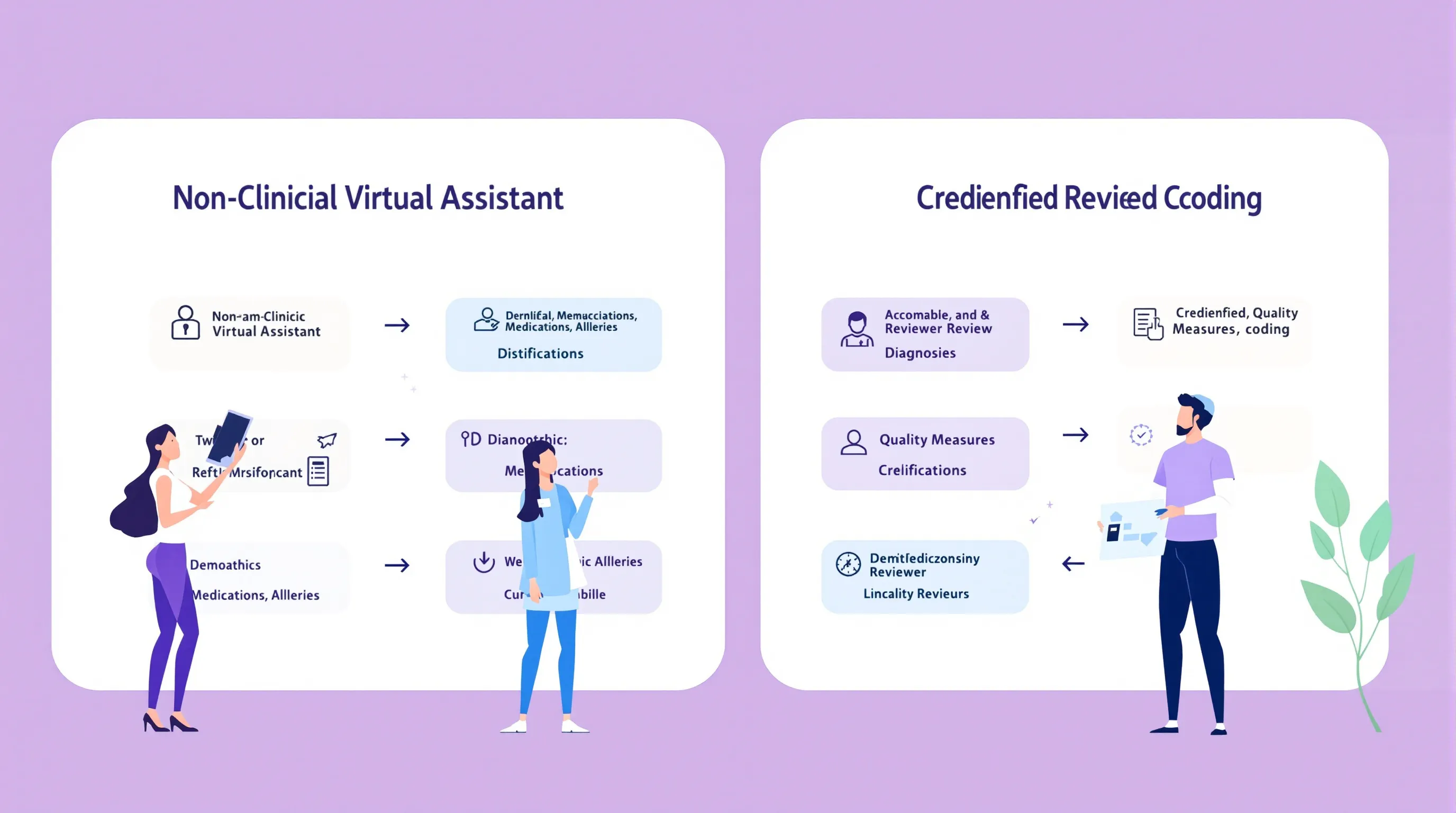
Entering what you see in the chart is one job. Applying cancer registry rules to that data is another. That distinction defines the line between what a non-clinical virtual assistant can safely do and what requires a credentialed reviewer.
| A Non-Clinical Virtual Assistant Can Abstract | Requires a Credentialed Reviewer (RHIT, CTR, or Clinical Staff) |
|---|---|
| Patient demographics (name, date of birth, address, contact information) | Reconciling conflicting diagnoses across providers |
| Insurance and payer information | Determining primary versus secondary diagnosis |
| Current and historical medication lists | Assigning HEDIS or Joint Commission quality measure status |
| Allergy list (as documented in the chart) | Cancer registry abstraction (CTR or ODS certification required) |
| Immunization records and dates | ICD-10 or CPT code assignment |
| Problem list (diagnoses as documented by the treating provider) | Clinical interpretation of abnormal lab values or imaging findings |
| Imaging study dates and order history | Prior authorization clinical justification narratives |
| Referral and consultation history | Any task requiring a licensed clinical opinion |
| Signed consent records and authorization forms | |
| Hospitalization and surgical history dates |
The strictest credentialing requirements sit in oncology and cancer registry work. For the administrative abstraction tasks most practices need on a daily basis, a trained non-clinical virtual assistant is the right fit.
How to Build a Compliant Chart Abstraction SOP
Accurate abstraction is not a talent. It is a system. A study in the Annals of Family Medicine set 95% agreement between abstractors as its quality bar and reached 94.3% using standardized protocols. An NIH-funded pediatric research network trained abstractors at thirty sites to an error rate no higher than 4.93%. The system is what produces consistency, not individual judgment.
This is the part of the work I know best. Building QA rubrics and training checklists taught me that you can hand detailed work to someone new safely only when the standard is written down before they start. The checklist tells a virtual assistant exactly which fields to pull and where to find them. The rubric tells both of you what a correct chart looks like. With those two documents in place, delegating non-clinical chart extraction becomes a managed process instead of a leap of faith, and you can see within the first few batches whether someone is ready to work on their own.
Here is how I would structure a compliant SOP for a virtual assistant team performing chart abstraction:
- Define the field list. Specify exactly which data elements the virtual assistant is authorized to extract. No more, no less. This satisfies HIPAA's minimum necessary rule, which requires that access to PHI be limited to what is required for the specific purpose.
- Sign a business associate agreement (BAA) before sharing any PHI. This is not optional. Any vendor handling protected health information on your behalf must have a signed BAA in place.
- Provide field-by-field extraction guidance. A good SOP maps each data element to the specific location in the chart where it is typically found, and defines what to do when that field is missing or inconsistently documented.
- Build in QA sampling. Score a sample of completed abstractions against a written rubric, field by field. I recommend reviewing 10% of completed charts weekly during onboarding and 5% monthly once the team is established. This is where you catch documentation drift before it becomes a pattern.
- Conduct inter-rater reliability checks. Periodically have two abstractors pull the same chart independently and compare results. Discrepancies surface both training gaps and ambiguous SOP language.
- Maintain an audit trail. Every access to a patient chart should be logged with the user, timestamp, and purpose. This is both a HIPAA requirement and your first line of defense in an audit.
The investment in building this system upfront pays for itself the first time you catch a discrepancy before it reaches a payer or registry submission.
What the CMS Audit Expansion Means for Your Chart Abstraction Process
On May 21, 2025, CMS announced a significant expansion of its Medicare Advantage audit program.
CMS plans to audit every eligible Medicare Advantage contract, roughly 550 a year, up from approximately 60 audits per year previously. The agency is expanding record samples from about 35 records per plan to as many as 200, and growing its team of medical coders from 40 to approximately 2,000. One caveat: in September 2025 a federal court in Texas vacated part of the CMS rule governing how these audits are scored, and CMS has appealed. The expansion is still moving, but how audit findings translate into payment recovery is not settled.
What does this mean for a practice that sees Medicare Advantage patients? It means the payers you work with are now under more scrutiny than they have ever been. And payers under scrutiny pass that scrutiny downstream. Expect more frequent record requests. Expect more detailed documentation reviews. Expect the quality of your chart data to become a direct factor in how your claims are processed and how quickly prior authorizations are resolved.
Payer utilization management teams are already using AI-assisted tools to summarize medical records and identify whether clinical criteria for authorization have been met. These tools can pull the points relevant to review criteria out of a long record and answer specific guideline questions such as "Has the patient tried conservative therapy for six weeks?" by analyzing the chart documentation. If the answer is not clearly documented and findable in your chart, the authorization request faces a harder road.
Clean, well-organized, accurately abstracted chart data is no longer just a quality improvement nicety. It is a direct protection against audit exposure and authorization denials. Practices that invest in systematic chart abstraction, using virtual assistants to maintain accurate structured data across active patient records, are better positioned in this environment than those relying on ad hoc chart updates.
How HelpSquad Virtual Assistants Support Chart Abstraction Work
At HelpSquad, our virtual assistants support healthcare practices with the non-clinical data extraction work described throughout this article. Our medical virtual assistant teams are available from $8 per hour for full-time staffing, operating under HIPAA-compliant BAAs with US-based management and structured QA oversight.
The tasks we support include EHR migration data abstraction, new patient chart review and intake summarization, payer record request compilation, and pre-visit chart preparation. Every engagement begins with a scoped field list that defines exactly what the virtual assistant is authorized to extract, consistent with HIPAA minimum necessary principles.
Our onboarding process includes field-by-field training on your specific EHR platform, QA sampling during the first 30 days, and regular inter-rater reliability reviews to maintain accuracy. It is the same approach I take with any QA rubric or training checklist: start with a precise definition of the task, train to the standard, measure against it, and correct early.
If you are managing an EHR migration, clearing a backlog of new patient fax reviews, or trying to keep up with registry data requirements, our healthcare outsourcing team can deploy within two weeks. The abstraction work that is straining your in-house staff today is exactly the kind of structured, repeatable work a trained virtual assistant can handle, so your clinical team can stay focused on patients.
The Bottom Line on Chart Abstraction and Virtual Assistants
Medical record abstraction is structured, repeatable, non-clinical work. That description is important, because it tells you exactly who should be doing it. A trained virtual assistant working from a precise SOP can safely extract demographics, insurance, medications, allergies, immunizations, problem lists, imaging dates, referrals, and consent records from existing charts. Clinical interpretation, quality measure assignment, and credentialed registry work belong with qualified reviewers. The line is clear.
The external environment is making this work more urgent, not less. CMS is auditing more Medicare Advantage plans, reviewing more records, and scrutinizing chart documentation at a scale the industry has not seen before. NCQA is shifting quality measurement toward structured EHR data. The health information technology workforce cannot meet the demand through traditional hiring. These are not temporary pressures. They are structural changes that reward practices with clean, systematically abstracted chart data.
Between working claims at UnitedHealthcare and building QA rubrics and training checklists since, I keep landing on the same conclusion: the practices that manage abstraction proactively, with trained people, documented processes, and regular QA, are the ones that move through record requests, registry submissions, and payer reviews with the least friction. Start with the field list. Sign the BAA. Build the SOP. The rest follows from that foundation.
Written by
Maria Rush
Marketing Team Lead, HelpSquad
Maria De Jesus-Rush is Marketing Team Lead at HelpSquad, a healthcare business process outsourcing company, with a background in content development, digital marketing, and project management.
Connect on LinkedInFrequently Asked Questions
Common Questions
Does a virtual assistant performing chart abstraction need to be HIPAA certified?
There is no single "HIPAA certification" required by law. What is required is that the virtual assistant receives HIPAA privacy training, operates under a signed business associate agreement (BAA) between your practice and their employer, and is restricted to accessing only the PHI needed for the specific abstraction task (the minimum necessary rule). Certification programs for health information management are relevant for credentialed registry and coding work, not for standard non-clinical data extraction.
What EHR systems can a virtual assistant work in for chart abstraction?
Experienced virtual assistants can navigate the major EHR platforms used in outpatient practice, including Epic, Athena, eClinicalWorks, Cerner, and Kareo, among others. Role-based access can be configured to provide read-only or limited write access to the specific modules the abstraction task requires, without granting full chart access.
Can a virtual assistant abstract records for cancer registry reporting?
No. Cancer registry abstraction requires a Certified Tumor Registrar (CTR) or Oncology Data Specialist (ODS) credential. This is a specific credentialing requirement tied to the application of cancer registry rules, staging systems (such as AJCC), and case-finding protocols. A non-clinical virtual assistant cannot perform this work. They can, however, support adjacent tasks such as pulling imaging dates, treatment history documentation, and demographic data for a credentialed reviewer to work from.
How long does it take to abstract a typical patient chart?
It depends on how many prior records arrive and how complex the patient's history is. A thick fax packet from several providers takes far longer than a migration record with clean existing data. Time your first batch of charts and use it as the baseline for calculating the virtual assistant hours a project needs.
What happens if the virtual assistant encounters missing or conflicting data during abstraction?
A well-written SOP specifies exactly what to do. Common approaches: flag the field as missing and document the source pages reviewed; leave the field blank and route the chart for clinical review; or note a discrepancy and escalate to a supervisor. The key is that the SOP defines the decision tree in advance, so the virtual assistant is never making an undocumented judgment call about how to handle a data gap.
Is AI-powered chart abstraction replacing human abstractors?
Not yet, and not in the near term. Current AI-assisted platforms work best as a productivity tool for trained human abstractors, surfacing where in the chart each data point is located and reducing manual search time. The abstractor reviews the AI's response and makes the final entry. This human-in-the-loop model is the current standard of practice, and it is consistent with what HIPAA and payer auditors expect: a person is accountable for what goes into the record.
Physician Virtual Assistant: Cutting Charting and Inbox Time
A physician virtual assistant takes charting, the EHR inbox, prior auth, and scheduling off a doctor's plate so licensed time goes to patients, not paperwork.

Remote Medical Scribe: Roles, Benefits, and Best Practices
A remote medical scribe documents visits in the EHR live, drafts notes during telehealth, and flags gaps so healthcare clinicians can focus on the patient.
Is an Offshore Virtual Assistant HIPAA Compliant?
Myth vs. Fact: Offshore Virtual Assistants and HIPAA Compliance Call each one, then see how other readers called it.
Let's talk about what your practice actually needs.
A 30-minute call. No sales pressure. We'll tell you honestly whether we're a fit.