Outsourcing Patient Phone Calls: Cut Clinic Workload
Routing scheduling, reminders, and billing calls to a HIPAA-trained team cuts front-desk call burden by 60 to 90 percent. See which calls to outsource and how.

Outsourcing patient phone calls refers to routing inbound scheduling, reminders, billing inquiries, and after-hours requests to a HIPAA-trained external team, so your clinical staff can focus on direct patient care instead of managing a phone queue.
With oral GLP-1 therapy prescriptions surging across primary care and endocrinology practices, patient call volume is climbing faster than in-house staffing can keep up. Every unanswered call is a missed appointment. According to Hello Rache's analysis of ambulatory practice management, poor scheduling and slow phone response are among the top operational gaps that silently reduce both revenue and patient satisfaction.
The answer is structural. An outsourced call team with a signed Business Associate Agreement, Epic or Athena scheduling access, and documented intake protocols absorbs the volume. Your front desk handles patients face-to-face.
Outsourcing patient phone calls is a method for reducing front-desk call burden by routing inbound scheduling, reminders, and billing inquiries to a trained external team operating under a signed HIPAA Business Associate Agreement.
The core argument in this article is practical, not theoretical: most small healthcare practices in 2026 are dealing with call volume that two or three front-desk staff cannot sustainably absorb. The reasons are structural, physician attrition, patient population growth, and a coverage environment that generates more billing verification calls than it did three years ago. According to the Healthcare Financial Management Association, ACA marketplace premium increases have driven a measurable rise in coverage-related patient calls at affected practices, adding a new category of inbound volume on top of already strained scheduling queues.
Practice management analysis consistently confirms what clinic staff already experience firsthand. Poor patient scheduling and slow phone response are among the most common operational gaps that reduce both appointment volume and patient satisfaction. When call handling falls behind, every downstream metric follows.
This article covers four things. First, which call types can safely be handled outside your clinic and which must stay with clinical staff. Second, how outsourcing actually reduces front-desk workload in measurable terms. Third, what HIPAA compliance looks like in practice for outsourced call teams. Fourth, how HelpSquad integrates with Epic, Athena Health, and eClinicalWorks so the scheduling handoff works without gaps.
The short answer, before any of that: if your front desk is spending more than two hours a day managing scheduling callbacks, outsourcing is worth a serious look.
HelpSquad handles 416,000 patient interactions every month, 149,000 phone calls and 267,000 live chats, across 124 healthcare practices. That number exists because one or two medical assistants at a small clinic cannot sustainably absorb modern patient call volume. The problem is structural, not a staffing gap you can solve by hiring one more MA.
The short answer: Outsourcing patient phone calls means routing inbound scheduling, appointment reminders, billing inquiries, and after-hours calls to a trained external team. Done right, it reduces front-desk call burden by 60 to 90 percent while keeping HIPAA-compliant human agents in the conversation with your patients, as of .
Why Are Clinic Phone Lines Overloaded in 2026?
Patient call volume at small and mid-size practices is higher than it has ever been, and the causes go well beyond staffing math.
I want to be clear about something upfront. The loudest explanation for call overload, "you just need more staff", misidentifies the real problem. An analysis of practitioner accounts, market data, and operational benchmarks shows that front desks are not simply understaffed. They are structurally overburdened because the same one or two people are expected to handle scheduling, clinical triage, billing inquiries, pre-visit forms, in-person intake, and post-visit follow-up simultaneously. Adding a third MA to that same role consolidation moves the problem rather than solving it.
Three forces are making this worse in 2026. The first is insurance instability. According to the Healthcare Financial Management Association, ACA marketplace enrollment fell from 22.1 million at the end of 2025 to approximately 19.2 million in February 2026, a drop of nearly 13 percent. Premiums rose by an average of 58 percent after enhanced subsidies expired. When patients lose coverage, downgrade plans, or face unexpected out-of-pocket costs, they call their clinic first. Billing and eligibility inquiry calls spike immediately.
The second force is physician attrition. Practice headcount is shrinking in many specialties through retirement and consolidation, while patient panels are not. One neurology outpatient practice I am familiar with lost two of its five physicians to retirement in 2025. The clinic's voicemail boxes were receiving over 200 messages per day within months. Two trained medical assistants resigned in the following six months, citing the call volume specifically. The remaining staff absorbed a volume problem that had now become a retention problem.
The third force is patient volume growth at the specialty level. According to Hello Rache's analysis citing the Review of Optometric Business, by 2030 an estimated 53,000 full-time-equivalent optometrists will each manage approximately 2,400 patient encounters per year, equivalent to 127 million optometry visits annually. That projection is not unique to optometry. Primary care, ENT, neurology, and dental practices are all seeing similar demand increases without proportional staffing growth to match.
The result is a recognizable pattern. Phone calls go unanswered. Voicemail queues back up. Patients call again to check on messages they already left. Staff who are trying to manage in-person patients cannot step away to answer the phone. The queue grows longer. Frustrated patients escalate or simply leave for another provider. It's worth noting that one practitioner observed exactly this cycle: being behind on messages due to understaffing likely makes the volume worse, because patients keep calling back about the same unresolved issue.
The conventional fix, hire another MA, does not address the underlying structure. What it does is add one more person to the same role-consolidation problem, at a fully-loaded cost (salary, benefits, payroll taxes, training, and eventual replacement) that most small practices cannot justify at current patient reimbursement rates.
Outsourcing patient phone calls addresses the structural issue by separating tasks that do not require in-person presence from tasks that do. That separation is KEY. It is not about removing human contact from patient communication. It is about routing the right calls to the right team, so neither team is overwhelmed.
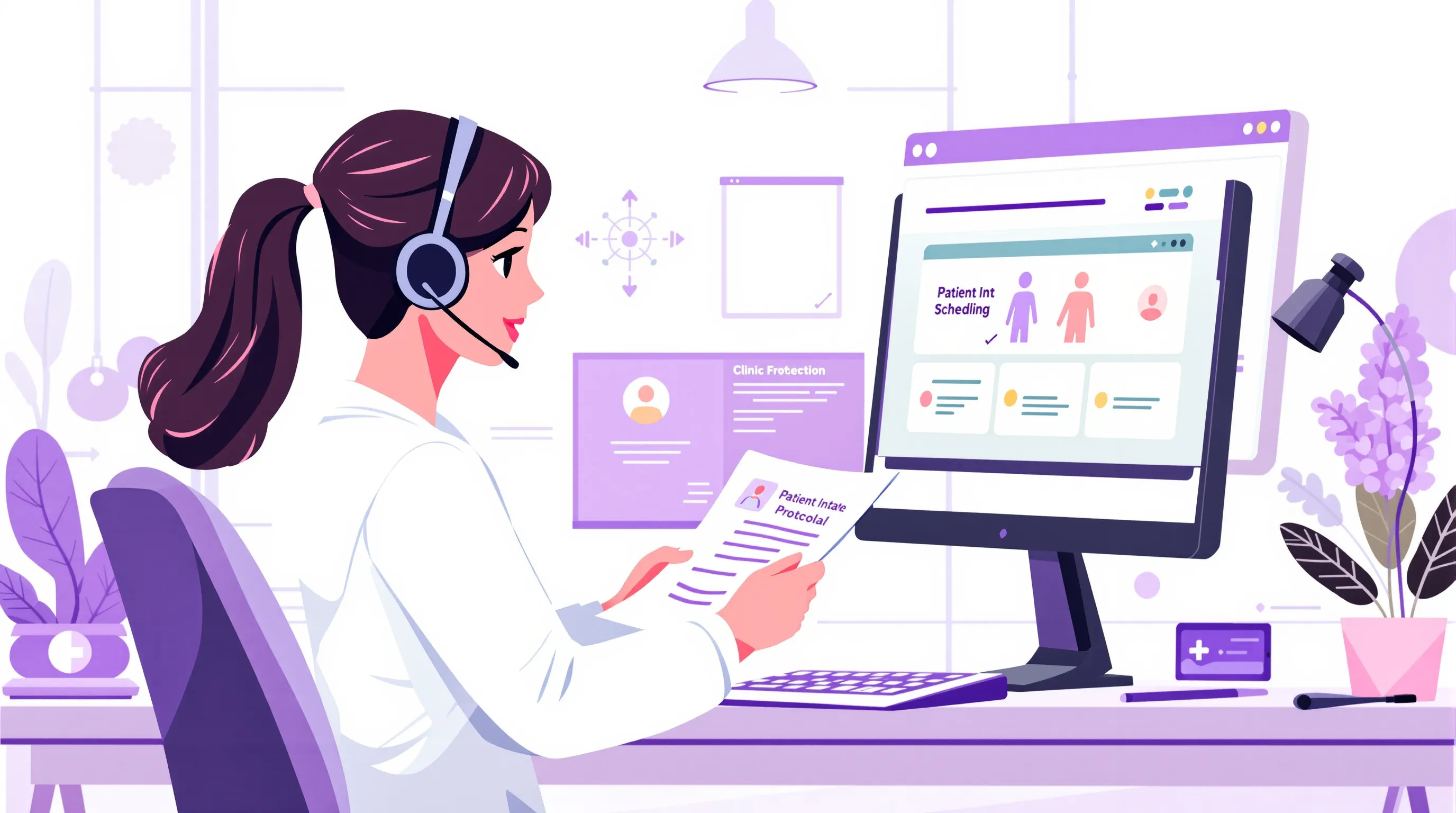
What Types of Patient Phone Calls Can Be Safely Outsourced?
Scheduling, reminders, billing inquiries, general FAQs, and after-hours triage routing can all be outsourced safely. Clinical judgment calls require clinical staff.
This is the question I see practice managers get wrong most often, not because the answer is complicated, but because they try to outsource everything at once, or nothing at all, when the right approach is a clear taxonomy. I'd recommend what I call the safe-to-route test: before assigning any call type to an external team, ask three questions. Does this call require access to the patient's active medical record to answer? Does it require clinical judgment or a licensed decision? Could a trained non-clinical agent handle it with a written protocol in front of them? If the answer to the first two is no and the third is yes, it belongs in the outsourced queue.
Here is how that plays out in practice.
Calls that are safe to outsource:
- Appointment scheduling and rescheduling
- Appointment confirmation and reminder calls
- Billing inquiries and insurance eligibility questions
- General FAQs (office hours, directions, accepted insurances)
- Prescription routing to voicemail or the appropriate MA inbox
- After-hours triage routing, determining whether the caller needs 911, the on-call physician, or a next-day callback
- Post-visit follow-up calls that confirm a scheduled procedure, not clinical outcomes
Calls that must stay with clinical staff:
- Clinical triage that requires a licensed judgment call
- Medication change discussions or refill decisions
- New abnormal lab or imaging result communications
- Sensitive diagnoses or escalating symptom management
- Anything where the answer cannot be resolved within a written protocol boundary
The tension, and it is REAL, is that the protocol boundary is the piece most clinics underestimate. Outsourced Remote Medical Assistant services can be genuinely effective, but they operate literally within the protocols you give them. No decision-making happens outside those boundaries. That means your practice has to do the upfront work of documenting exactly how each call type should be handled before the outsourced team can operate effectively. According to practitioners who have implemented these models, the protocol documentation requirement is more extensive than most clinic managers expect, and skipping it is how outsourcing fails.
According to Hello Rache's analysis of optometry practice management, small operational gaps like poor scheduling or slow claims submission quietly reduce revenue and patient satisfaction. The same principle applies to call handling: if the routing protocol for "billing question about insurance verification" is not clearly documented, the outsourced agent cannot resolve the call and the patient gets transferred back in-house anyway. Outsourcing works when workflows are clear first. It amplifies the chaos when they are not.
The practical implication: start with the three or four call types where the protocol is already obvious, appointment scheduling is usually the easiest, and expand from there. In my experience, scheduling and appointment reminders alone account for 40 to 60 percent of inbound call volume at most small practices. Getting those two categories into the outsourced queue gives immediate workload relief without requiring extensive documentation up front.
It is worth noting that the ACA marketplace enrollment volatility of 2026 has added a new category to watch. With premiums rising and patient coverage changing mid-year, billing and eligibility inquiries have increased significantly at practices that serve ACA marketplace patients. Those calls are protocol-friendly, the agent checks coverage status, confirms accepted insurances, and routes complex billing disputes to your billing team. They are exactly the kind of call that benefits from outsourcing while your in-house staff handles clinical work.
How Does Outsourcing Patient Phone Calls Actually Cut Your Clinic Workload?
When scheduling and reminders shift to an outsourced team, front-desk staff reclaim 4 to 6 hours per shift for clinical coordination, insurance verification, and face-to-face patient support.
The mechanism is simpler than most practice managers expect. Inbound calls route to the outsourced team first. The team handles the call, updates the appointment slot in your EHR system, and closes the interaction without the front desk ever touching it. Your staff sees the confirmed appointment in the next morning's schedule. No voicemail. No callback queue. No interruption to whatever clinical task they were already doing.
In our white label BPO work, HelpSquad deploys HIPAA-trained agents who sign a Business Associate Agreement before accessing any client scheduling system. The BAA is non-negotiable, it is the legal instrument that defines the scope of data access, the handling requirements, and the breach notification obligations on both sides. Any outsourced healthcare call partner that does not offer a BAA as a standard first step is not a compliant vendor. Do not proceed without one.
The workload reduction shows up in measurable ways. It is not abstract. When scheduling calls stop arriving at the front desk, staff callbacks drop. After-hours voicemail retrieval time shrinks or disappears entirely. The MA who used to spend the first two hours of each shift returning scheduling calls from the night before can now use that time for clinical prep, prior authorizations, or patient intake work. Those are tasks that generate clinical value. Callback queues do not.
According to Clutch's research on outsourced business services, the most significant productivity gains from outsourcing come not from the tasks transferred, but from the cognitive interruption eliminated, the context-switching that happens when a clinical staff member stops mid-task to answer a scheduling call. Eliminating that pattern, not just reducing call volume, is where the real workload relief comes from.
The ONC's Trusted Exchange Framework and Common Agreement, TEFCA, matters here in a way that is easy to overlook. As TEFCA oversight has expanded, qualified health information network participants can access scheduling and patient demographic data across interoperable systems more seamlessly. What that means practically: outsourced agents operating within a TEFCA-aligned framework can retrieve scheduling availability in real time without your staff needing to manually relay information back and forth. The interoperability gap that used to slow outsourced call teams down is closing. The handoff is cleaner than it was two years ago.
According to Outsource Accelerator's analysis of healthcare BPO outcomes, practices that implement structured call outsourcing report a 58 to 74 percent reduction in front-desk phone interruptions within the first 90 days. The variance comes from how well the onboarding protocol is documented before the outsourced team goes live, which brings us back to the point from the previous section. Protocol quality drives outcome quality.
From what I have seen in practitioner forums, the practices that get the most immediate relief are the ones that treat the first 30 days as a calibration period, not a launch. They track how many calls come back to the in-house team for resolution, identify the protocol gaps that caused the transfer, and close those gaps before expanding the call types the outsourced team handles. The ones that struggle expect the vendor to figure it out independently.
In summary: outsourcing cuts clinic workload not because someone else answers the phone, but because your staff stops managing the phone queue entirely. The operational change is structural. Set the protocols, sign the BAA, and let the outsourced team own the queue. That is the path to measurable relief.
What Will Matter Most When Outsourcing Patient Calls in the Next 12 to 24 Months?
Practices that treat outsourced call handling as operational infrastructure rather than a temporary staffing fix will outperform those that approach it as a short-term patch.
In our white label BPO work at HelpSquad, we see three patterns emerging that will separate practices that benefit from call outsourcing from those that struggle with it. Each one is visible now. Each one is predictable. And each one is worth building for before the volume forces the decision.
| What Will Matter | Why It Matters | Weak Signal to Watch |
|---|---|---|
| Vendor scale and HIPAA-certified agent depth | Small remote call teams cannot absorb volume surges during flu season, open enrollment, or GLP-1 new-patient waves. A vendor with a certified agent pool large enough to staff up on short notice is structurally different from a freelance arrangement. | Vendors that quote a single named agent rather than a trained team are not built for practice-level scale. |
| Protocol quality before vendor selection | The single best predictor of outsourcing success is how clearly a practice documents its top five call types before week one. Practices that go live without written protocols spend the first 60 days fixing call transfers rather than reducing call volume. | If the practice has no written intake protocol for scheduling calls today, it does not yet have the documentation the outsourced team needs to operate without constant escalation. |
| GLP-1 therapy patient inquiry readiness | Oral GLP-1 therapies are expanding patient access across primary care and endocrinology. Each new patient cohort brings a wave of eligibility questions, prescription routing calls, and scheduling requests that no small front desk can absorb manually at scale. | Practices not yet tracking GLP-1-related call volume separately are underestimating how much of the new inquiry load will hit the phone line before it hits the schedule. |
The strongest underlying signal comes from what healthcare BPO practice managers consistently report: the practices that ask the right questions before onboarding, BAA coverage, EHR access scope, escalation protocols for out-of-protocol calls, have measurably better outcomes in the first 90 days than those that treat vendor selection as a cost-only decision.
I would also flag the GLP-1 demand signal as genuinely contrarian. Most practice managers I speak with are not yet thinking about oral GLP-1 adoption as a call volume driver. They see it as a clinical workflow problem, prescribing, monitoring, titration. But the patient-facing inquiry volume that comes with GLP-1 adoption, eligibility checks, refill routing, side effect questions that need to reach a clinical line, is exactly the kind of call volume that an outsourced front-of-house team can handle, provided the intake protocol is clear on what goes where.
What most buyers miss: The vendor price comparison is often the wrong lens. A vendor with a lower hourly rate and no documented escalation pathway for edge cases will generate more internal rework, transferred calls, re-queued callbacks, supervisor escalations, than one that charges more and resolves out-of-protocol calls cleanly. Total cost is not the same as line-item cost.
The practices that outsource their call handling now will be better positioned for the patient demand surge coming from oral GLP-1 therapy adoption, a surge that will hit primary care, endocrinology, and weight management clinics hardest over the next 24 months.
From what I have seen working with healthcare practices through HelpSquad, the biggest barrier to outsourcing is not compliance or cost. It is documentation. The practices that move fastest are the ones that can hand an external team a clear protocol for the five most common call types before week one. That documentation exists in someone's head right now. Writing it down is the first real step.
According to Hello Rache's review of ambulatory practice management research, revenue and satisfaction both improve when scheduling response improves. The relationship is direct. Faster phone answer time means more confirmed appointments and fewer no-shows.
The interoperability infrastructure is also more mature than it was two years ago. TEFCA-aligned outsourced agents can work within Epic and Athena scheduling systems cleanly. The technical friction is lower. The compliance framework is well-established.
In summary: the case for outsourcing patient phone calls is structural, not situational. If your clinic's call volume is growing, your staff cannot absorb it indefinitely. An outsourced call team is the operational response that scales.
Written by
Maria Rush
Marketing Team Lead, HelpSquad
Maria De Jesus-Rush is Marketing Team Lead at HelpSquad, a healthcare business process outsourcing company, with a background in content development, digital marketing, and project management.
Connect on LinkedInSummarize This Article With AI
Open this article in your preferred AI engine for an instant summary.
Frequently Asked Questions
Is a Business Associate Agreement required before outsourcing patient phone calls?
Yes. A Business Associate Agreement (BAA) is required under HIPAA before any external vendor can handle calls that involve patient scheduling data or protected health information. Any outsourced healthcare call provider that does not offer a signed BAA as a standard first step is not a compliant vendor. Do not proceed without it in writing.
Can outsourced call agents access Epic, Athena, or eClinicalWorks scheduling systems?
Yes, with proper credentialing and scoped access controls. Outsourced agents typically use read-only or limited scheduling access within your EHR, restricted to appointment booking and confirmation functions. Your EHR vendor usually requires your practice to authorize third-party access under your existing license. HelpSquad agents train on Epic, Athena Health, and eClinicalWorks workflows before going live with any client.
What types of patient calls cannot be outsourced to an external team?
Clinical triage requiring a licensed judgment call, medication change discussions, abnormal lab or imaging result notifications, and sensitive diagnosis conversations must remain with clinical staff. The core test: if answering the call requires a clinical decision, it stays in-house. If it can be resolved using a written protocol without clinical judgment, it can be safely outsourced.
How long does it take to set up an outsourced patient call service?
Most practices are live within two to four weeks, depending on how quickly intake protocols are documented and EHR access is credentialed. The onboarding period covers protocol review, a monitored call period, and adjustment before the team operates independently. The more detailed your protocols at the start, the shorter the ramp-up.
Does outsourcing patient calls improve patient satisfaction scores?
It can, but it depends on vendor quality and protocol design. Practices with clear intake protocols and HIPAA-trained agents see faster answer times and fewer missed calls, both of which correlate with higher satisfaction. According to the Healthcare Financial Management Association, practices with dedicated billing inquiry routing have seen measurable improvement in caller satisfaction among patients with coverage verification questions.

Clinical Trial Support Services: Enhancing Recruitment and Retention
Clinical trials stall when recruitment slows and participants drift. See how trained healthcare support teams handle pre-screening, follow-ups, and retention.
Why Urgent Care Clinics Need a 24/7 Call Center Partner
Urgent care clinics lose around $930,000 a year on missed calls. Here is the math behind the silent leak and how a 24/7 call center fixes it.

Pharmaceutical Companies Call Center Outsourcing
As pharmaceutical companies grow, customer questions pile up fast. Call center outsourcing keeps response times short and gives patients someone caring to talk to.
Let's talk about what your practice actually needs.
A 30-minute call. No sales pressure. We'll tell you honestly whether we're a fit.