Provider Credentialing and Payer Enrollment: Why a New Physician Can't Bill for 90 Days
A practice's new physician cannot bill for 90 days or more because commercial payers, Medicare, and Medicaid each run entirely separate credentialing and enrollment queues, and none of them wait for the others.

Quick Answer
The Short Answer
A practice's new physician cannot bill for 90 days or more because commercial payers, Medicare, and Medicaid each run entirely separate credentialing and enrollment queues, and none of them wait for the others. Standard commercial payer credentialing takes 90 to 120 days per payer. Medicare PECOS enrollment takes 60 to 90 days. State Medicaid enrollment ranges from 30 to 120 days, and Medicaid managed care organizations add another 90 to 180 days on top of that. These processes are sequential, not parallel. "Fully credentialed" is never a single date. It is a sequence of approvals that routinely stretches five to six months from a physician's start date while the practice absorbs the full cost of their compensation against zero collections.
When a practice brings on a new physician, the clinical side moves fast. Privileges granted, onboarding complete, schedule loaded. The administrative side moves on a completely different clock, one that most practice owners do not see until it is already costing them money. This article breaks down exactly what consumes those months: three separate payer queues, primary source verification, CAQH attestation cycles, Medicare's PECOS enrollment system, and the Medicaid managed care layer that often goes unplanned. It then divides the work clearly, what only the physician can do versus what administrative back-office support can own. And it explains, from my experience on the payer side at Optum, what happens when the credentialing calendar is nobody's job and a clean claim hits an unenrolled provider at adjudication.
Questions this article answers
- Why does provider credentialing and payer enrollment take 90 to 120 days, and what is actually happening inside that window?
- Which parts of the credentialing process require the physician's direct involvement, and which tasks can be handled entirely by administrative back-office support?
- What are the revenue consequences when credentials lapse after initial enrollment, and how do lapsed credentials turn clean claims into denials that look like billing errors?
Quick Answer
When a practice brings on a new physician, it starts paying a full salary on day one. What it does not start doing: on day one, day thirty, or often day sixty, is collecting a single dollar from that physician's patient encounters. Provider credentialing and payer enrollment are the administrative gatekeeping processes that determine when a physician can legally bill under a practice's contracts. They take, at minimum, 90 days. They typically take 120. When the process is mismanaged, they take six months or more. During that entire window, the practice absorbs the physician's compensation against zero revenue from their work.
I spent years at UnitedHealth Group (Optum) on the claims and policy coverage side. What I learned there is that credentialing is not a formality. It is the foundation of the entire revenue cycle. A physician's NPI and tax ID mean nothing to a payer's adjudication system if that provider has not completed enrollment with that specific payer. The claim processes, the system checks the roster, the provider is not on it, and the claim is denied. Instantly. No grace period. No courtesy review. Just a denial code that the billing team may spend two weeks misdiagnosing as a coding problem.
Now, leading teams at HelpSquad, I see the same problem from the opposite side, practices that discover they have a credentialing gap only when denials start stacking up. The billing cycle is already broken by the time anyone realizes the cause. The revenue consequence is real, it is preventable, and it starts with understanding exactly what the credentialing calendar looks like and who is accountable for each piece of it.
What Actually Consumes the Credentialing Calendar
The phrase "90 days" gets used as shorthand for how long credentialing takes. It is not quite accurate, it understates the complexity.
A practice's new physician is not waiting for one process. They are waiting for at least three, and sometimes five or six, depending on how many payers the practice contracts with and which states are involved, as of .
Here is the breakdown of what is actually happening during those months.
Commercial Payer Credentialing: 90 to 120 Days Per Payer
Each commercial payer, Aetna, Cigna, BlueCross BlueShield, Humana, runs its own credentialing process entirely independent of the others. The standard timeframe is 90 to 120 days, with 120 days being the more likely outcome for a new provider. BlueCross BlueShield, depending on state, can run 120 to 180 days. Aetna has historically processed faster, but timelines shift by region and by how cleanly the application is submitted.
Each commercial payer credentialing process includes primary source verification: the payer confirms directly with medical schools, residency programs, and state licensing boards that the physician's credentials are exactly what they claim. There is no shortcut here. The payer is verifying with the original source, not accepting copies provided by the physician. A mismatch in any detail: a name spelled differently on a diploma versus a license, an address inconsistency, can trigger a hold and restart the clock.
CAQH ProView is supposed to streamline this. And it does reduce duplicate paperwork across payers. But CAQH is not enrollment. It is verification data. A provider must still complete each payer's own specific application even with a complete CAQH profile. And critically, CAQH attestation must be completed by the physician every 120 days. If it lapses, the profile flags as inactive and can stall every pending application across all payers simultaneously. That single missed re-attestation is one of the most common causes of credentialing delays I have seen, an application 60 days in progress suddenly stalling because the CAQH data went inactive while the payer was processing it.
Medicare Enrollment via PECOS: 60 to 90 Days
Medicare operates on a separate enrollment system, PECOS, the Provider Enrollment, Chain, and Ownership System. A practice's new physician must complete their own individual PECOS enrollment, separate from the practice's existing Medicare enrollment as an organization. CMS typically processes new physician enrollments in 60 to 90 days. CMS does not expedite this for financial hardship short of a formal exception, which is rarely granted.
It is worth noting that Medicare revalidation. The periodic re-enrollment that established physicians must complete every five years, runs on the same system and creates backlog. If a practice has multiple providers due for revalidation at the same time a new physician is waiting for initial enrollment, the queue lengthens. This is not an unusual scenario for practices that brought on several physicians within a few years of each other.
Medicaid Enrollment: 30 to 120 Days at the State Level, Plus Another 90 to 180 for Managed Care
Medicaid is the most variable piece of the timeline because it is state-administered. State enrollment timelines range from 30 days in faster-processing states to 120 days in slower ones. Some states have modernized their provider enrollment portals; others still rely on paper applications submitted by mail.
What catches many practices off guard is the Medicaid managed care layer. Most Medicaid patients in most states are enrolled through managed care organizations, Carelon, Molina, Healthpartners, and similar plans, not through fee-for-service Medicaid directly. Each managed care organization requires its own separate credentialing application, adding another 90 to 180 days on top of the state enrollment. A practice could have a provider fully enrolled with state Medicaid and still unable to bill the Medicaid managed care plans that cover the majority of their Medicaid patients.
These Queues Do Not Run in Parallel
Here is the part that most practice administrators do not fully account for when they plan a start date. Commercial payer credentialing, Medicare enrollment, and Medicaid enrollment cannot all begin simultaneously with the same packet. Each payer has its own portal, its own application format, its own documentation requirements. You assemble and submit commercial applications first, then address Medicare PECOS, then work through state Medicaid and managed care plans, each in sequence.
The result: total time from a practice's new physician start date to the day that physician can bill under all major payer contracts is often five to six months, not three. Community practitioners in r/physicianassistant report timelines of six months being routine, and some describe needing to pester payers on a near-daily basis for months to get applications across the finish line. Practices that plan for 90 days and start credentialing on the physician's first week are already behind. Understanding this at the beginning, not at week ten when claims start being rejected, is KEY.
For a broader look at how credentialing fits into the revenue cycle picture, see our complete guide to healthcare revenue cycle management.
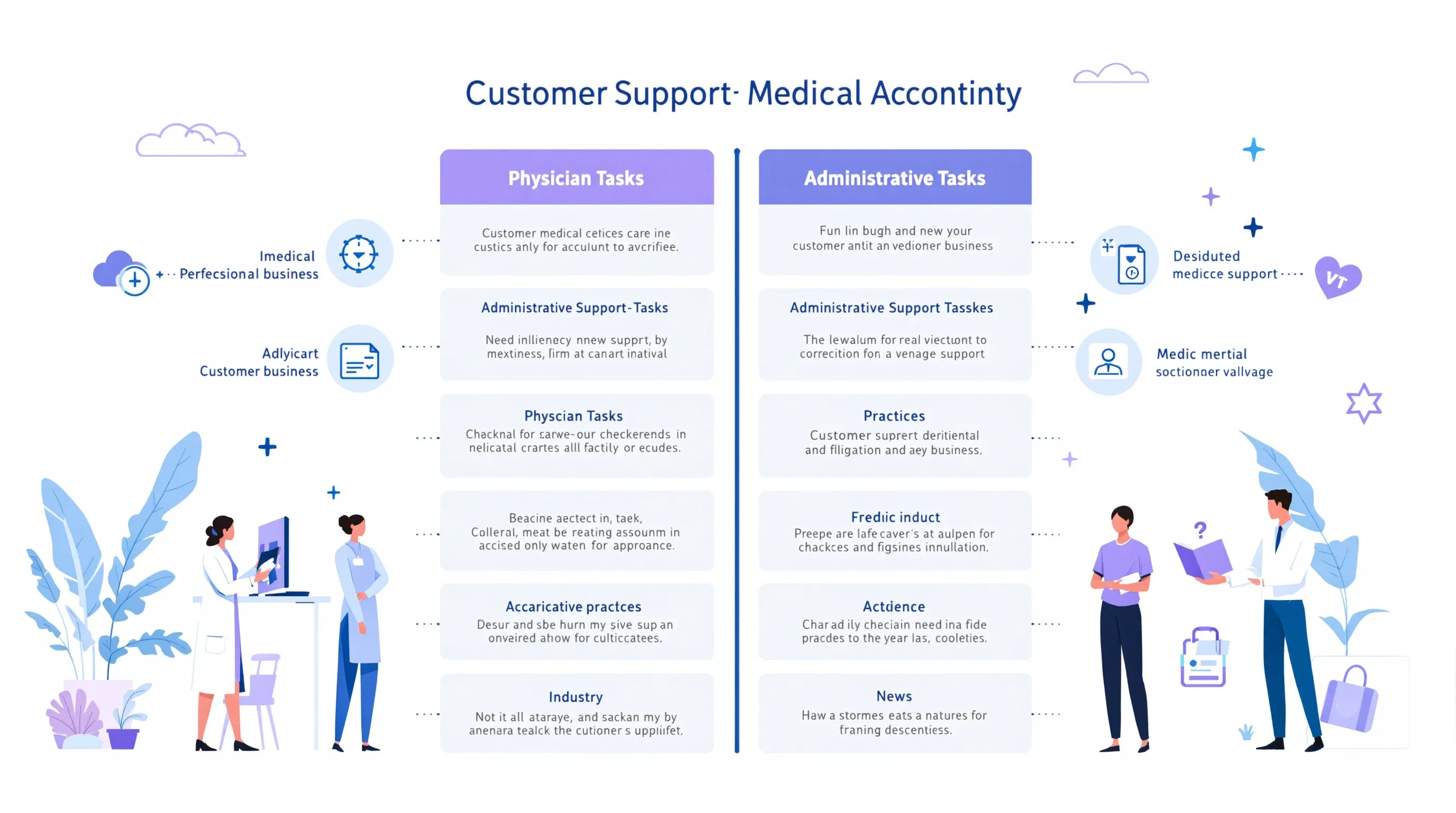
Who Owns What: Dividing the Credentialing Labor Correctly
One of the most common credentialing problems I see is not a paperwork problem or a timeline problem. It is a responsibility problem.
Nobody decided who owns the process, so it gets passed around until something falls through a gap. The physician assumes the office manager is tracking CAQH re-attestation. The office manager assumes the physician submitted the disclosure questions. Nobody follows up. The application stalls for four weeks on something that takes five minutes to resolve.
Credentialing involves two distinct types of tasks. Some require the physician's direct involvement and cannot be delegated. Others are pure administrative work that should never sit on a physician's desk.
What the Practice's New Physician Must Do Personally
There is no way around this category. Payers require the physician's direct attestation for specific elements, and no amount of administrative support substitutes for it. These tasks include:
- CAQH ProView attestation and re-attestation. The physician must log in and personally attest to the accuracy of their profile every 120 days. This is a non-delegable act. A single missed re-attestation can cause the profile to go inactive and stall pending applications across every payer using CAQH simultaneously, which is most of them.
- Signature on payer enrollment applications, Each payer application requires the physician's signature. Administrative staff can assemble and pre-fill the application; only the physician can sign and authorize it.
- Disclosure questions, Malpractice history, license sanctions, disciplinary actions, prior privilege revocations, and similar disclosures must be answered directly by the physician. These are attestations of personal professional history and cannot be delegated to administrative staff.
- DEA registration updates, If the physician's DEA registration information changes: practice address, schedule, state, only the physician can make those updates through the DEA's online portal. Mismatches between DEA records and payer applications are a common source of application holds.
It's important to note that a physician's clinical calendar does not naturally include time for credentialing administration. Unless someone is actively prompting them, and following up when the reminder goes unanswered, these tasks slip. The re-attestation deadline lands on a busy clinic day and nobody is watching the calendar.
What Administrative Back-Office Support Can and Should Own
Everything else, and there is a significant amount of it, can and should be handled by trained back-office administrative support. This is where the real administrative load lives, and where practices without dedicated credentialing capacity run into trouble. The number one reason for credentialing delays is a missing document or a small piece of incorrect information. All of those are preventable with organized administrative follow-through.
- Application assembly, Compiling the full documentation packet for each payer: malpractice certificates, medical school diplomas, residency completion letters, board certification documents, state license copies, DEA certificate, and work history.
- Document chasing, Proactively contacting medical schools, residency programs, and professional references to obtain primary source documents before the payer requests them. Getting ahead of these requests shortens the overall timeline.
- Portal submission and status follow-up, Submitting through payer portals, tracking application status, calling payer provider relations teams, and responding to requests for additional information before they age into formal rejections.
- Expirables tracking, Building and maintaining a forward-looking calendar of every expiration date: state medical license, DEA registration, malpractice insurance certificate, CAQH re-attestation due dates, board certification renewal cycles. This single function, consistently maintained, prevents most credentialing lapses.
- Post-approval roster confirmation, After each payer issues approval, confirming that the physician's name, NPI, and effective date appear correctly in the payer's provider directory before the first claim is submitted. A roster entry error at this stage generates denials that look like billing errors to the front desk.
At HelpSquad, my team provides exactly this kind of administrative support: not credentialing verification (that is the payer's function), but the document management, application assembly, and persistent follow-up that keeps applications moving. Our virtual medical assistants are trained in credentialing workflows and take the administrative weight off clinical and front-desk staff without adding a full-time employee to payroll. Back-office credentialing support starts from $8/hr, a fraction of the cost of a single month of unrecoverable revenue from an unenrolled physician.
The division is clear. The physician handles attestation, disclosure questions, and signatures. Administrative support handles everything else. When that division is not established in writing from day one, both sides assume the other is managing it, and the credentialing calendar drifts until it becomes a revenue crisis.
Clean medical billing and claims processing depends entirely on this credentialing foundation being complete before the first claim is submitted.
What Happens When Nobody Owns the Credentialing Calendar
I want to be direct about this, because I have seen it from both sides, the payer side at UnitedHealth Group (Optum) and the practice support side at HelpSquad.
When nobody actively owns the credentialing and expirables calendar, the outcome is not an administrative inconvenience. It is a revenue event. And it tends to be discovered at the worst possible moment, when claims start denying without an obvious explanation and the billing team spends two weeks working the wrong problem.
How Lapsed Credentials Turn Clean Claims Into Instant Denials
A physician's credentials are not permanent once obtained. They require active maintenance. State medical licenses expire, typically every one to three years. Malpractice insurance certificates must be current. DEA registrations require renewal every three years. CAQH must be re-attested every 120 days. Board certifications have their own renewal cycles. Re-credentialing with commercial payers is required every three to five years, and failure to complete it on time risks termination from the network.
When any of these expire, the payer's provider roster becomes outdated. The critical detail is that payer adjudication systems check the rendering provider's credentialing status at adjudication, not at claim submission. That means a claim can be submitted, pass initial editing, and sit in queue for two weeks, then be denied at adjudication because the provider's state license lapsed in the window between submission and processing. The denial code that comes back often looks like a billing or coding issue, not a credentialing issue. The billing team spends time working the wrong fix.
From my time at Optum processing claims and reviewing policy coverage, I saw this scenario play out regularly. A provider would have two years of clean billing history. CAQH re-attestation lapses. Profile goes inactive. Every claim submitted after that date denies as "provider not enrolled." The practice has changed nothing: same codes, same place of service, same everything. The claims are technically correct. But the credential is not current, and on the payer's adjudication system, that is functionally the same as the provider not being enrolled at all.
The Retroactive Billing Problem
Practices often assume that once the practice's new physician completes credentialing and enrollment, they can bill retroactively for the services provided during the waiting period. This assumption is only sometimes correct, and the eligibility window is strict.
Some commercial payers permit retroactive billing with an earlier effective date, but only if the application was submitted within approximately 30 days of the physician's start date. If the application was submitted late, that retroactive window is already closed. Medicare does not generally allow retroactive billing. Services provided before the enrollment effective date are revenue the practice will not recover. The physician saw the patient, the practice paid the physician's compensation, and no reimbursement will arrive from the payer. That is not a billing error that can be appealed or corrected. It is simply gone.
What Denial Recovery Looks Like in Practice
When a practice reaches out after a credentialing lapse has already caused claim denials, the denial management work is labor-intensive and only partially successful. The process involves identifying which specific claims were affected, which payers denied for which reason codes, whether any retroactive window remains technically open, and whether formal appeal rights are available. Some denials can be recovered. Many cannot.
The hidden costs of poor claims processing extend well beyond the face value of the denied claims. There is staff time spent working appeals. There are write-offs on the unrecoverable billing periods. There is the cash flow disruption while resolution is pending. And there is the cost of rebuilding a credentialing process from scratch after discovering that the existing one had gaps nobody was watching.
The financial math is straightforward. The average physician generates approximately $2.3 million in annual revenue for their affiliated facility, roughly $9,000 per calendar day in unrealized collections during a credentialing gap. A 90-day delay represents $800,000 in revenue that will not be collected during that window. For a smaller independent practice, the scale is different but the proportional damage is the same. That number does not become recoverable by waiting. It becomes locked in. The cost of proactive credentialing administrative support is a small fraction of that figure, and prevention is the only strategy that actually works.
What Will Matter Most for Credentialing in the Next 12 to 24 Months
Provider credentialing is not a static process. Payer requirements, federal enrollment systems, and state Medicaid portals are all changing in ways that will affect how long enrollment takes and how much administrative overhead practices must manage. Here is what I am watching.
CMS PECOS Modernization
CMS has been investing in updates to the PECOS enrollment system, including improved interface functionality and a shift toward digital-first workflows. When these changes roll out fully, Medicare enrollment for new providers may become more predictable. The risk is the transition period. Prior CMS system transitions have caused additional processing delays of four to six weeks on top of standard timelines, as legacy applications were migrated and staff adapted to new workflows. Practices should plan for possible PECOS delays during any announced upgrade windows rather than assuming the standard 60-to-90-day timeline holds.
State Medicaid Portal Digitization
More states are moving to centralized web portals for Medicaid provider enrollment, which is genuinely good news for timeline predictability in states that complete the transition. The catch is the migration period itself. States that have moved from paper to portal often experience processing backlogs for the first several months as older applications are entered into new systems. Practices in states currently in the middle of a Medicaid portal migration should build in extra buffer time, not assume the new digital process is already running at full speed.
Telehealth and Multi-State Licensing Complexity
Practices that expanded telehealth services after 2020 now carry providers credentialed across multiple states. A physician licensed in three states and enrolled with payer networks in each carries three times the credentialing maintenance burden of a single-state provider. Multi-state licensing compacts help on the licensure side, but payer enrollment remains state-by-state and payer-by-payer with no shortcut. The administrative calendar for a telehealth-active practice with multi-state providers is meaningfully more complex and requires systematic tracking that a single-person spreadsheet will not sustain.
CAQH ProView Enforcement Tightening
CAQH continues to refine ProView and has moved toward tighter automated enforcement around re-attestation timelines. Payers that pull credentialing data from CAQH are increasingly automating the response to lapsed attestations, meaning the window between a missed re-attestation and a roster status change is narrowing. Practices that have benefited from informal payer grace periods on CAQH lapses should not count on those grace periods continuing. The process is becoming more automated and less forgiving.
The Administrative Staffing Gap
The most consistent trend I see at the practice level is that credentialing expertise is concentrated in a small number of staff members, and those staff members are increasingly difficult to retain in a competitive labor market. When the person managing credentialing leaves, the institutional knowledge leaves with them. Expirables calendars live in personal spreadsheets. Portal login credentials go undocumented. The next credentialing lapse is quietly building.
The practices best positioned for the next two years are the ones that have systematized credentialing into documented workflows and shared tools, not a single person's spreadsheet. Building that system is exactly the kind of administrative infrastructure that back-office support can help create and maintain as an ongoing function, not a one-time project.
Forecast Watch: 12-24 months
Where Physician Credentialing Delays Head Next
Three forecasts on how long new physicians will wait to bill and what that delay will cost practices.
Credentialing Timeline Forecasts
Each forecast below is scored against supporting and contrary evidence from practice managers, billers, and industry sources.
Through 2027-2028, most new physicians and PAs will continue to wait 60-120 days (with 90 days as the commonly cited midpoint) before payers activate their billing privileges, regardless of practice size.
As the roughly $9,000-per-day revenue loss during credentialing delays becomes better understood, more mid-sized practices and health systems will shift credentialing and CAQH profile management to dedicated staff or outsourced vendors rather than folding it into general admin duties.
Even as CMS's 'Kill the Clipboard' initiative and near-universal EHR adoption progress over the next 12-24 months, they will not shorten the 90-day payer enrollment wait, because payers like UnitedHealthcare still require providers to be separately credentialed with each individual plan.
Weak signals watched: Practice managers and billers across hospital systems, private practices, and telepsychiatry startups independently report credentialing windows clustering at 90-120 days, with hospital systems around 90 days and smaller groups sometimes faster. Solo staff members are already reporting being stretched thin managing credentialing for 14 to 120+ providers at once, while practices are actively shopping for outside credentialing and billing vendors. Nearly every U.S. hospital already uses an EHR and CAQH already centralizes provider documents in one profile, yet billers still describe per-plan credentialing requirements (e.g., UHC's separate credentialing for each of its many plans) as the actual source of delay.
Evidence Behind the Forecasts
Sources that support each forecast are shown alongside sources that point the other way.
- The $9,000-Per-Day Positioning Gap In B2B Healthcare points the same way. [Substack / Newsletter]Average credentialing cycle takes 60 to 120 days, during which a newly hired physician cannot treat patients or bill. “Healthcare in the U.S runs on a weird paradox. Clinically, we're in the future. Robotics. Gene therapies. Wild stuff. But administratively? The back office is…”
- Backing it: How long is credentialing? [Community / Forum]Aetna online portal enrollment (when not already credentialed) takes approximately 3 months, per r/PMHNP user "Anonuserwithquestion," who manages credentialing for a 23-location organization. “Everyone, including everyone at my work, confuse the term credentialed with enrollment.”
- Credentialing time frame? is the strongest public backing for this call. [Community / Forum]Credentialing timelines reported by PA subreddit users ranged from 6 weeks (fastest reported) to 6 months (multiple reports of 4-6 months). “3 months / 90 days is the average. Some places take longer, other places are faster. Depends on the state and the system you’ve been hired by.”
- America digitized healthcare. Now it’s time to connect it. is the strongest argument against it. [Industry Publication]Nearly every U.S. hospital now uses an electronic health record (EHR), per the author. “Patients shouldn't have to repeatedly fill out the same forms or recreate their medical history every time they receive care.”
- The $9,000-Per-Day Positioning Gap In B2B Healthcare supports this forecast. [Substack / Newsletter]Credentialing delay costs approximately $9,000 per provider per day in unrealized revenue.
- Anyone else feel like billing and credentialing are holding your clinic is the strongest public backing for this call. [Community / Forum]Poster (OppositeMany5978) manages a "mid sized primary care clinic" experiencing claims sitting unpaid "for weeks" due to missed CAQH updates or payers dropping providers. “the denials have been getting increasingly obfuscated since at least 2020.”
- Credentialing, EHR, and billing service company to outsource supports this forecast. [Community / Forum]OP (u/Mindless-Tart-3321) is launching a startup telepsychiatry solo practice and wants to outsource credentialing and "full billing service" (revenue cycle management), with plans to expand into a group practice. “Not all insurances accept exclusively telehealth providers. And Medicare still has their rule that a patient must be seen in person every 6 months.”
- Pushing back: Credentialing takes too long. [Community / Forum]Original poster (OP, u/Outrageous-Payment87) signed a PA job contract in January (year not specified, thread is ~4 years old at time of scraping) with a contractual start date of April 1. “they kept saying it’s out of their control and everything is on pending.”
- Anyone else feel like billing and credentialing are holding your clinic points the same way. [Community / Forum]theobedientalligator manages a small mental health office with ~5 providers, doing credentialing solo; updated their tax ID last year and has faced ongoing issues since.
- Backing it: Step-by-Step Provider Credentialing Guide 2025. [Video]The National Provider Identifier (NPI) is a unique 10-digit number required for every standard healthcare transaction, especially billing insurance. “Credentialing is the process where insurance companies verify all your qualifications to make sure you meet their standards.”
- A Detailed Guide to Provider Credentialing is the strongest public backing for this call. [Video]Presenter: Kathy Harris, CBCS (nationally certified credentialing, billing and coding specialist), with over 20 years of experience in healthcare industry. “The credentialing keys to success can be broke down into four ways: research, preparation, tracking and communication.”
- America digitized healthcare. Now it’s time to connect it. complicates the call. [Industry Publication]EHR adoption resulted from "billions of dollars in public and private investment over the past two decades.".
What Could Shorten or Extend the Wait
These real-world shifts in payer or regulatory behavior would change how these forecasts play out.
Hedge Your Bets
It's worth noting that 83 rests on the strongest evidence we have, while 69 exists precisely because the evidence doesn't all point one way.
- If regulators or buyers move in the opposite direction, -120 day credentialing window persists would weaken first.
- If the source mix shifts toward stronger contrary evidence, EHR interoperability won't fix payer enrollment speed could become the more durable forecast.
Provider credentialing is not a one-time event. It is a revenue function that requires active management before a practice's new physician's first day, throughout the initial enrollment queue, and on an ongoing basis after initial approval is complete. The practices that treat it as a function: with documented owners, tracked timelines, and maintained expirables calendars, do not find themselves in a denial crisis six months after bringing on a physician.
The practices that treat it as paperwork find out the hard way that credentialing is the foundation of the revenue cycle. Every clean claim, every successful reimbursement, every collected dollar from a patient encounter depends on an enrolled, credentialed, currently-attested provider on the payer's roster. When that foundation has gaps, the denials follow automatically. And by the time the denials appear, the window to recover most of that revenue is already closing.
My team at HelpSquad provides administrative back-office support for practices navigating credentialing workflows: document assembly, portal follow-up, expirables tracking, and the steady coordination that keeps applications moving and credentials current. If your practice is onboarding a new physician, or if you are carrying more than three providers on your credentialing calendar without dedicated administrative oversight, the revenue risk is real. Prevention is always less expensive than recovery.
Written by
Maria Rush
Marketing Team Lead, HelpSquad
Maria De Jesus-Rush is Marketing Team Lead at HelpSquad, a healthcare business process outsourcing company, with a background in content development, digital marketing, and project management.
Connect on LinkedInFrequently Asked Questions
How long does provider credentialing and payer enrollment actually take?
Commercial payer credentialing typically takes 90 to 120 days, with 120 days being the more common outcome for a new provider. Medicare PECOS enrollment takes 60 to 90 days. State Medicaid enrollment ranges from 30 to 120 days depending on the state. Medicaid managed care organizations require their own separate credentialing on top of state enrollment, adding another 90 to 180 days. Because these processes are sequential rather than parallel, total time to full billing capability across all payers is routinely five to six months from a physician's start date.
Can a practice bill retroactively once a new physician finishes credentialing?
Some commercial payers allow retroactive billing with an earlier effective date, but only if the enrollment application was submitted within approximately 30 days of the physician's start date. If the application was submitted late, that retroactive window is already closed. Medicare does not generally allow retroactive billing. Services provided before the enrollment effective date are typically unrecoverable revenue: the physician saw the patient, the practice incurred the cost, but no payer reimbursement will arrive.
What is CAQH ProView and why does it affect credentialing timelines?
CAQH ProView is a universal credentialing data repository that most commercial payers use to pull and verify provider information during the credentialing process. Physicians must personally attest to the accuracy of their CAQH profile every 120 days. If the re-attestation lapses, the profile flags as inactive across all linked payers simultaneously, which can stall or invalidate multiple pending credentialing applications at once. Having a complete CAQH profile does not replace each payer's individual application; providers must still complete separate enrollment applications for each payer.
What happens to claims if a physician's credentials lapse after initial enrollment?
Payer adjudication systems check the rendering provider's credentialing status at adjudication, not at claim submission. When credentials lapse, the provider's roster status goes inactive or unenrolled. Claims submitted while credentials are lapsed are denied at adjudication, often with denial codes that appear to indicate a billing or coding issue rather than a credentialing problem. This causes billing teams to work the wrong fix. Many of these denials cannot be recovered because the credentialing gap eliminates retroactive billing eligibility.
Does HelpSquad perform credentialing verification for providers?
No. Credentialing verification, confirming a physician's credentials with primary sources such as medical schools, state licensing boards, and residency programs, is performed by the payer or a payer-authorized credentialing organization. HelpSquad provides administrative support for the credentialing process: document assembly, application preparation, portal submission and follow-up, and expirables tracking. This reduces the administrative burden on practices without replacing the payer's verification function.
When should a practice start the credentialing process for a new physician?
Credentialing and payer enrollment applications should be initiated 90 to 120 days before the physician's intended start date, ideally as soon as the offer is accepted and signed. This requires the physician to have a completed CAQH ProView profile, an active state medical license, current malpractice insurance, and DEA registration in place before the first application is submitted. Starting on the physician's first day of employment guarantees a billing gap of at least 90 to 120 days, and often longer.

Medical Claim Timely Filing Limits: Your AR Backlog Has an Expiration Date
A timely filing limit is a hard deadline set by each payer for when a claim must be submitted after the date of service. Medicare allows exactly one year (365 days). Most commercial payers set limits between 90 to 180 days, with some as short as 60 days.

How to Start a Therapy Private Practice: The 2026 Admin Setup Guide
The admin side of starting a therapy private practice: get an independent license, form an entity, obtain an NPI, begin credentialing early, pick private pay or insurance, then set up software, policies and phones.

EHR vs. Practice Management System: A Complete Guide
EHR handles patient charts, labs, and prescriptions while a Practice Management System runs scheduling and billing. See how both fit a healthcare practice.
Let's talk about what your practice actually needs.
A 30-minute call. No sales pressure. We'll tell you honestly whether we're a fit.