What Happens When Your Virtual Medical Assistant Calls Out Sick
When your virtual medical assistant calls out sick, one of two things happens depending on your vendor model. With a single dedicated VA, you have a real service gap for that day. There is no compliant backup available on short notice.

Quick Answer
The Short Answer
When your virtual medical assistant calls out sick, one of two things happens depending on your vendor model. With a single dedicated VA, you have a real service gap for that day. There is no compliant backup available on short notice. With a managed team model, the vendor absorbs the absence internally through pre-credentialed, cross-trained agents. The compliance issue most practices miss: sharing an EHR login with a backup person is a HIPAA violation. HIPAA's Audit Controls standard (45 CFR 164.312(b)) requires individually provisioned credentials. A shared login destroys the audit trail and creates an exposure that can reach $50,000 per violation instance. The right coverage starts before the absence, not after.
Questions This Article Answers
- Is sharing an EHR login with a backup person a HIPAA violation?
- Do virtual assistant companies provide backup coverage when your VA is absent?
- What is the real operational difference between a single dedicated VA and a managed team?
Quick Answer
After handling healthcare claims, policy inquiries, and sensitive patient data workflows at UnitedHealth Group (Optum), and now leading marketing and operations teams at HelpSquad where we have onboarded more than 340 healthcare practices since 2016, I can tell you that the sick-day question is one of the most misunderstood issues in virtual medical assistant staffing. Most practice owners ask it after the fact, after their VA has already called out and they are scrambling to figure out who covers the schedule, the prior authorization queue, and the patient callback list.
The answer nobody wants to hear: it depends on your staffing model, and the "quick fix" most vendors suggest is a HIPAA violation waiting to happen.
I want to walk you through what actually occurs when your virtual medical assistant calls out sick, why the instinct to "just send someone else" is more dangerous than it sounds, and what you can do right now to structure your coverage so that one person's absence does not become your compliance problem.
Is Sharing an EHR Login a HIPAA Violation? Yes, and Here Is Why
Let me start with the question that draws more search traffic than any other on this topic: can two people share an EHR login?
The answer is no. Full stop, as of .
When I worked at UnitedHealth Group (Optum), managing healthcare claims and policy inquiries involving sensitive patient data, credential management was not a guideline. It was a structural requirement. Every team member who accessed protected health information had their own individually provisioned login. Every action was logged against that credential. That is not bureaucracy. That is the HIPAA Audit Controls standard, codified in 45 CFR 164.312(b).
The standard requires covered entities and their business associates to implement hardware, software, or procedural mechanisms that record and examine activity in information systems containing or using electronic protected health information. The operative word is "record." The audit trail only works if each action is tied to a uniquely identified user. The moment two people share one login, the trail collapses. You can no longer prove who accessed what, when, or why.
What Does This Mean for the "Backup" Question?
Here is the scenario I see play out more often than I would like. A practice hires a single dedicated virtual medical assistant. The VA calls out sick on a busy Monday. The vendor, trying to be helpful, says: "No problem, I will have someone cover for you today." The replacement logs in using the absent VA's credentials, handles the morning schedule, answers a few patient messages, and the day moves on.
It feels like a solution. It is not. It is a HIPAA violation.
The replacement agent accessed protected health information under someone else's user account. If your practice is ever audited, and OCR audits are not reserved for large health systems. That shared login is evidence of a compliance failure. HIPAA civil penalties range from $100 to $50,000 per violation instance, with annual caps up to $1.9 million per violation category. A single shared-login incident, logged against the wrong credential, is not a minor paperwork problem.
I am not saying this to alarm you unnecessarily. I am saying it because vendors who promise "instant backup coverage" without explaining the credentialing requirement are either cutting corners or not fully accounting for HIPAA's audit trail rules. It's important to note that a Business Associate Agreement between your practice and a VA vendor does not authorize shared logins. The BAA governs data handling responsibilities. It does not waive individual user credentialing requirements.
The Right Way to Provide Backup Coverage
The only compliant path to backup coverage in an EHR environment is to have a second, separately provisioned credential ready before the absence happens. That means:
- A second agent who is already credentialed in your EHR system
- Completed security training and HIPAA training on file for that agent
- An updated BAA that covers the backup agent's access
- Access permissions scoped to what that agent actually needs, not a full copy of the primary VA's access
This is not something you can stand up in 20 minutes on a sick day. EHR credentialing for a new user can take days to weeks depending on the EHR vendor and your practice's IT setup. It requires advance planning, and it is the core reason why the two main staffing models, a single dedicated VA versus a managed team, produce very different outcomes when your VA calls out. The choice you make at contracting time determines what happens on that Monday morning.
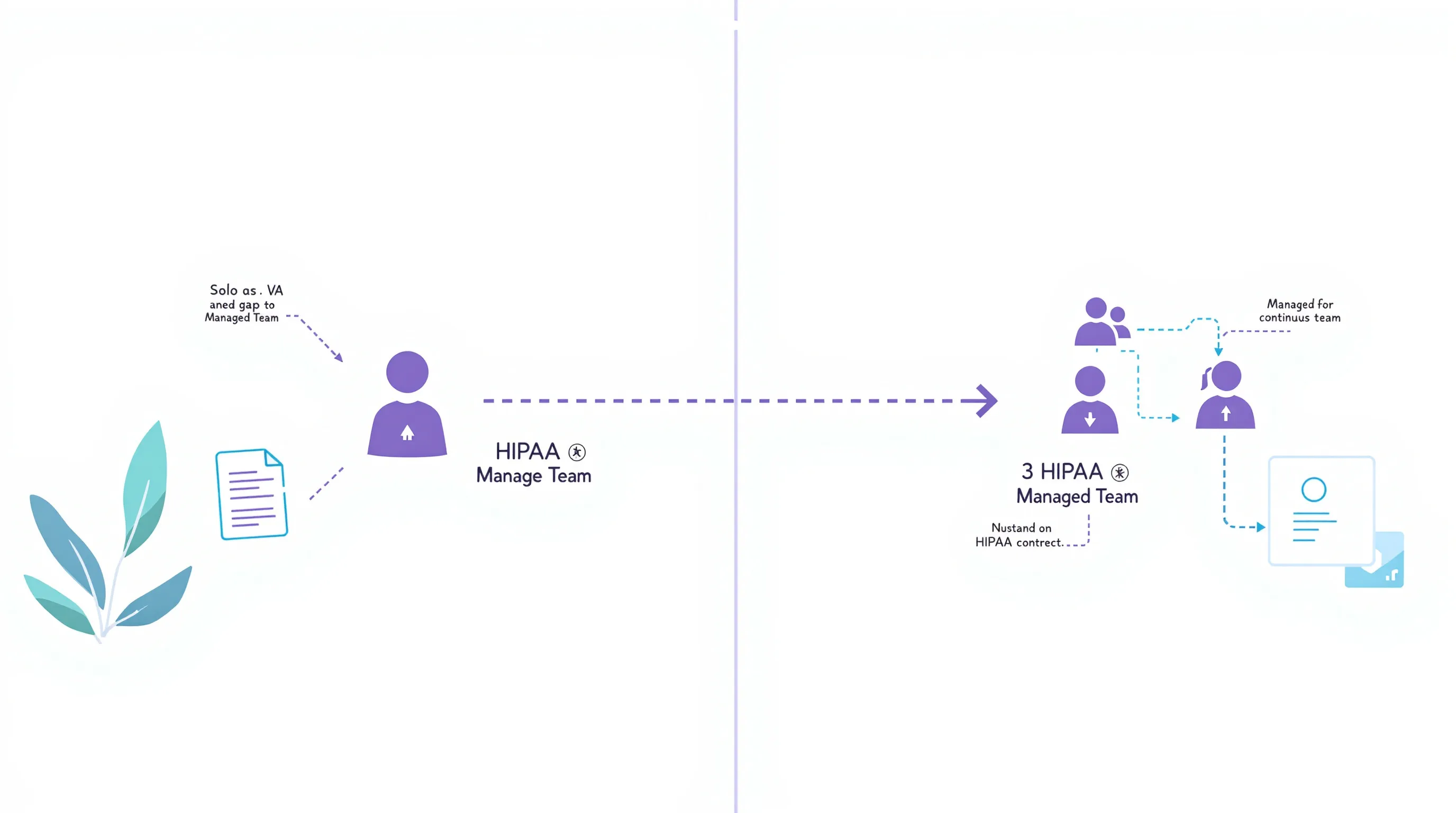
The Single Dedicated VA Model: What Happens When They Call Out Sick
I want to be completely honest with you here, because this is where a lot of vendors miss the mark, and where practices get disappointed.
If you hire a single dedicated virtual medical assistant, you absorb their sick days. That is the honest tradeoff. In operational terms, you are treating this person like a W-2 employee when it comes to daily attendance risk, even though they are a contractor or managed through a vendor. The average U.S. worker uses between 4 and 5 sick days per year, according to Bureau of Labor Statistics data. For a busy practice, that is 4 to 5 days when your scheduling queue, your prior authorization follow-ups, your patient callbacks, and your EHR task list either sit untouched or get handled through workarounds that may introduce compliance risk.
What the Single Dedicated VA Model Does Well
I do not want to dismiss this model. It has real advantages that matter for the right type of practice:
- Dedicated attention: A single VA learns your specific workflows, your providers' preferences, your EHR setup, and your patient population. That institutional knowledge has genuine value over time.
- Lower baseline cost: You are paying for one agent's time, not a full team infrastructure. For practices with modest administrative volume, this is often the right fit.
- Upfront screening and vetting: Reputable vendors screen and vet candidates before placement. If an attendance problem becomes chronic, a good vendor will replace the VA at no additional cost.
- Predictable relationship: Practices that value consistency: the same person who knows your EHR, your providers, and your patients, often find this model more comfortable for the first 12 to 18 months.
What the Single Dedicated VA Model Does Not Do
The single dedicated VA model does not solve for daily coverage gaps. It is not designed to. The structure is one person, one credential, one set of trained knowledge. When that person is unavailable, the coverage simply does not exist until they return.
Here is a mental model I find useful: hiring a single dedicated VA is operationally similar to hiring a part-time in-house employee, not to subscribing to a managed service. The VA becomes a key person in your workflow. Their absence creates a gap, just as it would if your front desk coordinator called out. Both are legitimate staffing choices; just name them accurately so you know what you are signing up for.
If your practice has the operational flexibility to absorb occasional single-day gaps: if you have an in-house staff member who can triage urgent items, or if your patient-facing volume is low enough that a one-day delay is manageable, then the single VA model may be the right fit for your budget and your workflows.
The Managed Team Model: How Structural Coverage Actually Works
Here is where the operational logic changes entirely.
At HelpSquad, when a practice works with one of our healthcare call center teams, they are not relying on a single agent. They are tapping into a team that already has multiple credentialed agents, a team lead, and QA oversight built into the structure from day one. When one agent calls out sick, the vendor, not the practice, absorbs that absence.
This works because of how the team is set up at the start, not as a scramble response to an absence. Each agent on the team is individually credentialed in the practice's EHR. Each has completed the required HIPAA training. Cross-training happens before the first day of live operations. When someone calls out, a teammate who already knows the workflows, already has active EHR access, and already has a valid user credential picks up the queue.
The audit trail remains intact. The practice sees no gap. The sick day is the vendor's operational problem, not the practice's compliance risk.
The Tradeoff You Accept With a Managed Team
Structural coverage is not free. A managed team model costs more than a single dedicated VA because you are paying for the infrastructure that makes coverage possible: the cross-training, the QA layer, the team lead oversight, and the additional credentialing overhead for multiple agents.
You are also accepting a different kind of working relationship. Instead of one agent who becomes deeply embedded in your specific workflows, you have a team that is trained on your workflows but distributed across multiple people. Some practices need a short adjustment period. Others prefer it immediately because it removes the key-person dependency risk entirely.
The right choice depends on the volume of your practice, the nature of your administrative workflows, and how much daily coverage continuity matters to your operations. For practices running high volumes of prior authorization, scheduling, and patient communication, the managed team's structural coverage is usually the correct solution, and the one that holds up under scrutiny when your compliance documentation is reviewed.
How to Reduce Your Exposure: Four Practical Steps for Any Model
Regardless of which staffing model you choose, there are steps you can take right now to reduce the operational and compliance impact when your virtual medical assistant calls out sick. My background as a Quality Assurance and Training Specialist, where I developed training materials and standard operating procedures for healthcare teams, taught me one thing above all else: true coverage does not come from improvising a backup. It comes from structured cross-training and documented protocols built before the absence happens.
The practice that has a written plan in place before the absence happens is the practice that weathers it without a compliance incident. The practice that improvises at 7:45 a.m. is the one that ends up in a conversation about shared logins and broken audit trails.
Step 1: Cross-Train a Second Person Early (Before You Need Them)
The most important step you can take is to identify a second person, whether that is an in-house staff member or a second agent from your vendor, who can handle at least your highest-priority tasks when your VA is unavailable. This person needs:
- Their own EHR credentials, provisioned and tested before any absence occurs
- Completed HIPAA and security training with documentation on file
- Familiarity with the 3 to 5 most time-sensitive task types: urgent scheduling changes, patient callbacks with clinical urgency, prior authorization follow-ups with same-day deadlines
- Access to your documented workflow SOPs, not just informal knowledge passed over the phone
I cannot emphasize this enough: this preparation cannot happen on the morning someone calls out. If you are calling your vendor at 7:45 a.m. asking them to provision a new EHR user for a replacement agent, you are already too late. Provisioning can take days or longer, and no reputable vendor should be logging into your EHR under someone else's credential while that credentialing is pending.
Step 2: Segment Your Task List by Urgency
Not everything your virtual medical assistant handles needs to be handled the same day. From my experience managing healthcare administrative workflows, roughly 30 to 40 percent of the typical VA task list can safely wait 24 hours without clinical or operational consequence. Knowing which tasks those are, and documenting that list explicitly, makes a one-day absence far more manageable.
Create a simple task-tier document with your VA:
- Tier 1 (same-day, cannot wait): Urgent patient callbacks, same-day prior authorization with a clinical dependency, schedule-critical changes for patients already in the building or en route
- Tier 2 (within 24 hours): Non-urgent appointment reminders, routine prior authorization follow-ups, billing inquiry responses, referral coordination
- Tier 3 (within 48-72 hours): Administrative follow-ups, medical record requests, non-urgent correspondence
When an absence happens, your coverage person focuses exclusively on Tier 1. Everything else holds. This is not negligence; it is triage. Triage = KEY when your staffing plan is under pressure and you need to avoid a compliance shortcut.
Step 3: Document Your Emergency Escalation Path
Your practice needs a written answer to the question: "If our VA is unavailable today and a patient-facing situation requires immediate action, who handles it and how?" This document should include:
- Who on your in-house team handles Tier 1 tasks if no backup VA is available
- The phone number and process for reaching your VA vendor's team lead or operations contact
- A list of EHR tasks that require provider or practice manager authorization, so the backup agent does not overstep their scope
- A note on which tasks should wait for the original VA's return rather than be handled by an improvised workaround
This document should live somewhere your entire team can find it, not in someone's email inbox or the practice manager's personal notes. If your VA is the only person who knows where the escalation path is documented, you have a single point of failure inside your backup plan.
Step 4: Have an Honest Conversation With Your Vendor Before You Sign
Before you finalize a virtual medical assistant contract, ask your vendor these specific questions about virtual medical assistant coverage and backup:
- Do you provide backup coverage when my VA is absent?
- How is that backup agent credentialed in my EHR? What is the typical timeline?
- Does the backup agent share a login with my primary VA, or do they have their own separately provisioned credential?
- What is the SLA for notifying me of an absence?
- Has your backup coverage process been reviewed for HIPAA compliance?
A vendor who cannot answer the credentialing question clearly is a vendor who has not thought through the compliance implications of their backup promise. That is a signal worth heeding before you are dependent on them, and before an OCR audit makes it urgent.
What Will Matter Most in the Next 12-24 Months: Coverage, Compliance, and Automation
The virtual medical assistant market is moving fast, and the sick-day question is going to get more nuanced, not simpler, as practices layer AI-assisted tools on top of their human VA infrastructure.
AI-Assisted Triage as Supplementary Coverage
One trend I expect to accelerate: the use of AI-powered scheduling and communication tools as a partial buffer when a human VA is unavailable. These tools cannot replace a credentialed VA for EHR work, but they can handle the top of the funnel: answering inbound appointment requests, routing patient messages to the correct inbox, flagging urgent items for review before the practice opens.
The distinction that matters for compliance purposes: AI tools that operate at the communication layer, outside the EHR, do not carry the same individual user credentialing requirements. They can legitimately absorb some of the communication volume during a one-day absence without creating a HIPAA exposure. But the moment a task requires touching protected health information inside an EHR: scheduling a patient, updating a record, pulling insurance information: a human with a valid, individually provisioned credential is required. No AI tool currently on the market substitutes for that.
Practices that layer AI triage tools on top of their human VA infrastructure will be better positioned to weather single-day absences than practices relying entirely on a single human agent with no supplementary tools. This is not a replacement for structural coverage. It is a first-response buffer that buys time.
Credentialing Speed as a Competitive Differentiator
One of the structural constraints in the current model is that EHR credentialing takes time. Provisioning a new user, completing security training, and activating that credential in a specific EHR can take anywhere from a few days to several weeks, depending on the EHR vendor and the practice's IT setup. This is precisely why a vendor cannot simply "send a backup" on the morning of an absence without creating a compliance exposure.
BPO vendors who invest in pre-credentialing pools, agents who complete training and credentialing before they are assigned to a specific practice: will have a structural advantage in providing fast, compliant virtual medical assistant coverage. I expect this to become a standard expectation for managed healthcare VA services within the next 24 months, rather than a premium differentiator. The practices asking their vendors about pre-credentialing today are ahead of the conversation.
The Documentation Standard Is Rising
OCR has increased audit activity in recent years, and scrutiny on business associates, which includes VA vendors operating under a BAA, has grown alongside it. According to the American Medical Association's March 2026 survey, more than 80% of physicians now use AI professionally, a rate that has more than doubled since 2023. That rapid adoption is drawing regulatory attention to the systems and people accessing healthcare data on behalf of practices.
The sick-day scenario is a useful stress test for your current compliance posture. Ask yourself: if OCR pulled your EHR audit logs from the last six months, would every user access event be tied to a uniquely identified, authorized credential? If the answer is "probably, but I am not certain," that is a documentation review worth doing before the question becomes urgent. In summary: the practices that build compliant coverage structures proactively are the ones that handle an audit with confidence rather than scrambling to explain an exception.
What To Expect: 12-24 months
Where Virtual Medical Assistant Staffing Is Headed
Three data-backed forecasts on how practices will staff around assistant absences, vendor choice, and AI governance.
What Comes Next For Virtual Medical Staffing
Use these forecasts to gauge which staffing and governance shifts are worth planning around.
Demand for identifying top healthcare BPO and virtual medical assistant vendors will keep growing as practices navigate a crowded field (Assist World, Stealth Agents, Talently, Pearl Talent, Ataraxis, HelloRache, MedVA, Virtudesk, CareIQ Assist, Solum Health, GoLean Health) and weigh cost and outcome claims such as Solum Health's reported 50% cost reduction and 80% increase in "time to care.".
Practices will keep combining virtual human staff with AI tools rather than shifting to fully autonomous AI agents, sustaining demand for 24/7 backup models like those offered by vendors such as Portiva, even as large-scale ambient AI rollouts (e.g., Kaiser Permanente's deployment to more than 25,000 physicians) expand.
More health systems will pursue certifications like the Joint Commission's Responsible Use of AI in Healthcare (RUAIH) credential, following Hackensack Meridian Health's 2026 certification, as physician AI use tops 80% (AMA, March 2026) while only 27% of clinicians say they understand their organization's AI governance (Wolters Kluwer).
Early indicators on the radar: Hackensack Meridian Health became the first organization certified under the Joint Commission's RUAIH program after its June 2026 launch. Physicians relying on Portiva's live staff for scheduling, billing, and medication call-ins during absences, alongside reports that offshore virtual assistants face real infrastructure risks like Philippine power and internet outages. Recurring buyer questions about which virtual medical assistant companies and healthcare BPO firms are worth using, alongside practices reporting active vendor switching and multi-vendor use.
Evidence For and Against Each Forecast
Each forecast pairs supporting and contrary sources drawn from practice reports, vendor testimonials, and industry data.
- When will the AI fad die out? cuts the other way. [Community / Forum]“Average intelligence made the new coke flavor. This is why it sucks.”
- Portiva's Virtual Medical Assistant Testimonials points the same way. [Video]Dr. Shorey is a board-certified family medicine physician who operates a solo practice with no other on-site medical assistants or physicians. “i have support i have somebody that i can access 24 7 pretty much and i know that things are still happening behind the scenes.”
- The case rests on How often does power go out in Philippines? [Community / Forum]Original poster (Basic_Scarcity_3809) reports their VA said they had no power at their house, following a router/internet issue, and was preparing to relocate offsite to work. “Back in our province, even light rains can cause power interruptions.”
- Virtual Medial Assistant questions is what puts this forecast on the board. [Community / Forum]
- Podcast: AI, innovation, and value-based care in medicine is the strongest argument against it. [Industry Publication]The AI ambient listening tool has been rolled out nationally to more than 25,000 Permanente physicians. “Innovation thrives when you get multiple diverse perspectives.”
- The case rests on Hackensack Meridian Health first to earn Joint Commission’s responsible health AI certifi. [Industry Publication]Hackensack Meridian Health (HMH) is the first organization to earn the Joint Commission's Responsible Use of AI in Healthcare (RUAIH) Certification. “As we expand our clinical AI initiatives, we operate under the utmost governance to ensure patient quality and safety are always the priority.”
- Healthcare AI in 2025 - a reflection - by Jan Beger - Second Opinion is the strongest public backing for this call. [Substack / Newsletter]LinkedIn community built by author Jan Beger has grown to more than 80,000 people; monthly newsletter now read by over 40,000 subscribers. “We tend to overestimate the impact of a new technology in the short run and underestimate it in the long run.”
- If ambient AI tools prove reliable enough to remove human backup coverage entirely, or if formal AI governance certification turns out not to affect liability or reimbursement, hybrid staffing and credentialing adoption would slow.
What Could Change These Forecasts
Regulatory shifts, vendor consolidation, or a stalling AI hype cycle could alter how practices staff around absences.
Either Way, Plan For This
Why hold both 84 and 70 in mind? Because confidence is not certainty, and the gap between them is where 70 could still prove right.
- If regulators or buyers move in the opposite direction, Fragmented vendor landscape drives active comparison shopping would weaken first.
- If the source mix shifts toward stronger contrary evidence, Human backup coverage persists alongside AI, not replaced by it could become the more durable forecast.
The sick-day scenario is not a minor inconvenience question. It is a proxy test for the structural integrity of your virtual staffing model. If you have never thought through what happens when your virtual medical assistant calls out sick, now is the time, before the 7:45 a.m. message arrives and you are making compliance decisions under pressure.
The honest bottom line: if you have a single dedicated VA, plan for gaps and build your backup credentials in advance. If daily coverage continuity is critical to your operations, a managed team model gives you structural coverage that a single agent simply cannot provide. Either way, never share EHR logins. The audit trail is not optional, and the compliance cost of a single shared-login incident far exceeds the effort required to build the right backup system before you need it.
If you are evaluating your current virtual medical assistant setup, or looking at options for the first time, I am happy to walk through the specific models available through HelpSquad. We have built our healthcare team structure around the credentialing and coverage realities that most VA vendors do not advertise. Visit our virtual medical assistants page to see how the two models compare, or explore our healthcare call center teams if structural coverage is your priority.
Written by
Maria Rush
Marketing Team Lead, HelpSquad
Maria De Jesus-Rush is Marketing Team Lead at HelpSquad, a healthcare business process outsourcing company, with a background in content development, digital marketing, and project management.
Connect on LinkedInFrequently Asked Questions
Is sharing an EHR login with a backup person a HIPAA violation?
Yes. HIPAA's Audit Controls standard (45 CFR 164.312(b)) requires that EHR access be logged against individually identified users. Sharing a login means two users operate under the same credential, which destroys the audit trail and creates a compliance violation. Civil penalties range from $100 to $50,000 per incident, up to $1.9 million per year per violation category, depending on the level of negligence involved.
Do virtual assistant companies provide backup coverage when my VA is absent?
It depends entirely on the vendor model. With a single dedicated VA, most vendors cannot provide compliant daily backup because provisioning a new EHR credential cannot happen on same-day notice. With a managed team model, backup is built into the structure: multiple pre-credentialed agents cover an absence without requiring new credentials or shared logins. Ask your vendor specifically how backup agents are credentialed before you sign.
What is the difference between a single dedicated VA and a managed team for medical practices?
A single dedicated VA is one agent assigned exclusively to your practice. When they are unavailable, there is no structural backup, the practice absorbs the gap. A managed team is a group of pre-trained, pre-credentialed agents who collectively handle your workflows, with team lead and QA oversight built in. When one team member calls out sick, the vendor absorbs the absence internally and coverage continues without a compliance exposure.
Can two people share one EHR login in a medical practice?
No. Shared EHR logins violate HIPAA's requirement to maintain an accurate audit trail of who accessed patient data and when. Each person who touches electronic protected health information must have their own individually provisioned credential. This applies to virtual assistants, backup agents, and in-house staff alike. There are no exceptions for convenience or emergency coverage situations.
How should I prepare for my virtual medical assistant calling out sick?
Prepare before any absence occurs: (1) identify and credential a second person in your EHR in advance; (2) create a tiered task list separating same-day critical tasks from work that can wait 24 hours; (3) document an emergency escalation path so your team knows what to do; (4) ask your vendor directly how backup agents are credentialed and what the SLA is for notifying you of an absence. None of these steps can happen effectively on the morning someone calls out.
Does a Business Associate Agreement cover shared EHR logins?
No. A Business Associate Agreement (BAA) governs how a vendor handles protected health information and defines their HIPAA responsibilities. It does not waive the technical safeguard requirement for individual user credentials. Even under a BAA, each person accessing your EHR must have their own provisioned login tied to their individual identity. A signed BAA does not make shared logins compliant.
Who covers when my virtual assistant is absent in a managed team model?
In a managed team model, the vendor's team absorbs the absence internally. Other agents on the team who are already trained on your workflows and hold their own active EHR credentials handle the queue until the absent agent returns. The practice does not need to provision new credentials or manage coverage logistics. That is the vendor's operational responsibility. This is the core structural difference between a managed team and a single dedicated VA arrangement.

How a HIPAA Business Associate Agreement Keeps You Compliant When Outsourcing
A HIPAA Business Associate Agreement is what stands between your practice and six-figure fines when you outsource admin work to a virtual assistant.

How Do You Supervise Someone You Cannot See? HIPAA Oversight for Virtual Assistants Handling Patient Data
You supervise a virtual medical assistant through controlled access, infrastructure-level audit trails, and structured quality assurance reviews. The HIPAA compliance question and the oversight question are not separate. They are the same question.
HIPAA-Trained Is Not HIPAA-Compliant: The BAA Loophole That Leaves You Exposed
Three things practice owners believe. Myth or fact? Call each one, then see how other readers called it.
Let's talk about what your practice actually needs.
A 30-minute call. No sales pressure. We'll tell you honestly whether we're a fit.