What Does a Patient Intake Specialist Do? Key Responsibilities & Benefits
05 Nov 2025 By: Maria Rush
Updated
A patient intake specialist is a healthcare professional who manages the initial patient experience, ensuring accurate medical history collection, insurance verification, and HIPAA-compliant data entry. But what does a patient intake specialist do exactly? From scheduling appointments to coordinating with clinical staff, their role streamlines operations, reduces administrative errors, and enhances patient satisfaction. Whether you run a private clinic or a multi-location practice, understanding this position is key to improving efficiency, patient flow, and overall care quality. In this guide, we break down the daily responsibilities, benefits, and best practices for integrating a patient intake specialist into your healthcare team.
You ever walk into a clinic and the front desk just feels… calm?
Someone greets you, takes your info, and before you know it, you’re checked in without the usual chaos.
That kind of smooth experience doesn’t just happen. It’s because there’s someone behind the desk who knows exactly what they’re doing a medical intake specialist.
Most people don’t realize how much this role matters until something goes wrong.
The wrong insurance number. A missing form. A mix-up in the schedule.
Suddenly the whole day’s off balance.
That’s why this role is gold for healthcare intake company. The patient intake specialist the person who keeps everything moving. Patients, staff, paperwork, and peace of mind.
What Is a Patient Intake Specialist? Key Role Explained
In simple terms, they’re the first stop in a patient’s visit.
They collect information, name, medical history, insurance. All the important stuff that needs to be right from the start. Then they make sure the doctor and the nurse have what they need before the appointment even begins.
But here’s the thing: they’re not “just receptionists.”
They handle private health data, insurance verification, and often emotional patients who are stressed or scared.
They do it all while following HIPAA rules to the letter.
It’s a lot. And they do it every single day, usually without much recognition.
What are the key responsibilities and daily tasks of a patient intake specialist?
Their day starts with a smile and usually a computer full of open tabs.
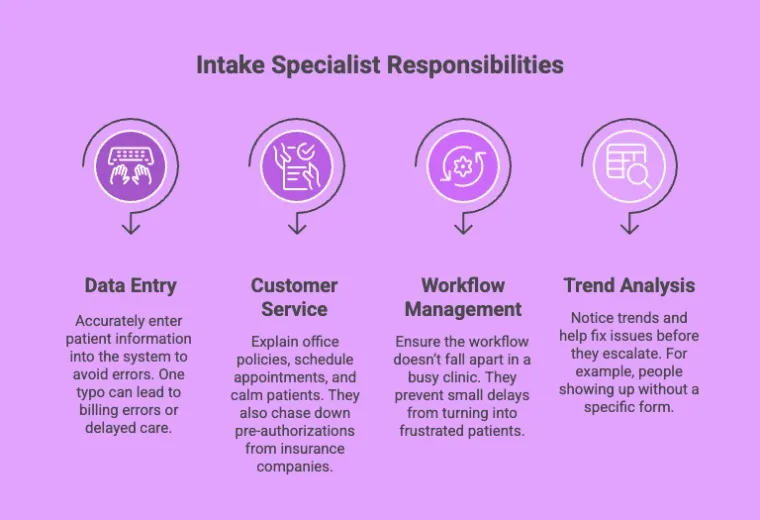
They answer phones, check insurance details, and make sure everything gets entered into the system correctly. Accuracy matters here. One typo can lead to billing errors or delayed care.
They’re also the ones who explain office policies, schedule appointments, and calm people down when things get confusing. Sometimes they even chase down pre-authorizations from insurance companies.
Intake specialists now streamline consent with an online signature, completing forms digitally before patient appointments.
And while everyone else is focused on medical care, the intake specialist is quietly making sure the workflow doesn’t fall apart.
If you’ve ever worked in a busy clinic, you know how one small delay can turn into an avalanche of frustrated patients. A good intake specialist stops that from happening.
They’re also often the first to notice trends “Hey, people keep showing up without this form” and they help fix it before it becomes a bigger issue.
Required Skills and Qualifications
A good patient intake specialist is half tech-nerd, half people-person.
They’re comfortable with EHR systems and insurance platforms, but they also know how to talk to people. Kindly, patiently, clearly.
You can train someone to use a software program. You can’t always train empathy.
They listen when patients talk. They catch small errors before they become big ones. They keep things professional even when someone’s yelling about a billing issue that isn’t their fault.
Most have a high school diploma, maybe a certification in medical administration. But the real skill? Adaptability.
Healthcare changes fast new software, new insurance rules, new everything.
They keep up. They learn. They figure it out.
That’s what makes them invaluable.
Benefits of Hiring a Patient Intake Specialist in Your Clinic

When you don’t have one, you notice.
Front desk staff get overwhelmed. Patients wait longer. Mistakes pile up.
When you do have one, it’s like the air clears.
Everything just… flows.
Patients feel seen. Staff aren’t drowning in paperwork. The doctor’s not wasting time waiting for missing info.
It’s one of those roles that pays for itself ten times over not just in money, but in sanity.
How to Improve Patient Experience and Satisfaction?
The first few minutes of a visit set the tone for everything.
If the patient’s greeted with warmth, if things move smoothly, they relax. They trust the clinic. They follow through with their care.
A patient intake specialist makes that happen.
They know how to communicate clearly. They double-check details so there are no surprises later. They make sure patients understand what’s next.
It’s not flashy work. But it’s the foundation of a great patient experience.
And here’s something most people don’t realize. When intake is handled well, patients actually get better care.
Because when admin chaos disappears, doctors can focus on the medical side. Everyone wins.
Enhanced Operational Efficiency and Reduced Administrative Burden
Let’s talk about what happens behind the scenes.
With a patient intake specialist, errors drop. Billing gets cleaner. Claims go through faster.
Without one, staff juggle too many things. Phones ringing, forms missing, patients waiting and that’s when mistakes happen.
When the intake specialist takes control, everything becomes smoother.
Wait times shrink. Staff can breathe. The whole system just works better.
And here’s a bonus, they often become the “go-to” person for feedback. They’re the ones who hear what patients love and what frustrates them.
That insight helps the clinic improve over time.
How to Integrate a Patient Intake Specialist Into Your Practice

Now, hiring one sounds simple. But doing it right takes thought.
It’s not just about filling a chair. It’s about reshaping how the front desk works.
You’ll need to adjust workflows, communicate clearly with the rest of the team, and check in regularly once the role’s in place.
But once you do it right? Everything gets better fast.
How to Integrate the Role into Your Practice Structure?
- Identify the problem areas. Start by asking: where are things breaking down right now? Are appointments running late? Are patients confused? Are billing errors common? That’s your roadmap.
- Involve your entire team. Bring everyone in. Billing, nurses, and admin. Make sure each department understands how the intake specialist supports their workflow.
- Provide proper training and tools. Train your intake specialist well. Give them the right software, communication tools, and a comfortable space to coordinate between staff and patients.
- Encourage and act on feedback. Listen to what your intake specialist observes. They’ll spot recurring issues before anyone else does. Fix those small things early, and you’ll see major improvements in how your clinic runs.
Measuring ROI and Success Metrics
Once your patient intake specialist is in place, start tracking changes.
- Shorter wait times? Check.
- Fewer billing errors? Check.
- Happier patients? Definitely.
But here’s the thing. It’s not just about the numbers.
You’ll feel the difference. The office will run smoother. The tension will drop.
Your staff will thank you. Your patients will notice.
And one day, someone will walk out of your clinic and say, “Wow, that was easy.”
That’s when you’ll know the role is working.
Patient Intake Outsourcing
Outsourcing patient intake means handing off check-ins, scheduling, and insurance verification to trained remote specialists. Here’s why it works:
- Virtual medical assistants handle intake tasks securely and accurately from off-site.
- They are HIPAA-compliant and trained to manage sensitive patient data.
- They free up in-house staff to focus on direct patient care.
- Practices reduce billing errors, cut wait times, and lower administrative overhead.
- It delivers the same reliability as an on-site specialist, without the added overhead of a full-time hire.
Top Skills for Patient Intake Specialists
Not everyone can do this job well. The best specialists combine technical ability with real people skills.
- EHR proficiency – comfortable navigating electronic health records and insurance platforms.
- Attention to detail – one typo can cause billing errors or delayed care.
- Empathy – patients are often stressed or scared; a calm, kind presence matters.
- Clear communication – they explain policies, next steps, and forms in plain language.
- Adaptability – healthcare rules and software change constantly; they keep up.
Virtual vs. On-Site Intake Specialists
Both options get the job done, but they serve different practice needs.
- On-site specialists are physically present, making them easier to loop into real-time team decisions and immediate patient interactions.
- Virtual specialists work remotely, offering flexible coverage, often at a lower cost.
- Both must be HIPAA-compliant and trained in data accuracy.
- Virtual options scale easily, useful for multi-location practices or after-hours coverage.
- On-site staff may have a slight edge in handling walk-in emergencies or reading in-person patient cues.
The right choice depends on your practice size, budget, and patient volume.
Trending Now
I’ve been reading about how AI is changing a lot of things in healthcare lately, and honestly, it makes sense. A lot of what doctors, nurses, and pharmacists do every day isn’t really “care”. It’s paperwork. Charting, billing, documenting… it’s nonstop. Now AI is stepping in to handle a lot of that. Big systems are already using massive data sets to make the process faster and cheaper.
But here’s what stood out to me: Technology can only do so much. If healthcare doesn’t change the way it works. AI might just create more busywork instead of fixing it. That’s the trap. The real win is when we use AI to give people more time for patients, not screens.
So if you’re in healthcare, this is the moment to lean in and learn it. The people who figure out how to work with AI are going to be the ones who stay ahead. Not the ones who get replaced by it.
FAQs: Patient Intake Specialists & Streamlined Healthcare Operations
What does a patient intake specialist do?
A patient intake specialist is the first point of contact for patients in a clinic or medical office. They collect personal, medical, and insurance information, verify details, and ensure everything is accurate before the patient sees the doctor. Their role keeps the entire patient flow organized and compliant with healthcare regulations.
Why is the patient intake specialist role so important?
They’re the backbone of operational efficiency in healthcare settings. A good intake specialist prevents scheduling mix-ups, insurance errors, and paperwork delays, saving time for both staff and patients while improving the overall experience.
How does having a patient intake specialist improve patient satisfaction?
A smooth check-in process helps patients feel calm and cared for. When information is correct and wait times are shorter, patients trust the clinic more and are more likely to follow through with their treatment plans.
What skills should a great patient intake specialist have?
They need a mix of technical and interpersonal skills, familiarity with EHR systems, strong attention to detail, empathy, and clear communication. Adaptability is key since healthcare processes and technologies change often.
How does a patient intake specialist reduce administrative burden?
By handling data entry, insurance verification, and patient coordination accurately, they allow medical staff to focus on patient care instead of paperwork. This leads to fewer billing errors and faster processing.
Can a virtual assistant perform patient intake tasks?
Yes. Trained virtual medical assistants (like those from HelpSquad) can securely manage patient intake, scheduling, and insurance verification remotely. They’re HIPAA-compliant, accurate, and empathetic, offering the same reliability as in-house specialists.
What tasks does a patient intake specialist perform daily?
They collect patient information, verify insurance, schedule appointments, enter data into EHR systems, and coordinate with clinical staff to keep the day running smoothly.
How can a patient intake specialist improve patient flow?
By ensuring all patient information is accurate and ready before appointments, they eliminate delays, reduce wait times, and keep the entire schedule on track.
Can a virtual assistant handle patient intake tasks?
Yes. Trained virtual medical assistants can remotely manage scheduling, insurance verification, and data entry while staying fully HIPAA-compliant.
What is the difference between patient intake specialists and medical receptionists?
Medical receptionists handle general front desk duties like answering phones and greeting patients, while intake specialists focus specifically on collecting medical histories, verifying insurance, and ensuring clinical staff have accurate patient data before each visit.
Final Thought
Every great patient experience starts before the doctor even walks in.
The patient intake specialist makes that happen.
They’re not just checking boxes they’re setting the tone for care, for trust, for everything that follows.
If you’ve got one on your team, take a minute to thank them.
They’re probably the reason your day runs as smoothly as it does.
Want a team that handles patient intake like that every day, every hour?
That’s what HelpSquad does.
Our trained, HIPAA-compliant virtual medical assistants manage patient intake outsourcing, scheduling, and insurance verification so your staff can focus on care, not paperwork. They’re real people, trained for accuracy, empathy, and confidentiality. The same traits that make a great in-house specialist.
If your practice could use that kind of steady support, let’s talk.
Ready to streamline your patient intake process?
Discover how HelpSquad’s virtual medical assistants improve check-in, scheduling, and insurance verification.

Maria, a BPO industry professional for a decade, transitioned to being a virtual assistant during the pandemic. Throughout her career, she has held various positions including Marketing Manager, Executive Assistant, Talent Acquisition Specialist, and Project Manager. Currently, she is a member of the marketing team as a Content Writer for HelpSquad. You may contact Maria on LinkedIn.