Medical Answering Services: Why Your Clinic Should Outsource
18 Aug 2025 By: Mary Dellosa
Updated

Medical answering services are external support teams that handle a clinic’s incoming calls, ensuring that every patient speaks to a real person, even after office hours. For example, if a patient calls at 2:00 AM with a high fever, the answering service can immediately patch them through to the physician on duty. This continuous coverage improves patient trust and relieves in-office staff from being tethered to the phone.
If you’ve worked many night shifts in a hospital, you know that medical emergencies don’t stop at 5:00 PM. Patients are often most anxious when the office is closed, and getting a voicemail can feel like a dead end. In this article, I will explain how medical answering services bridge that gap, providing your patients with 24/7 reassurance while allowing your clinical team to rest and recharge.
What Medical Answering Services Actually Do?
Medical answering services do not merely consist of phone operators. They provide support when your patients need reassurance, solutions, or simply a companion to hear their thoughts.
It might be a tired parent calling late at night, scared about a fever. Or a patient who forgot what you said and feels too nervous to ask again. They don’t want a machine. They want a kind voice that makes them feel safe.
These services learn how your clinic works. They speak like your team and care like your team. So even when you’re not there, your patients still feel like you are.
How to Improve Patient Experience and Retention?
When a patient rings up, it is possible that they are frightened, misunderstood, or merely needing the comfort of a nice voice. They do not want to interact with a robot. They require a person who hears and shows concern. Medical answering services guarantee that a live person is the one who answers the phone every time. Someone calm and kind who helps without rushing. That voice can ease fear fast.
It could be a parent worried at night or a patient with a simple question. No matter the reason, they feel heard and safe. These services learn how your clinic works and speak like your team. So even when you’re not there, your care is still felt.
24/7 Coverage for After-Hours and Emergencies
Health concerns don’t wait for office hours. A parent with a sick child at midnight or a patient feeling pain on a holiday needs to know someone is there. That’s where24/7 medical answering services come in. A human being, that is, a real one, takes the call even if your doors are shut. This person is kind, composed, and, above all, willing to assist you. They pay attention, comply with your clinic’s procedure, and are aware when it is time to notify the doctor or provide basic help.
It is not merely dealing with the phone, it is reassurance provided during a stressful situation. It is helping a person to feel less isolated no matter the hour.
Reduced Wait Times and Fewer Missed Calls
A clinic’s busy hours can lead to long wait times and missed calls. Every call that goes unanswered translates into one less patient assisted, one less appointment scheduled, one more treatment delayed, and one more patient unhappy.
In such situations of maximum call volume, clinic answering services come into play by taking the calls out of the clinic. They spread calls across trained staff, use smart systems to shorten wait times, and even offer callbacks so patients don’t have to sit on hold. These services also track call trends to spot busy times before they happen. That helps clinics plan ahead and stay ready.
Recording the details of calls, clinics get a clearer insight into what the patients require and request the most. Gradually, this being processed one call at a time, helps to make the care provided, scheduling and communication more effective.
Operational Efficiency and Staff Focus
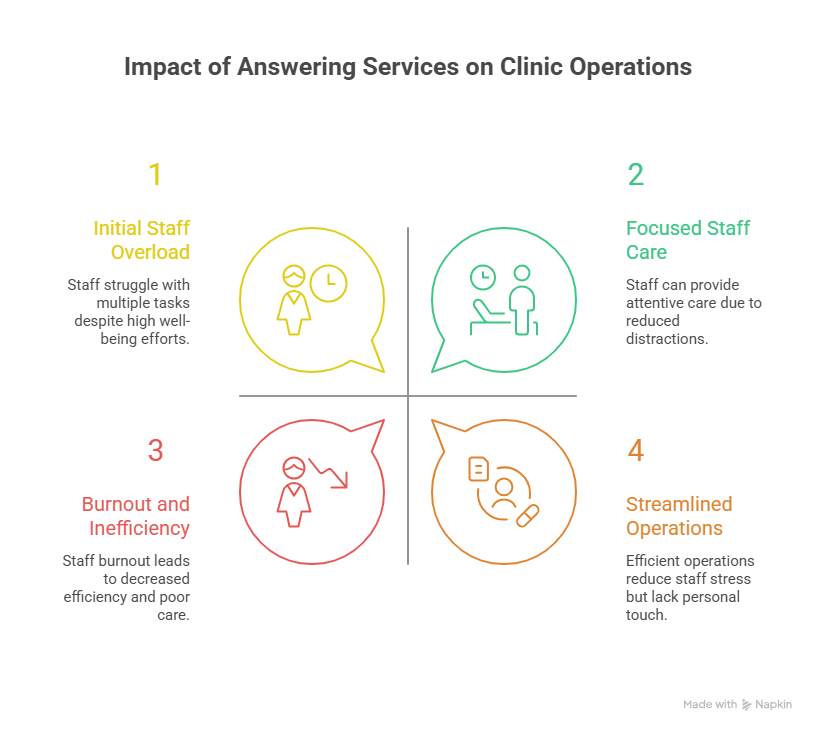
The clinic’s staff are whole hearted in their work and patients. They not only help the patients, but also render the best customer service. Each day, they try their best to give full attention to every patient no matter how busy the day is. However, the staff attending to the phone cannot give full attention to the patient being assisted as they are already performing multiple tasks at once.
Time spent by the staff with the patient is reduced for each call made to the clinic. Consequently, this hampers the workers to render the desired service; a service that has been described as tranquil, soft, and close. Every ring is another moment taken. Another pause in care. Another layer of pressure added to an already full day. It’s draining. And over time, it wears staff down.
That’s where medical answering outsourcing services come in. A real, kind voice picks up the phone, so your team can stay grounded, focused, and present. They get to breathe. They get to care. And patients on the phone and in person feel the difference. It’s not just help with calls. It’s help for your people. And that changes everything.
Streamlined Appointment Scheduling
Appointment scheduling wastes time. Answering services with scheduling tools can book, change, or cancel visits in the clinic’s system or through secure links. This avoids double bookings, stops errors, and fills open times faster. Some also offer online booking or reminders to lower no-shows and reduce admin work.
Lower Training and HR Burden
Hiring and training front-desk staff always require both time and money. Besides that, high turnover in healthcare makes it even tougher to find and train new employees. Outsourcing defaults HR costs by taking away the requirement to expand in-house teams. The answering service takes care of hiring, training, and checking, while the clinic receives professional assistance without any difficulties.
Cost-Effectiveness and Predictable Pricing
Cost plays a key role in every decision. Running an in-house call center means paying for staff, training, tools, and systems. These costs rise fast, especially for small clinics. Outsourcing turns these into fixed monthly fees that grow with use.
Answering services offer plans like pay-per-call, flat rates, or mixed models. Clinics can pick what fits their budget and call flow. For seasonal spikes, outsourcing offers a flexible way to avoid extra year-round costs.
Hidden Savings and ROI
Outsourcing brings real savings, often in ways you don’t notice right away. Fewer no-shows, quicker bookings, and fewer billing mistakes help bring in more money.
When staff spend less time on calls, they focus more on patients. That means smoother days and better use of everyone’s time. In the end, the gains often cover the cost.
Compliance, Privacy, and Security
Healthcare calls must follow strict privacy laws. Any outside service that handles patient info must meet legal and security rules.
Good answering services know the rules and protect data with encryption, secure portals, and strict access limits. Clear roles matter too. Contracts and BAAs explain how data is stored, shared, and protected.
Vendors should openly share their safety standards and how they handle issues. For clinics without strong systems, a trusted partner can boost data safety.
Standardized Protocols and Clinical Safeguards
Medical answering services use call scripts and triage steps to keep replies clear and safe. Nurses often handle tougher cases and follow set rules to guide care.
This setup cuts errors and helps patients get the right help, fast—especially in urgent situations. It brings calm and order when it matters most.
Scalability and Flexibility for Growth
As clinics grow, their call needs grow too. Outsourcing scales fast without big spending. Need weekend help or flu season support? The service adjusts quickly.
For clinics with many sites, it keeps calls and rules the same across all spots. That makes things smoother and easier to manage as demand changes.
Temporary and Special Event Support
Clinics often host events like vaccine drives or health fairs. These bring more calls and need quick changes in how calls are handled.
Answering services can step in during busy times so staff can focus on the event. Afterward, the service scales down, with no long-term cost.
Integration with Clinical Systems and Workflows
Modern answering services connect with health records and tools. This cuts manual work and lowers the risk of entry mistakes.
Messages link to patient charts and reach the right team fast. Doctors see full call history, which helps them give better care and stay on track.
Automated Call Routing and Smart Escalation
Smart answering systems route calls by time, urgency, or who’s on call. Emergencies go straight to doctors, while routine calls follow normal steps.
Urgent issues get quick help. Non-urgent ones stay organized. This keeps care fast, clear, and smooth for everyone.
Choosing the Right Answering Service
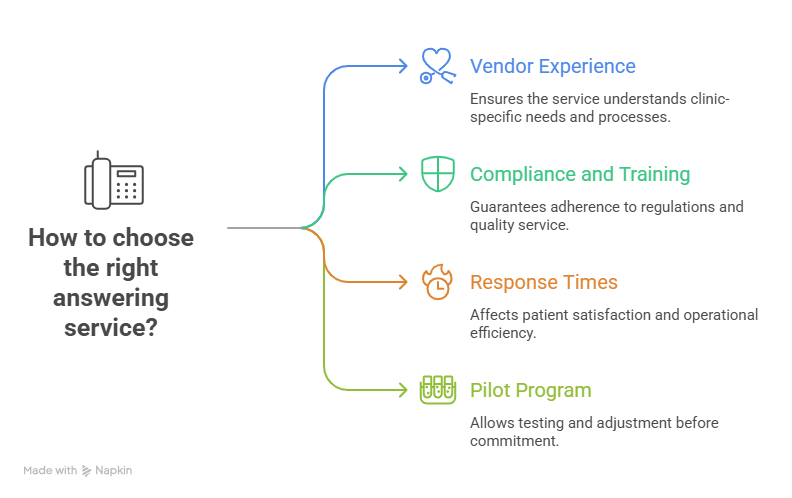
Choose an answering service with care. First, review your call volume, peak times, and common call types. Pick vendors with clinic experience like yours. Ask about training, compliance, triage, and response times.
Get references and case studies that show real results. Try a pilot program to test fit before signing long-term.
Key Questions to Ask Potential Vendors
When picking an answering service, ask if they’ll sign a BAA and how quickly they answer calls. Check how they handle busy times and if they offer nurse triage—and who does it. Find out how you’ll get messages, like through a portal, your EHR, fax, or phone. Ask what happens if their system goes down. Getting clear answers helps you choose a service that fits your clinic, keeps things running, and supports your patients.
Pilot Programs and Metrics for Success
Set clear goals before bringing on a vendor. Track things like answer time, call drop rate, calls handled without help, booking rates, and patient feedback. A short pilot program helps test all this and tweak things early. If the service doesn’t meet your needs, you can adjust or walk away without a long contract.
What are the Common Misconceptions and How to Address Them?
Some clinics think that outsourcing is a way to lose the personal touch co to the patients. This worrying can be reasonable, but if the setup is right, the patients can still be perceiving as appreciated and taken care of. Little things like nice hellos, well-finished process, and instant connection with your team play very important role.
Outsourcing isn’t just for big clinics. Small clinics get support they can’t always afford in-house. Big clinics save time and stay more organized. It all comes down to picking a good partner and setting it up to match how your clinic works.
Maintaining Brand and Patient Connection
Outsourcing can still feel personal. Use warm greetings and messages that sound like your team. Patients should feel like they’re calling your clinic, not a stranger.
If the service connects to your systems and gets proper training, it works like part of your team—not just a voice on the phone.
Ensuring Clinical Oversight
Outsourcing doesn’t mean losing control. It can actually make things stronger. Clear steps, regular checks, and shared reports keep everything open and easy to track.
Meet often with the service team to adjust as needed. This way, your staff stays in the loop without needing to answer phones themselves.
Real-World Benefits and Case Examples
When clinics use answering services, things just get easier. Calls are picked up fast, staff feel less pressure, and patients feel heard and helped.
People like knowing someone is there, even at night. Doctors can focus on care, not phones. With nurse help, patients get the right care without extra stress.
Implementation: Steps to a Smooth Transition
Setting up an answering service takes planning. Start by listing call types, busy times, and what’s not working now.
Next, decide how many people you need and set clear steps for messages, triage, and bookings. Make sure legal checks are done, like signing a BAA and reviewing data safety.
Training matters. Give them scripts, provider info, common questions, and contact lists. Start slow, track results, and ask staff and patients for feedback. Small early tweaks make a big difference later.
Communication and Staff Buy-In
Clear communication with your team helps ease concerns. Explain the benefits—fewer distractions, smoother workdays, and better patient support.
Show how calls will be handled and how issues will reach the right person. Ask for staff input early so the plan fits real needs. Keep everyone updated during the rollout to build trust and fix problems quickly.
Ongoing Evaluation and Continuous Improvement
After setup, keep checking how things are going. Meet with the vendor often to review call speed, quality, and patient feedback.
Update steps as your clinic grows or changes. Good teamwork includes fresh training, script updates, and solving problems together.
Trending Now
Doctors are experiencing rising levels of stress and burnout, with 88% of physicians on Sermo reporting feeling overworked at least occasionally and more than half saying it’s constant. Burnout shows up as exhaustion, emotional numbness, loss of purpose, and even cognitive decline, with many physicians admitting to skipping basic self-care due to patient load and relentless schedules. The main drivers of stress include overwhelming patient volumes, lack of administrative support, grueling call schedules, prior authorization battles, and digital overload from constant inbox demands.
Stress relief methods of some doctors include family, hobbies, and therapy, yet a majority hold that only the healthcare organizations’ system-wide reforms can bring about the change and most of them feel that the latter are not doing much currently. The burnout resulting from heavy workload, lack of support, and emotional strain will continue to be a threat to both physicians’ well-being and patient care quality unless proper structural reforms are implemented.
Final Considerations: Is Outsourcing Right for the Clinic?
Outsourcing medical calls can boost speed, cut admin work, and help clinics grow. It’s a smart move for clinics that want better service and steady costs.
Success depends on picking the right partner and setting things up well. With clear steps and teamwork, clinics can focus more on care while patients get fast, kind support every time they call.
Ready to give your patients the professional, 24/7 support they deserve? Partner with HelpSquad’s medical call answering services and let us handle the calls, while your team focuses on what matters most, quality care. Get started with HelpSquad today!
What are the main functions of a medical answering service for a medical office?
A medical answering service, in essence, handles the calls that come in when your personnel are not around. However, it is a service that does much more than just taking messages. The operators respond as your medical office, follow your procedures, advance and direct emergency calls, make or change appointments, pass on requests for prescription refills, and record every interaction. They treat every contact with the same smooth operator who is the front desk of your practice at night, and the flow and the manner of speaking are such that the patients think they are talking to your staff, not to the outside world.
In what ways can a medical answering service make patient experience and retention better?
Patients worried about something do not want their calls to go to voicemail but rather to a person. The attention of a medical answering service will ensure that a live sympathetic voice will be there to listen day and night. The engagement of the patient will not be one of being left silent, ignored, or transferred; rather, it will be one of being heard, reassured, and guided. The gradual partnership between the clinic and the patient, characterized by the lessened occurrence of missed calls, quicker responses, and warm, unvarying interactions, will finally result in the winning of trust, the lessening of frustration, and the increment of the patient’s likelihood of not only staying with the clinic but also recommending it to others.
What makes it so essential for medical practices to have 24/7 coverage?
Medical problems do not respect business hours. A parent at midnight whose child is ill or a patient with sudden pain on a holiday will be in need of the reassurance that someone is available to provide assistance. A medical answering service that operates 24/7 can coordinate your on-call and escalation schedules and thus provide full-time coverage for your clinic. Sometimes, non-urgent issues may be either resolved or logged, while true emergencies will be dispatched urgently, thus giving patients the assurance they need and at the same time safeguarding your practice against the potential loss of patients due to missed care.
In what ways do medical answering services contribute to lower staff burnout and also improve the efficiency of clinics?
Each call coming in can’t be permitted to interrupt the care given to the patient. When front-desk and clinical staff are trying to deal with phones, patients, and paperwork at the same time, the stress level increases and the attention level decreases. Outsourcing of calls allows the staff to concentrate on the patients that are physically present instead of continuously multitasking. The answering services take on increased call volume, deal with routine questions and scheduling, cut down on missed calls, and allow the staff to participate in more valuable work, thus, quality patient care is supported and burnout is decreased.
Is it true that a medical answering service can perform the function of appointment scheduling and thus lead to a reduction in no-shows?
Absolutely. A lot of medical answering services do connect with your scheduling system or operate through secure portals to book, confirm, reschedule, or cancel appointments just the way you would like them to. They assist in the filling of open slots, keeping a record of patient bookings to avoid overbooking and sending or triggering reminders which ultimately cut down on no-shows. This results in your schedule being fuller and more predictable and at the same time, your staff not getting stuck in the loop of endless phone tag.

Mary is an executive assistant with over 3 years of experience. She enjoys doing various tasks such as graphic design, video editing and content writing. She is on HelpSquad's marketing team and helps leverage the company's business for growth. You may contact Mary on LinkedIn: https://www.linkedin.com/in/gelai-dellosa/