Strategic Healthcare Outsourcing: From Cost Savings to Revenue Growth
15 Jan 2026 By: Maria Rush
Updated
Strategic healthcare outsourcing in 2026 goes beyond cutting costs by using external teams to protect revenue and improve the patient experience at the same time. It works best when outsourcing supports the patient journey—like virtual medical assistants handling scheduling, reminders, and insurance verification, and RCM partners improving clean-claim rates and reducing denials. For example, consistent reminder and follow-up workflows can reduce no-shows, while specialized billing support can speed collections and prevent revenue loss from avoidable claim errors.

From Cost Center to Strategic Asset: The New Role of Outsourcing
Patient support services used to be treated like overhead. Phones needed to be answered. Appointments needed to be booked. Bills needed to go out.
What changed is volume and complexity.
More patients. More digital touchpoints. More insurance rules. More compliance pressure. Meanwhile, staffing shortages keep getting worse.
According to the American Hospital Association, workforce shortages remain one of the top operational challenges for U.S. healthcare providers, especially in administrative and revenue-related roles.
Healthcare outsourcing stepped in not just to fill gaps, but to stabilize operations.
What does outsourcing now supports beyond cost savings?
- Consistent patient communication during staffing shortages
- Faster appointment scheduling and follow-ups
- Reduced administrative backlog for clinical teams
- More predictable cash flow through better process control
Outsourcing stops being a cost center when it helps protect revenue and improve patient experience at the same time.
What are the Key Areas of Healthcare Outsourcing Driving Growth?

Not all outsourcing delivers growth. The biggest gains come from roles that directly support patients and revenue at the same time.
Patient support services, virtual medical assistants, and revenue cycle management outsourcing are where that overlap happens.
Virtual Medical Assistants & Administrative Support
Virtual medical assistants quietly carry a lot of weight.
They handle scheduling. They send reminders. They verify insurance. They update records. Small tasks that prevent bigger problems later.
A 2024 report from MGMA showed that appointment no-shows cost healthcare practices thousands of dollars per provider per year. Reminder systems and follow-ups were cited as one of the most effective ways to reduce that loss.
From what I’ve seen, virtual medical assistants help:
- Reduce missed appointments through reminders and confirmations
- Speed up billing by ensuring documentation is complete
- Support front-desk teams that are already overloaded
- Keep patient support services running even during staff turnover
This is not just about saving on labor. It’s about keeping operations tight so revenue does not slip through preventable gaps.
Outsourced Patient Support Services and Experience
Patient support services are often the first and last interaction a patient has with a healthcare provider.
That first call. The reminder text. The billing question after a visit.
According to Press Ganey, patient experience scores are directly tied to patient loyalty and repeat utilization of healthcare services. When patients struggle to reach support, satisfaction drops quickly.
Healthcare outsourcing has allowed organizations to extend patient support without exhausting internal teams.
Outsourced patient support services commonly help with:
- Appointment scheduling and rescheduling
- After-hours call handling
- Billing and insurance questions
- Follow-up outreach and reminders
A Deloitte healthcare consumer survey found that patients value access and responsiveness almost as much as clinical quality. Faster responses lead to higher trust and better retention.
From experience, when patients feel supported, they cancel less, return more often, and are less likely to leave for another provider.

Revenue Cycle Management (RCM) and Billing Services
Revenue cycle management outsourcing is where the financial impact becomes obvious.
Billing issues rarely come from one big mistake. They come from small breakdowns across the patient journey.
The Healthcare Financial Management Association (HFMA) reports that denied claims and delayed payments remain one of the biggest revenue risks for providers, especially when staffing is inconsistent.
Revenue cycle management outsourcing helps by:
- Improving claim accuracy and clean-claim rates
- Reducing denial backlogs
- Speeding up payment timelines
- Supporting compliance with payer rules
A study cited by Becker’s Hospital Review noted that healthcare organizations using specialized RCM partners often see measurable improvements in days in accounts receivable and overall collections.
This is what revenue integrity in healthcare looks like in practice. It is not aggressive billing. It is making sure earned revenue is not lost due to process failure.
Domestic vs. Offshore: Finding the Right Balance
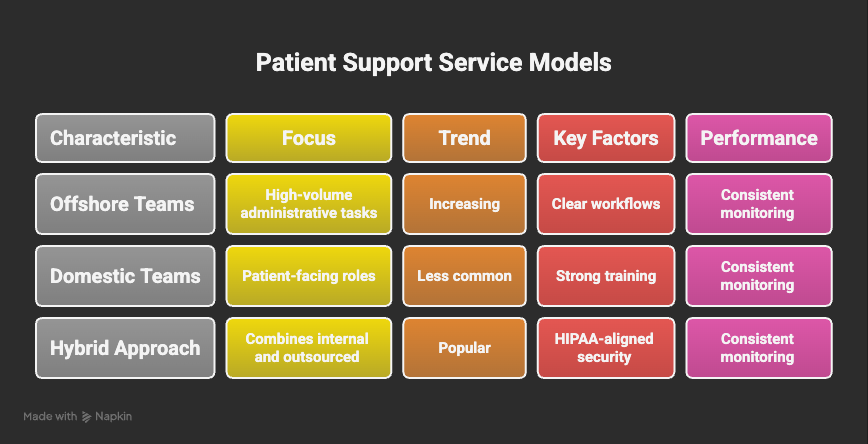
There is no single right model for patient support services.
Some healthcare organizations use offshore teams for high-volume administrative tasks. Others keep more patient-facing roles domestic. Many use a hybrid approach.
Deloitte’s 2024 Global Outsourcing Survey shows that organizations across industries are increasingly balancing traditional outsourcing with insourcing and global in-house centers to create a more flexible, value-driven sourcing model. This broader trend supports why many healthcare providers are now adopting hybrid approaches that combine internal teams with outsourced partners.
What matters most is:
- Clear workflows
- Strong training
- HIPAA-aligned security standards
- Consistent performance monitoring
I’ve seen both offshore and domestic teams succeed when expectations are clear and communication is strong.
Conclusion

Healthcare outsourcing has evolved because it had to. Staffing shortages, rising admin complexity, and patient expectations made the old model unsustainable.
From my experience, outsourcing works best when it strengthens the entire patient journey. When patient support services, virtual medical assistants, and revenue cycle management outsourcing work together, revenue integrity in healthcare becomes easier to maintain.
By outsourcing the right things, healthcare teams can focus on care while the business stays stable.
If you’re exploring better patient support services and want to see what’s possible, let’s talk.
FAQs
What is the role of patient support?
The role of patient support is to help patients navigate their healthcare experience before, during, and after care. This includes appointment scheduling, reminders, answering questions, billing support, and follow-up communication.
What is hospital operations and patient support service?
Hospital operations and patient support services refer to the non-clinical functions that keep a healthcare organization running smoothly. These include patient access, call handling, scheduling, registration, billing inquiries, and coordination between departments.
What is support outsourcing?
Support outsourcing is the practice of using third-party providers to handle operational or administrative functions instead of managing them fully in-house.
In healthcare, this often includes patient support services, administrative work, and revenue-related processes.
What is revenue cycle management?
Revenue cycle management is the financial process healthcare providers use to track patient care episodes from registration and insurance verification through billing and final payment.
Healthcare RCM includes coding, claims submission, denial management, payment posting, and collections.
How do we know the information in this article is reliable?
This article is based on established definitions and trends from recognized healthcare organizations such as the American Hospital Association (AHA), Healthcare Financial Management Association (HFMA), Press Ganey, AHRQ, and Deloitte, combined with real-world operational experience in healthcare and BPO environments.

Maria, a BPO industry professional for a decade, transitioned to being a virtual assistant during the pandemic. Throughout her career, she has held various positions including Marketing Manager, Executive Assistant, Talent Acquisition Specialist, and Project Manager. Currently, she is a member of the marketing team as a Content Writer for HelpSquad. You may contact Maria on LinkedIn.