Patient Satisfaction & Practice Growth: How Outsourcing in 2026 Makes Both Possible
08 Apr 2026 By: Mary Dellosa
Updated

Outsourcing administrative tasks significantly improves patient satisfaction by reducing wait times, ensuring 24/7 accessibility, and allowing providers to focus entirely on clinical care. By leveraging specialized external teams for scheduling and inquiries, practices can offer a more responsive “always-on” experience that meets modern patient expectations for immediate communication.
Growing a healthcare practice without burning out your team is one of the hardest things to get right. But more clinics are finding a way to do both and it starts with letting go of the wrong tasks. Patients notice when someone is rushed. They also notice when they’re not. That difference is worth protecting as you grow.
The “Scaling Paradox”: Why Growth Often Hurts Patient Satisfaction
Nobody opens a practice wanting to frustrate their patients. But growth has a sneaky way of doing exactly that. More patients means more of everything and it all lands on the same team. Your staff absorbs it quietly, until they can’t anymore. Calls take longer, mistakes happen and patients feel that shift in the hurried tone, the distracted energy, the sense that everyone around them is just trying to get through the day.
Recent data shows that the strain on healthcare teams is no longer the exception, it’s the norm. With 84% of professionals reporting understaffing, 76% experiencing burnout, and 66% considering leaving the field, many practices are being pushed to operate beyond their limits. Too often, the solution has been to ask already stretched teams to carry even more.
Outsourcing offers a different path one that eases the load without expanding payroll. When administrative pressure is lifted, your staff can finally breathe again, and your patients can feel the difference.
3 Ways Outsourcing Boosts Your Patient Satisfaction Scores
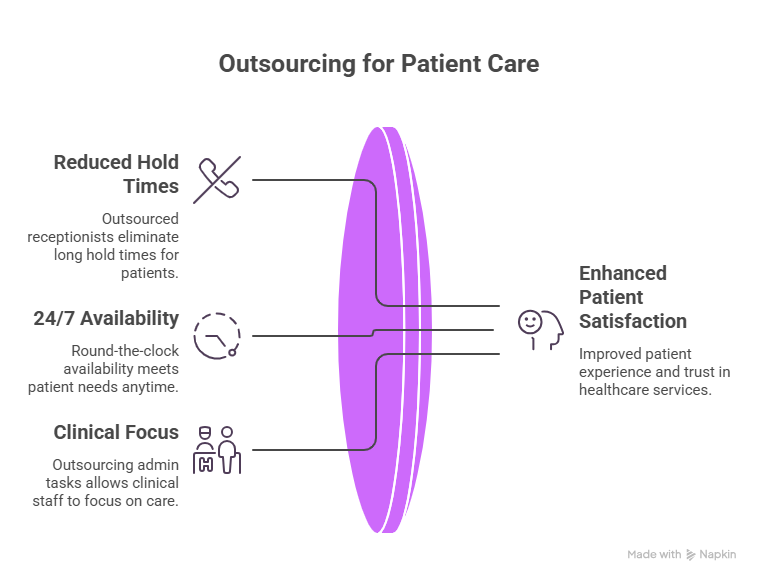
1. Elimination of “Hold Time” Fatigue
We have all felt the quiet frustration of being stuck on hold, watching the seconds tick by and wondering if someone will ever return. It is a small moment, but it speaks volumes about how a practice values a patient’s time and for a patient who may have taken days to finally make that call, it says exactly the wrong thing.
One of the top reasons patients leave isn’t a bad appointment or a billing mistake. It’s a phone that rang too long. Your front desk team isn’t the problem. They just can’t do everything at once, greet the walk-in, handle the insurance call, and answer the phone all at the same time. So the phone waits. And so does your patient.
An outsourced receptionist has one focus: the person calling. They pick up, they listen, and your patient hangs up feeling like they actually matter.
2. 24/7 Availability in a “Right Now” World
Patient needs do not follow a 9 to 5 schedule. A parent concerned about a child’s fever at 10 PM, a new patient trying to book their first appointment on a Sunday morning, or a follow-up question after an afternoon procedure. These moments matter, and they happen outside of business hours.
80% of healthcare executives identify 24/7 digital accessibility as a leading driver of both patient satisfaction and revenue growth. Practices that are reachable after hours retain more patients simply because they are available when competitors are not. An outsourced support team makes round-the-clock coverage economically viable for practices of any size.
3. Returning the “Care” to Patient Care
When your clinical team is buried in admin work, they’re physically in the room but mentally somewhere else. Patients can feel that even if no one says anything about it.
Take that weight off their plate and something changes. Doctors slow down. Nurses have a moment to actually check in. A routine visit starts to feel like someone genuinely cares about the person sitting on that exam table. That’s the difference between a practice people tolerate and one they trust.
Maintaining Quality: HIPAA and the Human Touch in 2026 Outsourcing
A common concern among providers considering outsourcing is compliance. It’s a question worth asking out loud: can an outside team really be trusted with your patients’ personal health information? That hesitation makes complete sense. But with the right partner, the answer is yes.
Reputable healthcare outsourcing companies are legally bound to protect patient data through a Business Associate Agreement, a requirement under HIPAA that holds them to the same strict privacy standards your practice is already held to. This isn’t a handshake deal. It’s a legal commitment with real accountability behind it.
They use encrypted systems and follow strict protocols for every single patient interaction. Compliance isn’t an afterthought for them. It’s the foundation of what they do. But the part that surprises most practice owners isn’t the security. It’s how seamless the experience feels for patients.
The best outsourcing partners don’t try to stand out. They just make sure your patients always feel like they reached exactly the right person. As 2026 standards continue to evolve around data security and patient privacy, working with a HIPAA aligned BPO partner is not just a compliance checkbox but a trust signal to your patients that their information is always protected.
In-House vs. Outsourced Support: A Side-by-Side Comparison
| Factor | In-House Team | Outsourced Support |
|---|---|---|
| Availability | Business hours only | 24/7, including weekends and holidays |
| Cost | Full salary, benefits, taxes, office space | 30% to 70% lower overhead |
| Scalability | Limited by hiring timelines | Scales on demand |
| Response Time | Varies with daily volume | Consistently fast |
| Staff Burnout Risk | High during growth phases | Reduced for on-site clinical staff |
| HIPAA Compliance | Managed internally | BAA-covered, encrypted systems |
| EHR Integration | Dependent on training | Direct integration with Epic, Athenahealth, and others |
The numbers are hard to ignore. Healthcare practices that outsource their administrative support typically save anywhere from 30% to 70% compared to building and maintaining an in-house team. And that’s before you factor in everything that doesn’t show up on a job posting, the weeks spent recruiting, the time lost to training, the benefits, the desk space, the turnover. When you add all of that up, the gap between the two approaches becomes very difficult to justify.
Is Your Practice Ready to Scale with Outsourced Support?
Every practice is different, but some things have a way of nagging at you:
- A patient called, never got through, and booked somewhere else before anyone even noticed.
- Your team is working hard and still falling behind. Good people are burning out and moving on.
- The care is good, but something in the experience keeps letting it down and patients are starting to feel it.
- No-shows have become a weekly frustration because reminders keep slipping and nobody has time to follow up.
- You know where you want to take this practice, but another full-time salary just isn’t in the cards right now.
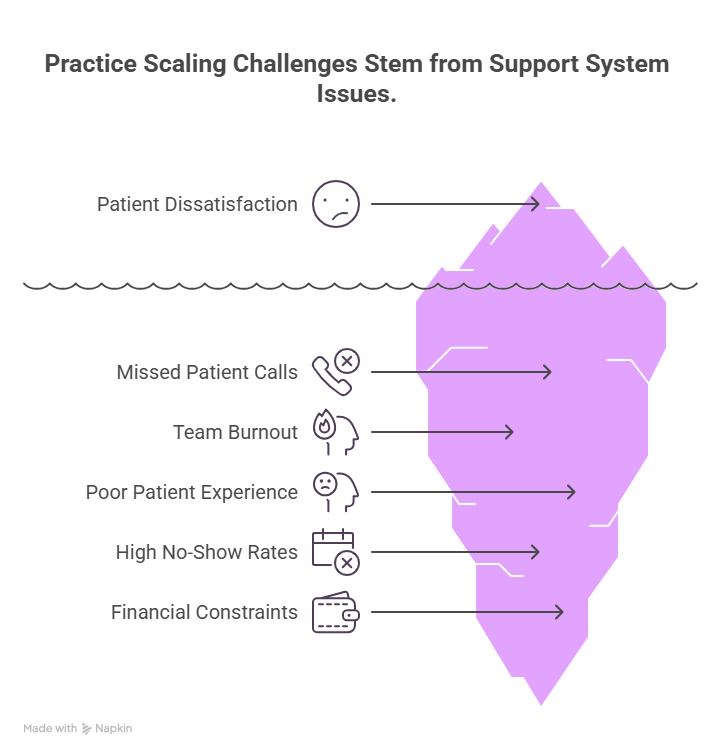
If any of this sounds familiar, the problem isn’t your care. It’s that your support system is running on fumes.
Frequently Asked Questions
How does outsourcing improve patient satisfaction?
Outsourced support ensures every call is answered immediately, reducing wait times and providing 24/7 access, which are key drivers of satisfaction.
Will my patients know they are speaking to an outsourced service?
No. Professional agents are trained to act as a seamless extension of your office, using your specific scripts and tone.
Is healthcare outsourcing HIPAA compliant?
Yes. Reputable providers sign a Business Associate Agreement (BAA) and use encrypted systems to protect PHI.
Can an outsourced assistant handle complex medical scheduling?
Yes. Assistants can integrate directly into your EHR/PMS, including Epic and Athenahealth, to manage appointments in real-time.
How does outsourcing help reduce staff burnout?
By offloading administrative tasks like billing and scheduling, your on-site clinical staff can focus entirely on patient care.
Does outsourcing help reduce appointment no-shows?
Yes. Outsourced teams manage proactive outreach, including personalized phone and SMS reminders.
Can I outsource patient support for specialized practices?
Yes. Many BPOs offer agents trained in specific medical terminologies for specialties like dermatology or mental health.
Is it more cost-effective to hire in-house or outsource?
Outsourcing typically saves 30% to 70% in costs by eliminating overhead like benefits, taxes, and office space.
How does 24/7 support impact patient retention?
Patients are more likely to stay with a practice that is reachable after hours, preventing them from calling a competitor.
What is the difference between an answering service and a virtual receptionist?
An answering service takes messages. A virtual receptionist books appointments, verifies insurance, and resolves issues in real-time.
The Bottom Line
Most patients don’t leave because of a bad appointment. They leave because they couldn’t get through on the phone, or nobody followed up, or the experience just felt harder than it should be. In 2026, being reachable isn’t a nice to have. It’s part of the care.
Outsourcing isn’t a shortcut or a sign that something is broken. It’s a decision to protect the patient experience as you grow and the numbers back it up. The global hospital outsourcing market is on track to hit $508 billion this year, growing nearly 11% year over year. The practices winning in that landscape aren’t just growing fast. They’re growing smart.
Your patients deserve a practice that’s always there when they need it. HelpSquad can make that happen. Book your discovery call and find out how outsourced support can transform your patient experience, reduce burnout, and fuel the kind of growth that doesn’t come at the cost of your care.

Mary is an executive assistant with over 3 years of experience. She enjoys doing various tasks such as graphic design, video editing and content writing. She is on HelpSquad's marketing team and helps leverage the company's business for growth. You may contact Mary on LinkedIn: https://www.linkedin.com/in/gelai-dellosa/