AI in Medical Coding 2026: Accuracy, Compliance and Human Review
Key Points
- Coherent Market Insights' March 2026 forecast says autonomous coding engines reach up to 95 to 98 percent accuracy, a vendor-market claim no independent audit has confirmed.
- In October 2025, CMS finalized a -2.5% efficiency adjustment in the CY 2026 Medicare Physician Fee Schedule for services including surgical procedures, diagnostic imaging interpretation and orthopedic services.
- The FY 2026 ICD-10-CM Official Guidelines state that following them when assigning diagnosis codes is required under HIPAA, so a guideline error is a compliance problem.
Quick Answer
AI in medical coding reads clinical notes and suggests ICD-10-CM, CPT and HCPCS codes. A trained person must still review every entry before submission. Denials, liability and audit risk stay with the practice, not the software.
That review matters more now. Medicare's 2026 fee schedule, finalized in 2025, trimmed pay for procedure-heavy services. Outside help can be set up without guesswork: HelpSquad builds a playbook from the practice's own rules and goes live only once the practice is satisfied with mock-call performance.

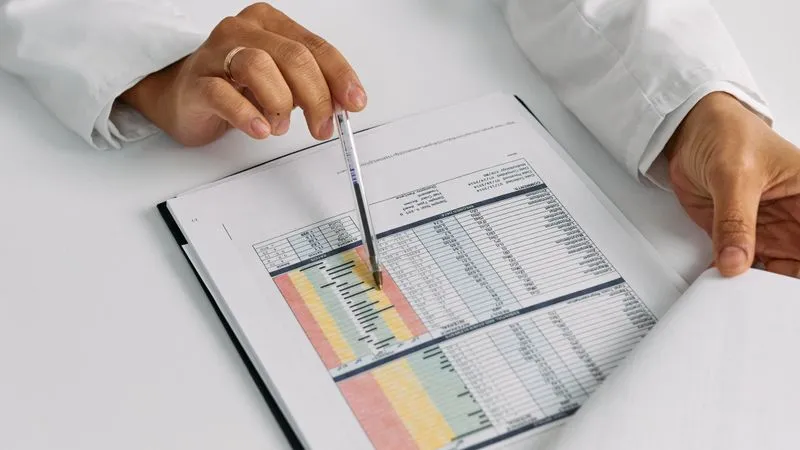
A trained reviewer at her desk checks the work on screen before anything goes out.
Can software code your claims for you? Partly. AI reads a clinical note fast and drafts ICD-10-CM, CPT and HCPCS codes. It cannot always tell what the visit was really about.
The AMCI Medical Coding Institute put the stakes plainly in a 2024 training video: inaccurate coding can cause "denied claims delayed payments" and "even Financial penalties." Its speakers also explained that when a diagnosis is uncertain, coders report the documented symptoms instead, because "you can't code for what you don't know for sure." That is a judgment call, not a lookup.
This guide covers what changed in 2026, how accurate the tools really are, where a person has to step in, and what review costs. My position is simple. AI drafts the codes. So ask one plain question of any setup: who signs off on each code before the claim leaves your office?
AI in medical coding is software that reads clinical notes and suggests ICD-10-CM, CPT and HCPCS codes. It is fast. It is not the final word. A university career program describes the setup most organizations actually run: natural language processing reads the documentation, machine learning spots patterns in past claims, and computer-assisted coding proposes codes for a certified coder to review.
Is any of this new? Not really. In a 2023 video, one coding educator recalled a note-reading tool for E/M codes that "was not as accurate as we had probably wanted it to be." With Medicare trimming payment on procedure-heavy services under its 2026 fee schedule, every unchecked code is money at risk. The research section below walks through what the accuracy numbers do and do not prove.
Questions this article answers
Which video shows what a human coder checks that AI can miss?
A beginner video from a medical coding school walks through ICD-10-CM lookups, first-listed diagnoses and excludes notes. Those are the judgment calls a reviewer makes on every AI suggestion.
I would hand this video to any office manager before they sign off on a coding tool. It shows why the work is more than matching words to codes. Watch these moments:
- 1:19: how codes justify medical necessity and set what the provider gets paid
- 2:41: the lookup sequence, from main term to Alphabetic Index to Tabular List
- 5:14: why the first-listed diagnosis is what the visit was mainly about, not the most serious condition
- 6:37: coding symptoms when a diagnosis is uncertain, and how Excludes1 and Excludes2 notes differ
- 9:16: where the speakers see AI helping and where a human coder still decides
One coding writer sums up the same point in 2026: "The future is often a hybrid model combining both." I agree. If your practice is weighing an in-house hire against outside review, and Medicare's 2026 fee schedule has already trimmed pay for your procedures, this is the skill set you are paying for.
What changed in medical coding for 2026?
Three rule sets moved in 2026: new CPT codes, a new ICD-10-CM guideline year and Medicare payment cuts. AI coding tools built on 2025 assumptions are already behind.
Before you trust any AI coding suggestion this year, check these four things:
- Does the tool load the AMA's CPT 2026 code set, which added 288 new codes along with revisions and deletions?
- Does it apply the FY 2026 ICD-10-CM Official Guidelines, effective October 1, 2025 through September 30, 2026?
- Has it been updated for the FY 2027 ICD-10 files, effective October 1, 2026?
- Does a person review claims for the services most exposed to Medicare's 2026 payment changes?
When I verified medical claims and billing codes at Optum, one lesson stuck: a code is only correct against the rulebook in force on the date of service. That rulebook was rewritten again this year. Why does this matter for AI? Because, as UTSA explains, machine learning identifies coding patterns from historical claims, and history reflects last year's rules.
Payment pressure rose too. In October 2025, CMS finalized a -2.5% efficiency adjustment in the CY 2026 Medicare Physician Fee Schedule for surgical procedures, diagnostic imaging interpretation, outpatient interventions, interventional pain management and orthopedic services. Time-based services such as office visits and behavioral health therapy were excluded. Lower payment per service means each denied claim takes a bigger share of margin.
The common assumption is that AI software keeps itself current. It does not. The official guidelines state that adherence when assigning ICD-10-CM codes is required under HIPAA, so someone must confirm the tool follows this year's version. A review of 5 sources behind this section points the same way: the rules change every year. Currency matters more than speed.
Adding in-house staff to keep pace is costly. HelpSquad's February 2026 baseline puts a full-time in-house medical receptionist at about $55,000 to $70,000 a year fully loaded, counting salary, benefits, payroll taxes and overhead. That is why many practices first map what to outsource in a medical practice before adding headcount.
In summary, 2026 rewards the practice that checks every code against current rules, not the one that codes fastest.
How does AI medical coding actually work?
AI medical coding reads the chart, matches documented terms to likely codes and sends its suggestions to a certified coder. Four technology layers share that work.
Each layer has one job:
- Natural language processing (NLP) interprets physician documentation and pulls clinical information out of the EHR.
- Machine learning (ML) identifies coding patterns from historical claims.
- Computer-assisted coding (CAC) software suggests ICD-10-CM, CPT or HCPCS codes for certified coders to review.
- Intelligent automation flags missing documentation, spots inconsistencies and prioritizes claims before submission.
Let's walk one note through those layers. A follow-up office visit documents type 2 diabetes mellitus and essential hypertension. NLP picks out both terms. ML compares them with similar past claims, and CAC proposes diagnosis codes plus a visit code. Automation then checks for gaps, and some EHR-integrated tools will even flag a code with a missing digit. Then a coder decides.
Is any of this new? Not really. Epic has offered applications that read a clinical note and return coding suggestions for a long time. One longtime coding educator recalls an in-house tool staff called "the wizard," which suggested E/M codes but "was not as accurate as we had probably wanted it to be."
A university career program sums up the pattern well: these systems "excel at identifying patterns. They struggle with understanding context." I read that as the whole story in two sentences. AI drafts faster. It does not judge better.
With Medicare trimming payment on procedure-heavy services this year, the automation layer that catches gaps before a claim leaves is the one I would value most. It's worth noting that this layer still hands its flags to a person. That person can sit in-house or on a HIPAA-compliant healthcare BPO team; HelpSquad, for example, pairs AI tools on its LiveHelpNow platform with bilingual agents across the US, Europe, Central America and South Africa.
In summary, AI coding is an evolution of tools coders have used for years: four layers that speed up the first draft, with the final call still made by a human.
Computer-assisted coding vs autonomous coding: which model are practices using in 2026?
Most practices use computer-assisted coding, where AI suggests and a human finalizes. Autonomous coding, where AI finalizes and humans see only flagged cases, is growing but still uncommon.
The difference comes down to one question: who signs off on the code? In AI-assisted coding, the software suggests codes from clinical documentation and a human coder reviews, verifies and finalizes them. In fully automated coding, the AI extracts the data, selects the codes and finalizes them, and a human steps in only when a case is flagged as high-risk or uncertain.
| Feature | Computer-assisted coding (CAC) | Autonomous coding |
|---|---|---|
| Who finalizes the code | Certified coder | The AI system |
| When a human reviews | Every encounter | Only flagged high-risk or uncertain cases |
| Main risk | Slower throughput | Unnoticed errors on cases that were never flagged |
| Typical fit | Complex, specialty and mixed caseloads | High-volume, routine outpatient visits |
| Accuracy evidence | Rests on the coder's review | Mostly vendor-reported |
Which model dominates? One market forecast projects integrated CAC software at 66.1% of the medical coding software market in 2026. The same report says autonomous engines from 3M Health Information Systems, Nym Health and Maverick Medical AI reach "up to 95-98 percent accuracy with little human intervention." The research section below tests that figure. Nym, for its part, extended autonomous coding to inpatient professional services back in November 2023.
UTSA's assessment is more sober: fully autonomous coding "remains uncommon." Even a software developer promoting automation conceded in 2025 that the fully automated model "may still carry a high risk of unnoticed errors."
My recommendation for most practices is CAC with review on every claim. Autonomous coding can make sense for very routine, high-volume outpatient work. Even then, someone should sample its output. Both models can be useful, depending on your case mix and how much audit risk you can absorb.
The same split already shows up at the front desk, where AI answers routine questions and trained people handle exceptions, as with healthcare call center teams for practices. Coding is following that pattern.
In summary, ask any vendor which model its tool runs by default, and which encounters it finalizes without a coder ever seeing them.
AI suggestion:   hypertension diagnosis code
Code set check:  current ICD-10-CM file   → PASS
Note support:    treated this visit?       → UNCLEAR
Sequencing:      first-listed reason?      → HOLD
Action:          query provider, do not submit
As coding educator Victoria puts it, "Coding isn't just this equals this code." The highlighted HOLD line is the point. The software found a valid code. Only a person asked whether the note supports it.
How accurate is AI medical coding compared with certified coders?
AI coding handles routine, repetitive cases well but misses documentation nuance and complex code combinations. No independent benchmark in 2026 shows it matching certified coders on complex work.
Start with what the evidence does show. Gauri Chavan's 2026 comparison of automated and manual coding puts it in one line: automation "can reduce repetitive errors but may miss documentation nuances." Experienced coders, by contrast, interpret complex cases more accurately. The same comparison finds that automation supports compliance checks but "still needs oversight."
| Dimension | Automated coding | Certified human coder |
|---|---|---|
| Speed | Faster on large data volumes | Slower, line-by-line review |
| Accuracy | Fewer repetitive errors, misses nuance | Stronger on complex cases |
| Compliance | Supports checks, needs oversight | Stronger in audits and compliance reviews |
| Best fit | Routine cases | Complicated diagnoses and specialty coding |
What happens when someone actually tests a general AI tool? One coding educator with more than 15 years in the field ran real cases through ChatGPT and reported that "the majority of them it's missed things," especially combination codes, which carry large financial consequences. To an untrained eye the output looked right. To a trained expert it did not.
That last point is the one I keep coming back to. The host of the Contempo Coding channel put it bluntly: "without having skilled coders there's no way to tell if what is being outputted by AI is of any quality." In other words, accuracy is not something the software can certify about itself.
When I verified claims and billing codes at Optum, I learned that speed and correctness are different skills. Automated systems process data quickly. They do not have clinical intuition, the sense that a note reads wrong even when every keyword matches. That gap is exactly where denials start.
It's important to note what the evidence does not show. Vendor accuracy figures exist, but none in this research come from an independent audit comparing AI against certified coders on the same charts.
In summary, treat AI accuracy as strong on routine volume and unproven on complexity, and plan your review effort around that split.
Is a vendor's accuracy score good enough to skip human review?
Up to 95 to 98 percent accuracy, with little human intervention: a 2026 market report says some autonomous coding engines already deliver that. We went looking for whoever had checked the number.
The figure comes from Coherent Market Insights' March 2026 forecast for the medical coding software market. It sits in a sentence naming three software companies said to be "implementing autonomous coding engines" connected to electronic health records. The report does not say who measured the accuracy or how. Nothing else we collected offers an independent test of autonomous engines against certified coders. The setup it describes is also unusual. In June 2026 the University of Texas at San Antonio, which runs a billing and coding certification program, wrote that fully autonomous coding "remains uncommon."
Up to 95 to 98 percent
What the report states: autonomous coding engines connected to health records reach this accuracy "with little human intervention." What it leaves out: who ran the test, which kinds of claims were scored, what the engines were compared against, and which year's code set applied.
Why is outside testing so scarce? Victoria, a coder with more than 15 years in the field who hosts the Contempo Coding channel, gave one reason in 2025. Most AI coding systems are proprietary and built for specific software or health record systems. Because they work on patient charts, outsiders "can't really see them in action."
So we turned to coders who had tested AI on their own cases. Victoria ran cases through ChatGPT herself, and "the majority of them it's missed things," she said, especially combination codes, "which can have some huge financial ramifications." To the untrained eye the output looked right, she said, but "to a trained expert it did not." ChatGPT is a general chatbot, not a purpose-built coding engine, and her test was informal. Her test shows what a trained reviewer catches. It cannot show how often commercial tools fail.
Purpose-built tools have a mixed record of their own. In a 2023 episode on the same channel, the host described a tool that staff at a former employer called "the wizard." It read a clinical note and suggested the evaluation and management code. It "was not as accurate as we had probably wanted it to be," the host said, and added a broader warning: "without having skilled coders there's no way to tell if what is being outputted by AI is of any quality."
A single average also cannot show which errors matter. On inpatient claims from general acute care hospitals, CMS requires a Present on Admission indicator for every diagnosis. For selected hospital-acquired conditions, one letter decides whether Medicare pays the higher CC/MCC DRG.
| POA indicator | What it means | CC/MCC DRG paid for selected HACs? |
|---|---|---|
| Y | Present at admission | Yes |
| N | Not present at admission | No |
| U | Documentation insufficient to determine | No |
| W | Clinically undetermined | Yes |
| 1 | Unreported or not used, exempt from POA reporting | No |
Look at U and W. In both cases the record leaves open whether the condition was present on admission. A W means the provider could not determine it clinically, and CMS pays. A U means the documentation fell short, and CMS "will not pay the CC/MCC DRG for those selected HACs." Telling the two apart means reading the chart for context, and UTSA describes AI tools this way: "They excel at identifying patterns. They struggle with understanding context."
A percentage also comes without a date. Coders are required under HIPAA to follow the ICD-10-CM guidelines, and those guidelines are reissued every fiscal year. Since October 1, 2026, CMS has pointed coders to the FY 2027 diagnosis files, which apply to encounters through September 30, 2027. Its current procedure code files cover discharges only through March 31, 2027. Even an honest accuracy score describes a code set that has since changed.
When we traced the 95 to 98 percent figure back, it turned out to be the least tested number in the story. Against it stand coders who tested AI on their own cases and found misses on combination codes and E/M levels, payment rules that turn on one POA letter, and a rule book that changes every October. An average can be very high and still say nothing about the claims where the money is. Whatever the tool scored, a practice cannot pass an overpayment back to "that robot over there," as the 2023 host put it. In 2026, Victoria gave new coders advice that fits practices too: "Be the person who knows when the computer is wrong." We staff the trained reviewers this article recommends, so we have a stake in that conclusion. The CMS rules apply no matter who does the checking.
- Ask any coding vendor who measured its accuracy figure, on which claim types, against which coders and under which code year.
- Before relying on a tool, have a certified coder compare its suggestions with your own past claims, including combination codes and E/M levels.
- On inpatient claims, have the reviewer check the POA indicator on every selected hospital-acquired condition, and ask whether a provider query is needed before a U goes out.
- Ask which ICD-10-CM year the tool's suggestions reflect, and confirm it moved to the FY 2027 files for encounters from October 1, 2026.
How we checked this
We traced the accuracy figure to a 2026 market research report. We read CMS pages on POA indicators and ICD-10 files, the CDC and NCHS coding guidelines for FY 2026, a university article on AI-assisted coding, and three videos from a coding educator. No figures in this section come from our own data. The market report gives no testing method. The coders' tests are informal accounts, and one used a general chatbot rather than a commercial coding engine. UTSA promotes a coding certification program, the video channel trains coders, and we sell human review services, so all three of us have a stake. Still unknown: how autonomous engines perform against certified coders on complex claims in an independent test, and how often POA errors reach payers.
- Coherent Market Insights, medical coding software market report, March 17, 2026.
- University of Texas at San Antonio, article on human expertise in AI-assisted coding, June 1, 2026.
- Contempo Coding, video on AI in medical coding, January 16, 2025, at 2:48 and 4:14.
- Contempo Coding, discussion of AI coding tools, May 19, 2023, at 21:06 and 34:11.
- Contempo Coding, guide for new medical coders, August 20, 2026, at 22:42.
- Centers for Medicare & Medicaid Services, POA indicator coding and payment page, last modified July 31, 2026.
- CDC and National Center for Health Statistics, ICD-10-CM Official Guidelines for FY 2026, posted July 10, 2025.
- Centers for Medicare & Medicaid Services, ICD-10 code files page, checked November 11, 2026.
Which coding decisions still need human clinical judgment?
Present on Admission indicators, diagnosis sequencing, differential diagnoses, combination codes and payer-specific gray areas still need a human. These are the spots where context changes the code.
The first one to check sits on every inpatient claim. These decisions cluster where clinical context matters most, which is the clinical intuition I relied on when checking claims at Optum. Here are the five areas I would never leave to software alone:
- Present on Admission (POA) indicators. CMS requires a POA indicator for all diagnoses on claims for inpatient admissions to general acute care hospitals, so diagnoses group into the proper MS-DRG. The indicator is assigned after the ICD-10-CM codes are set.
- Resequencing. CMS states that anyone who resequences diagnosis codes before transmission must also resequence the POA indicators. Miss that and the claim no longer matches itself.
- Differential diagnoses. A note that says symptoms are concerning for pneumonia while ruling out pulmonary embolism names two conditions. A coder decides which one, if either, should be coded.
- Combination codes. General AI tools tested on real cases have missed these, and they carry heavy financial weight.
- Payer and policy gray areas. Where Medicare, payers or the AMA have not clearly defined something, coding teams set an internal policy for how to report it.
Why does POA matter so much? Because the letter on the claim decides payment for selected hospital-acquired conditions:
| POA indicator | Meaning | CMS payment for selected HACs |
|---|---|---|
| Y | Present at admission | Pays the CC/MCC DRG |
| N | Not present at admission | Does not pay |
| U | Documentation insufficient to determine | Does not pay |
| W | Clinically undetermined | Pays |
| 1 | Exempt from POA reporting | Does not pay |
Look closely at U and W. A documentation failure loses payment, while genuine clinical uncertainty does not. Software cannot tell those apart without someone reading the chart.
Victoria of Contempo Coding describes the job the same way: coding goes beyond lookup into clinical context, documentation interpretation, compliance, querying and payer-specific logic. Her advice to new coders is the best summary I have found: "Be the person who knows when the computer is wrong."
In summary, note which of these five show up most often in your own claims, and route those encounters to a reviewer first.
What does a single wrong billing code cost a practice?
A wrong code can mean a denied claim, a delayed payment or a financial penalty. So the number worth tracking is your own: how many denials trace back to a code the note did not support.
Codes do more than label a visit. A training series from the AMCI Medical Coding Institute explains that codes justify that treatment was "medically necessary" and "determine how much the provider gets reimbursed." Get one wrong, and the same source lists the fallout plainly: "denied claims delayed payments" and "even Financial penalties."
Why can one code sink a whole claim? Because the payer reads the claim against the record. Go back to our diabetes and hypertension note. If the AI attaches a code the documentation does not support, the claim no longer matches the chart. A denial follows, and the cash for that visit waits until someone corrects and resubmits it.
How common is the problem? One AI software developer claimed in 2025 that almost 42% of doctors see coding inaccuracies as the primary reason for claim denials, though it named no survey behind the figure. I treat that number as a signal, not a settled fact.
Denials are the mild outcome. In 2025, Medicare's Fraud Defense Operations Center stopped nearly $185 million in improper payments to suspect providers billing for skin substitutes. In September 2025, it stopped more than $4.3 million from one medical group practice, virtually all of it wound care billed for a single beneficiary who lacked evidence of prior wound treatment. Those were suspected abuse cases, not honest slips. Still, they show the scrutiny every claim now passes through.
Verifying claims and billing codes at Optum taught me that a mismatched code rarely fails quietly. The software moves on to the next chart. Ask your billing team how long a corrected claim takes to get paid, because that wait is part of the cost.
So what does this mean for you? Speed saves nothing if the claim comes back. Accuracy before submission = KEY.
The takeaway: pull last quarter's denials, sort them by reason, and mark the ones a review against the note would have caught.
Is AI medical coding HIPAA compliant?
It can be, but compliance comes from how the tool is built and contracted, not from its marketing. An AI tool that handles patient data for your practice falls under HIPAA.
Accuracy is only half the compliance picture. The other half is what happens to patient data when an AI tool touches it. HIPAA reaches coding in two separate ways.
The first is the code itself. The official FY 2026 ICD-10-CM guidelines state that "Adherence to these guidelines when assigning ICD-10-CM diagnosis codes is required under the Health Insurance Portability and Accountability Act (HIPAA)." A code that breaks the guidelines is a compliance problem, not just a billing one.
The second is the data. When an AI coding tool creates, receives, maintains or transmits protected health information on your behalf, the HIPAA Privacy and Security Rules apply to it. Even one AI coding vendor's own compliance guide concedes that a "HIPAA compliant" label in vendor marketing "does not make compliance automatic."
So what should you check before any chart reaches the software? Five points matter most:
- A signed BAA. An AI vendor that qualifies as a business associate generally needs a Business Associate Agreement with your practice.
- The model underneath. Many coding platforms run on third-party large language model infrastructure. If PHI reaches that provider without a BAA covering the transfer, your practice is exposed, whatever safeguards you run in-house.
- Training on your records. Using your PHI to train a model without proper de-identification and contract limits may risk Privacy Rule violations.
- Shadow AI. Staff pasting patient details into unapproved consumer AI tools is its own HIPAA risk.
- Pending rule changes. As of December 2024, HHS proposed stronger cybersecurity standards under the Security Rule. Those remain proposals, and the existing rule still applies.
Picture our diabetes and hypertension note again. It carries a name, dates and diagnoses. Every system it passes through needs a signed agreement.
The question I'd put to any vendor first is simple: where does my patients' data go, and who signed for each stop? A vague answer is an answer. Walk away from it.
The bottom line: HIPAA compliance in AI coding covers both the codes you submit and the path the chart travels to produce them.
What does human review change on a single inpatient claim?
It catches the quiet mismatches software leaves behind, such as diagnosis codes moved into a new order while their POA indicators stay put on the wrong codes.
| Step | Before human review | After human review |
|---|---|---|
| Diagnosis order | Software moves a secondary diagnosis to first position | Reviewer confirms the new order matches the record |
| POA indicators | Left in their old positions, now attached to the wrong codes | Resequenced with the codes, as Medicare requires |
| Claim outcome | Grouping risk and a likely payment problem | Claim goes out consistent with the chart |
Nothing in the "before" column is exotic. It is one small slip. This is where I want a trained person on every claim, because the fix is quick and the miss can cost the whole payment.
What does a human review workflow look like before claims go out?
AI drafts the codes, a trained person verifies every one against current rules, then the claim goes out. Our Hue AI chatbot handles up to 80% of general inquiries; coding allows no such share.
That contrast is deliberate. In our own patient support work, Hue's agent assist predicts what the customer wants and offers prepared replies, but an agent still takes every conversation the bot does not. Coding deserves a stricter version of that same split: the software prepares, and a person signs off on 100% of entries, not a remainder.
Here is how the check runs, using our diabetes and hypertension note:
- Treat the AI output as a draft. The tool proposes ICD-10-CM and CPT codes from the note. Nothing is final yet.
- Check each code against this year's code sets. Confirm it exists in the current CPT release and the current ICD-10-CM files. One coding training provider also points to a mid-year ICD-10-CM update on April 1, 2026, so a tool loaded in January can already be stale.
- Confirm the note supports every code. If the documentation does not clearly show the condition was treated, the code waits. Medicare's coding guidance calls complete, accurate coding a joint effort between the provider and the coder.
- Check order and POA indicators. Medicare requires that anyone who resequences diagnosis codes before transmission also resequences the POA indicators. Move one, move both.
- Query, then submit. Send gaps back to the provider, then release the claim. If a denial still returns, one billing outsourcer describes the fix plainly: specialists "analyze denied claims, correct errors, and resubmit them for approval."
Why five steps instead of one quick glance? Because each step catches a different failure. A code can be valid but unsupported. It can be supported but out of order.
The same training provider warns that "speed should not replace accuracy." I'd go further. Speed = nothing if the claim bounces.
The takeaway: write down who owns each step, what puts a claim on hold, and how quickly a provider query should come back.
"that robot over there is the one who really is responsible doesn't work that way"
That line sums up the liability question. The software can suggest. Your practice still signs the claim.
Is hiring in-house cheaper than a managed virtual medical assistant for coding review?
Our February 2026 baseline puts a full-time in-house medical receptionist at about $4,600 to $5,800 a month fully loaded. HelpSquad staffs full-time roles at $8 to $13 per hour.
Once the review step is non-negotiable, the practical question is who staffs it. The in-house figure counts salary, benefits, payroll taxes and overhead, so it is the true monthly cost of a seat, not just the paycheck. Put your own weekly hours against the hourly rate and compare the two. The gap is easy to see.
| Factor | In-house hire | Managed virtual assistant |
|---|---|---|
| Cost | About $4,600 to $5,800 a month fully loaded | $8 to $13 per hour for full-time staffing |
| HIPAA training | Whatever your practice schedules | Every agent trains every quarter |
| Compliance record | Depends on your own program | 9 years with zero breaches or reportable incidents, as of February 2026 |
| Management | You hire, train and supervise | Fully managed, with dedicated account management |
| Coverage | Your office hours | Available 24/7, with bilingual agents |
Is price the whole story? No. A reviewer touches every chart, so the compliance record matters as much as the rate. As of February 2026, we had maintained HIPAA compliance for 9 years with zero breaches or reportable incidents, and every agent completes HIPAA training each quarter. That training cadence is what I would value in anyone handling your claims.
The role itself is changing too. A university career program describes the coder's work shifting toward auditing and quality assurance as AI takes on more first drafts. A review assistant fits that shift. They check the software's work rather than start from a blank chart.
Both options can work, depending on your claim volume and whether a certified coder already signs off in-house. If you have one, a managed assistant can take the first review pass and route hard cases to them. If you have none, start with the hourly model and scale up.
The bottom line on cost: compare monthly against hourly using your real hours, then weigh the compliance record before the rate.
How do you choose a HIPAA-compliant outsourcing partner for your medical practice?
Vet the partner's HIPAA setup first, then expect discovery of 1 to 5 days, about 3 more days for training materials, and go-live only after mock calls satisfy you.
After deciding to outsource the review, you need two things: criteria for picking a partner and a realistic timeline for getting reviewers live. Start with the criteria, because a fast start with a weak setup is no start at all.
Ask every candidate these seven questions:
- Who signs the BAA? It should be the company, never individual agents.
- Where do agents work? Look for an isolated virtual desktop with no patient information stored on local devices.
- Does every agent have a unique login? Shared credentials make audits impossible.
- Is multi-factor authentication enforced on every session?
- Is data encrypted at rest and in transit?
- Are copying, drive mapping, USB devices and printing disabled, and are sessions logged and monitored?
- Will they take part in a third-party security review if you request one?
Those questions mirror our own setup. At HelpSquad, the Business Associate Agreement is signed with the company because the obligations sit with the entity that hires, trains, supervises and controls access. Patient information also stays in the practice's own systems rather than ours, which keeps your charts where your audit trail already lives.
What does going live actually look like? Our onboarding runs in stages:
- Day 1: kickoff and discovery, which takes 1 to 5 days and captures workflows, escalation paths, hours and access needs.
- Week 1: discovery becomes a structured playbook; training materials and the knowledge system take about 3 more days, then the assigned team is trained.
- Go-live: mock scenarios test escalation, and the practice goes live only once it is satisfied with performance.
- Month 1: quality is monitored closely, workflows are tuned on real work, and staffing is adjusted.
The most common snag in our experience is thin or inconsistent training material from the practice. An onboarding manager fills those gaps through interviews, shadowing and reviews. For a coding review role, I'd hand over your payer rules and provider query process on day one.
One point stays fixed through all of it. A university program on AI-assisted billing stresses that the certified coder remains the final decision-maker. Your partner checks; your coder or provider decides.
In summary, choose on safeguards first, plan for a staged start, and keep final sign-off with a qualified person.
| Phrase in the note | What AI does with it | What the human reviewer decides |
|---|---|---|
| "Type 2 diabetes mellitus" | Recognizes the term and suggests an ICD-10-CM code | Whether the documentation supports the code as written |
| "Essential hypertension" | Recognizes the term and suggests an ICD-10-CM code | Whether it is confirmed, and how this care setting and payer want it reported |
| "Chest X-ray completed" | Suggests a procedure code for review | Whether the note supports billing the service |
| "Total knee arthroplasty" | Suggests a procedure code for review | Whether clarification or a provider query is needed first |
| "Concerning for pneumonia" while "ruling out pulmonary embolism" | Spots both condition names | Which condition, if either, should be coded at all |
| Provider shorthand and abbreviations | May misread terms that vary from provider to provider | What the provider actually meant |
What should a practice do about AI medical coding next?
Let AI draft the codes, then have a trained person check every entry before submission. Over the next year or two, review before the claim goes out will matter more than coding speed.
Why? Medicare's 2026 payment cuts leave less margin to absorb a denied claim. A university career program frames AI output as "a starting point rather than a final answer" and says "the certified medical coder remains the decision-maker." I agree with both lines. Software is quick. Judgment protects revenue. If your team has no time to recheck every suggestion, book an intro call at helpsquad.com/contact or call 877-775-3667.
If your team has no time to recheck every AI suggestion, a HelpSquad virtual assistant can take that review step on. Book an intro call to see how it would fit your workflow.
Frequently Asked Questions
What else do practices ask about AI in medical coding?
Most questions come down to three things: whether AI replaces coders, which code sets and credentials matter, and what outside review costs. Here are short answers.
Will AI replace medical coders?
No. A university career program says AI is shifting coders toward auditing, quality assurance and revenue integrity, away from simple data entry. I would plan for that shift, not for a smaller team. Someone still has to catch what the software gets wrong.
What is computer-assisted coding?
Computer-assisted coding (CAC) is software that reads clinical documentation and suggests diagnosis and procedure codes for a certified coder to review. It drafts. A person decides.
What is the difference between CPT and HCPCS Level II codes?
One coding educator explains that HCPCS Level II codes "are five digits long" and "usually start with a letter." They cover products, medications, durable medical equipment and ambulance services. CPT is technically HCPCS Level I, and the AMA holds its copyright.
Which credentials should a coding reviewer hold?
Employers mainly look for certification from the AAPC or AHIMA. The CPC from the AAPC is heavy on CPT. The CCS from AHIMA leans toward inpatient work.
Does Medicare's 2026 efficiency adjustment hit office visits?
No. When the agency finalized the rule in 2025, it excluded time-based services such as office visits and behavioral health therapy. Procedure-heavy specialties carry the cut, so their claims deserve the closest review.
How much does HelpSquad charge for a virtual assistant?
HelpSquad charges $8 to $13 per hour for full-time staffing. It is a fully managed service with HIPAA compliance, transparent pricing and dedicated account management.
Does HelpSquad offer bilingual support?
Yes. HelpSquad has bilingual agents across the US, Europe, Central America and South Africa, available 24/7. To talk through your coding review needs, book an intro call at helpsquad.com/contact or call 877-775-3667.
Sources & Further Reading
Which outside resources are worth bookmarking?
Keep three kinds of sources close: official payment rules from Medicare, plain-language coding education for new staff, and practitioner comparisons of automated and manual coding.
- CMS Modernizes Payment Accuracy and Significantly Cuts ... (Centers for Medicare & Medicaid Services)
- Why Human Expertise Still Matters in AI-Assisted Medical Billing and ... (utsa.edu)
- Coding, CMS (Centers for Medicare & Medicaid Services)
- ICD-10-CM Official Guidelines for Coding and Reporting, CDC Stacks
- Medical Coding Software Market Size and Share, 2026-2033 (coherentmarketinsights.com)
- Medical Coding for Beginners: What You Need to Know to Get Started! (Contempo Coding (YouTube))
- What is Medical Coding ? A Really Deep Dive for Beginners (AMCI Medical Coding Institute (AMCI) (YouTube))
- AI in Medical Coding. Okay. Let's Talk., YouTube
- Medical Coding Automation vs Manual Coding, Gauri Chavan (Gauri Chavan (Substack))
- Medical Coding Vs AI, YouTube
Related Articles
- Medical Billing and Claims Processing Services | HelpSquad Health: how a managed team handles claims from entry to follow-up.
- Revenue Cycle Management Process: Steps, KPIs, Denials: where coding sits in the full cycle.
- Healthcare BPO Guide: Costs, Compliance & How to Choose: a deeper look at vetting a partner.
- Medical Virtual Assistant Services from $8/hr | HelpSquad Health: the role that can own your pre-submission review.
Written by
Maria Rush
Marketing Team Lead, HelpSquad
Maria De Jesus-Rush is Marketing Team Lead at HelpSquad, a healthcare business process outsourcing company, with a background in content development, digital marketing, and project management.
Connect on LinkedIn
Podiatry Medical Assistant: Duties, Skills, Careers
A podiatry medical assistant handles a foot and ankle practice's intake, records, scheduling and chairside procedure support. The clinical half stays on-site under the podiatrist. The screen-based half can move to remote support .

AI Chatbot for Emotional Support: Features and Benefits
An AI chatbot for emotional support offers round-the-clock coping exercises, a private space to vent and fast triage, but it cannot provide genuine empathy.
HelpSquad vs HelloRache: Healthcare Virtual Assistants Compared
HelloRache has individual VAs sign your BAA; HelpSquad signs one as a company. Compare BAA structure, management model, onboarding, training and pricing.
Let's talk about what your practice actually needs.
A 30-minute call. No sales pressure. We'll tell you honestly whether we're a fit.