The Rise of AI for Customer Service
AI for customer service has moved from pilots to daily operations. What AI agents do, what the 2026 numbers show, where they fall short, and the new rules like California's AB 1609.
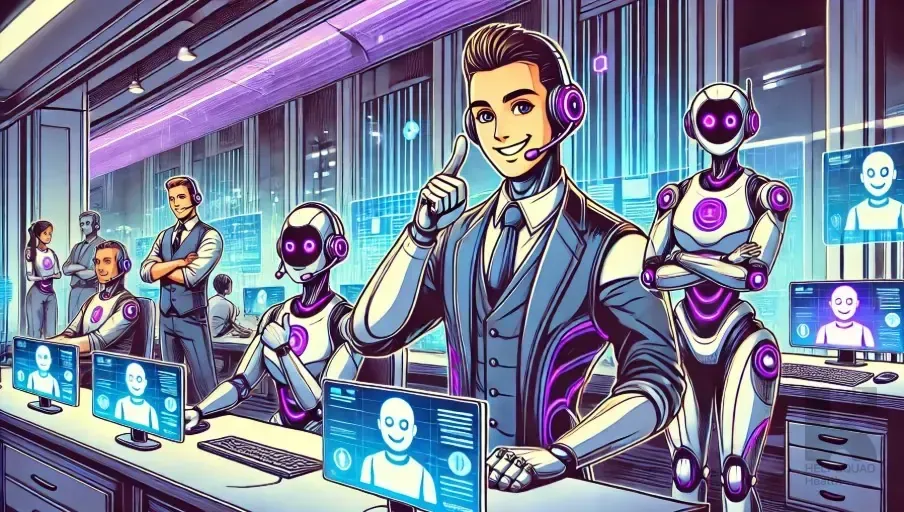
AI for customer service has moved from pilot projects to daily operations. Help desk vendor Freshworks reports that 43.6% of service teams now use AI across their workflows, up from 32% in 2025, based on its 2026 benchmark of 1.2 billion tickets. The results still split sharply: Lenovo says its Copilot rollout cut handle times by 20%, while Commonwealth Bank of Australia reversed 45 planned job cuts after staff reported that its AI voice bot had increased their workloads.
AI for customer service is revolutionizing the customer-business interaction, thus improving customer satisfaction. It takes over the mundane tasks and provides quick, tailor-made support. The AI-powered systems bring about a radical change in the customer service area, replacing it with a smooth and technology-driven experience. AI agents are the main facilitators of this transition. They rely on AI and instantaneous problem-solving to cater to consumer requirements quicker and more effectively than before.
Explore how AI agents are transforming customer service by enhancing efficiency, personalizing interactions, and reducing costs.
The short answer: AI agents now handle a growing share of routine support, such as order tracking, FAQs and password resets, and they work best alongside human agents rather than in place of them. Customers reward AI that resolves their issue quickly and resent AI that stands between them and a person. New rules, such as California's AB 1609, are starting to turn that path to a human into a legal requirement.
So what exactly is rising, and what should your business do about it? To keep things concrete, I'll follow one customer through this whole guide: a shopper whose package shows "delivered" but never arrived, and who reaches out at 11 p.m. on a Sunday. We'll see what a basic chatbot, an AI agent and a human agent each do with that problem, what the 2026 numbers say, where AI falls short, and which new laws now shape the answer.
Understanding AI Agents in Customer Service
AI agents are software tools built to interact with customers. They answer questions, solve problems, and offer support, automating many traditional customer agent responsibilities such as handling FAQs, tracking orders, and managing basic troubleshooting.
Unlike basic chatbots, AI agents use advanced artificial intelligence. This lets them understand natural language, plan actions, and complete tasks on their own. To fully leverage the potential of AI agents, businesses can collaborate with an experienced AI agent development company to implement customized, intelligent solutions that align with their customer service goals.
Why does that difference matter? Because it decides what happens to our shopper with the missing package. A basic chatbot replies with a tracking link that still says "delivered." An AI agent can check the order record, read the carrier scan, open a claim and offer a replacement under the store's policy. A human agent can do all of that too, plus hear the customer's frustration and decide when an exception is warranted.
| Capability | Basic chatbot | AI agent | Human agent |
|---|---|---|---|
| How it responds | Follows scripted flows and a limited set of FAQs | Understands intent in natural language | Listens, asks follow-up questions and reads tone |
| Access to company systems | Limited, mostly canned answers and links | Connects to CRMs, order data and APIs | Uses the same systems, often switching between tools |
| Can it finish the task? | Rarely, it points the customer elsewhere | Yes, such as processing a refund or rebooking | Yes, including approved exceptions to policy |
| Availability | 24/7 | 24/7, many conversations at once | Limited by shifts and staffing |
| Best fit | Store hours and simple FAQs | Order status, password resets, routine account changes | Billing disputes, complaints, emotional or complex cases |
What Are AI Agents and Their Role?
AI agents operate on websites, mobile apps, and social media. They handle inquiries efficiently, from basic FAQs to complex problems, offering quick support. Many businesses deploy these systems using tools like an AI agent builder, which helps create and customize automated assistants for different platforms.
AI agents, in addition to providing quick replies, also record the customer interactions data. This data along with the revenue intelligence shows trends, preferences, and places to sharpen. They remain efficient and adjust to the customers’ insights, thus upgrading the service quality.
It's worth noting that most businesses don't build the underlying AI model themselves. The Federal Trade Commission describes a common setup in which one company trains a large language model (LLM), the engine that reads and writes text, and sells access to online stores, hotels and banks that use it to power their customer service chatbots. Developing these models takes large amounts of data and computing power, so many businesses rent one instead. That convenience has a catch, which I'll return to in the challenges section: what your customers type into the bot can end up with the model provider.
In summary, an AI agent is a chatbot that can act, not just answer. That one difference explains most of the gains, and most of the risks, covered in the rest of this guide.
Trending Now: The 6 Core Functions of AI Agents
Jordan Wilson, host of the Everyday AI podcast, outlined six key functions that set AI agents apart from traditional tools like chatbots:
- Natural Language Processing (NLP)
- AI agents are powered by large language models, enabling them to understand and generate human-like responses in natural language.
- Tool Interaction
- AI agents can connect with external tools, such as CRMs, databases, and APIs, to perform tasks beyond basic conversation.
- Planning and Decision-Making
- Equipped with reasoning capabilities, AI agents plan multi-step workflows and execute complex tasks autonomously.
- Memory and Data Access
- They can access real-time and historical data, enabling personalized and contextually accurate responses.
- Task Execution
- AI agents don’t just provide insights. They actively perform tasks, such as processing refunds, scheduling appointments, or updating records.
- Learning and Adaptation
- AI agents learn from interactions, improving their performance over time to better meet customer needs.
These core functions make AI agents vital for businesses, automating workflows and enhancing personalization in ai for customer service.
How Do the Six Functions Work Together in One Conversation?
A list of functions is easy to follow, but the value shows up when they work together. Let's run our missing-package shopper through all six:
- Natural language: the customer types "my box says delivered but it's not here," and the agent understands the intent without a menu.
- Tool interaction: it pulls the order from the store's system and the latest scan from the carrier.
- Planning: it sets the steps, which are to confirm the address, check for a delivery note, then start a claim.
- Memory: it sees this is the customer's second missing package this year, which changes the right offer.
- Task execution: it files the claim and issues a replacement within the limits the business has set.
- Learning: the case feeds into reporting, so the team can spot a pattern with one carrier or one neighborhood.
It's important to note that the second function, tool interaction, is what separates an agent from a chatbot. Salesforce, which sells the Agentforce platform, lists the top AI agent use cases in service as customer FAQs, order inquiries, conversation summaries, knowledge retrieval for reps and technicians, and personalized product recommendations. Nearly every one of them depends on access to company data. Without a connection to your systems, you don't have a real agent, just a friendlier FAQ page.
The Evolution of AI in Customer Service
The role of AI in customer support began with basic programs that often frustrated users.
Over time, advancements in machine learning and natural language processing (NLP) have significantly improved these systems, enhancing their ability to understand context and intent.
Moreover, integrations with voice recognition and sentiment analysis have revolutionized AI agents, enabling them to:
- Assist hands-free through voice activation.
- Gauge customer emotions during interactions.
These capabilities allow AI agents to provide tailored responses that resonate with users, ultimately leading to higher satisfaction rates.
How Fast Has AI in Customer Service Grown?
The last two years moved faster than the decade before them. Here is the short version, drawn from news coverage and from the vendors' own research (marked as such):
| When | What happened | Reported by |
|---|---|---|
| May 2025 | Airbnb said half of its customers now choose its AI chatbot over human agents | PYMNTS |
| 2025 | 30% of service cases were resolved by AI, with 50% projected for 2027 | Salesforce research (vendor) |
| September 2025 | Salesforce CEO Marc Benioff announced about 4,000 customer service positions would be eliminated, citing AI | ABC7 News |
| 2026 | 43.6% of service teams use AI across their workflows, up from 32% in 2025 | Freshdesk Customer Service Benchmark Report 2026 (vendor) |
| September 2026 | California's AB 1609, the "Right to Human Customer Service Act," awaited the Governor's signature | Quarles |
Notice the pattern? Adoption climbs every year, and so does the pushback. As of October 2026, the question is no longer whether businesses will use AI in support. It's how they will use it without losing the customers it is supposed to serve.
What are the Benefits of AI Agents in Customer Service?
AI agents bring numerous advantages to businesses, transforming how customer service operates. According to Fantasy.ai, by 2025, 19 out of 20 customer interactions were expected to involve AI, and these AI Agents use cases highlight their growing role in managing complex workflows, automating routine tasks, and scaling support efficiently:
- Increased Efficiency and Productivity
- AI agents work 24/7, managing inquiries around the clock without breaks or downtime.
- They handle multiple queries simultaneously, reducing wait times and optimizing labor costs.
- The gains show up in published results. Lenovo reported in October 2025 that Microsoft Copilot in its Premier Support contact centers raised agent productivity by 15% and cut handle times by 20%, largely by automating post-call summaries. Coworker AI, which sells AI agents, points to the NBER study "Generative AI at Work," which measured a 14% average increase in issues resolved per hour for agents using a generative AI assistant, rising to about 34% for less-experienced agents.
- 24/7 Customer Support
- AI agents provide immediate assistance, ensuring customers receive help anytime, anywhere.
- They triage inquiries, resolving simple ones autonomously and directing complex issues to human agents.
- Speed matters more than most teams assume. HubSpot Research, cited in Help Scout's 2025 statistics roundup, found that 90% of customers rate an "immediate" response as essential or very important, and 60% define "immediate" as 10 minutes or less. Our shopper, writing at 11 p.m. on a Sunday, gets an answer right away instead of on Monday morning.
- Personalized Customer Experience
- AI agents analyze customer data to deliver tailored solutions, fostering loyalty and enhancing satisfaction.
- They learn from past interactions, continuously improving their responses and anticipating customer needs.
- Context is what customers notice. Zendesk research cited in the same 2025 Help Scout roundup shows that more than 70% of consumers believe companies should work together on their behalf so they don't have to repeat information to different representatives.
- Lower Cost per Contact
- Gartner benchmarks, cited by AI support vendor Crescendo, put the median cost per contact at $1.84 for self-service and $13.50 for assisted channels.
- Freshworks reports that 46.8% of organizations using AI during seasonal peaks avoided hiring additional agents.
- More Consistent Answers
- AI applies the same policy every time. As one product professional put it in a September 2025 Reddit discussion on r/customerexperience, "Customers hate getting different answers from different reps. AI helps standardize policy-based replies, which actually improves trust."
Do These Benefits Hold Up in Practice?
Partly. It's worth noting that the Fantasy.ai figure above was a forecast, and the measured numbers tell a more modest story. Salesforce's own research says 30% of service cases were resolved by AI in 2025. The bigger trap, though, is how "success" gets measured. Look at how far apart these figures sit:
| Metric | Reported figure | What it actually tells you |
|---|---|---|
| AI agent deflection rate | 83.1% average across industries (Freshworks, 2026) | The share of conversations an AI agent handled without passing them to a person. Deflected does not always mean solved. |
| Self-service resolution | 14% of issues (Gartner, cited by Giva; also reported in Lorikeet's 2026 roundup) | The share of issues fully resolved without a human |
| Vendor savings headlines | 60-80% | Per-ticket savings on AI-eligible tickets only |
| Realistic blended savings | 20-35% within 6-12 months, net of AI licensing | Savings across the whole operation (Digital Applied, citing Lorikeet, as summarized by Coworker AI) |
Why such a gap? Because a deflected conversation is not a resolved one. As Coworker AI puts it, "A ticket that a bot 'deflects' but that the customer re-opens an hour later was not resolved; it was delayed." If our shopper closes the chat at 11 p.m. and calls back angry at 9 a.m., the dashboard records a win while the customer records a failure. My advice is simple: make resolved issues and repeat contacts your headline numbers, and treat deflection as a supporting figure.
AI Solutions Transforming Businesses of All Sizes
Tech giants are driving the adoption of AI agents, demonstrating their potential for businesses of all sizes:
- Microsoft introduced Copilot Studio, allowing businesses to create customizable AI agents.
- Salesforce launched AgentForce, showcasing the seamless integration of AI agents with CRM systems.
- OpenAI is advancing agentic models capable of reasoning and executing tasks autonomously.
What Happened When Big Companies Deployed AI Agents?
Announcements are one thing. Results are another. Here is what news coverage from 2025 shows about real deployments:
| Company | What it deployed | Reported result | Worth knowing |
|---|---|---|---|
| Lenovo | Microsoft Copilot in its Premier Support contact centers | 15% higher agent productivity, 20% shorter handle times, and a 10% rise in customer satisfaction | Lenovo's own figures (October 2025) |
| Salesforce | AI agents in its own support operation | About 4,000 customer service positions eliminated | CEO Marc Benioff said AI can now handle complex inquiries (September 2025) |
| Airbnb | AI customer service chatbot | Half of customers now choose the chatbot over human agents | Customers can still choose a person (May 2025) |
| Commonwealth Bank of Australia | AI voice bot | Projected 2,000 fewer calls per week, but staff reported higher workloads | The bank reversed 45 planned job cuts (August 2025) |
| CarMax | AI-driven reorganization of its Customer Experience Centers | About 350 employees laid off | No customer outcome reported (October 2025) |
| Quant | Agentic "digital colleagues" that rebook flights, reroute bags and adjust payment plans | About 77% of issues resolved without human help, with responses in under 5 seconds | Quant's own early production data (September 2025) |
What's the lesson? In these cases, the clearest win came where AI supported people, with Lenovo's Copilot writing post-call summaries and translating in real time. The clearest reversal came where AI was expected to absorb the work on its own, as with Commonwealth Bank's voice bot. Both an AI-first model and a human-first model can work, depending on how complex your customers' problems are and how cleanly the AI outsources to a person.
While these innovations are shaping the future, AI agents are no longer exclusive to large enterprises. Smaller businesses and BPOs are also leveraging advanced AI solutions like Hue to transform their operations.
Hue, powered by ChatGPT, revolutionizes customer interactions by delivering instant, accurate answers sourced from data such as websites, knowledge bases, and support documents. It blends AI efficiency with human oversight, seamlessly escalating complex queries to live agents when necessary.
Hue is a data powerhouse that can connect to any number of data sources, support SMS, social media, and other communication channels, and secure, compliant solutions customized for healthcare and finance. It has advanced features like intent screening, real-time updates, no-code setup, and personalized responses that help save time, lower operational costs, and improve customer satisfaction. Thus, making it perfect for all types of businesses.
The data backs up the shift toward smaller firms. Freshworks reports that the AI agent deflection rate in its SMB segment reached 81.4% in 2026, up from 48% a year earlier. The same report shows how early most teams still are: in retail, 78.9% of companies have piloted AI agents, but only 18.3% run them at scale. In other words, most businesses are still testing, and the gap between a pilot and a dependable service is where a managed partner earns its keep. At HelpSquad, Hue runs on the LiveHelpNow platform alongside trained human agents, so a conversation the bot can't finish moves to a person instead of a dead end.
What are the Challenges of Implementing AI Agents?
Despite their advantages, AI for customer service presents challenges that businesses must address:
- Overcoming Customer Resistance
- Some customers may prefer human interaction over AI.
- Offering seamless transitions between AI and human agents can build trust and ease concerns.
- The resistance is measurable. SurveyMonkey data cited by EverHelp puts the overall preference for AI support over humans at just 8% (14% among Gen Z), and 23% of customers lose trust when they feel trapped in an AI loop.
- Zendesk research cited by Nextiva found that 80% of customers still expect access to a human representative when needed.
- Mistakes are costly to undo. Help Scout cites research showing it takes 12 positive experiences to make up for one negative one.
- Ensuring Data Privacy and Security
- AI agents handle sensitive customer information, making robust security measures essential.
- Transparency in data usage and compliance with regulations like GDPR are critical to maintaining customer trust.
- Your AI provider's privacy promises are enforceable. The FTC has warned AI model providers that breaking privacy commitments, including promises not to use customer data to train their models, can make them liable. In the agency's words, "There is no AI exemption from the laws on the books."
- Third parties widen the risk. In October 2025, Discord disclosed a breach at its third-party support provider, 5CA, that exposed government ID images belonging to about 70,000 users.
- Healthcare adds another layer. As the law firm Quarles notes, HIPAA's minimum necessary standard applies to any protected health information exchanged in chatbot interactions.
- Measuring Deflection Instead of Resolution
- An AI that blocks customers can look efficient on paper. Commonwealth Bank of Australia projected that its AI voice bot would cut calls by 2,000 per week, yet staff reported that workloads went up, and the bank reversed 45 planned job cuts.
- Judge your AI on resolved issues and repeat contacts, not on how many conversations it kept away from your team.
- Preparing Your Team
- Training lags behind spending. Zendesk data cited by Coworker AI shows 55% of agents say they have not received generative AI training, while 72% of leaders believe they have provided adequate training.
- Nextiva reports that 45% of businesses have made only minor AI investments, and 36% cite employee resistance as a main reason.
In summary, the hardest challenges are less about the technology and more about how it's deployed. Can customers reach a person? Does their data stay protected? Does your team know how to work with the tools? Get those three right, and the technology is the easy part.
What New Rules Apply to AI in Customer Service?
Lawmakers have started writing the human handoff into law. The clearest example so far is California's AB 1609, the "Right to Human Customer Service Act." As of September 17, 2026, the bill was awaiting the Governor's signature, with a standard California effective date of January 1, 2027, according to the law firm Quarles.
What Does California's AB 1609 Require?
AB 1609 applies to any "large private business," meaning one with more than $500 million in gross annual revenue nationally that makes a customer service chatbot available to someone in California. The bill defines a customer service chatbot broadly, as any AI system with a natural language interface that gives adaptive, human-like responses for customer service or support. Here are its core requirements:
| Requirement | What it means in practice |
|---|---|
| No pretending to be human | A chatbot may not be presented as a person, and the business must clearly disclose it when a reasonable person would be misled into thinking they are talking to a human |
| A visible path to a person | During regular business hours, customers need a clear and conspicuous way to request a live agent |
| 15-minute connection window | A good faith effort to connect the customer with a human within 15 minutes, or to offer a specific appointment time within one business day |
| Phone hold limits | Calls answered promptly, no single hold longer than 15 minutes after the call is answered, and no more than one hour of hold time in total |
| Defined business hours | 10 hours a day over 5 days, or 8 hours a day over 7 days |
| Penalties | Civil penalties of up to $5,000 for an initial violation and $10,000 for each subsequent violation |
A few details are easy to miss. Email, web forms and voicemail are exempt from the 15-minute window, and a business does not have to add a channel it did not offer as of January 1, 2027. The duties stack on top of HIPAA, California's CMIA and the CCPA/CPRA rather than replacing them. Hospitals won a broad carve-out for health care chatbot communications, but health plans, payers, managed care organizations, pharmacy benefit managers and pharmacies did not.
Are Other AI Customer Service Rules Coming?
Yes, and they point in the same direction. The bipartisan Keep Call Centers in America Act of 2025 would require businesses to:
- Give 120 days' notice before moving support roles offshore.
- Disclose at the start of a call if they are using AI.
- Let customers transfer to a human agent located in the U.S.
Meanwhile, the FTC has made clear that existing consumer protection law already covers AI. In its view, what a company leaves out of its data disclosures can draw the same enforcement as an explicit misrepresentation.
Why should a business below the $500 million line care? Because Quarles expects AB 1609's influence to "almost certainly extend further," both as a model for other states and as a benchmark that shapes what customers expect everywhere. My recommendation is to build the human handoff now, while it is a choice, rather than later, when it is a deadline. Think back to our shopper with the missing package: under rules like these, the "talk to a person" option cannot be buried three menus deep.
Future Trends in AI for Customer Service
The future of AI for customer service is promising, with emerging trends enhancing its impact:
- Predictive AI for Proactive Service
- AI agents analyze customer behavior to anticipate needs, addressing issues before they arise.
- Proactive service fosters loyalty and strengthens customer relationships.
- For our shopper, proactive service means a message saying the package is running late, sent before they ever have to ask. GigaBPO describes the same pattern: a delay notice that reaches customers before they contact support.
- It's important to note that proactive support takes groundwork. Giva lists "strong data infrastructure and ongoing investment" as the main cost of AI-driven, proactive support models.
- Omnichannel Support
- AI agents provide consistent support across multiple platforms, ensuring seamless customer experiences.
- They track interactions across channels, personalizing responses based on past conversations.
- One approved knowledge base makes this work. Crescendo, an AI support vendor, argues that when an AI answers only from your published content, "it's far less likely to invent a policy or quote an expired price," and customers get the same answer on chat, voice, email or SMS.
- AI Copilots for Human Agents
- A copilot is an AI assistant that works behind the scenes, drafting replies and summarizing cases for a human agent. Lenovo's Copilot rollout, covered above, is the clearest example: it writes post-call summaries and translates in real time while the agent stays in charge.
- Access is still uneven. Zendesk data cited by Coworker AI shows only about one in five frontline agents (roughly 21%) say they actually have generative AI tools.
- The prize is time with customers. Salesforce reports that 81% of service reps say building customer relationships is an important part of their job, yet they spend only 46% of their time with customers.
- More Autonomous Resolution
- Agentic AI, meaning systems that plan and complete tasks on their own, is expected to take on more cases. Gartner predicts it will autonomously resolve 80% of common customer service issues by 2029, as cited by Coworker AI, and Salesforce projects that AI will resolve 50% of service cases in 2027.
- Treat both as forecasts, not results. Remember the 2025 forecast earlier in this guide? Plan around what you can measure today.
- A Legal Right to a Human
- Rules such as California's AB 1609 and the proposed Keep Call Centers in America Act point toward mandatory AI disclosure and a guaranteed path to a person. The section above covers what they require.
In summary, the future of AI in customer service is less about bots replacing people and more about AI doing the groundwork so people can spend their time where it counts.
Balancing Human and AI Interaction
AI agents are not only efficient but also scalable in customer service, yet they cannot substitute human empathy.
Emotional problems, grievances, and intricate necessities still need humans to deal with them, no matter how advanced AI tools get. The customers are the ones who need compassion, reassurance, and genuine understanding, and that is why generative AI cannot completely replicate them.
The optimal solution is a hybrid method that integrates AI agents and human supervision. AI agents take care of the monotonous tasks such as answering frequently asked questions, processing orders, and classifying inquiries. In cases that are difficult or sensitive to the point that empathy and creative problem-solving are necessary, human agents come into the picture.
This collaboration creates a balance. AI agents free human representatives from repetitive work. AI is giving human agents a hand by giving them access to real-time data, history, and insights that help them make better decisions. Organizations that want to create advanced AI agent solutions can cooperate with specialized firms such as EffectiveSoft to build tailored systems that will be perfectly integrated with the current customer service infrastructure.
Combining automation with human interaction in the customer service team ensures fast, efficient service without losing the emotional connection customers need. By using AI to enhance human efforts, businesses can deliver compassionate and cutting-edge role of AI in customer service that builds trust and loyalty. In many cases, ai development services help design systems where automation supports agents rather than replacing them, keeping interactions both efficient and human-centered.
Customers say the same thing in their own words. "Speed helps, but if the response doesn't solve the problem, it just feels like a faster letdown," one commenter wrote in a September 2025 Reddit discussion on r/customerexperience. Another added, "The frustration comes when companies use AI as a shield to avoid letting customers reach a human." Even the vendors agree: Salesforce research cited by EverHelp in 2026 found that 89% of service professionals say positive service requires a balance among automation, AI and the human touch.
Which Tasks Should AI Handle, and Which Need a Person?
The split is easier to see task by task. Here is how I'd divide the most common requests:
| Task | Best handled by | Why |
|---|---|---|
| Order status and tracking | AI agent | High volume and fully data-driven |
| Password resets | AI agent | Rule-based, with one clear right answer |
| Store hours and return policy | AI agent or self-service | The answer is the same for everyone |
| Billing disputes and account issues | Human agent | Needs judgment and the authority to make exceptions |
| Complaints and emotional situations | Human agent | Needs empathy and reassurance |
| Refund requests outside standard policy | Human agent, with AI pulling the history | Needs a decision, not a lookup |
What Makes a Good AI-to-Human Handoff?
Escalation is where hybrid models win or lose. A hybrid model only works if the handoff works, and most failures happen right at that seam. I call the fix the Resolve-or-Route rule: every AI conversation should end in one of two places, a resolved issue or a warm handoff to a person. Never a loop. Here is the checklist that puts it into practice:
- Make the exit visible. Put a "talk to an agent" option where customers can see it, not three menus deep.
- Pass the context. Good AI "decides when to escalate to a human, and does so with a clean handoff (including the context so the customer doesn't have to repeat themselves)," as one Reddit commenter put it.
- Escalate on frustration, not just on topic. A customer stuck in a loop should reach a person even when the question looks simple.
- Measure outcomes. Design for resolved problems, not just for metrics like average handle time.
Let's finish our shopper's story. The AI agent checks the carrier scan, finds nothing useful and sees this is the customer's second missing package this year. Instead of looping, it routes the case to a human agent with the order, the scan and the history attached. The agent approves a replacement in one reply, and the customer never repeats a word. That's the balance in practice: AI does the legwork, and a person makes the call.
Conclusion: Embracing AI for Customer Service
AI agents are transforming customer service, giving businesses a competitive edge in today’s fast-paced world. They automate repetitive tasks and deliver personalized experiences, freeing human agents to focus on high-value interactions.
“I don’t think we’ve kind of nailed the the right way to interact with these agent applications. I think a human in the loop is kind of still necessary because they’re not super reliable.”
Harrison Chase, Founder of LangChain
In summary, the rise of AI for customer service is real, but the businesses that gain the most are not the ones that automate the most. They automate the right things and keep a person within reach. Here is the checklist I'd start with:
- Start AI on high-volume, rule-based requests such as order status and password resets.
- Connect it to your order, CRM and knowledge base data, or it will only ever be a chatbot.
- Make resolved issues and repeat contacts your headline metrics, with deflection as a supporting number.
- Follow the Resolve-or-Route rule: every AI conversation ends in a fix or a warm handoff, never a loop.
- Check what data your AI vendor collects and keeps, and what it has promised not to do with it.
- Plan for rules like California's AB 1609 now, even if your business sits below its revenue threshold.
How HelpSquad Can Help
Want to take your customer service to the next level with AI? HelpSquad provides virtual assistants and customer support teams that work alongside your AI tools, with coverage up to 24/7 with a dedicated team. Full-time staffing starts at $8 per hour, with part-time schedules quoted individually, and our trained bilingual agents give your customers fast, courteous service. Talk to us to see the difference.
HelpSquad pairs the Hue AI chatbot, part of the LiveHelpNow platform, with trained bilingual agents. Routine questions get instant answers, and complex or sensitive ones go to a person. As a fully managed BPO rather than a staffing agency, HelpSquad provides HIPAA-compliant support with dedicated account management. To see how a hybrid AI and human model would fit your team, book an intro call at helpsquad.com/contact or call 877-775-3667.
FAQ
What are AI agents in customer service?
AI agents are software tools that interact with customers to answer questions, solve problems, and complete tasks like order tracking, refunds, appointment scheduling, and basic troubleshooting. Unlike simple chatbots, AI agents use advanced AI to understand language, make decisions, and take action across systems.
How are AI agents different from traditional chatbots?
Traditional chatbots usually follow scripted flows and handle limited FAQs. AI agents can understand intent, access data, connect to tools (like CRMs and APIs), plan multi-step workflows, and complete tasks autonomously, making them more flexible and capable in real-world customer support.
How do AI agents improve efficiency and reduce wait times?
AI agents work 24/7, handle many conversations at once, and instantly respond to common questions. They can resolve simple issues immediately and triage complex cases to humans, which reduces queues and helps teams handle higher volume with fewer delays.
How do AI agents personalize customer service?
They use customer history and real-time data to tailor responses, like referencing past orders, preferences, or previous issues. Because they can retain context, AI agents can deliver more relevant help and smoother follow-ups, which improves customer satisfaction and loyalty.
What kinds of customer service tasks are best for AI agents to automate?
AI agents are strongest with repeatable workflows like FAQs, order updates, returns/refunds, appointment scheduling, account updates, and routing requests. They can also support agents by pulling data, summarizing context, and suggesting next steps.
Will AI replace human customer service agents?
Not entirely, though some roles are being cut. In 2025, Salesforce announced about 4,000 customer service positions would be eliminated, and CarMax laid off about 350 customer experience employees after an AI-driven reorganization. Yet Commonwealth Bank of Australia reversed 45 planned cuts when its AI voice bot left staff with more work, and Zendesk research cited by Nextiva found that 80% of customers still expect access to a human when needed. The most likely future is a hybrid: AI for routine requests, people for complex and emotional ones.
Do businesses have to tell customers they are talking to AI?
Increasingly, yes. California's AB 1609, which was awaiting the Governor's signature as of September 17, 2026, would bar businesses with more than $500 million in annual revenue from presenting a chatbot as human, and would require a good faith effort to connect customers with a person within 15 minutes. The proposed federal Keep Call Centers in America Act of 2025 would require AI disclosure at the start of a call. Even without a specific AI law, the FTC has stated that there is no AI exemption from existing consumer protection law.
How much can AI really cut customer service costs?
Less than the headlines suggest. Vendor headlines often promise 60-80% savings, but those figures measure per-ticket savings on AI-eligible tickets only. Digital Applied, citing Lorikeet, puts realistic blended savings at 20-35% within 6-12 months, net of AI licensing. Gartner benchmarks cited by Crescendo put the median cost per contact at $1.84 for self-service and $13.50 for assisted channels, so your savings depend on how many issues the AI fully resolves, not on how many it deflects.
Written by
Maria Rush
Marketing Team Lead, HelpSquad
Maria De Jesus-Rush is Marketing Team Lead at HelpSquad, a healthcare business process outsourcing company, with a background in content development, digital marketing, and project management.
Connect on LinkedIn
Automated Customer Service Solutions | 24/7 AI Support
Support teams drowning in repeat FAQs and after-hours tickets can use ai automation to handle chat, email, and voice while agents focus on complex cases.
The Role of Data Integrity in AI-Powered Customer Support Solutions
When AI automation gives customers wrong answers, messy data is usually the reason. Here's how data integrity shapes chatbot accuracy and trust.

AI Customer Service: Transforming Support for the Modern Era
Chatbots that handle first contact, sentiment analysis that reads customer mood, and ai automation that triages urgent tickets so agents focus on harder cases.
Let's talk about what your practice actually needs.
A 30-minute call. No sales pressure. We'll tell you honestly whether we're a fit.