Back Office BPO & Outsourcing: Boost Efficiency in 2026
01 Feb 2024 By: Michael Kansky
Updated
Back office BPO and outsourcing are critical for streamlining business operations, from finance and HR to data management. Companies leveraging back office process outsourcing reduce costs, improve efficiency, and allow front-office teams to focus on core goals. In this guide, we cover everything you need to know about back office BPO services, outsourcing strategies, and best practices to optimize your operations in 2026.

Back office support operations have been very important in today’s highly competitive market, being often overlooked or unnoticed but still having a great effect on customer satisfaction. These operations, which include functions like document and data management as well as customer support, are indirectly contributing to the creation of good customer experiences by the high volume and quality of efficiency and effectiveness they bring to the organization. The organization is then able to handle these tasks without any issues, have a good workflow, and support the scaling of its business through professional bpo management.
What is back office BPO?
Front office operations focus on customer service. Conversely, the back office consists of several functions that support the main business operations of the organization. These functions are often rather complicated and require particular knowledge and abilities. The major areas of back-office activities are data management, accounting, compliance, human resource management, and information technology services.
Though these activities do not contribute to revenues directly, they are still the key to the company’s overall operations. In fact, they are upholding the legal obligations and the financial stability of the company. They manage staff well and boost operations with technology.
Dive into the heart of your business: Explore Front Office Operations now!
Data Management
Data management is a critical back office function. It encompasses the gathering, the keeping, and the evaluation of the data. This data can serve as the basis for smart business choices in addition to increasing client satisfaction and efficiency of operations. Data management also guarantees the protection of the firm’s data and its safe-keeping against hackers by the means of cyber threats.
By means of proper data management, firms come to know what is trending, where the opportunities are, and what decisions to take in a strategic manner. It may also contribute to the enhancement of efficiency through the automation of performing the same task over time and the minimization of the occurrence of errors.
Accounting and Finance
Accounting and finance are other important aspects of back-office operations. This includes tasks such as managing the company’s finances. Moreover, it consists of preparing financial statements and making sure that financial regulations are adhered to. In addition, it includes the administration of the company’s liquidity position and making sure that there are enough funds available to cover its obligations.
Good financial management is capable of keeping a company in its best financial condition. It is also a means to get investors, to not fall into financial troubles. Besides, it will render honest company performance through valuable insights and thereby, help to steer its strategic decisions.
What Are Back Office Operations and Their Meaning?
Back Office Operations are considered the backbone of Business Process Outsourcing (BPO) companies. The BPO companies provide a wide range of services to other businesses, giving them the opportunity to concentrate on their main activities. The BPO company is responsible for data entry, customer service, accounting, and HR management operations.
Outsourcing these tasks to the BPO company allows businesses to make significant savings on costs. Besides, it also makes the businesses to become more efficient and to put more emphasis on their core activities. The BPO companies have specialized knowledge and skills in handling back-end operations, which in turn enables them to deliver top-notch services to their clients.
Boost your business intelligence: Discover the power of Knowledge Process Outsourcing (KPO) today!
Customer Service
One of the most critical factors in the back-office operations of BPO firms is customer service. It includes taking care of customer questions, fixing problems, and supplying information regarding products and services. Technology is often the main element in supporting the customer service of BPOs. For instance, the use of customer relationship management (CRM) systems and artificial intelligence (AI).
The provision of an efficient and cost-effective multilingual customer service will be a factor that will help to realize the satisfaction of customers. It secures the trust of customers and also leads to more sales. Moreover, it can be a source of precious feedback that can be utilized for the betterment of products and services.
Learn how Multilingual Support can expand your business!
Human Resources Management
Human resources is another important aspect of back-office operations in BPO companies. This involves tasks like recruiting and hiring employees. Plus, managing employee benefits, and handling employee relations. BPO firms mostly depend on the HR management software for these purposes as they aim to make everything more efficient.
Good HR practices are a major factor in recruiting and keeping skilled workers. They not only bring up the level of employee happiness but also contribute to the company’s success. Furthermore, it could be an effective way to get rid of the worries related to the labor law and regulations compliance.
Challenges in Back Office BPO & How to Overcome Them
Even state governments envision integrated back offices that reduce overlap and turn these functions into strategic assets. This strategy enhances overall efficiency. It has increased the ability to make decisions and built efficiency structures. Thereby, supporting broader objectives.
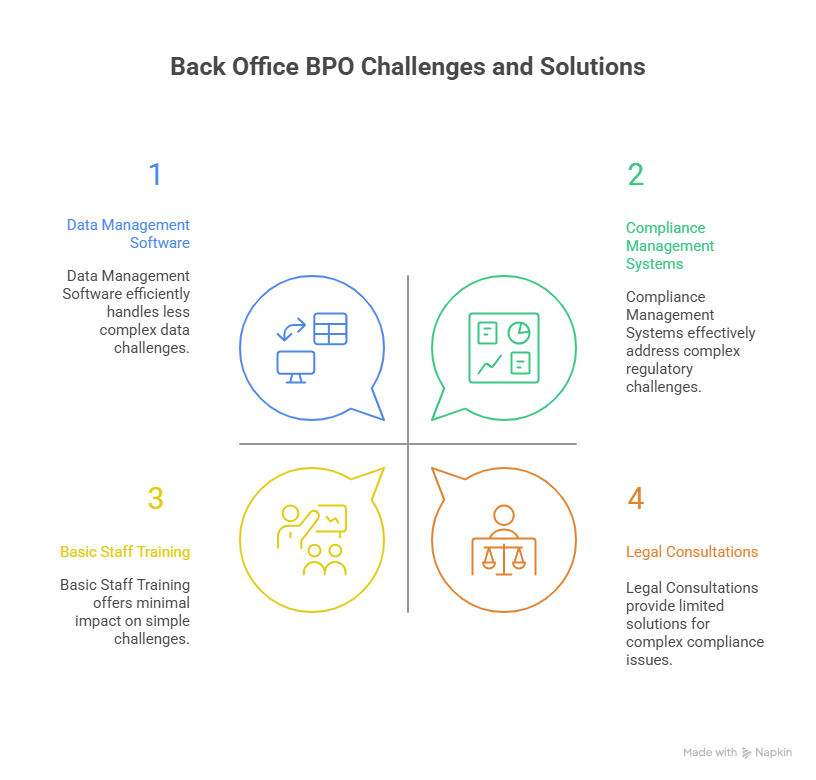
While back office BPO operations are essential for the smooth running of a company, they also present several challenges. These include managing lots of data. It also means ensuring compliance with rules, managing costs, and keeping good service quality.
You can beat these challenges with good management. Use tech and keep improving. These challenges may serve as trials for companies, which eventually result in the improvement of their back-office functions and heighten their overall performance.
Data Management Challenges
Data management, approvingly, is one of the most demanding areas of back-office operations. Corporations, at times, find themselves handling data in such large quantities that it becomes a matter that consumes a lot of their time and is costly as well. Data has to be constantly managed so that it is accurate and secure, which can be hard achieved because of the threat posed by human slips and cyber invasions.
Companies can beat these challenges by using data management software. Adding data security measures and staff training in data management can be done by them too. Additionally, data analytics can be applied to the data in order to extract insights and support business decision-making based on the created information.
Compliance Challenges
Compliance is a big deal in back-office operations. Companies must follow many laws. The primary matters of these laws are finance, data protection, and employment. The absence of adherence can result in huge monetary fines, and lawsuits, and can also negatively affect the reputation of the entity involved.
For the purpose of avoiding any potential non-compliance factors, companies can build compliance management systems, provide employee training, and do regular checks on procedures. In addition, it is indispensable to be in constant communication with legal and compliance professionals to ensure that the compliance is up to the mark.
On the other hand, companies that are having a hard time dealing with compliance issues, especially the constantly changing data protection and employment law rules, may find the engagement of a lawyer beneficial. One instance where the presence of a supportive cybersecurity attorney could turn out to be extremely beneficial is when he/she would take the legal landscape, ensure compliance with the standards, and thus prevent the organization from being breached.

Back Office Outsourcing Overview
Back office BPO (Business Process Outsourcing) means hiring a third party to handle internal business functions. These are the operations that keep a company running but don’t directly involve the customer.
What counts as back office?
- Data entry and processing
- Payroll and accounting
- IT support and infrastructure
- Human resources administration
- Compliance and reporting
Back office BPO has grown rapidly. Companies of all sizes now outsource these functions to cut costs and stay competitive.
Who uses back office BPO?
- Startups looking to scale without heavy overhead
- Mid-size firms managing rapid growth
- Enterprises streamlining non-core departments
The global BPO market is projected to exceed $450 billion by 2027. Back office functions make up a significant share of that figure.
Back Office Process Outsourcing Benefits
Back office BPO delivers measurable advantages. Here are the most impactful benefits:
Cost Reduction
- Eliminate the need for in-house staff for non-core roles
- Reduce overhead costs (office space, equipment, benefits)
- Pay only for services used, not full-time salaries
Operational Efficiency
- Outsourced teams are specialists in their function
- Faster turnaround on repetitive processes
- Fewer errors through standardised workflows
Scalability
- Scale operations up or down without hiring or layoffs
- Handle seasonal demand without long-term commitments
Access to Talent
- Tap into global pools of skilled professionals
- Access expertise that may be unavailable locally
Focus on Core Business
- Free up internal teams to work on revenue-generating tasks
- Leadership can focus on strategy, not administration
Risk Management
- BPO providers maintain compliance with local regulations
- Built-in redundancy and business continuity planning
Back Office Business Process Outsourcing Explained
Back office BPO is a specific category within the broader BPO industry. It is important to understand how it works before committing to a provider.
How It Works
- A business identifies non-core internal processes
- A BPO provider is selected based on expertise and cost
- Processes are transferred and workflows are aligned
- The provider manages day-to-day execution
- Performance is tracked through agreed KPIs
Types of Back Office BPO
- Offshore BPO: Functions are handled in a different country (e.g., India, Philippines). Lowest cost option.
- Nearshore BPO: Functions are handled in a neighbouring country. Balances cost and time zone alignment.
- Onshore BPO: Functions are handled domestically. Higher cost but easier oversight.
Common Back Office BPO Models
| Model | Description | Best For |
|---|---|---|
| Staff Augmentation | Adds external workers to your team | Short-term gaps |
| Managed Services | Full process ownership by provider | Long-term functions |
| Project-Based | Outsourcing for a defined project scope | One-off needs |
What Makes a Good BPO Partnership?
- Clear SLAs (Service Level Agreements)
- Transparent reporting and dashboards
- Secure data handling practices
- Defined escalation processes
Back Office Services: Finance, HR, IT
Back office BPO covers three major service pillars. Each delivers distinct value.
Finance and Accounting
Finance is the most commonly outsourced back office function.
Services include:
- Accounts payable and receivable
- Payroll processing
- Tax preparation and compliance
- Financial reporting and reconciliation
- Budgeting support and forecasting
Key benefits:
- Reduces risk of financial errors
- Ensures regulatory compliance
- Provides real-time financial visibility
Human Resources (HR)
HR outsourcing handles the people operations that consume significant internal time.
Services include:
- Recruitment process outsourcing (RPO)
- Onboarding and offboarding
- Benefits administration
- Employee records management
- Training and development coordination
Key benefits:
- Speeds up hiring cycles
- Reduces HR administrative burden
- Improves employee experience through faster response times
Information Technology (IT)
IT back office BPO keeps systems running without requiring a full in-house tech team.
Services include:
- Help desk and technical support
- Network monitoring and management
- Software administration
- Cybersecurity operations
- Data backup and recovery
Key benefits:
- 24/7 support without round-the-clock staffing costs
- Access to specialised technical skills
- Faster incident resolution
Outsourcing Back Office Operations
Transitioning to a back office BPO model requires planning. Follow this structured approach for a smooth handover.
Step 1: Audit Your Current Operations
- List all back office tasks currently performed in-house
- Identify which are time-consuming but low in strategic value
- Pinpoint where errors or inefficiencies occur most often
Step 2: Define Your Goals
- Are you primarily cutting costs?
- Improving service quality?
- Scaling faster?
Clear goals will drive your provider selection.
Step 3: Choose the Right BPO Provider
Look for:
- Proven experience in your industry
- Strong data security certifications (ISO 27001, SOC 2)
- Transparent pricing with no hidden fees
- References and case studies from similar businesses
- Flexible contracts that allow for scaling
Step 4: Transition Planning
- Document all current processes before handover
- Set up communication channels and reporting cadences
- Run a pilot phase before full transition
- Train internal stakeholders on how to manage the relationship
Step 5: Monitor and Optimise
- Review KPIs monthly at minimum
- Hold regular performance reviews with your provider
- Continuously identify further functions that can be outsourced
Common Mistakes to Avoid
- Setting vague or unmeasurable SLAs
- Outsourcing without documented processes
- Choosing a provider based on price alone
- Failing to assign an internal point of contact
- Ignoring data security requirements
Technology in Back Office BPO Operations
Technology is key in back office bpo services. It streamlines tasks, boosts efficiency, and betters service quality. It tackles challenges like data handling and compliance.
Different technology tools, which include data and HR software as well as accounting and compliance systems, are among the various tech tools. They lubricate the operations, reduce errors, and improve the precision and trustworthiness of the data.
Automation
Automation is essential for back office operations, as tech is employed to carry out activities like data entry, invoicing, and payroll processing. It increases productivity, reduces errors, and makes it possible for employees to deal with more challenging tasks.
Robotic process automation (RPA), AI, machine learning, and automated workflow systems are the types of technology that help cover from the basic data entry to the complex decision-making process. Thus streamlining the processes across various domains.
Uncover the impact of AI and Automation in BPO operations!
Cloud Computing
Cloud computing is crucial for back office tasks, letting you use software and services online instead of on each computer. It cuts costs, boosts access, and makes scaling easier.
Services like Software as a Service (SaaS), Platform as a Service (PaaS), and Infrastructure as a Service (IaaS) offer everything from data management to HR systems.
Skyrocket your SaaS MRR: Dive into 11 proven Lead Gen Strategies today!
Trending Now
A Spiceworks article talks about the technological transformation in the back-office business process outsourcing (BPO) area caused by artificial intelligence (AI). It claims that in such a scenario management practices will not only have a more efficient but also a highly pleased and engaged work force. The front of the AI’s impact on the U.S. job market is shifting from a pure replacement in the case of back-office positions to considering tech as a facilitator of productivity rather than a one that takes away security. Leaders are encouraged to educate their teams on AI’s benefits, helping employees focus on meaningful tasks and take on more strategic roles.
The article also underscores the importance of upskilling and training to close the digital competency gap, ensuring employees can effectively use AI. Some research points out a correlation in terms of job satisfaction between automation and inter-departmental staff movement, thus portraying the story of AI in IT as a win-win scenario for staff engagement. Proper handling of AI through education and training in the back-office operations can not only result in high productivity but also job satisfaction.
Conclusion
Ultimately, the success of back office processes is foundational to the organization’s success, influencing everything from resource allocation to strategic initiatives. With the right staff and a focus on innovation, businesses can navigate the intricacies of today’s business environment, seizing new opportunities and fostering long-term relationships with clients. This holistic approach, blending traditional and modern back offices, enables companies to not only meet but exceed customer and market expectations, securing their position in a competitive landscape.
“Operations is where the rubber meets the road. It’s one thing to have a vision; it’s another to execute it.”
– Larry Page
Boosting your back office operations can significantly improve operational efficiency, reduce costs, and allow you to concentrate more on your business’s core competencies. Ready to elevate your business efficiency and customer satisfaction to the next level? Check out HelpSquad! With an affordable starting rate of just $8.50 per hour, you can enhance your business operations with our professional virtual assistants and our 24/7 customer service team. Start your trial today and experience the future of BPO with HelpSquad.
What is BPO of the back office?
Back office BPO (Business Process Outsourcing) is a situation in which a company entrusts to a third-party provider its non-customer-oriented activities such as data management, accounting, compliance, human resources, IT support, etc. Back office BPO services do not interact with the end-users directly, but rather make sure that the business continues to operate with accurate financial records, secure data, well-supported staff and smoothly running systems in a quiet manner.
Why are the back office operations so essential for customer service?
Although the back office processes are deemed “invisible,” they nonetheless play a significant role in the customers’ perception at the front end. The application of correct data, rapid internal workflows, legal processes, and properly organized personnel culminate in reducing errors, speeding up responses, making orders smoother, and giving service that is more reliable. When the back office BPO is managed correctly, customers suffer from fewer delays and problems, and are thus more likely to remain loyal.
Backup BPO services involve what processing operations?
Usually, the back-office BPO processes include data management (collecting, storing, and analyzing business data), accounting and finance (billing, bookkeeping, reporting, compliance), HR management (recruiting, onboarding, payroll, benefits, employee relations), compliance support, and IT services. Some providers also handle “back office” customer support tasks, such as ticket processing or documentation, which indirectly support front-line teams.
What are the benefits of externalizing back-office functions for a company?
The process of outsourcing back-office operations helps the companies in different ways such as costs reduction, making the investment on tools and skilled personnel unnecessary, and getting the advantages of experts with high skills and well-established processes. Besides, it allows the internal teams to spend more time on their core functions such as product creation, sales, or maintaining customer relationships. In the case of professional BPO management, companies can grow faster, improve their work processes, and ensure compliance without having to invest in everything themselves.
Which are the biggest problems in back office BPO operations and what can be the solutions?
The most common issues faced are the management of huge data volumes, security of that data, compliance with laws related to finance, data protection and employment, cost control, and maintaining consistent quality of service. The companies can overcome these challenges through the deployment of advanced data management tools, strong security measures, well-defined compliance frameworks, staff training, and regular process reviews aimed at improvement.
What is back office outsourcing?
Back office outsourcing means hiring an external company to manage your internal business functions. These include finance, HR, IT, and data processing. You retain control of your core business. The provider handles the operational work behind the scenes.
How does back office process outsourcing improve efficiency?
It removes repetitive tasks from your internal team. Specialist providers use proven systems and trained staff. This reduces errors and speeds up turnaround times. Your team gains time to focus on higher-value work. Workflows become standardised and easier to scale.
What are the top services offered by back office BPO providers?
The most in-demand services include:
Payroll and accounts processing
Tax compliance and financial reporting
HR administration and recruitment support
IT help desk and network management
Data entry and document processing
Regulatory compliance and reporting
How to outsource back office operations effectively?
Follow these key steps:
– Audit all current internal processes first
– Identify tasks that are high volume but low in strategic value
– Set clear goals before approaching providers
– Vet providers on experience, security standards, and pricing
– Start with a pilot phase before a full rollout
– Assign an internal manager to oversee the relationship
– Track performance against agreed KPIs every month
What is back office support in BPO?
Back office support refers to behind-the-scenes assistance provided by a BPO partner. It keeps your business operations running smoothly. This includes processing transactions, managing records, handling payroll, and maintaining IT systems. It is not customer-facing. But it directly impacts how well your front office performs.
Back office meaning in BPO – what does it entail?
In BPO, “back office” refers to all internal functions that support the business but do not involve direct customer interaction. It sits behind the front office, which handles sales and customer service.
Back office functions typically include:
– Finance and accounting
– Human resources
– IT operations
– Data management
– Legal and compliance
– Supply chain administration

Michael Kansky, Founder of LiveHelpNow and HelpSquad, has leveraged his 20 years of industry experience and innovative support strategies to revolutionize customer service approaches, making LiveHelpNow a leading customer service software provider, and establishing HelpSquad as a bridge between businesses and customer needs. You may contact Michael on LinkedIn: https://www.linkedin.com/in/mkansky/