Dentrix Front Office Training: What Staff and Dental VAs Need to Know
Quick Answer
Dentrix front office training should cover daily reports, charting status and insurance benefit rules first, because those decide whether a front desk or dental VA collects what was diagnosed.
Free video lessons teach the clicks. The judgment takes structured practice.
Is a trained remote assistant worth it? Yes, when the practice can reach Dentrix securely from outside the office and tests every new hire on a real benefit breakdown, not a tour of the Appointment Book.
Key Points
- HelpSquad's view is that Dentrix training starts with the reports that close every day: the day sheet, the deposit slip and the aging reports.
- A 2011 Dental Economics column cited an American Dental Association estimate that a typical dentist had up to $1 million of diagnosed but never completed dental work.
- Free Dentrix training exists: DenMed USA posted a free Dentrix lesson series on YouTube in 2021, including a full Patient Chart walkthrough.
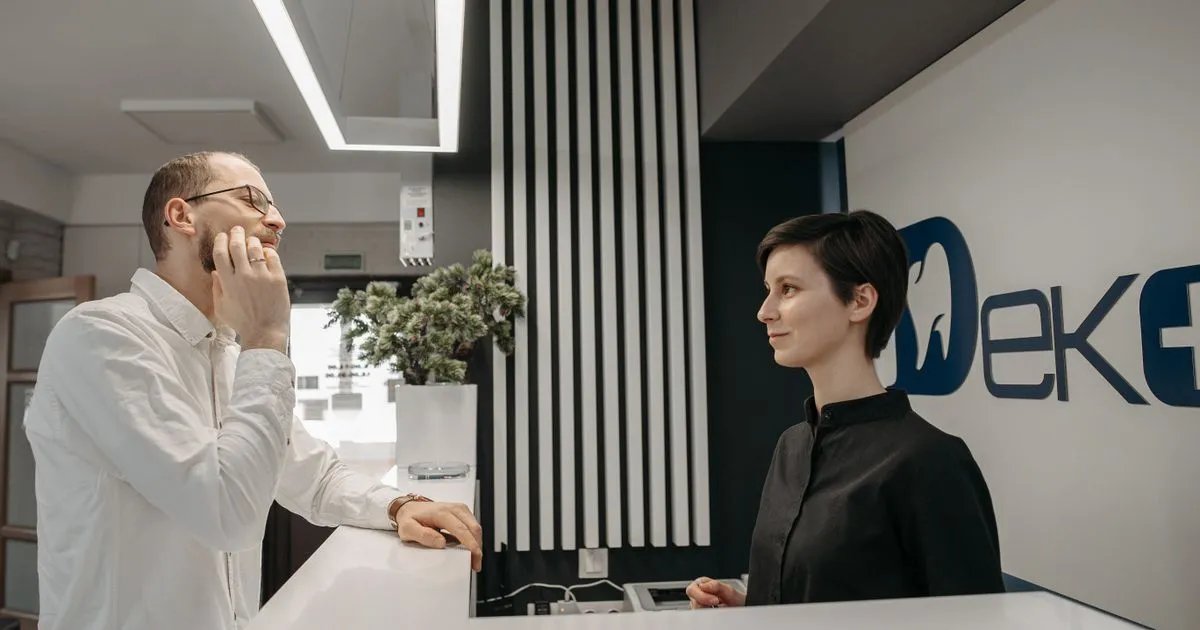
Front office work at the dental desk starts with listening as patients describe what brought them in.
A Dentrix-trained virtual assistant is worth it when one person owns the phones and the bookings together, so every patient who calls lands in the Appointment Book instead of a voicemail queue.
Why train anyone on software people love to complain about? Because practices are not leaving it. In a January 2026 r/Dentists thread asking why offices stick with legacy systems like Dentrix and EagleSoft, one dentist put it bluntly: "Mostly inertia and fear of downtime." Another said they had yet to find software better than Dentrix at handling attachments. A third commenter, who supports dental clients on the IT side, said complaints about cloud alternatives were "100% equal" on functionality, and others noted that some insurers and imaging setups still sync best with the older systems.
That changes the question.
It is no longer whether to learn Dentrix. It is what to learn first, and who on the team, in the office or working remotely, should own each piece of it. This guide takes those pieces in order:
- whether staff and dental VAs can simply pick Dentrix up on the job
- why add-on software cannot cover for an undertrained front desk
- which daily reports a new hire should master before anything else
- which insurance rules cause the costliest write-offs
- where Dentrix front office skill is heading next
I wrote it for two readers at once: the office manager weighing a new hire, and the assistant teaching themselves the system at night. Both need the same map, starting with the screen every patient visit touches.
Dentrix front office training is structured practice in how the Family File, Appointment Book, Ledger and Chart connect, and in using them to post treatment, check insurance and close the day cleanly. The modules are linked. Select a patient in one, and the others follow.
That link is why the chart is not just a clinical screen. In a 2021 DenMed USA chart lesson, the trainer shows completed procedures posting straight to the Ledger as that day's work, and says the treatment plan should already be in order "before the patient walks up to the front." The front desk inherits whatever the chair entered.
Then comes insurance. One experienced front desk trainer describes an office forced to write off two implant crowns because new receptionists mishandled the missing tooth clause. Frequency limits, coordination of benefits and the split between major and basic coverage cause the same kind of loss.
Is knowing where to click enough? No.
It's worth noting that practices are not abandoning the software either, since dentists who complain about clunky charting still stay because switching means retraining the whole team and risking data loss during conversion. So I treat Dentrix skill as a long-term asset, starting with the screen a dental VA touches on every single patient.
Why does Dentrix front office training matter now?
Structured Dentrix training decides whether a front desk, in-office or remote, protects revenue. For HelpSquad, a Clutch 2026 Top Virtual Assistant Company, it is the base of remote dental support.
Before you plan a single training session, check where your own desk stands:
- List every task your front desk owns in Dentrix, from booking to running the insurance aging report.
- Mark the tasks that touch money: posting treatment, entering benefit breakdowns, taking payments, presenting treatment plans.
- Ask who taught each person those tasks, and whether any of it was ever written down.
- Decide which tasks could move to a remote assistant and which must stay at the physical desk.
If the answer to the third question is "whoever was around that week," you have found the problem.
Who is actually responsible for Dentrix skills?
Why does no one else own this? Because the rules do not ask anyone to. The Washington State Department of Health states that staff whose only task is data entry and note charting are not required to register as dental assistants. The same agency notes that continuing education is not required by law for dental assistants, and that its rule book lists 38 allowable and 23 prohibited tasks without a word about practice software.
The common assumption is that a credentialed hire arrives ready for your software. Washington's rules tie registration to clinical contact, not to job title, and certainly not to whether someone can post a payment correctly in the Ledger. It's important to note that federal policy moved the records themselves onto screens years ago, when the HITECH Act required providers accepting Medicare and Medicaid to switch to electronic patient records by 2015.
I'd put it bluntly. The practice owns the training gap. Nobody else is coming to fill it.
What changes when a remote assistant logs in?
The gap gets wider, not narrower, once part of the desk works from somewhere else. Our VAs are HIPAA-certified through HIPAATraining.com, which covers how patient information must be protected on every call and screen. HIPAA certification does not teach a payer's frequency limits, though, or how your office codes a family discount, or which day sheet the doctor wants on the desk before closing.
That office-specific layer comes from structured Dentrix training, whether you hire locally or bring in medical virtual assistant services to extend the team. Compliance is the floor. Workflow skill is what pays.
Taken together, these 3 evidence items point the same way: the law sets privacy and scope rules, the credential covers clinical contact, and the practice alone decides whether its people can run Dentrix well. Leave that decision unmade and the cost shows up in places most owners never think to check, starting with treatment that was diagnosed, charted and then quietly never scheduled.
Can front office staff and dental VAs simply learn Dentrix on the job?
Ask working dental assistants how hard Dentrix is, and most will tell you it is easy. Ask the people who fix front desk mistakes where the money went, and the answer changes.
In a 2022 Reddit thread, a job seeker asked where to learn Dentrix. At least four of the six replies said offices teach it. "dentrix is extremely easy!!" one wrote. Another called a switch from a different system "super easy." The advice: some YouTube videos, then "for the most part you'll learn as you work."
A 2026 thread in the same community tells the other half. When an aspiring receptionist complained that every clinic wanted "2+ years experience," a commenter who trains front desk staff explained why. Their office had to write off two implant crowns because inexperienced receptionists mishandled the missing tooth clause in patients' insurance, which the trainer called "a very, very large and pricey mistake." Frequency limits were a second trap. When staff "put random months on the frequency" in an insurance breakdown, the claim goes unpaid, the patient disputes the bill, and the office gets "a bad rep that we have a billing issue." In the trainer's words: "We do not have time for financial mistakes."
None of those losses came from a wrong click. Each was an insurance judgment typed correctly into the wrong place. Remote assistants hear a version of the same message. When a dental VA listed Dentrix Ascend, insurance verification and scheduling as qualifications in a July 2026 thread, a commenter who reviews dental resumes replied: "These are not extraordinary skills."
| Where money leaks | What goes wrong | Who reported it |
|---|---|---|
| Missing tooth clause | Implant crowns treated as covered; one office wrote off two | Front desk trainer, Reddit, 2026 |
| Frequency limits | Wrong months entered in the breakdown; claim unpaid, patient disputes the bill | Front desk trainer, Reddit, 2026 |
| Payment plans | Arrangements stay "almost like non-written," with no agreement in the system | Dana Johnson and Laura Hatch, 2018 |
| Block scheduling | Emergencies and hygiene visits booked over production blocks | Dana Johnson and Laura Hatch, 2018 |
Certified trainers point to a second gap: features that protect revenue but sit unused. Dana Johnson, a certified Dentrix trainer since 2006, said her own first couple of days of training "barely scratched the surface." On a 2018 Front Office Rocks webinar she said "most offices don't use the payment agreements," and her co-presenter Laura Hatch suspected offices make more arrangements than they realize. Johnson's reasoning was blunt: a payment plan means "you are technically lending the patient money." Entered as an agreement, it can print a Truth in Lending statement and appear on the Collection Manager report. Block scheduling follows the same pattern. Hatch said the blocks are easy to override, and Johnson brings the entire team into that training because "a lot of times it's the hygienists that schedule over the top of the blocks."
"it's great when it's in there but if it's not being followed and the team's not trained on it then it doesn't really work well in the practices"
Laura Hatch, on block scheduling, Front Office Rocks webinar, 2018
So why not hire people who already know all this? The market makes that hard. Around 9 in 10 practices say hiring is still hard, according to ADA Health Policy Institute data cited by a dental software vendor in July 2026. Experience also brings its own baggage. On The Dental Billing Podcast in 2022, the founder of a six-month dental front office program said experienced hires arrived with preconceived notions about how an office should run, and that many billers guarded their knowledge as job security. Students in that program practiced hands-on in Dentrix, but only after learning dental codes and calculating hundreds of treatment plans. The founder said 78% were hired straight out of their externship. That figure comes from the program itself.
Side by side, the sources show a pattern. The clicks transfer easily, from school to office and from one system to another. The judgment does not transfer on its own: the insurance rules behind a breakdown, the habit of writing down a payment plan, the discipline to protect a schedule block. Learning on the job passes these along only as well as whoever does the teaching, and a tight hiring market means a practice cannot count on buying them ready-made. We place remote dental assistants, so we have a stake here, but these checks apply to any hire.
- Before a new hire or VA works benefit breakdowns alone, check several of their breakdowns for missing tooth clauses, frequency limits, major versus basic percentages and coordination of benefits.
- Ask your front desk which payment plans exist only as verbal promises. Record each one as a Dentrix payment agreement, with a signed Truth in Lending printout scanned into the Document Center.
- Bring the whole team, hygienists included, into block scheduling training before you turn the blocks on.
- When you interview an experienced candidate or a dental VA, ours included, ask how they would handle an implant case on a plan with a missing tooth clause and how they enter frequencies. Ask what habits from past offices they would bring.
- Ask whether your training covers codes and treatment plan math before the Dentrix billing screens, the order one front office program used.
How we checked this
We drew on three Reddit threads from dental assistants, front desk staff and a dental VA, a 2018 webinar with a certified Dentrix trainer, a 2022 podcast episode from the founder of a front office school, and ADA Health Policy Institute hiring data as summarized by a dental software vendor. None of the figures are ours. The written-off implant crowns are one office's experience reported by an anonymous commenter. They show what can go wrong, but they do not show how often it happens. The 78% hiring rate is the school's own figure. The vendor that cited the ADA data sells front office automation, the trainer and the school sell training, and we provide remote dental assistants, so every source here has a stake. Still unknown: how much revenue a typical practice loses to these errors. None of our sources measured that.
- r/DentalAssistant, thread on learning Dentrix, May 2022.
- r/DentalAssistant, thread on becoming a dental receptionist, February 2026.
- r/DentalInsurance, thread from a dental VA seeking work, July 2026.
- Dana Johnson and Laura Hatch, Front Office Rocks Dentrix webinar, August 2018.
- The Dental Billing Podcast, episode 12 on starting a front office school, February 2022.
- ADA Health Policy Institute staffing data, as cited in a dental practice software vendor's blog post on the staffing shortage, July 2026.
Why can't add-on software fix an undertrained front desk?
Add-on tools only multiply what the front desk already enters in Dentrix. Billing accuracy, the area where HelpSquad was named a Clutch 2026 Top Medical Billing Company, starts at that desk.
Here is where the simple answer breaks down. Most practices already own more software than their team uses well, and the gap between the two is where money goes missing.
How much revenue sits in the chart unused?
In a 2011 Dental Economics column, Larry Emmott cited an American Dental Association estimate that a typical dentist had up to $1 million of diagnosed but never completed dental work sitting in the files. That figure is from 2011, and the evidence does not show a newer one. The pattern behind it has not gone away, though: treatment gets diagnosed, charted and then forgotten.
Emmott's answer at the time was apps. He described tools that send reminders from the next day's schedule, publish patient reviews, and one that used an artificial intelligence program to search practice data for needed but uncompleted treatment and contact those patients. He was candid about their limits, too: "Dental apps have little or no value as standalone programs, but when combined with Dentrix, PracticeWorks, or any leading PMS, they can add a lot of value."
Read that sentence again. The value depends on the data underneath.
Where does the tension actually sit?
Conventional wisdom says the next tool will close the leak. It won't, on its own. A recall program can only find unfinished treatment that someone charted as planned treatment. A reminder tool can only remind patients who were booked correctly. Garbage in, garbage out, at the speed of automation.
So the real tradeoff is not software versus no software. It's software bought versus people trained to feed it accurately. Tools are easy to purchase. Accurate operators are scarce.
I see that scarcity in our own hiring. Less than 3% of our applicants clear every dimension of our screening, and those are the only people a practice ever meets. That bar matters here, because a fast, careless operator in Dentrix does more damage than a slow, careful one.
Are healthcare virtual assistants worth it, then? They are when the person behind the login is trained on your workflows, not just on the software in general. A practice also does not need a full-time hire to test that idea: our part-time engagements start at 20 hours per week and are quoted individually, which is often enough to work the unscheduled treatment list. If you are weighing which tasks belong in-house, our guide on what to outsource in a medical practice walks through the split.
Either way, the work begins with something every Dentrix office already has and few use well: the reports sitting one click away in the Office Manager module.
Which Dentrix reports should front office training cover first?
Founder-operated since 2015, HelpSquad's view is simple: Dentrix training starts with the reports that close every day, the day sheet, the deposit slip and the aging reports.
Why start there? Because reports are where a morning mistake either gets caught or gets paid for later. Charting shortcuts can wait a week. The daily close cannot.
What does a real Dentrix training session show?
A recorded 2021 office training led by Dentrix trainer Lisa Davis is a useful benchmark. The first round of that session, she said, "took nearly two hours just because of setup," before the team even reached reports or charting. Then she walked staff through the Office Manager module, the chair icon that keeps track of every report run that day.
Her running example is one I'd borrow for any onboarding plan. A doctor reviews the printed day sheet and says, in effect, wait, we forgot to charge this patient for nitrous. One page caught a missed charge before the claim went out. That is the whole case for daily reporting, in a single sentence.
| Dentrix report | Suggested timing | What it catches |
|---|---|---|
| Day sheet | Printed at the end of each day | Missed charges, wrong provider, payments not posted |
| Deposit slip | With each bank deposit | Card payments wrongly mixed in with cash and checks |
| Adjustments | Alongside the day sheet | Write-offs and discounts the doctor never approved |
| Patient aging | Once a month | Balances over 90 days, plus credit balances worth scheduling |
| Insurance aging | About twice a month | Claims that were sent and never paid |
The deposit slip detail is a good test of whether training stuck. The trainer is explicit that only cash and checks belong on it, because card payments go through the terminal system and never reach the bank in paper form. Select every payment type and the slip will be wrong. Small setting. Real consequence.
How do you keep report habits consistent across a team?
Write them down. Habits that live in one person's head leave when that person does.
This matters even more for distributed teams. Our teams operate across six countries so patients are never sent to voicemail, and that kind of coverage only works when every shift runs the same reports the same way. If you want to see what that looks like in practice, here is how our managed teams work from onboarding to go-live.
In my view, the practical sequence for a new hire is clear: learn the day sheet first, then the deposit slip, then both aging reports, and only then move into charting. A front desk that can read those reports can explain them to the doctor. And a front desk that can explain them is the one that notices, well before month end, which insurance claims have quietly stopped moving.

Where is Dentrix front office skill heading next?
Dentrix skill is moving from knowing where to click toward accurate benefit breakdowns and treatment that actually gets scheduled, so training time should follow that shift.
A July 2026 post from a dental VA job seeker in a dental insurance forum shows why. The VA listed a full remote stack, Dentrix Ascend, Mango Voice and all dental insurance portals, plus benefit breakdowns covering maximums, deductibles, non-covered services and coverage percentages. A practice owner replied, "These are not extraordinary skills."
Harsh? Yes. Also accurate.
The same thread spelled out what owners say they want instead: complete treatment planning from the doctor's notes, fast follow-up on new leads and patient financing. Even a front office AI vendor agrees the people stay: Unified Office founder Ray Pasquale wrote in Dental Economics in January 2026 that tools which coach staff are "far more likely to succeed" than ones built to replace them. Accuracy = KEY.
Practices are staying on the platform they already have, which makes that a training question rather than a software one. So before the next hire or vendor contract, ask one plain question: who in this setup answers for it when a benefit entered in Dentrix turns out to be wrong?
Frequently Asked Questions
What else do people ask about Dentrix training?
Most questions about Dentrix training come down to cost, insurance rules, remote access and whether the software is worth learning at all, so here are direct answers.
Is there free Dentrix training for front office staff?
Yes. DenMed USA posted a free Dentrix lesson series on YouTube in 2021, including a full Patient Chart walkthrough. Its trainer suggests a practical drill: have new staff chart the existing fillings, root canals and crowns in their own mouths from their own x-rays. I like that drill because it builds the habit, not just the vocabulary.
Which insurance rules should a Dentrix front desk learn first?
Start with the missing tooth clause, coverage percentages for major versus basic work, coordination of benefits and frequency limitations, the rules on how often a procedure is covered. Typing random months into the frequency field leads to denied claims. Then come the patient disputes.
Can a remote dental VA work in hosted Dentrix?
It can work well. In 2022, one IT provider said a client on hosted Dentrix "rarely has issues," while another warned that support tends to blame virtual machines for any problem. Confirm secure remote access before the first shift.
Should a practice switch software instead of training staff?
Rarely. Even critics who call Dentrix clunky admit most practices stay because switching means retraining everyone and risking data loss during conversion.
What does a HelpSquad dental VA cost?
HelpSquad's full-time staffing runs $8-$13/hour, with 24/7 coverage, HIPAA compliance and bilingual agents. Book an intro call at helpsquad.com/contact or call 877-775-3667 to scope the role.
Written by
Maria Rush
Marketing Team Lead, HelpSquad
Maria De Jesus-Rush is Marketing Team Lead at HelpSquad, a healthcare business process outsourcing company, with a background in content development, digital marketing, and project management.
Connect on LinkedIn
Dental Billing Process & Guidelines: Cross-Billing & Claims
Dental billing is the process of submitting claims to dental and, when procedures qualify, medical insurance to collect payment for dental services.
How to Outsource a Treatment Plan Financial Coordinator for Your Dental Practice in 2026
Outsourcing a treatment plan financial coordinator means contracting a trained, HIPAA-ready remote specialist to verify insurance, present case fees, and follow up on estimates under a signed Business Associate Agreement.

eClinicalWorks Front Office Guide: Training, Billing and What to Hand to a VA
Good eClinicalWorks training teaches your own setup, makes insurance verification before every visit a measured task, and hands scheduling, eligibility checks and callbacks to trained staff or a virtual assistant.
Let's talk about what your practice actually needs.
A 30-minute call. No sales pressure. We'll tell you honestly whether we're a fit.