Knowledge Process Outsourcing (KPO) Meaning, Services & Companies
01 Feb 2024 By: Michael Kansky
Updated
Knowledge Process Outsourcing (KPO) is transforming how businesses manage complex, knowledge-intensive tasks. From analytics and research to intellectual services, KPO allows companies to outsource specialized functions to experts while focusing on growth. In this guide, we explore KPO meaning, its benefits, services, top companies, and how it differs from traditional BPO models.

KPO Meaning: What is Knowledge Process Outsourcing?
In simple terms, it’s when a company outsources tasks that require brains, not just hands. These are not simple, repeatable jobs. They’re analytical, research-heavy, and skill-based. Think financial forecasting, legal analysis, or data modeling. That’s the KPO meaning. Handing complex, knowledge-driven work to experts who know it inside out.
And that’s exactly why the demand for knowledge process outsourcing services keeps growing. Businesses don’t just want help; they want insight. They want smart people who can think, analyze, and help them make better decisions.
A solid knowledge base management system is key to keeping that knowledge flowing efficiently, especially when teams span across the globe.
KPO vs BPO: Key Differences Explained
If you’ve ever outsourced, you probably know Business Process Outsourcing (BPO). That’s when companies hire others to handle repetitive, everyday tasks, answering customer calls, processing payroll, or managing data.
It’s great for efficiency and cost savings. But Knowledge Process Outsourcing (KPO) takes things a notch higher.
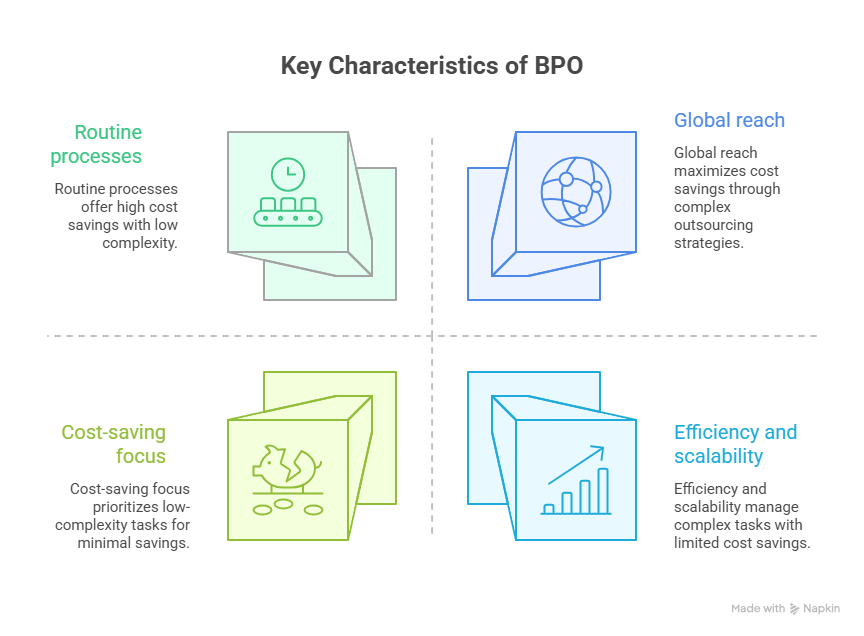
Key Characteristics of BPO:
- Cost-saving focus: Lowering operational costs by outsourcing high-volume, low-complexity tasks.
- Efficiency and scalability: Helps companies handle large workloads efficiently by tapping into the resources of external vendors. Can scale up or down as needed.
- Routine processes: Typically standardized, repetitive, and easy to train for. Includes call center support or transaction processing.
- Global reach: Many BPO providers are located in countries where labor costs are lower. This makes it a good option for companies looking to cut expenses.
Knowledge Process Outsourcing (KPO)
KPO, on the other hand, focuses on outsourcing high-level, knowledge-based tasks. They usually require specialized expertise and advanced analytical skills. KPO is not just about saving costs but also tapping into expert talent that can drive business strategy, innovation, and growth. KPO services include tasks such as market research, legal services, financial analysis, data analytics, and R&D.
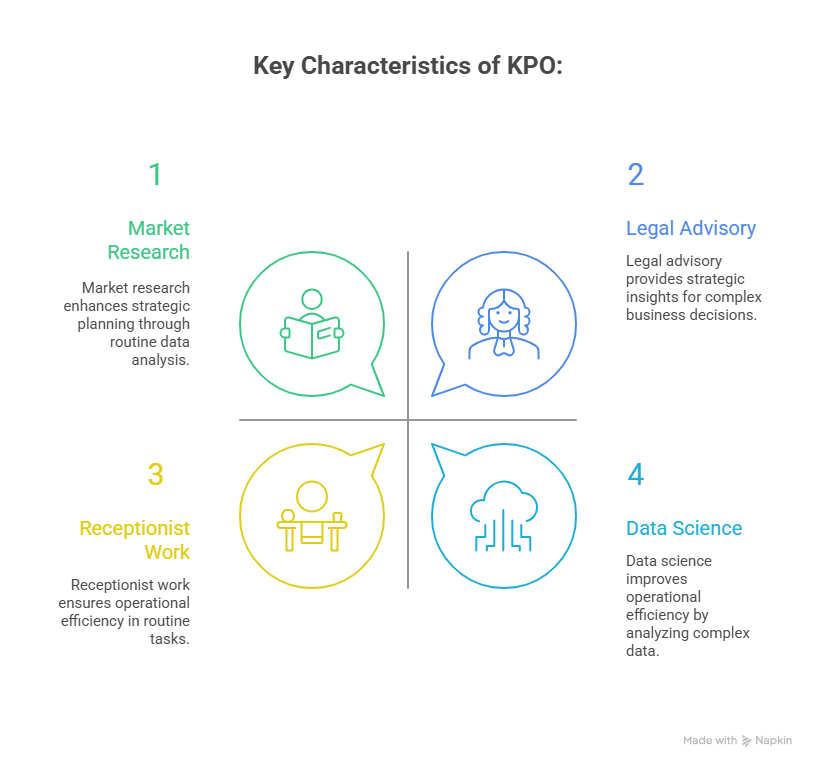
Key Characteristics of KPO
- Specialized expertise: Outsourcing complex, knowledge-driven tasks to experts who possess industry-specific skills and advanced knowledge.
- Innovation and strategy: Designed to enhance business capabilities by providing insights and expertise. This supports decision-making, innovation, and competitive advantage.
- Value-added services: KPO delivers high-value services that directly impact a company’s strategic goals. This includes legal advisory, market research, or data science.
- Knowledge retention: KPO helps businesses develop intellectual capital by leveraging the knowledge and expertise of external specialists.
Types of KPO Services
The range of KPO services is huge. From data analytics and research to legal process outsourcing and R&D. There’s a KPO solution for almost every industry.
- Market Research & Analytics: Understanding trends, consumer behavior, and market opportunities.
- Financial Services: Investment analysis, accounting, and forecasting.
- Healthcare Knowledge Services: Data management, claims, and clinical documentation.
- Legal Process Outsourcing: Research, drafting, and contract review.
- R&D Outsourcing: Innovation without the massive in-house cost.
Every one of these knowledge process outsourcing services requires specialized skill — the kind you’d usually only find in top-tier analysts or consultants. That’s what sets KPO service providers apart. By working with KPO companies, they get to work with experts who are adept at handling tasks that require deep knowledge in various fields. Similarly, a business that wants to launch or upgrade a mobile product can hire dedicated android developer through specialized vendors, gaining platform-specific expertise without the overhead of permanent recruitment. Businesses adopting RPO solutions can enhance their recruitment efficiency and gain access to specialized hiring expertise.
Transform BPO efficiency with data analytics insights – read now!
Key Players in the KPO Industry
The Knowledge Process Outsourcing (KPO) industry is dominated by a handful of trusted companies that provide specialized knowledge services. Here are some of the top players:
Genpact
Offers expertise in:
- Finance & accounting
- Procurement
- Supply chain management
- Risk management
Evalueserve
Known for strength in analytics
- Services include:
- Market research
- Data management
- Business intelligence
Wipro
- Financial research and legal outsourcing
- Focuses on innovation in knowledge services
Infosys
- Financial research and legal outsourcing (similar to Wipro)
- Known for process automation expertise
Why They Matter
These KPO service providers are shaping the industry. They’ve proven that deep expertise can be outsourced successfully and profitably.
KPO vs BPO: Key Differences and Advantages
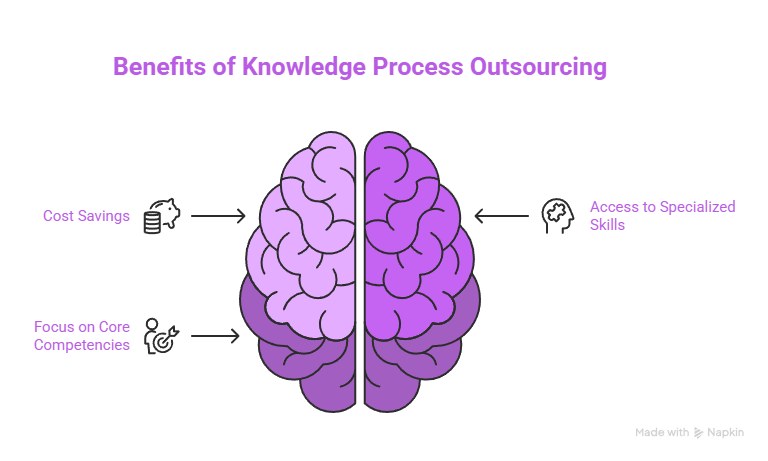
Like anything, Knowledge Process Outsourcing has pros and cons.
Access to Specialized Skills and Expertise
The biggest advantage? Access to specialized skills. You get the kind of experts who’d normally cost a fortune to hire in-house. Whether you need data scientists or financial analysts, KPO companies give you that high-level talent on demand. Students also often seek expert help. A reliable college paper writing service can enhance their academic performance.
Cost Savings
Then there’s cost savings. Hiring full-time experts can be expensive. Outsourcing those roles lets you save money while still getting world-class results.
Level up your customer service game now with our ultimate outsourcing guide!
Challenges of KPO Implementation
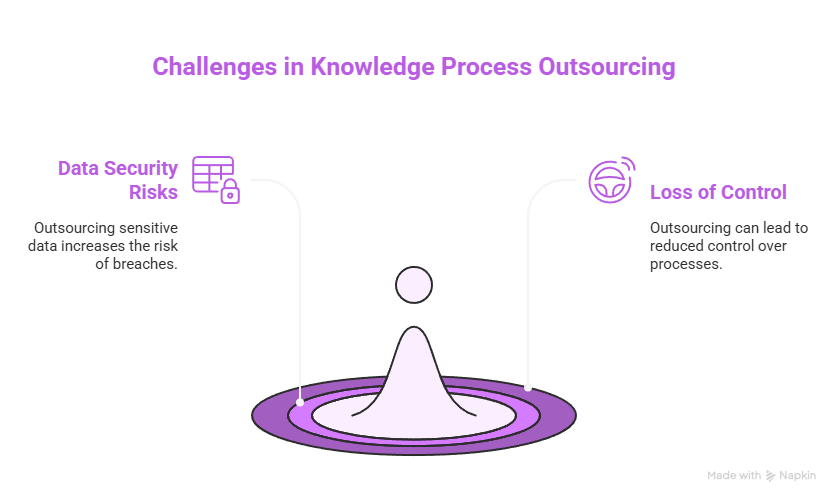
Of course, KPO has challenges too. Mostly around data security and control. You’re trusting another company with sensitive information. That’s why choosing the right KPO service provider is critical. Make sure they have airtight security and clear service-level agreements.
Data Security Risks
A big challenge in KPO is data security. Outsourcing complex tasks means sharing sensitive info with providers. Without strong security, data breaches can happen.
So, it’s vital for businesses to carefully check a KPO provider’s security before partnering. They need to make sure the provider follows strict data protection rules and has solid security measures.
Loss of Control Over Business Processes
Losing control over business processes is another KPO challenge. Outsourcing means giving up some control. If the provider falls short on quality or efficiency, it can cause problems.
That’s why setting clear service level agreements (SLAs) with the provider is key. These SLAs must spell out both sides’ expectations and duties. Doing so can help lessen the risk of losing control over processes.

How Knowledge Process Outsourcing Benefits Businesses
Knowledge Process Outsourcing (KPO) involves delegating high-skill, knowledge-intensive tasks to specialized external teams. Unlike standard BPO (which handles routine tasks), KPO requires deep expertise, critical thinking, and domain knowledge.
Core KPO service areas include:
- Analytics and Data Science – Market research, predictive modeling, business intelligence, and consumer behavior analysis
- Legal Process Outsourcing – Contract review, legal research, patent drafting, compliance documentation, and litigation support
- Financial Research – Equity research, risk assessment, financial modeling, due diligence, and investment analysis
- Healthcare and Pharma – Clinical data management, medical coding, drug research support, and regulatory documentation
- Intellectual Property Services – Patent searches, trademark monitoring, IP portfolio management
- Content and Publishing – Technical writing, e-learning development, academic research, and editorial services
KPO firms do not just execute tasks. They interpret data, provide recommendations, and add strategic value.
Top KPO Services for Businesses
The KPO landscape includes both large global players and niche specialists. Here are some of the most recognized names in the industry:
| Company | Known For |
|---|---|
| EXL Service | Analytics, insurance, healthcare KPO |
| WNS Global Services | Finance, legal, research outsourcing |
| Genpact | Data analytics, risk, financial services |
| Evalueserve | Business research, IP services, analytics |
| Infosys BPM | Finance, procurement, knowledge services |
| Syntel (now Atos) | IT-driven KPO, financial research |
| Accenture Operations | Advanced analytics, legal, HR knowledge work |
| ICRA Analytics | Financial and risk research |
India remains the dominant KPO hub globally, with the Philippines and Eastern Europe growing fast as alternative destinations.
KPO Services and Use Cases
KPO stands for Knowledge Process Outsourcing. Companies outsource high-skill, knowledge-intensive tasks to specialized third-party providers.
Core KPO Service Areas
Analytics and Data Services
- Business intelligence and data mining
- Predictive modeling and forecasting
- Market research and competitor analysis
- Consumer behavior analytics
Legal Process Outsourcing (LPO)
- Legal research and document review
- Contract drafting and management
- Patent research and filing support
- Compliance and regulatory analysis
Financial Research and Services
- Equity and investment research
- Financial modeling and valuation
- Risk assessment and credit analysis
- Accounting and tax advisory support
Intellectual and Specialized Tasks
- Engineering and R&D support
- Medical research and clinical data analysis
- Publishing and content development
- E-learning and training material creation
Top KPO Companies
These are some of the leading KPO providers operating globally.
| Rank | Company | Specialization |
|---|---|---|
| 1 | WNS Global Services | Analytics, finance, healthcare |
| 2 | EXL Service | Insurance, banking, analytics |
| 3 | Genpact | Financial services, risk, analytics |
| 4 | Syntel (Atos) | IT-driven KPO, legal, finance |
| 5 | Evalueserve | Market research, analytics, IP services |
| 6 | Inductis (EXL) | Decision analytics |
| 7 | Accenture Operations | Cross-industry knowledge services |
| 8 | Infosys BPM | Finance, procurement, legal |
| 9 | Wipro BPS | Healthcare, banking, HR analytics |
| 10 | ICRA Analytics | Financial and credit research |
Most top KPO companies are headquartered in India, the Philippines, and Eastern Europe, with delivery centers serving clients in the US, UK, and Australia.
KPO Market Trends
Knowledge Process Outsourcing Market Overview
The global KPO market is growing fast. Here is what the data shows.
- Market size: Valued at approximately $67 billion in 2024.
- Growth rate: Expected to grow at a CAGR of around 19% through 2030.
- Key driver: Rising demand for specialized skills that in-house teams cannot easily provide.
- Top outsourcing destinations: India, Poland, Philippines, and South Africa.
KPO Industry Meaning in Today’s Context
The KPO industry goes beyond simple task outsourcing. It involves transferring deep domain expertise.
Key trends shaping the industry:
- AI integration – KPO firms are embedding AI and automation to speed up research and analysis.
- Shift to insights – Clients no longer just want data. They want actionable recommendations.
- Niche specialization – Providers are focusing on specific verticals like healthcare or law.
- Cloud-based delivery – Secure cloud platforms are replacing traditional on-site data handling.
- Talent arbitrage – Companies tap expert talent in lower-cost regions without compromising quality.
What is KPO in Simple Words?
KPO means hiring outside experts to handle smart, skilled work for your business.
Think of it this way:
- BPO (Business Process Outsourcing) handles routine tasks. Think data entry or customer calls.
- KPO (Knowledge Process Outsourcing) handles expert tasks. Think financial analysis or legal research.
A simple example:
A bank in the US needs stock market research. Instead of hiring a full in-house team, it works with a KPO firm in India. That firm has analysts who do the research and send back reports. The bank saves money and gets expert work done faster.
In short:
- KPO = outsourcing brain work, not just manual work.
- It requires trained professionals, not just any worker.
- It adds strategic value, not just operational support.
KPO Industry Trends and Future Outlook
The knowledge process outsourcing market is expanding rapidly. Here is what is shaping the industry right now:
Market Size and Growth
- The global KPO market was valued at over $67 billion in recent years and is projected to grow at a CAGR of around 19% through 2030.
- Demand is being driven by businesses needing specialized insights without the cost of full in-house teams.
Key Trends Driving the Industry
- AI and Automation Integration – KPO firms are embedding AI tools into research and analytics workflows, increasing output speed without sacrificing quality.
- Shift Toward Niche Expertise – Clients are moving away from generalist providers toward KPO firms with deep vertical knowledge (e.g., fintech, biotech, legal tech).
- Cloud-Based Delivery Models – Remote-first, cloud-enabled delivery is now standard across most KPO operations.
- Data Privacy and Compliance Pressure – GDPR, HIPAA, and other regulations are pushing KPO providers to invest heavily in security infrastructure.
- Rise of Emerging Markets – Countries like Colombia, Poland, and Vietnam are entering the KPO space as alternative delivery locations.
The KPO industry meaning has also evolved. It is no longer just about cost-cutting. It is about accessing world-class expertise on demand.
What is KPO in Simple Words?
Think of KPO like hiring a team of experts you do not have in-house.
Say your company needs financial analysis done, legal contracts reviewed, or market research conducted. You could hire full-time specialists, but that is expensive and slow. Instead, you outsource that work to a KPO firm that already has trained experts ready to go.
The simplest way to understand it:
- BPO handles repetitive tasks (data entry, customer calls)
- KPO handles thinking tasks (research, analysis, legal review)
A KPO provider acts as an extension of your team, just operating remotely and at a fraction of the cost of building that capability internally.
A real-world example: A hedge fund outsources equity research to a KPO firm in India. The KPO analysts study companies, build financial models, and deliver reports. The hedge fund gets expert-level work without hiring a full research department.
That is KPO in its simplest form: outsourcing brainwork, not just busywork.
Future of Knowledge Process Outsourcing
The future of knowledge process outsourcing looks promising. As technology like AI and machine learning evolve, KPO companies are using them to deliver even smarter insights.
Imagine getting predictive analytics, faster research, or automated data analysis. All through your KPO service provider. That’s where we’re headed.
Businesses are realizing that staying competitive isn’t just about cutting costs anymore. It’s about accessing deep knowledge, faster. That’s the real KPO meaning in today’s world.
Role of Technology in KPO
Technology is at the core of KPO sector. Breakthroughs in areas like AI and machine learning are changing how KPO services work. Making it possible for providers to offer services more efficiently and effectively.
Unlock unparalleled efficiency in BPO operations with AI and automation!
Increasing Demand for KPO Services
As companies focus more on what they do best, they’re turning to KPO for help with specialized tasks that can give them a competitive edge. Unlike BPO, which handles routine tasks, KPO offers expert services like market research, data analysis, and financial consulting.
With companies going global, the need for KPO services is growing even more. KPO providers bring that deep knowledge to the table, helping businesses make smarter decisions and succeed.
Trending Now
An article from Yahoo! shines a light on the emerging trend of KPO. Explaining how KPO stands out from traditional BPO. It focuses on more intricate and value-driven tasks. Including in-depth research, analytical reasoning, and creative problem-solving. The narrative tells us benefits of KPO, including significant cost reductions. Plus the acquisition of niche expertise and a boost in operational efficiency.
Frequently Asked Questions about KPO
What is Knowledge Process Outsourcing (KPO)?
Knowledge Process Outsourcing (KPO) is when a company outsources specialized, knowledge-based tasks (market research, data analytics, or legal research) to external experts. KPO focuses on analytical and strategic work that requires advanced skills and expertise.
How does KPO differ from BPO?
While Business Process Outsourcing (BPO) focuses on repetitive tasks, KPO handles complex processes that demand critical thinking and domain expertise. In short, BPO is about efficiency and KPO is about insight and innovation.
What are the main benefits of KPO for businesses?
KPO gives companies access to
-specialized talent
-deeper insights
-cost-effective expertise
Without hiring full-time professionals. It helps organizations innovate faster, make smarter data-driven decisions, and stay competitive in their industries.
What are the main challenges of KPO?
Biggest challenges include data security risks and loss of control over outsourced processes. Since KPO involves handling sensitive information, companies must partner with providers who follow strict security measures and have clear service-level agreements (SLAs).
What does the future of KPO look like?
The future of KPO is being shaped by AI, automation, and machine learning. Technologies that are helping providers deliver smarter insights, faster analysis, and more value-driven services. As businesses focus on knowledge and innovation, KPO will continue to grow in demand.
What is KPO in simple words?
KPO is when a business outsources skilled, knowledge-based tasks like research, analysis, or legal work to an external team of experts.
Which are the top KPO companies?
Some of the leading KPO companies include EXL Service, WNS Global Services, Genpact, Evalueserve, and Infosys BPM.
What services do KPO providers offer?
KPO providers offer services like financial research, legal process outsourcing, data analytics, market research, IP services, and healthcare documentation.
How is KPO different from BPO?
BPO handles routine, repetitive tasks like data entry or customer support, while KPO handles complex, judgment-driven work that requires specialized expertise and domain knowledge.
How can KPO benefit my business?
KPO gives you access to expert-level talent at a lower cost, speeds up research and analysis, and lets your core team focus on higher-priority business goals.
What is Knowledge Process Outsourcing in simple words?
KPO means hiring an outside company to handle work that requires deep expertise and specialized knowledge. Think of it as outsourcing brain-intensive tasks like research, analysis, or legal work to skilled professionals in another location.
How does KPO differ from BPO?
BPO (Business Process Outsourcing) handles routine, rule-based tasks like data entry or customer calls. KPO handles complex, knowledge-driven tasks that require expert judgment. BPO focuses on volume; KPO focuses on expertise.
Which are the top KPO companies?
Some of the leading KPO companies include EXL Service, WNS Global Services, Genpact, Evalueserve, Mphasis, CRISIL, and Accenture. Many are headquartered in India, which is the world’s top KPO destination.
What tasks can KPO handle?
KPO can manage a wide range of high-skill tasks, including financial research and analysis, legal process outsourcing, market research, data analytics, medical and pharmaceutical research, intellectual property services, and engineering design.
What is the future of Knowledge Process Outsourcing?
The KPO industry is growing fast. AI and automation are changing the type of work being outsourced, but demand for human expertise remains strong. Areas like data science, ESG research, and advanced analytics are driving new growth. The global KPO market is expected to keep expanding through the next decade.
Conclusion
At the end of the day, KPO is about tapping into global intelligence. It’s about partnering with experts who bring value beyond routine work.
If you’re serious about scaling, not just growing. It might be time to explore knowledge process outsourcing services for your business.
And if you’re already thinking about where to start, HelpSquad can help. Our team of trained professionals provides the kind of high-level support that helps you focus on what you do best while we handle the rest.
Talk to us today and see how outsourcing smarter can transform your business.

Michael Kansky, Founder of LiveHelpNow and HelpSquad, has leveraged his 20 years of industry experience and innovative support strategies to revolutionize customer service approaches, making LiveHelpNow a leading customer service software provider, and establishing HelpSquad as a bridge between businesses and customer needs. You may contact Michael on LinkedIn: https://www.linkedin.com/in/mkansky/