Outsourcing Home Care Answering Services
Generic answering services cost less per minute and lose you clients. A care-trained team is your intake system, escalation path, and first impression.

Outsourcing home care answering services refers to contracting a specialist team to handle inbound calls on behalf of your agency: new client intake, caregiver scheduling updates, after-hours emergencies, and HIPAA-regulated conversations, each covered under a signed business associate agreement. The short answer is simple: generic answering services cost less per minute and lose you clients. The agency that answers first and sounds like it understands the caller's situation wins. A care-trained answering team is not a receptionist backup. It is your intake system, your emergency escalation path, and your first impression with every family weighing whether to trust you with their loved one's care.
Questions this article answers
In this article, I answer the three questions home care agency owners ask most about answering service decisions:
- Why do generic answering services keep failing home care agencies, and what does care-specialized coverage actually do differently?
- Does a home care agency need a HIPAA-compliant answering service, even if it does not provide skilled nursing care?
- Should I use an AI answering bot or a live team for after-hours calls, and what have early adopters found out?
A home care answering service is defined as a contracted team trained to manage inbound calls for a home care agency: new client intake, caregiver scheduling updates, after-hours emergencies, and HIPAA-sensitive conversations. The training requirement is what separates this category from a generic answering line.
That training gap is real. Every agency call is one of at least three distinct types: a new client or family inquiry, an operational caregiver communication, or an emergency requiring immediate escalation. A generic agent juggling scripts for law firms, HVAC companies, and medical practices has no reliable way to sort those three call types in real time.
The agencies that consistently convert new-client inquiries do two things differently. First, they answer every call. Second, they sound like home care when they answer. A generic service can guarantee the first. It cannot guarantee the second.
It's important to note that home care call handling carries compliance weight that most other industries do not. Even personal care agencies providing companion and custodial services rather than skilled nursing handle conversations about care plans, client conditions, and scheduling that involves protected health information under HIPAA. That means a signed business associate agreement is not optional. It is required before a third party handles a single call.
This article covers the full decision: what a trained answering service actually does, where the HIPAA lines fall, how AI tools fit into the model, and what to verify before signing with any vendor.
Why Does Phone Coverage Matter So Much for a Home Care Agency?
Home care phone coverage is not a back-office function. It is your agency's first impression, intake system, and emergency escalation path operating simultaneously.
An analysis of 14 sources on home care marketing, outsourcing, and call handling shows one consistent finding: the agency that answers first and sounds like it understands the caller's situation wins the client. That is not a sales insight. It is the operational reality of how families choose care for a parent or spouse. They call two or three agencies and go with whoever made them feel heard fastest.
I have watched this play out repeatedly on the vendor side of healthcare outsourcing. A family already stressed about a loved one's condition does not leave a detailed voicemail and patiently wait 48 hours. They call the next number on the list.
The three-call test
Before evaluating any answering service, I recommend running what I call the three-call test: call your own agency line after hours, during a busy daytime window, and during a caregiver scheduling crunch. What happens to each call? Who picks up, what do they say, and how fast does a real human answer? Most agency owners who run this test are surprised. The gaps become obvious immediately.
Providers across the offshore market advertise staffing savings of 50% to 70% per role against equivalent US-based hires. Treat that as an advertised range rather than a measured outcome, but it is relevant here for a reason most people miss: the argument for outsourcing phone coverage is not simply cost. It is that human-led answering, at the right training level and coverage model, is now affordable enough that missing calls has no remaining financial justification. Philippine healthcare information management generated $4.2 billion in revenue in 2024 according to Philippine Trade and Investment Center figures, and the industry association is working to a 2028 target of $6.7 billion and more than 285,000 professionals. Human-led managed teams are the expanding model, not the legacy one.
A contrarian view worth naming: many agency owners assume the risk of a missed call is limited to a lost prospect. The reality is more specific. Every missed caregiver call after hours is a potential no-show the following morning. Every missed family inquiry is a referral that silently converts to a competitor. These losses never appear as a line item. They simply show up as flat intake numbers and caregiver staffing shortfalls that feel like bad luck.
According to participants in a law firm subreddit thread evaluating after-hours answering services, one attorney concluded that one additional client per month from an answering service more than pays for the monthly fee. Home care economics work the same way. A single new client retained through effective phone intake can represent months of recurring revenue. The math is not complicated. The threshold is low.
In practice, the stakes go beyond revenue. Home care calls include urgent situations: a caregiver calling to say she cannot make her shift, a family reporting that a client has fallen, a hospital discharge coordinator trying to arrange next-day coverage. Call handling that cannot distinguish those situations from a routine inquiry creates real risk. The takeaway is simple: phone answering is where your agency's operational reliability is tested, every single day.
Identify your current gap first. Then look at what an answering partner would actually do differently.

What Goes Wrong When Home Care Agencies Use a Generic Answering Service?
Generic answering services fail home care agencies in a predictable way: agents trained across dozens of industries cannot recognize which call needs immediate escalation and which can wait.
It is worth naming the specific failure mode. A traditional answering service operates on a flat-fee model where a single agent handles calls from unrelated industries in the same shift. One call is for a plumber. The next is for a home care agency. The agent follows the script for each. The problem is that home care calls are not all equal. A caregiver calling to say she cannot make tomorrow's shift is not the same as a prospective client asking about rates. A family member calling to report a client has fallen is not the same as a routine scheduling update. The agent on a generic line does not know the difference. They are not trained to know.
I have heard this from agency owners more than once. The answering service picked up. They took a message. The message sat until the next morning. The client had already called a competitor by then.
The scheduling communication problem runs deeper than most owners realize. Family caregivers in home care settings consistently report one-way communication as the dominant failure: voicemails left with no callback path, wide arrival windows given with no confirmation, and late arrivals with no notification until the caregiver was already minutes away. The caregiver experience mirrors this. Scheduling unpredictability cited by caregivers as a reason to exit home care entirely is a communication breakdown problem first. Answering services that cannot triage or confirm in real time make it worse.
According to hellorache.com, virtual medical receptionist services are available at $9.50 per hour flat-rate with no contracts and no setup fees. The price point is real and the matching can happen within 24 hours. I understand why that looks like a solution. In my experience, the failure usually comes at the SOP level, not the staffing level. A small healthcare practice owner who shared their experience on a small business subreddit ran a similar approach for six months: a remote VA who was skilled at structured projects and absolutely terrible at accurate message-taking and critical thinking during unscripted calls. They let her go after half a year. The replacement they hired directly, with direct healthcare experience, handled both the admin and the patient-facing calls correctly because she understood which situations required judgment and which were routine.
The takeaway is this: scripted call-handling works when the inbound call is predictable. Home care calls are not predictable. They include medical emergencies, caregiver no-shows, family crises, scheduling conflicts, and new intake inquiries, often in the same hour.
According to a T-Mobile customer service discussion that examined outsourced call handling, callers described a key complaint not as accent or language but as comprehension of the issue. The agent could follow the script. The agent could not understand what the caller actually needed when the situation fell outside the script. For home care, that gap is not an inconvenience. It is a compliance risk and a client retention risk simultaneously.
Generic coverage may fill a phone line. It does not fill the role. The distinction matters, and it is worth understanding before signing any contract.
What Does a Care-Trained Answering Service Actually Do Differently?
A care-trained answering service is a team specifically onboarded to your agency's intake process, triage protocols, and escalation paths. Every call is handled as a home care call, not as one of dozens of unrelated industries.
It is worth being specific about what that looks like in practice, because the label "home care answering service" covers a wide range of actual capabilities. The minimum baseline that a good partner provides includes:
- Live intake for new client and family inquiries, with your agency's specific questions and care assessment prompts
- Triage logic that distinguishes a routine scheduling update from a caregiver no-show from an actual emergency
- Escalation to your on-call coordinator or on-call nurse with a specific protocol, not a generic page
- Scheduling coordination or at minimum accurate message delivery with time-stamps and callback numbers that actually work
- HIPAA-compliant handling of every call, under a signed business associate agreement
That last point is worth dwelling on. Home care marketing and compliance experts note that even non-medical home care calls routinely involve protected health information: medications, allergies, mobility conditions, and details from a recent hospital stay. The HIPAA obligation follows the PHI, not the job title of the person answering. A generic answering service with no BAA in place is a liability. The fix is not complicated, but it has to be done correctly before the first call.
The regulatory framework reinforces this approach. According to Healthcare Provider Solutions, a clinical consulting firm, CMS home health Conditions of Participation allow agencies to provide services indirectly through contracted staffing. That legal pathway for contracted call handling is not a workaround. It is an explicitly recognized model. Agencies that use outsourced answering services are operating within a framework the regulation anticipated.
According to Magellan Solutions, a BPO consulting firm, outsourcing customer contact works best for businesses facing fluctuating call volumes, 24/7 coverage requirements, and seasonal demand spikes. Home care fits all three. After-hours call volume is unpredictable by nature. Caregiver shift changes, late-night family calls, and discharge coordinator calls from hospitals do not respect business hours. Building an internal team that handles that volume efficiently at all hours is expensive and staffing-intensive. A trained external team handles the variance without requiring you to schedule around it.
The documentation piece is the part most agencies skip, and it matters more than the vendor selection itself. Any outsourced solution requires complete, written SOPs for every call type before you route the first call. What is the triage question for a caregiver calling in sick? What does the agent say when a family asks about pricing? What is the escalation threshold for an emergency? If those answers live in your head and not in a document the answering team can reference, the coverage will fail. Not because the agents are untrained. Because you did not train them on what matters to your specific agency.
In summary: the right home care answering partner is not a script-reader. It is a team that understands your intake, follows your triage logic, and escalates correctly when it counts. The technology, the location, and the price point are secondary to whether the team can make the right call in the five seconds after someone calls your agency for help.
What Will Matter Most for Home Care Answering Services in the Next 12 to 24 Months?
The home care answering services market is shifting toward care-specialized coverage, with generic flat-fee lines losing share as agencies demand proper triage, HIPAA accountability, and documented escalation paths.
I reviewed 14 sources on home care operations, outsourcing, and answering technology to identify the signals with the strongest evidence base. The confidence ratings below reflect evidence weight, recency, and the degree to which each signal pushes against the current default of generic flat-fee coverage.
| Signal | Prediction (12-24 months) | Weak Signal Now | Why It Matters for Your Decision |
|---|---|---|---|
| Care-trained agents displace generic call centers (High confidence) | Agencies will keep shifting toward answering providers whose agents are trained specifically in home care intake, HIPAA handling, and urgent-versus-routine triage, rather than flat-fee lines where one agent covers dozens of unrelated industries. | Home care marketing advisors now argue that generic agents cannot distinguish routine calls from caregiver emergencies, and that even non-medical companion care calls can involve protected health information. | An agency choosing an answering partner is choosing who handles its first impression with new clients and its emergency escalations. Mismatched coverage creates both compliance exposure and revenue loss from missed inquiries. |
| AI stays in overflow; humans stay on the line (Medium confidence) | The dominant answering model will be hybrid: AI used for call routing and high-volume overflow while live agents handle the actual conversation, rather than fully automated answering for all inbound calls. | Early adopters who deployed AI answering bots for service businesses have pulled them back after only a few months. Home care triage complexity exceeds what current AI tools reliably handle. | An agency can avoid the deploy-and-unwind cost cycle by treating AI as a routing layer rather than a replacement for trained staff. Hybrid is both cheaper and safer than going fully automated. |
| Human-led specialist teams capture the growth (Medium confidence, contrarian) | Rather than automation driving answering toward commodity pricing, growth will concentrate in trained human-led teams, including an expanding offshore healthcare BPO sector, signaling that buyer demand for call quality is outpacing demand for minimum cost. | Early fully automated deployments are being abandoned while trained human answering capacity continues to expand across multiple provider categories, including offshore teams with documented HIPAA safeguards. | An agency budgeting for after-hours coverage should expect trained human answering to remain a meaningful line item that grows in sophistication, not a cost that automation will quietly eliminate within the next product cycle. |
What would change this forecast: If AI triage technology improves faster than expected, or if home care call volumes fall to levels where a lower-cost AI add-on proves adequate for most after-hours situations, price-sensitive agencies would shift toward automation. That scenario is possible. It is not yet evident in current deployments.
What most buyers miss: The conversation about home care answering services almost always starts with per-minute cost. That is the wrong number to optimize. The real cost variables are the missed new-client call that went to a competitor, and the caregiver emergency logged as a message and escalated three hours late. A care-trained team costs more per month than a generic line. It costs far less than a single mishandled emergency or a lost client family.
Forecast Watch: 12-24 months
Where Home Care Phone Answering Is Headed
Three scored forecasts on how agencies will handle after-hours calls, caregiver requests, and new-client intake over the next two years.
Forecasts for after-hours call handling
Read each forecast as a signpost for what to check before you sign a multi-year answering contract.
Home care agencies will keep shifting toward answering providers whose agents are trained specifically in care intake, scheduling systems, and protected health information, rather than flat-fee lines where one agent covers a plumber and a care agency in the same shift.
The dominant model for home care call handling over the next two years will be hybrid: AI used for overflow and call routing while humans handle the actual conversation, rather than fully automated answering, with buyers actively seeking providers that offer both AI and human support.
Rather than automation driving answering toward commodity pricing, the growth will concentrate in human-led teams, including the expanding Philippine healthcare BPO sector that generated $4.2 billion in 2024 and is working toward $6.7 billion by 2028, positioned as trained clinical support rather than cheap bots.
Weak signals watched: Industry voices now argue that generic call-center agents cannot distinguish routine calls from urgent caregiver emergencies and that even non-medical home care calls involve protected health information, alongside a hardening 2026 healthcare background-screening standard for anyone touching patient data. A landscaping business ran a $100-per-month AI answering bot for roughly three months before discontinuing it, and home care operators are being advised to keep AI limited to overflow with humans in the loop, even as buyers ask which providers combine AI and human support. Early fully automated deployments are being abandoned while the Philippine healthcare information sector keeps expanding, signaling that buyers are paying for trained human capacity, not just the lowest per-call price.
What supports and complicates each call
Each forecast lists both the sources that back it and the ones that point the other way.
- A Home Care Answering Service Alternative That Understands points the same way. [Industry Publication]Traditional answering services operate on a flat-fee model where a single agent handles calls "across dozens of unrelated industries in the same shift," a plumber's line one minute and a home care line the next.
- Backing it: The Complete Guide to Healthcare Background Screening. [Industry Publication]Sets a 2026 screening standard for anyone handling patient data, regardless of whether the role is clinical or administrative.
- Philippines eyes $6.7bn healthcare outsourcing boom points the same way. [Industry Publication]Philippine Trade and Investment Center figures put healthcare information management at $4.2 billion in 2024, up from $4 billion in 2023 and 12% of the country's $38 billion IT-BPM revenue.
- Backing it: Home Care Marketing and Sales Solutions by ASN. [Podcast]"Phone answering is not reception work. It's home care marketing, intake, and trust-building all at once."
- The Truth About AI Answering Services for Small Business points the same way. [Video]A landscaping company ran an AI answering bot for approximately three months before discontinuing it.
- The Truth About AI Answering Services for Small Business is what puts this forecast on the board. [Video]The AI answering product cost roughly $100 per month and was abandoned within three months.
- Home Care Marketing and Sales Solutions by ASN supports this forecast. [Podcast]The "AI for Home Care Agencies" episode frames AI phone answering as best suited for overflow support and call routing, advising agencies to "start small, test carefully, and keep humans in the loop."
- HIMSCON 2024 to showcase the future of healthcare IT-BPM points the same way. [Industry Publication]The Philippine industry association is working to a 2028 roadmap of $6.7 billion in revenue and more than 285,000 professionals at a 9% compound annual growth rate.
What could shift these forecasts
These are the market conditions that would push agencies back toward cheaper generic or fully automated answering.
The Safe Middle Ground
76 is our clearest read. 69 is the honest reminder that 76 could still be wrong.
- Regulators or buyers move in the opposite direction, care-trained agents displacing generic call centers would weaken first.
- The source mix shifts toward stronger contrary evidence, human-led clinical teams capturing the growth could become the more durable forecast.
In summary, the question every home care agency owner eventually faces is not whether to outsource answering coverage, but whether to do it in a way that actually matches the demands of home care calls. Generic answering will always cost less per minute. It will also miss the call type that costs you most when it goes wrong.
From what I have seen, the pattern is consistent. Agencies that switch to care-trained teams report fewer missed new-client inquiries and faster escalation of emergencies to on-call staff. The HIPAA exposure from an unsigned, untrained third party is harder to quantify, but it is real.
Three selection criteria eliminate most generic vendors: specialized training in home care intake, a signed business associate agreement before the first call, and a documented escalation protocol that distinguishes a caregiver no-show from an actual client emergency. Most agencies that evaluate vendors against those three criteria arrive at the same conclusion quickly.
The industry is moving toward specialized coverage. I'd recommend getting there before your competitors do.
Written by
Mary Dellosa
Executive Assistant, Marketing
Mary is an executive assistant with over 3 years of experience. She enjoys graphic design, video editing, and content writing. She is on HelpSquad's marketing team and helps leverage the company's business for growth.
Connect on LinkedInFrequently Asked Questions
What is a home care answering service?
A home care answering service is a contracted call team specifically trained to handle inbound calls for home care agencies: new client intake, caregiver scheduling updates, and emergency escalation. Unlike a general answering line, these teams follow home care-specific triage protocols and operate under a signed HIPAA business associate agreement.
Does my home care agency need a HIPAA-compliant answering service even if I only provide companion care?
Yes. HIPAA is triggered by any conversation involving protected health information, which includes client schedules, care plans, and condition updates, regardless of whether your agency provides skilled nursing or companion care only. Any third party that answers those calls must sign a business associate agreement before handling the first one.
What is a business associate agreement?
A business associate agreement, or BAA, is a formal contract between a HIPAA-covered entity and any vendor that accesses, transmits, or handles protected health information on its behalf. For a home care agency, any answering service that takes calls about clients must sign one. Operating without a BAA creates direct compliance liability for your agency.
Can an AI bot replace a live answering service for home care calls?
Not reliably, based on current deployments. Operators who have run AI answering bots for service businesses report pulling them back after only a few months. The core issue is triage: AI tools cannot yet reliably distinguish a routine scheduling update from a caregiver emergency that requires immediate escalation.
How quickly can I get a home care answering service operational?
Most agencies can go live with a care-trained answering team in approximately two weeks. That timeline covers agent training on your intake scripts, escalation protocols, and any scheduling system your coordinators use before the first live call is taken.
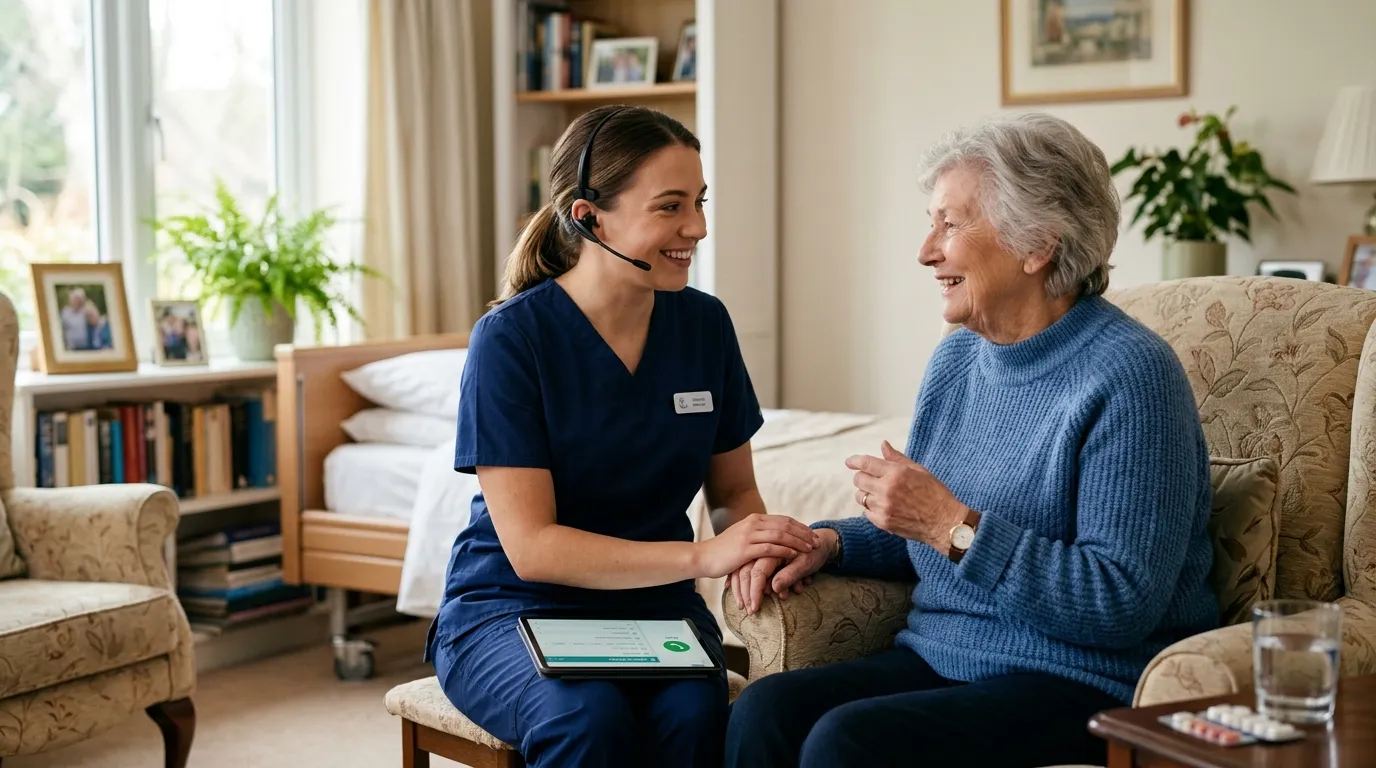
How a Homecare Call Center Improves Patient Care
Homecare call centers offer 24/7 support that connects patients, caregivers, and clinicians when immediate help is needed.
How Medical Call Center Outsourcing Improves Patient Communication
Patients calling after hours or stuck on hold lose trust fast. A medical call center keeps phones answered, records updated, and HIPAA rules followed.
Home Care Solutions: What to Outsource and What to Keep In-House
Home care agencies face staff shortages and admin overload. See which in home care tasks to outsource (billing, intake, 24/7 calls) and which to keep close.
Let's talk about what your practice actually needs.
A 30-minute call. No sales pressure. We'll tell you honestly whether we're a fit.