Virtual Medical Assistant Pricing Comparison

A virtual medical assistant costs $8 to $13 per hour in 2026 through a managed, HIPAA-compliant provider like HelpSquad: $8 to $10 for back-office work such as billing and claims, and $10 to $13 for patient-facing phone work. Those are full-time rates; part-time schedules are quoted individually. The wider market runs from about $5 to $75 per hour by region and role, with no setup fee on standard engagements.
The Short Answer
Most practices pay $8 to $13 per hour for a managed, HIPAA-compliant virtual medical assistant in 2026. Region, role type (voice vs. digital), and specialty complexity are the three variables that move the price. A cheaper hourly rate does not equal a lower total cost once you account for screening, training, turnover, and the compliance risk of working with an individual who cannot execute a valid company-level Business Associate Agreement.
Quick Answer
What does a virtual medical assistant cost in 2026?
The honest answer is: it depends, and the range is wide. A general offshore virtual assistant runs roughly $5 to $15 per hour. Add healthcare-specific training and that floor climbs to $13 to $22 per hour for freelance medical VAs with clinical terminology knowledge. Roles requiring scribing, RN-level triage support, or clinical documentation jump to $23 to $38 per hour. And a fully managed, HIPAA-compliant assistant priced on a monthly model typically lands somewhere between $1,200 and $3,000 per month for full-time coverage.
At HelpSquad, our dedicated medical virtual assistant rates are straightforward: $8 to $10 per hour for back-office digital roles: billing, claims, AR follow-up, data entry, research, and scribe support, and $10 to $13 per hour for patient-facing voice roles covering front desk calls, appointment scheduling, and patient intake. Those are full-time rates. Engagements can start at 20 hours per week, but part-time schedules are quoted individually. Every rate includes HIPAA-compliant virtual desktop infrastructure, a company-level BAA, a dedicated account manager, and a $0 replacement guarantee. Nothing is unbundled and charged back later.
Here is what I want you to hold onto as you read the rest of this article: the hourly rate is the easiest number to compare, but it is also the least useful. Two quotes that look 30 percent apart on a spreadsheet can produce identical, or even inverted, total costs once you account for everything the cheaper rate excludes. I have watched this play out across many practices, and I want to give you a clearer framework for making the decision.
How region changes the price
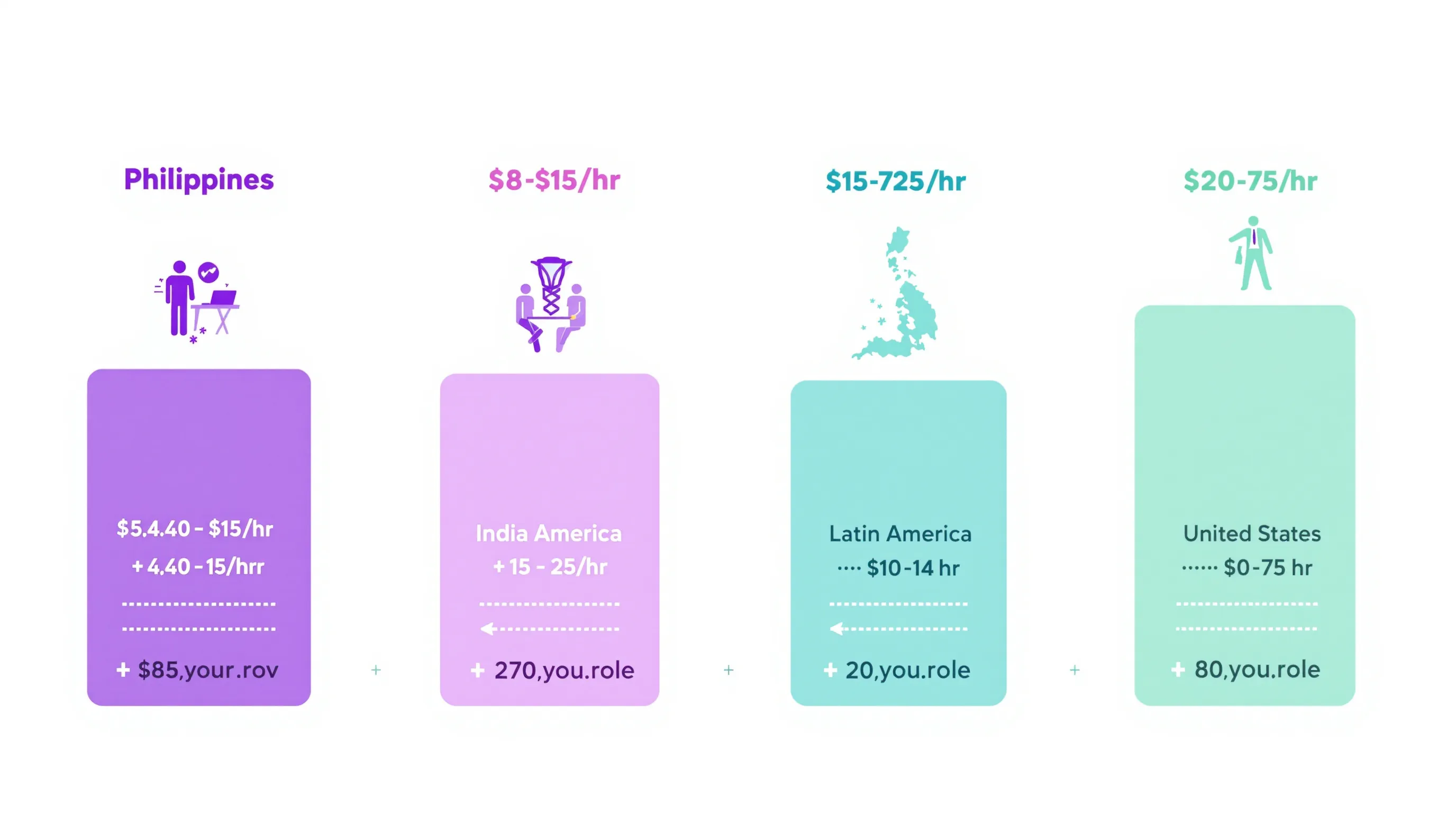
Region is the single biggest driver of virtual medical assistant pricing. The global labor market for medical support has four primary sourcing zones, and each carries a distinct rate band and a distinct set of strengths. Here is how they compare:
| Region | Typical Hourly Rate Range | Best Fit For |
|---|---|---|
| Philippines | $4.50 to $15/hr | Patient-facing voice (front desk, intake, scheduling) |
| India | $8 to $14/hr | Back-office and billing (claims, AR, coding support) |
| Latin America | $15 to $25/hr | US time-zone alignment, bilingual (English/Spanish) |
| United States | $20 to $75/hr | Complex regulatory roles, native English, onshore compliance |
The Philippines and India look close on the low end of that range. But they are not interchangeable, and treating them as such is where many practices make a costly mistake. I understand this distinction from direct experience, I live and manage teams in the Philippines within the BPO space, and the difference is concrete, not theoretical, as of .
The Philippines has built its service culture around voice, customer care, and interpersonal communication. English is an official language, spoken daily from childhood. Accent profiles trend neutral and broadly intelligible to US patients across age groups and hearing levels. The cultural emphasis on hospitality is genuine. It is not a script added during a two-day onboarding. These qualities translate directly into patient experience outcomes when a Filipino VA is handling a 75-year-old patient who needs an appointment rescheduled with patience and warmth.
India's BPO sector has a different center of gravity. Technical precision, structured data workflows, and strong written English make Indian teams highly effective for billing, claims verification, AR follow-up, and back-office tasks governed by rules rather than relationship. When I am thinking about sourcing for a multi-step billing denial workflow, my instinct goes to India. When I am thinking about who answers a patient's call at 8 a.m., my instinct goes to the Philippines.
Latin America commands a premium for a practical reason: US time-zone overlap. If your practice needs real-time availability across Pacific, Mountain, Central, and Eastern time without asking a team to work nights, Latin American staffing solves that problem. The bilingual English/Spanish advantage is meaningful for practices serving Spanish-speaking patient populations.
US-based VAs sit at the top of the range for roles where onshore presence is a regulatory or contractual requirement, or where the complexity of the work genuinely requires native-level fluency and deep familiarity with US health system norms.
Why accent and role fit matter more than the rate
I have watched practices make expensive sourcing mistakes by focusing on cost per hour without first asking a more important question: what kind of communication does this role actually require?
Patient-facing voice roles: front desk, appointment scheduling, prior authorization follow-up calls, patient intake, depend on spoken communication that patients trust under stress. A patient calling about an insurance denial is often frustrated, sometimes frightened. The assistant handling that call needs clear spoken English, strong active listening, and the composure that comes from a culture that treats service as a professional identity. That is the profile of a well-screened Philippines-based VA. It is not a universal profile across all offshore regions.
Back-office roles are different. Billing, claims processing, and AR follow-up are largely digital and written: email threads, payer portals, claim submission forms, EHR data fields. The relevant skills are accuracy, process adherence, and healthcare billing knowledge. Regional accent is essentially irrelevant. What matters is technical precision and familiarity with US payer rules, which Indian BPO teams have developed over decades of supporting US healthcare clients. For dedicated medical billing and claims support, that depth of payer-specific knowledge is what moves revenue cycle performance.
At HelpSquad, this region-to-role matching is the structural core of how we staff. Philippines for patient-facing voice. India for back-office digital. US-based account management and company-level BAA coverage across both. You get the right sourcing for each role type, under a single managed structure, without having to negotiate between two separate vendors or manage two compliance relationships.
It is worth noting that practices sourced purely from one region often find that the profile optimized for billing is the wrong fit for phones, and vice versa. The ask becomes: find me one person who excels at both. That person is difficult to find and more expensive to retain. A regional model that matches the right talent to the right role is more efficient and more sustainable.
How specialty drives price
Once you fix the region variable, specialty complexity is the next lever. The pricing ladder follows a predictable pattern:
- Basic administrative scheduling and patient intake: $8 to $12 per hour. Straightforward patient communication, appointment booking, EHR data entry. Minimal clinical knowledge required.
- Insurance eligibility verification and prior authorization: $10 to $15 per hour. Requires familiarity with payer portals, CPT and ICD-10 codes, and denial documentation. Error rates have direct revenue consequences.
- Medical billing and AR follow-up: $10 to $14 per hour for managed billing support. Demands deep payer-specific knowledge and the ability to navigate denial reason codes and appeal workflows.
- Clinical scribing and chart documentation support: $18 to $30 per hour. Requires understanding of clinical workflows, specialty-specific terminology, and in many cases real-time interaction with the physician during patient encounters.
- RN-equivalent triage and clinical coordination roles: $25 to $38 per hour. The top of the market rate band. Managed team structures at this level typically move to custom pricing that reflects the full clinical oversight infrastructure.
My operational background in healthcare billing: including claims verification, revenue cycle support, and back-office process management, taught me that specialty complexity is not just about knowledge. It is about the cost of errors. A scheduling assistant who books a patient for the wrong time creates a fixable inconvenience. A billing assistant who misfires on a prior authorization appeal can cost the practice several times its monthly rate in denied revenue. That is why the rate ladder exists. Higher complexity commands higher rates because the skills are harder to source, the training investment is larger, and the risk of underqualified staffing is real.
It is worth noting that HelpSquad's managed team tier, available for practices engaging three or more assistants: includes a team lead, QA oversight, and dedicated trainer. Clinical and RN-equivalent roles at this level roll up into custom pricing that reflects the complete managed infrastructure, not just an individual headcount rate.
The number the comparison usually hides
Here is what almost every vendor pricing comparison leaves out: the total cost of the hiring relationship, not just the hourly line item.
I have spent years in talent acquisition and quality assurance, building screening processes, onboarding programs, and training systems for healthcare support teams. The most consistent pattern I saw was practices treating a direct-hire freelancer rate as the full cost of the relationship. It is not. Not even close.
Direct-hire marketplaces routinely advertise rates 30 to 50 percent below managed service rates. On paper, that looks like a clear win. In practice, the arithmetic falls apart when you account for what is not included:
- Screening and recruiting time: Finding a qualified, HIPAA-aware medical VA on a freelance platform takes hours of sorting, interviewing, and skill-testing, sometimes weeks. That time has a real cost, even when it does not appear on an invoice.
- Onboarding and training: A freelancer arrives without knowledge of your EHR, your payer mix, your scheduling protocols, or your documentation standards. Training a new VA from zero typically consumes 40 to 80 hours of internal staff time in the first month. At $30 per hour of your staff coordinator's time, that is $1,200 to $2,400 in absorbed overhead before the VA is fully productive.
- Turnover and re-hiring cycles: Freelancers leave. When they do, you absorb the full recruiting and retraining cycle again. Managed providers absorb that cost and provide replacement guarantees. HelpSquad's replacement guarantee is $0 at no additional charge, a built-in protection against turnover cost exposure.
- Compliance risk and the BAA gap: This is the one that concerns me most from my background in healthcare billing operations. Individual freelancers cannot execute a valid Business Associate Agreement at the company level. A BAA requires the signing entity to have policies, procedures, breach notification protocols, and liability coverage that an individual contractor cannot carry. If you are handling Protected Health Information, which every medical practice does: and your assistant is not covered under a company-signed BAA, you have a compliance exposure that an OCR audit will identify. HelpSquad's BAA is executed at the company level, covering every assistant assigned to your practice.
The math is straightforward. A managed assistant at $10 per hour over a 12-month, 20-hours-per-week engagement costs roughly $10,400. A direct hire at $7 per hour at the same volume costs roughly $7,280 on the rate line. Add one turnover event, one replacement cycle with recruiting and retraining at a conservative $2,000 absorbed cost, and you have closed most of that gap. Add a compliance exposure event and the economics invert entirely.
I am not arguing that managed services are always the right answer for every practice. I am arguing that the hourly rate comparison, without this math behind it, is not a complete picture.
How to compare quotes without getting burned
After watching this evaluation process play out across many practices, I have condensed what actually matters into a five-point checklist. Use it the next time a vendor sends you a quote.
-
Ask what the rate includes, not what it costs.
Request a written itemization of what is covered. Does it include a HIPAA-compliant virtual desktop? A company-level BAA? Dedicated account management? Training and onboarding? QA oversight? A replacement guarantee? These items cost real money to provide. If they are absent from the vendor's operations, the rate will look lower, until you need them.
-
Ask where the assistant is based and why that region fits the role.
Region and role alignment is a primary quality variable, not a secondary consideration. Ask the vendor directly: where is this person based, and why is that region the right fit for the work I am asking them to do? A vendor who cannot answer that question clearly does not have a sourcing model. They have a rate card.
-
Ask for the BAA before you sign anything.
A legitimate HIPAA-compliant provider will have a company-level BAA ready to execute. If a vendor hesitates, hedges, or offers an individual contractor's training certificate as a substitute, that is not compliance. It is a liability. Individual freelancers cannot carry or issue a valid company-signed BAA. Walk away from any arrangement that cannot produce one.
-
Ask about turnover rates and the replacement process.
Ask directly: what is your average retention rate for medical VAs? What happens when my assistant leaves? Who absorbs the recruiting and retraining cost? A managed service provider with a strong retention model and a no-cost replacement guarantee is structurally different from a marketplace where you absorb every transition on your own.
-
Calculate total cost, not hourly rate.
Take the quoted hourly rate, multiply by weekly hours and months of engagement, then add estimated recruiting time, onboarding overhead, and a turnover probability adjustment. A managed service at $10 per hour often compares favorably to a direct hire at $7 per hour once those numbers are in the model. Check our published rates for a transparent starting point to run that comparison against.
A vendor who can answer all five of these questions clearly and in writing is a vendor worth evaluating. One who deflects, bundles vague language around "compliance" and "quality" without specifics, or refuses to provide a BAA for review is giving you a signal. It is important to note that the structure of the vendor relationship, not just the rate, is what determines your real exposure.
What will matter most when evaluating pricing in the next 12 to 24 months
The virtual medical assistant market is moving quickly, and a few structural trends will reshape how practices evaluate pricing over the next one to two years. I want to flag them now because they affect how you should interpret the rate bands I have described above.
Compliance scrutiny is increasing
HIPAA enforcement at the Office for Civil Rights level has intensified. Settlements involving insufficient Business Associate Agreements and unauthorized PHI access have been rising. This is not a theoretical risk for the average medical practice. It is an operational reality. Practices that sourced virtual assistants through freelance platforms without a company-level BAA are exposed, and many do not yet know the extent of that exposure. Over the next two years, I expect compliance verification to become a standard part of vendor due diligence, not an afterthought tacked on at contract review. The practices that address this now will not have to scramble when an audit cycle hits.
Wage pressure in the Philippines and India is real, but manageable
Offshore labor costs have been rising steadily in both the Philippines and India as demand for English-speaking, healthcare-trained support workers has outpaced supply. The implication for buyers: rock-bottom offshore rates are increasingly a signal of undertrained talent, not a bargain. The floor rate for a well-screened, healthcare-experienced Philippines-based VA with voice support capability has been moving toward $10 per hour on the open market. Vendors still advertising $5 per hour rates for healthcare-specific roles in 2026 are either drawing from undertrained pools or subsidizing introductory rates to lock in long-term contracts. Both scenarios cost more than the rate suggests.
Specialty complexity is expanding
The scope of what practices expect from virtual medical assistants has grown significantly. Scribing support, prior authorization workflows, and payer portal management, tasks that were once the exclusive domain of in-house staff or specialized vendors, are now commonly folded into VA roles. That expansion adds credential complexity to the sourcing equation. A practice that needs a single assistant to handle both patient intake calls and insurance eligibility verification is asking for a genuinely broader skill set, and that breadth carries a price. The "one VA for everything" model tends to produce either a mediocre generalist or a specialist priced above what the practice budgeted for. Role clarity before sourcing is KEY.
Managed team structures are becoming the standard
The market is bifurcating. On one side: managed service providers with built-in QA, compliance infrastructure, role-specific sourcing, and transparent rates. On the other: freelance marketplace platforms with commodity-level pricing and structural accountability gaps. Practices that are growing: adding providers, expanding payer panels, scaling patient volume, will find that managed team structures provide the operational predictability that marketplace sourcing cannot. The economics favor managed structures at scale even when the per-hour rate appears higher at the line-item level. This is a pattern I expect to become increasingly visible over the next 12 to 24 months as more practices model total cost rather than hourly rate.
In summary: the trends all point in the same direction. Rate visibility is increasing, compliance scrutiny is tightening, and specialty complexity is expanding. The practices that will manage costs most effectively are the ones making sourcing decisions based on total cost and structural fit, not the hourly number at the top of a vendor comparison spreadsheet.
Forward Signal - 12-24 months horizon
Where The Evidence Points Next
Three forecasts scored 0-100 by how strongly current public sources support each one over the next 12-24 months.
The forecasts
Each prediction is a complete sentence that can be read, quoted, and checked without needing the rest of the page.
As the medical coding market grows from an estimated $8.91 billion toward $14.01 billion by 2030 and health-intelligent-assistant markets grow from about $1.25 billion in 2025 toward $7.42 billion by 2032, pricing will keep splitting between flat hourly rates near $8-$9.50/hour for administrative and documentation support and custom enterprise pricing for AI-driven platforms serving large hospitals and health systems.
Because most virtual assistant companies still cannot sign a HIPAA Business Associate Agreement, expect compliance capability to become as important a comparison point as hourly rate over the next 12-24 months, with buyers continuing to seek clarity on which vendors are best, whether the services are worth the cost, and which BPO firms serve medical practices and hospitals.
For higher-skill clinical documentation work, virtual delivery will not guarantee a cost discount over the next 12-24 months: expect continued wage parity between remote and in-person clinical scribe roles, since ScribeAmerica already pays virtual scribes $10/hour, the same base rate as in-person scribes, with training pay at $11/hour.
Weak signals watched: Current listed rates already show this split: $8/hour and $185/month tiers alongside a $9.50/hour flat rate for admin and documentation work, contrasted with custom enterprise pricing for large hospital AI platforms. ScribeAmerica's virtual scribe base pay matches its in-person rate at $10/hour, with training pay slightly higher at $11/hour. Recurring unanswered buyer questions about which virtual medical assistant companies are best, whether healthcare virtual assistants are worth it, and which BPO firms serve medical practices and hospitals, alongside the finding that most virtual assistant companies cannot sign a HIPAA BAA.
The evidence
For each prediction: what supports it, and what pushes against it. Both sides are shown for every forecast.
- Best Virtual Medical Assistant Jobs: 2026 Platform Guide is the clearest counter-signal. [Video]
- How Remote Care Coordination and Virtual Medical Assistants is the clearest counter-signal. [Blog]
- How to Hire and Train Your Virtual Assistant in DPC! is the clearest counter-signal. [Video]
Where we could be wrong
These forecasts assume current trends continue. The scenarios below would meaningfully change them.
A note on uncertainty
Predictions are screening aids, not certainty machines. The strongest signal here (93/100) still has counter-evidence, and the contrarian signal (62/100) reflects real disagreement among sources.
- If regulators or buyers move in the opposite direction, Two-tier pricing solidifies as the market scales would weaken first.
- If the source mix shifts toward stronger contrary evidence, Wage parity emerges for skilled clinical documentation roles could become the more durable forecast.
The bottom line
The hourly rate is the starting point of a pricing comparison, not the conclusion. Region explains the rate range. Role fit determines whether that region is the right choice. Specialty complexity sets the floor for the skill investment the role requires. And total cost: screening, training, turnover, compliance, determines what you actually pay over the life of the engagement.
In my experience, practices that anchor their vendor decision on the hourly number alone tend to cycle through VA relationships every six to twelve months, absorbing retraining costs and operational disruption each time. Practices that evaluate on structure: managed versus direct, BAA coverage, replacement guarantee, role-to-region fit, stabilize their support operations faster and at a lower total cost over time.
A managed, US-supervised full-time rate in the $8 to $13 per hour band, with HIPAA infrastructure and a company-level BAA included, is not a premium. It is what accountable healthcare support actually costs when all the variables are priced in. The transparency is the point. A vendor who can show you exactly what is in the rate, and exactly what is not, is the one giving you the information you need to make a real cost comparison.
If you are ready to move from a rate comparison to a real cost conversation, I invite you to review our published rates and reach out for a consultation. We will help you model the total cost for your specific role mix and volume, without the guesswork.
Written by
Maria Rush
Marketing Team Lead, HelpSquad
Maria De Jesus-Rush is Marketing Team Lead at HelpSquad, a healthcare business process outsourcing company, with a background in content development, digital marketing, and project management.
Connect on LinkedInFrequently Asked Questions
How much does a virtual medical assistant cost per hour in 2026?
In 2026, virtual medical assistant pricing ranges from roughly $5 to $75 per hour depending on region, role type, and service model. General offshore VAs run $5 to $15 per hour. Healthcare-specific freelance VAs run $13 to $22 per hour. Managed, HIPAA-compliant medical VAs with company-level BAA coverage and QA infrastructure run $8 to $10 per hour for back-office digital roles and $10 to $13 per hour for patient-facing voice roles at HelpSquad for full-time staffing, with part-time schedules quoted individually. Clinical and RN-equivalent roles start at $23 per hour and go up from there. A fully managed full-time assistant on a monthly model typically costs $1,200 to $3,000 per month for full-time coverage.
Why are Philippines-based assistants cheaper than US-based ones?
The wage differential reflects differences in cost of living, labor market supply, and currency exchange rates, not a difference in quality for the right role type. Philippines-based assistants are particularly well-matched to patient-facing voice roles because of high English proficiency, neutral accent profiles that US patients readily understand, and a strong cultural orientation toward service and hospitality. US-based VAs command a premium for roles requiring onshore regulatory presence, native cultural fluency, or complex compliance involvement. For standard front-desk, scheduling, and intake roles, the Philippines provides the strongest combination of communication quality and cost value.
Does a cheaper hourly rate actually save money?
Not always. Direct-hire freelancers can be 30 to 50 percent cheaper on the hourly line item, but the total cost is often higher once you add screening and recruiting time, onboarding overhead (typically 40 to 80 hours of internal staff time in the first month), turnover and retraining cycles, and the compliance risk of working without a company-signed BAA. A managed assistant at $10 per hour with a built-in replacement guarantee and no-cost onboarding typically delivers better total-cost economics than a direct hire at $7 per hour over a 12-month engagement. The key is to model both scenarios fully before deciding.
How does specialty affect virtual assistant pricing?
Specialty complexity moves the rate because it increases both the skill requirement and the cost of errors. Basic scheduling and intake sits at the low end ($8 to $12 per hour). Insurance eligibility verification and prior authorization demand payer-specific knowledge and command $10 to $15 per hour. Medical billing and AR follow-up requires deep coding and claims expertise in the $10 to $14 per hour range. Clinical scribing and RN-equivalent support roles, where errors have direct patient and revenue consequences, run $18 to $38 per hour. Each step up in complexity represents a larger training investment and higher stakes for under-qualified staffing.
What should be included in a virtual medical assistant rate?
At minimum, a HIPAA-compliant medical VA rate should include: a company-level Business Associate Agreement (not an individual contractor's certification), a HIPAA-compliant virtual desktop environment, dedicated account management, QA oversight, and a replacement guarantee at no additional cost. Training, onboarding, and compliance infrastructure should be built into the rate, not billed separately. If a vendor's quoted rate excludes these elements, add their market cost back into your comparison before concluding the cheaper quote is actually cheaper. It is worth noting that individual freelancers cannot carry or issue a valid company-level BAA: that is a structural limitation, not a documentation oversight.

Virtual Medical Scribe: Role, Benefits, and Workflow
A virtual medical scribe is a remote professional who documents patient visits into the EHR in real time, freeing the clinician to focus on care. The Oregon Health & Science University research shows the documentation relief is real but conditional.

Physician Virtual Assistant: Cutting Charting and Inbox Time
A physician virtual assistant takes charting, the EHR inbox, prior auth, and scheduling off a doctor's plate so licensed time goes to patients, not paperwork.

What Is an ER Scribe and Why Emergency Departments Can’t Afford to Ignore Them
An ER scribe documents every patient encounter in real time so emergency physicians can focus on care instead of charting through their healthcare shift.
Let's talk about what your practice actually needs.
A 30-minute call. No sales pressure. We'll tell you honestly whether we're a fit.