What Is an ER Scribe and Why Emergency Departments Can’t Afford to Ignore Them
An ER scribe documents every patient encounter in real time so emergency physicians can focus on care instead of charting through their healthcare shift.
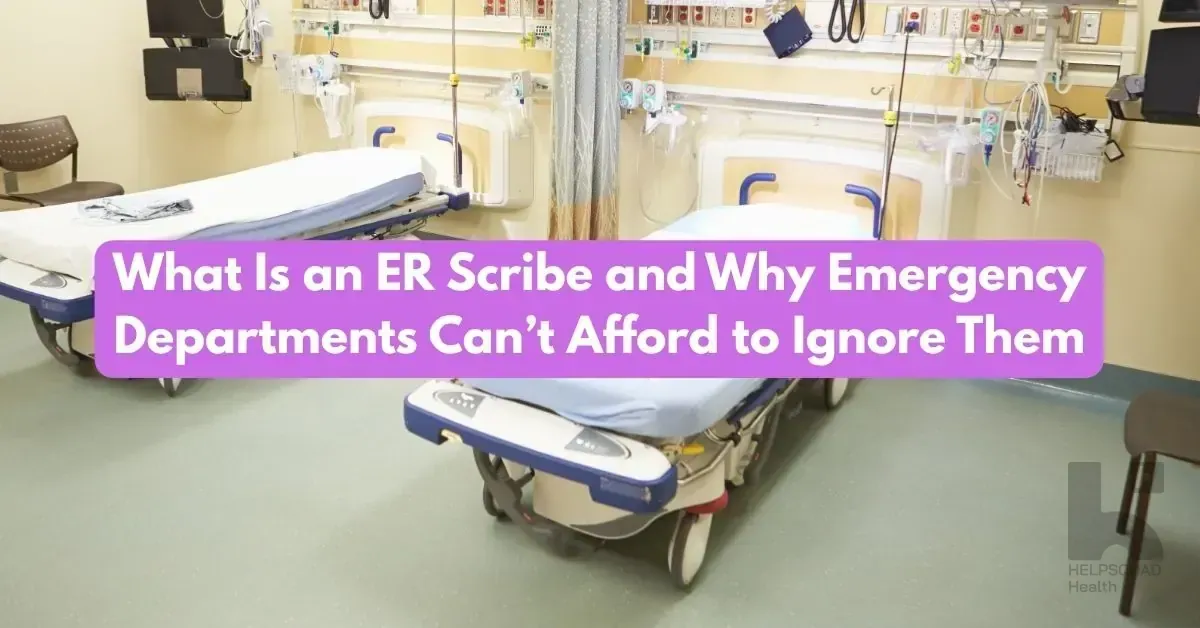
An ER scribe is a trained assistant who documents everything a physician says and does during a patient visit in real time, so the doctor can focus on care instead of typing. They record details like symptoms, exam findings, and treatment plans as they happen. For example, while a doctor evaluates a chest pain patient, the scribe captures the full encounter in the medical record immediately.
What Is an ER Scribe?
An ER scribe has one job: follow the physician and write everything down.
That’s it. While the doctor is listening, examining, and thinking out loud, the scribe is right there capturing all of it, the history, the findings, the plan, the orders. Not billing. Not scheduling. Just the medicine, documented in real time so the physician never has to stop and type.
They’re in the room when it matters, fingers moving while the doctor’s attention stays where it belongs, on the patient. When the encounter ends, the physician reads through it, signs off, and moves on. No catching up on charts at the end of a twelve-hour shift. No trying to reconstruct a conversation from memory at midnight. The documentation is done.
To be clear, scribes don’t make clinical calls. They don’t advise patients or act in any licensed capacity. Their job is to capture what the physician does, but don’t let that narrow definition fool you. The ripple effect of having someone in that role goes well beyond keeping the chart clean.
In-Person Scribes vs. Remote Scribes: What’s the Difference?
There are two primary models for ER scribe support, and both have grown significantly in adoption across the United States.
In-Person ER Scribes
Traditional scribes work directly in the emergency department. They follow the physician from room to room, observe patient encounters, and document in real time. This model works well in high-volume environments where detailed observation is critical and the physician prefers a dedicated person physically present during care.
Remote Medical Scribes
Remote scribes work from somewhere else entirely listening in as the encounter happens and handling the documentation from offsite. It’s a model that took off during the pandemic, when healthcare was already being forced to rethink what actually needed to happen in person. Turns out, writing down what a doctor says doesn’t require being in the same room. And for many facilities, going remote has meant lower costs, easier scheduling, and a much bigger pool of people to hire from.
For emergency departments specifically, remote scribe services have become increasingly practical. With the right workflow and a secure connection, a remote scribe can be just as effective as an in-person one, and in some cases more consistent, since remote platforms often use trained specialist scribes matched to specific departments.
What Does an ER Scribe Actually Do During a Shift?
A typical ER scribe shift involves a range of documentation tasks that directly sIn practice, the scribe is tracking everything as the encounter unfolds:
- What brought the patient in and the history the physician gathers
- Exam findings, described in real time by the doctor
- Lab results, imaging interpretations, and diagnostic data
- Medications given and treatment decisions made
- The physician’s clinical reasoning and thought process
- Discharge plans and follow-up instructions
- Any documentation gaps flagged before the physician signs off
In a busy ER, a physician might move through two to four patients every hour. Without a scribe, each encounter comes with several minutes of typing, usually at a workstation, away from the bedside. Do that math across a full shift and you’re looking at an hour or more of the physician’s time swallowed up by documentation alone. Time that has nothing to do with actually caring for patients.
Why ER Scribe Support Matters More Than You Think
Physician Burnout Is a Documentation Problem
Burnout among physicians isn’t a quiet problem anymore. Ask any ER physician how they’re doing and a lot of them will give you the same honest answer: exhausted. More than half say they’re burned out and the ER has quietly become one of the hardest specialties to stick with over a career. When you ask what’s pushing them to that edge, it’s rarely the patients.
It’s rarely the long hours or the high stakes or the weight of the decisions they’re making. It’s the paperwork. Scribes hit that problem directly. When a physician isn’t spending the last two hours of a twelve-hour shift catching up on charts, the job starts to feel a little more like the job they signed up for. The one where they actually got to talk to patients, help people, and use the skills they spent a decade training for
Patient Throughput Improves
An ER runs on momentum. When documentation isn’t pulling the physician out of the encounter, everything moves better, patients are seen faster, beds open up sooner, and the people sitting in the waiting room aren’t sitting there as long.
And it shows up in the numbers too. Physician and patient time together jumped by nearly 37 percent when a scribe was in the room. Patients noticed. Their satisfaction scores went up. Because when a doctor isn’t half-focused on a keyboard, the person on the exam table can actually feel it.
Documentation Quality Improves
Nobody does their best work when they’re splitting their attention. When a physician is managing a critical patient and trying to document at the same time, things get missed. A medication detail. An exam finding. Something small that matters later. That’s not a skill problem, that’s just too much on one person’s plate. When documentation is someone’s only job, the record is better. Fuller. And a lot less likely to cause problems when it’s time to code and bill.
ER Scribes and the EHR Problem in Emergency Medicine
Electronic health records were supposed to make things easier. In a lot of ways, they made things harder. What was meant to improve care coordination ended up adding hours of administrative work to every physician’s day. Emergency medicine felt that particularly hard, most EHR systems were built with inpatient workflows in mind, not the fast, unpredictable rhythm of an ER.
Scribes sit between the physician and that system. Instead of the doctor stopping to navigate menus, click through templates, and type notes between patients, the scribe handles all of it. The physician talks. The scribe documents. The record gets built in real time, not pieced together from memory at the end of a long shift.
That matters most with the complicated ones, the patient with chest pain who also has a history of anxiety, the elderly patient juggling five different conditions, the trauma case where decisions were happening one after another and every single one needs to be in the chart. Those are exactly the encounters where a distracted, rushed note falls short. And exactly where a focused scribe makes the difference.
Is an ER Scribe Program Right for Your Department?
Not every ER has made the move to scribes yet. Some are holding back over cost. Others aren’t sure how it would fit into their workflow, or have questions about privacy. Those concerns are fair, but for most busy emergency departments, the math tends to work out pretty clearly.
A few signs it might be time to take a closer look:
- Physicians are regularly staying late just to finish their charts
- Incomplete or inaccurate records keep creating billing and coding headaches
- Physician satisfaction is slipping, and documentation keeps coming up as the reason
- Wait times are longer than they should be
- Your EHR rollout was supposed to save time and somehow made things slower
Remote scribe programs are usually the easiest way in. A good vendor can have trained scribes, people who already understand emergency medicine workflows, up and running within weeks. And unlike building an in-house team from scratch, you can adjust coverage based on shift volume without taking on a lot of extra overhead.
What to Look for in an ER Scribe Service
If you’re evaluating vendors, here’s what actually separates a good scribe program from a generic one:
- Emergency medicine specialization. Scribes trained specifically for the ED understand the terminology, the pace, and what good documentation looks like in that environment. Someone trained in primary care doesn’t always make that transition well.
- EHR familiarity. Whether you’re running Epic, Cerner, Meditech, or something else, the scribe should already know their way around it - not learn on your time.
- HIPAA compliance. For remote scribes especially, the vendor needs to show their work here: encrypted connections, clear data security practices, and documented compliance protocols.
- Physician feedback loops. The best programs build in structured review so documentation gets better over time and physicians can actually flag issues with a specific scribe.
- Flexible scheduling. ERs don’t close. Your scribe coverage shouldn’t have gaps on nights, weekends, or holidays.
Download the Patient Communications Support case study (PDF)
Trending Now
This cross-sectional study found a high prevalence of burnout among emergency department staff, with 45.1% meeting burnout criteria and over 70% at risk of emotional exhaustion or depersonalization. Burnout was most common among doctors and nurses especially interns and specialist nurses, while non-clinical staff were less affected.
Despite this, awareness (41.8%) and use (8.82%) of support interventions were very low, mainly due to poor communication, limited access, and reactive use. The study concludes that burnout is a significant systemic issue requiring coordinated organizational and health system strategies to improve intervention awareness, accessibility, and overall staff well-being.
Frequently Asked Questions About ER Scribes
What qualifications does an ER scribe need?
Most ER scribes come in with a bachelor’s degree, usually in something pre-health or science-related and go through a formal training program before they ever set foot in a department. Some hold certification through organizations like the American College of Medical Scribe Specialists.
A lot of them are pre-med students or people working toward medical school or a physician assistant program, which means they tend to take the role seriously. For many of them, it’s not just a job, it’s their first real look at clinical medicine.
Is an ER scribe the same as a medical assistant?
Not the same thing. A medical assistant is in the mix, taking vitals, prepping patients, helping with procedures. A scribe stays out of all of that. They’re there to document, and that’s it. No clinical tasks, no patient contact. Just eyes, ears, and a keyboard making sure nothing gets lost.
Can a remote scribe work in a busy ER environment?
Yes, and many do. Remote scribes connect via secure audio or video during each encounter. As long as the physician has a clear connection and a consistent workflow, remote scribes can handle the documentation demands of a high-volume emergency department effectively. Many facilities report similar outcomes with remote scribes as with in-person staff.
How does an ER scribe affect billing accuracy?
Significantly. Accurate documentation is the foundation of accurate medical coding and billing. When scribes capture the full complexity of an encounter in real time, coders have the detail they need to apply the correct codes, which can directly improve reimbursement rates and reduce denials.
What is the typical cost of an ER scribe program?
It varies. In-person or remote, how many hours, which vendor, all of it factors in. Remote tends to be the more affordable route, especially compared to hiring and training your own team. Most facilities find that the cost pays for itself fairly quickly, fewer overtime hours, cleaner billing, doctors who can actually move through their shift without falling behind. The savings tend to show up sooner than people expect.
The Bottom Line
Emergency medicine is hard enough. Physicians shouldn’t be spending a third of their shift wrestling with an EHR when there are patients who need them.
That’s the problem scribes solve. Documentation takes time, time is scarce in the ED, and every minute a physician spends typing is a minute they’re not at the bedside. It really is that simple.
And the results speak for themselves. Less burnout. Faster patient flow. More time actually spent with patients. Cleaner, more accurate records. Whether you’re thinking about an in-person program or looking into remote scribe services, it’s a conversation worth having sooner rather than later.
HelpSquad works with healthcare organizations to place trained remote staff , including virtual assistants and live support professionals who understand what clinical environments actually demand. If you’re ready to take some of that administrative weight off your emergency medicine team, we’d love to talk.
Contact HelpSquad today to learn how our virtual healthcare support services can support your team.

Remote Medical Scribe: Roles, Benefits, and Best Practices
A remote medical scribe documents visits in the EHR live, drafts notes during telehealth, and flags gaps so healthcare clinicians can focus on the patient.
7 EHR efficiency strategies to reduce documentation time
Seven EHR efficiency strategies for healthcare practices, from ambient AI scribes that save 18 hours weekly to inbox triage automation that recaptures 1.5 hours.
Physician Virtual Assistant: Cutting Charting and Inbox Time
A physician virtual assistant takes charting, the EHR inbox, prior auth, and scheduling off a doctor's plate so licensed time goes to patients, not paperwork.
Let's talk about what your practice actually needs.
A 30-minute call. No sales pressure. We'll tell you honestly whether we're a fit.