What AI Can and Can't Do at a Medical Front Desk in 2026
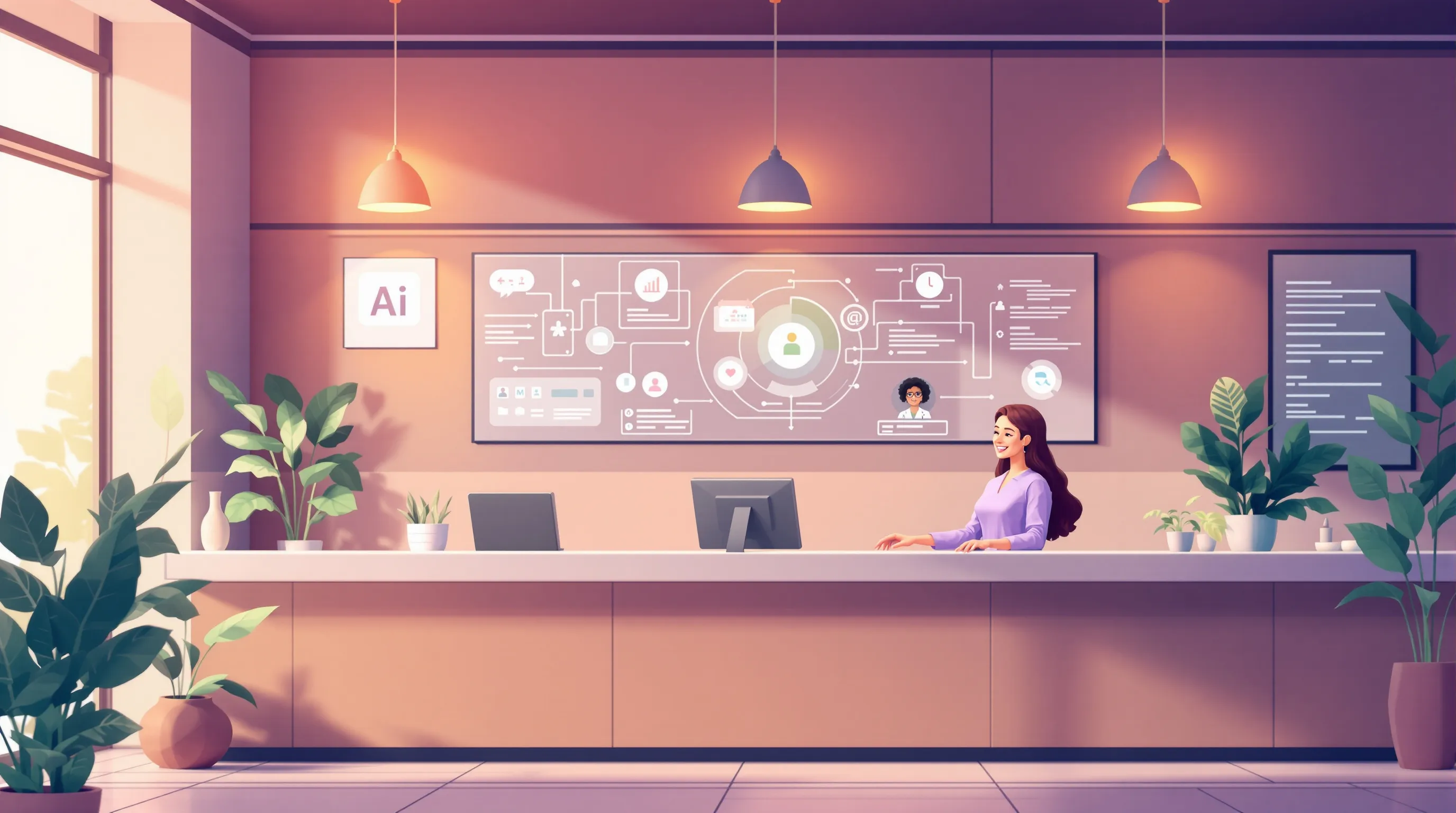
AI is reshaping the medical front desk, but not in the way most vendors will tell you. After years working in member support at UnitedHealth Group (Optum) and now leading content strategy at HelpSquad, I have seen firsthand what automation can and cannot actually do in a high-stakes patient-facing environment. AI can handle up to 70% of routine front-desk administrative tasks: appointment scheduling, automated reminders, digital intake, and basic FAQ routing, but the remaining 30% is where patient relationships are won or lost. That 30% still needs a human.
This article breaks down exactly where AI earns its place at the front desk in 2026, where it falls short, and how to build a hybrid model that delivers the efficiency of automation without sacrificing the patient experience your practice depends on.
Questions this article answers
- Can AI fully replace a medical receptionist in 2026?
- What front-desk tasks can AI handle reliably, and which ones create more problems than they solve?
- How do you build a hybrid AI-human model that actually works for your practice?
Quick Answer
The average medical practice misses 150 patient calls every month. At the same time, 82% of healthcare staff report burnout, spending up to 34 hours per week on administrative tasks instead of patient care. And yet, 65.8% of patients report low trust in their health care system to use AI responsibly. Those three numbers together tell you everything you need to know about the AI front-desk problem in 2026: the need is real, the technology is available, and the trust gap is just as real.
The Short Answer: AI Is a Tool, Not a Replacement
Can AI replace your medical receptionist? No: not fully, and not without serious risk to your patient relationships. What AI can do is handle the high-volume, repetitive tasks that consume your staff's time and energy, freeing them to focus on the work only a human can do well.
I want to be direct here because I have seen the hype from both sides, as someone who spent years on the phones at Optum handling member coverage inquiries and billing verifications, and now working in the healthcare BPO space at HelpSquad. The calls I took at Optum were rarely straightforward. Patients were confused about their coverage. They were scared after a diagnosis. They were frustrated after a denial. No AI system in 2026 is equipped to handle those conversations the way a trained human can. What AI IS equipped for is everything that happens before and after that call, and that is genuinely valuable.
What AI Can Do at the Medical Front Desk Today
Let me start with the good news, because there is genuine good news here. AI tools have matured significantly, and for a specific category of front-desk tasks, they deliver real, measurable results.
Here is where I have seen AI earn its keep, as of .
24/7 Appointment Scheduling and Confirmation
This is AI's strongest use case at the front desk, and it is not even close. A patient who wants to book an appointment at 10 PM on a Sunday should not have to wait until Monday morning to do so. AI-powered scheduling systems can accept bookings, confirm appointments, and send reminders around the clock, without a staff member on the line.
The no-show problem alone justifies the investment. SMS-based appointment reminders through automated AI systems carry a 98% open rate, and practices using voice AI and automated reminder stacks report a 25-30% reduction in no-shows. For a practice with high patient volume, that translates directly into revenue recovered and schedule slots protected.
Preliminary Patient Intake and Digital Form Collection
Paper intake forms are a time sink. Staff spend time scanning, re-entering, and correcting data that patients could just as easily provide digitally before they arrive. Digital intake forms handled by AI save front-desk staff an estimated 5-7 hours per day in data entry alone. That is nearly a full workday reclaimed, per staff member, every single day.
AI intake tools can collect demographic information, insurance details, chief complaint, and consent signatures, and push all of it directly into the EHR. It's structured, it is consistent, and it arrives before the patient does. That is a material workflow improvement.
Answering Routine Questions
What are your hours? Where is parking? How do I access the patient portal? Do you accept my insurance? These questions are asked dozens of times per day at most practices, and every one of them can be answered by a well-configured AI chatbot or IVR system. AI can reliably handle up to 70% of routine patient inquiries without human intervention when properly implemented.
The key phrase is "properly implemented." From what I have seen in the BPO space, AI receptionist failures almost always trace back to a design problem, not a technology problem. As one practitioner in the small business community put it: the issue is not whether AI works. It is that most setups fail because they are "bolted on without mapping the actual call flow." When the logic is right and there is a clear path to a human fallback, patients often do not even realize they are talking to an automated system.
Inquiry Routing and Triage
AI can route calls and messages to the right department efficiently. Billing question? Route to billing. Prescription refill? Route to the nurse line. New patient appointment? Route to scheduling. This kind of smart routing reduces hold time and prevents calls from landing in the wrong queue, a common frustration that erodes patient experience and wastes staff time.
| AI Front-Desk Task | Maturity Level in 2026 | Key Benefit |
|---|---|---|
| 24/7 appointment scheduling | High | 25-30% no-show reduction |
| Automated appointment reminders | High | 98% SMS open rate |
| Digital intake form collection | High | 5-7 hours/day saved per staff member |
| Routine FAQ answering | High | Handles up to 70% of routine inquiries |
| Inquiry routing / department triage | Medium-High | Reduces hold time and wrong-queue routing |
| Insurance eligibility pre-check | Medium | Reduces manual verification calls |

What AI Still Cannot Do at the Front Desk
This is the part of the conversation that gets glossed over in most vendor content.
I want to be specific, because the gaps matter: not just for patient experience, but for safety, compliance, and your practice's reputation.
Provide Genuine Empathy to Distressed Patients
I handled thousands of calls at UnitedHealth Group (Optum) as a Member Support Specialist. Coverage inquiries, claims questions, prior authorization updates, billing verifications. The one thing I learned consistently: patients calling a medical office are almost never calm and neutral. They are anxious. They are in pain. They just received a diagnosis they do not understand. They are fighting a denial on a procedure they need.
What those patients need first is to feel heard. An AI system, no matter how sophisticated its natural language processing, cannot provide that. It can detect sentiment keywords and trigger escalation logic, but that is not empathy. It is pattern recognition. Real empathy involves active listening, adjusting tone in real time, and sometimes just being quiet while someone processes something difficult. No LLM in 2026 can do that reliably in a live patient interaction.
The research backs this up. A national survey published in JAMA Network Open found that 65.8% of respondents reported low trust in their health care system to use AI responsibly, and 57.7% reported low trust that AI would not harm them. That level of patient skepticism is a real operational risk for any practice that moves too fast on full AI replacement.
Resolve Ambiguous Insurance or Billing Disputes
Insurance disputes are not rule-following exercises. They involve exceptions, appeals, plan-specific nuances, and often, a patient who is confused and upset. AI can answer basic eligibility questions when the data is clean. What it cannot do is navigate a dispute where the patient's plan has a carve-out, the denial reason is ambiguous, or the answer requires calling the payer directly and advocating on the patient's behalf. That requires judgment, relationship knowledge, and persistence. Those are human skills.
Make Nuanced Administrative Judgment Calls
Consider this scenario: a patient calls to schedule an appointment, but in the course of the call, mentions chest pain. Or a patient arrives at the desk visibly distressed and says something ambiguous about not wanting to be here anymore. An AI system running a scheduling script cannot appropriately respond to these moments. A trained human front-desk staff member can, and should.
The front desk is often the first point of contact in a care episode. The judgment calls that happen there: about urgency, about safety, about when to loop in clinical staff, are not administrative trivia. They are clinical-adjacent decisions that require a human in the loop.
Replace the In-Person Welcome
When a patient walks through the door of your practice, the first 60 seconds shape their entire experience of that visit. A kiosk cannot make eye contact. A chatbot cannot notice that someone looks pale and unsteady. The warm, human greeting at check-in is not just a nicety. It is part of the clinical environment.
Practices that have tried full front-desk automation have learned this the hard way. Multiple hospitals that rolled out self-check-in kiosk systems found that elderly patients in particular struggled significantly: in some cases, practices had to reverse course entirely after patient satisfaction scores dropped. The human at the front desk is not just an administrative resource. They are part of the care experience.
The Training Problem: AI Only Works If Your Staff Is Prepared
Here is a truth that most AI implementation guides skip over: AI tools at the front desk only succeed when the humans around them are trained for it. I learned this firsthand in my Quality Assurance and training work earlier in my career. The technology is only as good as the handoff protocols built around it.
Think about it this way. You implement an AI chatbot to handle initial patient inquiries. It collects the patient's name, date of birth, and reason for the visit. Then the patient writes something the AI does not parse correctly: maybe they describe a symptom ambiguously, or their insurance ID is formatted in a way the system does not recognize. What happens next?
If your staff has not been trained on a clear escalation pathway, one of two things occurs. Either the AI loops the patient endlessly (creating frustration), or the patient reaches a human who has no context about what just happened (creating inefficiency and a poor handoff experience). Neither outcome is acceptable, and both are preventable with proper escalation protocol design.
In my QA and training work, the pattern was consistent: implementation failures came not from bad technology but from inadequate change management. Staff were not told when to intervene, how to take over from the AI mid-interaction, or how to handle patients who were upset after a poor AI interaction. Those are not technology problems. They are training problems.
The Escalation Protocol Your Practice Needs
Before deploying any AI front-desk tool, your team should have clear answers to these questions:
- Trigger points: At what point does the AI escalate to a human? (Expressed distress, billing complexity, clinical urgency signals)
- Handoff context: Does the human receiving the escalation know what the patient already communicated to the AI?
- After-hours coverage: When the office is closed, what happens to escalated calls that cannot be deferred?
- Feedback loop: How does your team report AI misinterpretations so the system can be improved?
- Patient recovery: If a patient is frustrated from an AI interaction, who owns the recovery call, and when?
These questions are not glamorous. They do not show up in a vendor demo. But in my experience, getting them right is the difference between an AI deployment that builds patient trust and one that quietly erodes it.
The Recommended Hybrid Model for Medical Practices in 2026
The model that actually works is human-in-the-loop by design. AI handles the background volume. Humans handle the relationships. This is not a compromise. It is a deliberate architecture that plays to the strengths of both.
At HelpSquad, we position this as an AI-plus-human support model rather than an either/or choice. The practices that get this right treat AI as a filter. It catches the high-volume routine work and passes the right interactions to trained humans who can handle them with judgment and care. HelpSquad clients using this hybrid structure reduce front-desk labor costs by 60-80% compared to in-house staffing alone, while maintaining the human touch that patient-facing healthcare requires. Practices under five providers tend to see the highest savings, often near the top of that range, because the fixed cost of a full in-house reception team is disproportionate to their volume.
The hybrid model is not about replacing your receptionist. It is about giving your receptionist back the time to do the part of their job that only a human can do well.
What Will Matter Most at the Medical Front Desk in the Next 12-24 Months?
The patient access and front-end RCM market is projected to grow by $1.65 billion between 2026 and 2030, driven by AI adoption, telehealth expansion, and cloud-based platform development. That is a market signal, not a prediction. The investment is already flowing. What matters now is where practices should focus their attention.
In my view, there are three areas that will separate the practices that get AI right from those that struggle with it over the next two years.
1. HIPAA-Compliant AI Tools Will Become Non-Negotiable
Any AI tool that touches patient information: scheduling, intake, billing inquiries, must operate under a signed Business Associate Agreement (BAA) with your practice. This is not optional. It is HIPAA. And yet, in the rapid rollout of AI receptionist tools, HIPAA compliance is frequently treated as an afterthought. I have seen cases where clinics deployed AI tools without verifying vendor compliance status.
Before you implement any AI front-desk tool, your first question to the vendor must be: "Do you sign a BAA?" If they cannot answer that question confidently, stop the conversation. A HIPAA violation in an AI-related incident can cost a practice anywhere from $50,000 to $1.9 million per incident. That is not a risk worth taking for a scheduling convenience.
2. Patient Trust Will Become a Competitive Differentiator
We are early in the AI adoption curve for patient-facing healthcare applications. Right now, more than half of patients report skepticism about AI in healthcare settings. That skepticism will not simply go away as AI improves. In fact, practices that move aggressively toward AI automation without maintaining visible human touchpoints may find themselves at a competitive disadvantage as patient experience becomes a more prominent factor in provider selection.
It's worth noting that the practices winning right now are not the ones with the most AI. They are the ones with the most thoughtful integration, where AI does the invisible work and humans own the relationship. Patients notice the difference. And increasingly, they are making provider choices based on it.
3. Staff Training Will Be the Deciding Factor
The AI tools available to medical practices in 2026 are genuinely capable. The gap is in implementation. Practices that invest in training their front-desk staff on escalation protocols, AI handoff procedures, and patient recovery workflows will see consistently better outcomes than those that simply install a tool and expect results.
From what I have seen in the BPO and healthcare support space, the organizations that build clear human-AI handoff protocols see stronger patient satisfaction scores, fewer escalated complaints, and higher staff confidence. The technology is a commodity. The training and process design around it is the competitive advantage.
The Bottom Line for 2026
AI is not going to replace your front desk. But it is going to change it. The practices that use AI as a filter: handling volume, freeing humans, building smarter workflows, will outperform those that either ignore it entirely or try to replace their human staff with it. The hybrid model is not a compromise. It is the strategy.
Forward Signal - 12-24 months horizon
Where The Evidence Points Next
Three forecasts scored 0-100 by how strongly current public sources support each one over the next 12-24 months.
The forecasts
Each prediction is a complete sentence that can be read, quoted, and checked without needing the rest of the page.
Practices will increasingly turn to outsourced medical virtual assistant and BPO vendors - rather than building AI in-house - to get front-desk coverage, as the front-end revenue-cycle market grows by a projected $1.65 billion from 2026-2030 and vendors like Hello Rache ($9.50/hour, 24-hour matching, 50+ specialties) compete on cost and speed of deployment.
Most practices will adopt AI for routine call handling, scheduling, and prior-authorization processing (as already seen with tools like Tandem) while keeping staff for exceptions, pushing the patient-access/front-end revenue-cycle category toward the $1.65 billion in projected 2026-2030 growth.
Full front-desk replacement stories like the one where a receptionist trained her own AI replacement (a tool called 'callivy') before being let go will remain notable exceptions rather than a broad pattern, as national survey data showing 65.8% low trust in health systems' AI use and 57.7% low trust that AI won't cause harm will keep most practices from removing human oversight entirely.
Weak signals watched: A medical assistant thread already documents Quest Diagnostics locations running on kiosks with no receptionist, a physical therapy clinic with full self-check-in, and a platform (Tandem) automatically processing prior authorizations and appeals. A receptionist community thread describes a clinic replacing a decade-long employee with an AI tool it says isn't HIPAA compliant, drawing strong backlash and a parallel case of a 17-year receptionist laid off the same way. Internal client data shows front-desk labor cost reductions of 60-80% versus in-house staffing, with practices under 5 providers seeing the largest savings, mirroring the broader BPO cost structures seen in adjacent categories like Helpware's $8-15/hour dispute-resolution staffing.
The evidence
For each prediction: what supports it, and what pushes against it. Both sides are shown for every forecast.
- My mom just got replaced by the AI she helped train is the clearest counter-signal. [Community / Forum]
- Do you think AI will ever replace front-desk duties in clinics? supports this forecast. [Community / Forum]
- AI Front Desk: How Doctors Save $100k With Automation supports this forecast. [Video]
- Mistrust in artificial intelligence in health care - 6 items is the clearest counter-signal. [Substack / Newsletter]
- Who has actually replaced front-desk tasks with an AI receptionist? is the clearest counter-signal. [Community / Forum]
- My mom just got replaced by the AI she helped train supports this forecast. [Community / Forum]
- Mistrust in artificial intelligence in health care - 6 items supports this forecast. [Substack / Newsletter]
- Who has actually replaced front-desk tasks with an AI receptionist? supports this forecast. [Community / Forum]
- Do you think AI will ever replace front-desk duties in clinics? is the clearest counter-signal. [Community / Forum]
- AI Front Desk: How Doctors Save $100k With Automation is the clearest counter-signal. [Video]
Where we could be wrong
These forecasts assume current trends continue. The scenarios below would meaningfully change them.
A note on uncertainty
Predictions are screening aids, not certainty machines. The strongest signal here (95/100) still has counter-evidence, and the contrarian signal (64/100) reflects real disagreement among sources.
- If regulators or buyers move in the opposite direction, Outsourced medical virtual-assistant vendors grow faster than in-house AI builds would weaken first.
- If the source mix shifts toward stronger contrary evidence, Full staff replacement stays rare due to trust deficits and public failure cases could become the more durable forecast.
How HelpSquad Supports the Human Side of Your Front Desk
At HelpSquad, we have built our virtual medical assistant services specifically around the hybrid model described in this article. Our trained staff handle the patient interactions that require human judgment, empathy, and real-time problem-solving, while AI tools handle the background volume that would otherwise consume your team's time.
This is not a theoretical model. It is what we have deployed across healthcare practices, from primary care offices to specialty clinics and dental service organizations. Our healthcare outsourcing solutions are HIPAA-compliant, US-managed, and designed to integrate with your existing workflows rather than disrupt them.
If you are evaluating how to bring AI into your front-desk operations without losing the patient experience your practice has built, I would encourage you to explore what a managed hybrid model looks like in practice. The goal is not automation for its own sake. It is freeing your staff to do the work that actually requires them.
In summary: AI at the medical front desk in 2026 is real, it is useful, and it has clear limits. Know what it can do. Know what it cannot. Build the human layer around it intentionally: and your front desk will be stronger for it, not weaker.
Written by
Maria Rush
Marketing Team Lead, HelpSquad
Maria De Jesus-Rush is Marketing Team Lead at HelpSquad, a healthcare business process outsourcing company, with a background in content development, digital marketing, and project management.
Connect on LinkedInFrequently Asked Questions: AI at the Medical Front Desk
Can AI fully replace a medical receptionist in 2026?
No. AI can handle a significant portion of routine, high-volume front-desk tasks: appointment scheduling, reminders, digital intake, and FAQ routing: but it cannot replace the human judgment, empathy, and in-person presence that patient-facing healthcare requires. The appropriate model is a hybrid: AI handles the repetitive background work, while trained humans manage patient relationships and complex situations.
What front-desk tasks can AI handle reliably right now?
In 2026, AI performs reliably for: 24/7 appointment booking, automated SMS and voice reminders, digital patient intake form collection, answers to routine questions about hours, location, and portal access, and basic department routing. These are high-maturity, low-risk applications where AI tools have proven their value at scale.
What are the biggest risks of AI-only front desk automation?
The highest risks occur when AI handles emotionally sensitive or clinically adjacent interactions without a human fallback. Distressed patients, clinical urgency signals, insurance disputes, and in-person check-in are areas where AI failures can cause patient harm, HIPAA liability, or serious erosion of patient trust. These functions require human oversight.
Does AI at the front desk need to be HIPAA compliant?
Yes, absolutely. Any AI tool that collects, processes, or stores patient information must operate under a signed Business Associate Agreement (BAA) with your practice. This is a non-negotiable HIPAA requirement. Before deploying any AI front-desk tool, verify the vendor's BAA status and review their data handling practices.
How much can a practice save by using AI at the front desk?
Savings vary significantly by practice size and implementation quality. Practices that adopt a managed hybrid model, pairing AI automation with trained human support, report front-desk labor cost reductions of 60-80% compared to fully in-house staffing. Smaller practices under five providers tend to see the highest percentage savings. However, poorly implemented AI can create costs through patient dissatisfaction and compliance risk.
How do I train my staff to work alongside AI front-desk tools?
Effective AI integration requires clear escalation protocols: defining when and how staff take over from the AI, what context they receive at handoff, and how they recover frustrated patients. Staff should be trained before deployment, not after. Build a feedback loop so misinterpretations are caught and corrected quickly. The technology alone is not enough; the process design around it is what determines success.
The Critical Role of a Medical Referral Coordinator
Think sending a patient to a specialist is a simple handoff? Behind every referral is a coordinator managing insurance checks, prior authorizations, scheduling, and constant follow-up between...

How to Get Physician Partners to Approve Outsourcing
The short answer: To get physician partners to approve outsourcing, address their three primary objections before they voice them: compliance risk, financial opacity, and staff disruption.
How to Outsource a Treatment Plan Financial Coordinator for Your Dental Practice in 2026
Outsourcing a treatment plan financial coordinator means contracting a trained, HIPAA-ready remote specialist to verify insurance, present case fees, and follow up on estimates under a signed Business Associate Agreement.
Let's talk about what your practice actually needs.
A 30-minute call. No sales pressure. We'll tell you honestly whether we're a fit.