What Is Patient Intake? Process Steps, Forms and Going Digital

Quick Answer
Patient intake is the process of collecting a patient's identity, insurance, medical history and consent before the provider sees them, and it is the first billing task in the revenue cycle.
Digital forms help only when answers land in the EHR as structured data. Payers push the same way. CAQH CORE's 2024 rules tie cleaner diagnosis data on claims to fewer preventable denials. Someone still checks each submission, in-house staff or an outsourced BPO team, before the claim goes out.
Key Points
- In 2024, CAQH CORE released updated operating rules that standardize socio-demographic intake and diagnosis data on claims, with the stated aim of reducing preventable denials.
- Dialog Health's March 2026 roundup reports intake software cuts data entry errors to 0.67% , against approximately 20% for manual entry.
- The same Dialog Health roundup says MetroHealth cut claim denials by 44% by automating patient registration checks at intake.
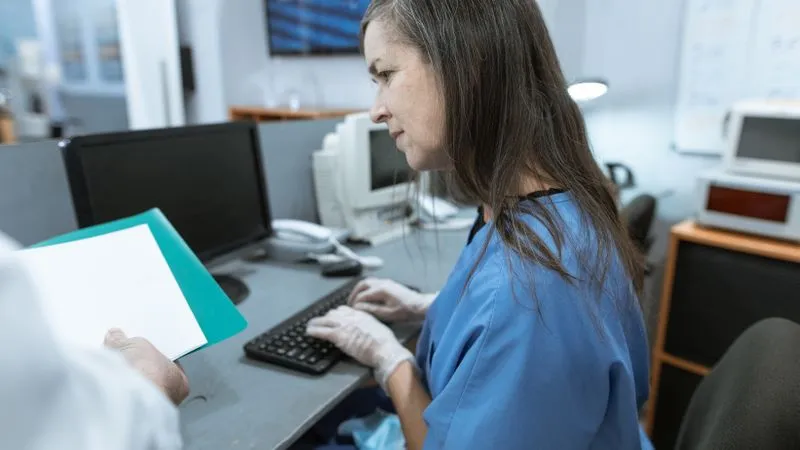
Patient intake starts at the front desk, where a staff member with a tablet greets the arriving patient.
Payers now care what your intake form collects. In 2024, CAQH CORE described its updated operating rules as streamlining the management of value-based payment contracts through standardized socio-demographic intake, and as changing how diagnosis information is communicated on claims to simplify billing, especially for telehealth.
So what does a lean intake actually need? Physicians in one family medicine discussion boiled the minimum down to three things: chief complaint, vitals and an updated medication list. One went further and replaced assistant history-taking with a paper slip where patients write their top 3 concerns. Knee pain on the slip? The assistant hands over shorts before the doctor walks in.
That small detail matters more than it looks.
Here's where I'd push back on most intake software demos. They show you the form, never what happens after a patient types "knee pain" into it. Ask the vendor to show you the next screen: who sees that answer, and which field of the chart it lands in.
That idea runs through the rest of this guide: the steps a patient moves through, paper against digital forms, what to demand from intake software, and who keeps the whole thing running day to day. On that last question, HelpSquad operates across six countries so patients are never sent to voicemail, and its full-time staffing is billed by the hour. Whether you keep intake in-house or hand part of it off, every form still needs an owner, and the steps below show where each one tends to break first.
Patient intake is the process a practice uses to collect a patient's identity, contact details, insurance, medical history and signed consents before the provider sees them. Why does it matter so much? Because every claim is built from that data. The revenue cycle starts the moment a patient books a visit or logs on.
Payers are raising the bar on that front-end data. In 2024, CAQH CORE released updated operating rules aimed at preventable denials and gave organizations already certified under its program a two-year period to build the changes into their systems. Intake is where those rules meet a real patient.
Going digital helps. So where does it fall short first? Therapists report that even forms sold as integrated with their EHR fail to flow into progress notes. One solo massage therapist routes web-form intakes to a personal inbox for convenience, while a peer warns that HIPAA applies and that non-compliant software can end a career.
I'll take you through the steps a patient moves through before the visit, how paper clipboards compare with digital patient intake forms, and how to choose intake software and decide who runs it, starting with the definition and the order of operations.
Questions this article answers
What Is Patient Intake and What Steps Does It Include?
Patient intake is the ordered process of capturing a patient's identity, insurance, medical history and consent before the provider walks in. Every claim the practice files later is built from it.
Here are the steps in sequence. I'll follow one new patient, booking a visit for knee pain, through all seven:
- Scheduling. The appointment is booked and the intake packet is triggered.
- Form delivery. A link goes out by email or text so the patient can finish forms at home.
- Demographics and contact details. Legal name, date of birth, address and phone number.
- Insurance capture and eligibility verification. Card details are collected, then coverage is checked.
- Medical history and medications. Conditions, allergies and a current medication list.
- Consents and signatures. Consent to treat, HIPAA acknowledgment and the financial policy.
- Check-in and rooming. Identity is confirmed, vitals are taken and the chief complaint is recorded.
Our knee-pain patient books on a Monday. In a well-built setup, the forms link arrives right after booking, and the patient can stop halfway and return to the same link later. So ask yourself: who in your office will verify insurance on that form, and by what time on the day before? A clipboard handed over at the desk leaves only a few minutes.
The common assumption is that intake is a front-desk chore. It isn't. Intake is the first billing task of the visit. A denial often starts as a wrong digit at step 4.
Why does step 4 matter so much? Because payers are standardizing what they expect to receive. In 2024, CAQH CORE said its updated operating rules standardize the intake of socio-demographic data and how diagnosis information is communicated, with the stated aim of reducing preventable denials. In 2024, those updates won approval rates of 86% and higher in the CORE participant vote. Health IT practitioners in an r/healthIT discussion add the ground-level view: any intake process has to settle eligibility through a clearinghouse and handle enrollment for payers such as Medicare, Tricare and state Medicaid programs.
Step 7 is the quiet time sink. In one family medicine clinic, a medical assistant took 20-30 minutes for intake and vitals inside a 20-minute appointment slot. Peers suggested trimming rooming to the chief complaint, vitals and an updated medication list. It's worth noting the honest trade-off here: patients loved that assistant, and an unhurried intake can feel like care has already begun. But a schedule that slides for everyone helps no one.
Combining 5 sources points to one pattern. Intake rarely breaks inside a single form. It breaks at the hand-offs between steps.
If you are deciding which of these steps to outsource, our guide on what to outsource in your medical practice maps the options by task. HelpSquad's part-time engagements start at 20 hours per week and are quoted individually, which matters when intake is only one slice of the front-office workload.
Get step 4 wrong and the knee-pain visit still happens. The payment just doesn't.
Paper Clipboards vs Digital Patient Intake Forms: Which Is More Accurate?
Digital intake forms beat paper on accuracy and speed, but only when answers land in the EHR as structured data. Ask any vendor to prove both before you sign.
| Factor | Paper clipboard | Digital intake form |
|---|---|---|
| Data entry errors (vendor-reported) | Approximately 20% with manual entry | 0.67% with intake software |
| New-patient check-in time (vendor-reported) | 25 minutes | 5-7 minutes |
| Eligibility check (vendor-reported) | 10-15 minutes by phone | 30-90 seconds automated |
| When staff see the answers | At the desk, minutes before the visit | Ahead of the visit, if the patient finishes early |
| Where the data ends up | Retyped into the chart by hand | Structured fields in the EHR, or a PDF someone still has to read |
| Main failure mode | Handwriting and transcription mistakes | Late completion, abandoned forms, poor EHR mapping |
Intake software vendors publish striking numbers. One vendor compilation puts data entry errors at 0.67% with digital intake against approximately 20% with manual entry, and says new-patient check-in falls from 25 minutes to 5-7 minutes. Another vendor says automated eligibility checks return payer responses in 30-90 seconds versus 10-15 minutes by phone.
Discount those figures as much as you like. The direction still holds. Speed counts as well: in 2024, Medical Economics reported a Duke Health finding that every ten-minute increase in waiting to see a doctor was associated with a 3% decrease in patient satisfaction.
So why hasn't every practice switched? Partly because digital brings its own problems, and practitioners are blunt about them. In an r/healthIT thread, one commenter observed that "forms are often not completed until right before check-in, so someone doing manual entry is racing to get the data in before the provider is staring at an incomplete chart." The same commenter's verdict on what matters most: "The feature that trumps nearly every other feature is getting the data to where it needs to go in the EHR."
Therapists in an r/HippaTherapy discussion describe a second gap. Even forms sold as "integrated" often fail to autofill into progress notes or treatment plans, lack conditional logic, and lock after submission for compliance reasons. One clinician explained that even small mistakes then mean the client has to fill out the whole thing again.
Length matters too. Vendors report that static forms typically see 20-35% completion, and that roughly 30% of patients abandon long digital intake forms before finishing. Every extra question costs you finished packets.
Then there is compliance. A generic form builder that emails answers to an inbox is not a safe intake system. As the r/healthIT discussion put it, a form tool is only HIPAA compliant for you if a BAA is in place with the vendor.
Here's my take. Paper's problem is retyping, and digital only fixes that when someone owns the gaps: chasing late forms, correcting locked submissions and confirming insurance before the visit. Some practices hand that reconciliation work to virtual medical assistant support rather than stretching the front desk.
Back to our knee-pain patient. If they finish the form at 8:55 for a 9:00 visit, the software has done its job and the chart still isn't ready, which turns the buying question from paper or digital into something sharper: which software, and who checks its output?
Where does the accuracy of digital intake actually come from?
Vendor statistics put digital intake errors at a small fraction of paper's. People who run these forms every day keep pointing somewhere else: to the hours after a patient taps submit.
Start with the headline gap. Dialog Health, a company that sells digital intake, published a statistics roundup in March 2026. It reports that intake software cuts data entry errors to 0.67%, against approximately 20% for manual entry. The same roundup cites a JAMA Surgery study where electronic consent forms had a 1% error rate and paper forms had 32%.
The size of the gap varies: the roundup's figures for manual or paper errors include approximately 20%, 31% and 32%. To see why the gap exists, consider who does the typing. Shruti, a presenter on the practice management channel MyPractice101, put it simply in 2021: clinics "were responsible for the accuracy of patient data since the forms would be transcribed onto patient charts." Digital intake hands the typing to the patient, and patients use the chance. In the same roundup, 98,000 of 475,000 patients at one major health system changed their race, ethnicity or language data through digital intake.
The gain lasts only if nobody retypes the answers. Perspective AI sells a conversational intake product. Its June 2026 implementation guide says integration depth decides whether these projects succeed. When answers land as structured fields, staff "move from data entry to a five-second confirmation." When they do not, "you've added a screen without removing the work."
Then there is the clock. In a 2024 r/healthIT discussion, one commenter described a common scene: "Forms are often not completed until right before check-in, so someone doing manual entry is racing to get the data in before the provider is staring at an incomplete chart." A form finished in the lobby can bring back the clipboard's time pressure.
Same form, two arrival times
- Sent 24 to 48 hours ahead by text or email, as Perspective AI recommends: forms can come back "even days before the appointment so you get to verify their insurance," Shruti said. An automated eligibility check returns in 30 to 90 seconds, according to Perspective AI. A phone check takes 10 to 15 minutes.
- Completed at check-in: staff race to enter data before the provider walks in. With paper, staff get to study a patient's history "just for a few minutes" before the appointment, Shruti said.
Spare hours are where intake accuracy meets the claim. From my years in claims and billing at UnitedHealth Group's Optum, I learned to trace a denial back to the front desk where its data began. Two intake vendors tie 61% of claim denials to errors at this stage, though Perspective AI blames transcription while Dialog Health points to "simple demographic or technical errors." Neither names the original study, so we treat the figure with caution. The clearest case in the roundup involves a check, not a form: MetroHealth cut claim denials by 44% by automating patient registration checks at intake.
Going digital also creates new places for errors to hide. Perspective AI estimates that roughly 30% of patients abandon long digital forms before finishing. A clinician on r/HippaTherapy said submitted forms "usually" get "locked for compliance reasons, so even small mistakes mean they have to fill out the whole thing again." Perspective AI also warns against judging success by completion rate: "high completion with bad data quality just moves cleanup downstream to billing."
Most practices have not reached any of these problems yet. Dialog Health's roundup finds that 81% of patients prefer digital intake forms. Even so, 83% of practices still use the front desk as their main check-in method, and 85% of healthcare organizations still use paper in some capacity.
Read side by side, these sources place the accuracy of digital intake in two spots: the fields where the answers land, and the hours left to check them before the patient arrives. A tablet handed over at check-in has neither. The screen gives a practice the chance to be accurate. Structure and time are what let staff use that chance.
- Before signing, ask the vendor for a test submission inside your own EHR, and note which answers arrive as fields and which as an attachment someone must retype.
- Send intake links 24 to 48 hours before the appointment, and track what share of forms arrive before the day of the visit.
- Run an eligibility check on submitted insurance as soon as it arrives, while there is still time to reach the patient.
- Judge the rollout on data quality. Compare a sample of submissions against your rejected claims instead of reporting completion rate alone.
- Ask each vendor how a patient fixes one wrong field after submitting, and cut questions you do not use, given the estimate that roughly 30% of patients abandon long forms.
How we checked this
We used a vendor statistics roundup, a vendor implementation guide, a 2021 practice management video, and two practitioner discussions on Reddit. None of the figures come from HelpSquad. The error rates, the 61% denial figure and the MetroHealth result come from intake software sellers, who benefit when practices go digital. The roundup gives several different manual error rates, and neither vendor names the study behind the 61% figure. The Reddit comments are individual experiences and do not show a pattern. HelpSquad supplies staff who work on patient intake, so we have a stake in the conclusion that review time matters. Still unknown: how much of the reported error gap holds when forms are completed at check-in instead of ahead of time. None of our sources measured that.
- Dialog Health, digital patient intake forms statistics roundup, March 2026.
- Perspective AI, step-by-step guide to implementing digital intake, June 2026.
- r/healthIT, discussion of form software for healthcare settings, September 2024.
- MyPractice101, video on online patient intake forms, August 2021.
- r/HippaTherapy, therapists on paper versus digital intake forms, August 2025.
- FormDoctor, intake software homepage describing insurance card uploads, accessed October 2026.
How Do You Choose Patient Intake Solutions, and Who Should Run Them?
Choose intake software on compliance and EHR integration first, form design second. Then assign a named person, in-house or virtual, to review every submission before the visit.
Use this checklist when you compare patient intake solutions. Each item is something to confirm in writing before a single patient form goes out:
- A signed Business Associate Agreement. No BAA, no patient data. Full stop.
- Encryption in transit and at rest, plus multi-factor authentication and role-based permissions so staff only see what their job needs.
- Timestamped e-signatures with an audit trail. The ESIGN Act and UETA established the legal validity of e-signatures across the United States, so consent to treat and HIPAA acknowledgments can be signed on a phone.
- Structured EHR integration. Ask whether answers land in the right chart fields through HL7 or an API, or arrive as a PDF attachment. A one-way PDF drop is a flat-file integration in disguise, and staff still end up transcribing.
- Mobile-first forms with required fields, conditional logic and save-and-resume, so patients can finish on their own schedule.
- Insurance card photo capture, so coverage can be checked before the patient arrives.
- An in-office fallback, such as a tablet at the desk, for patients without internet access or with low comfort using technology.
Vendors in this market list most of these features on their product pages. Treat the list as a floor, not a differentiator. What separates tools is item 4.
Then roll out carefully. A common recommendation is to send pre-visit intake links 24-48 hours before the appointment by text or email, and to run a two-to-four-week pilot with a single provider or appointment type before going practice-wide. New-patient visits make a sensible starting point because their packets are longest.
Now the harder question. Who owns the workflow once the software is live?
Both an in-house owner and a virtual assistant can work, depending on your volume and how many locations share one front desk. An in-house owner knows the providers and the payer mix. A virtual team can cover the hours when submissions actually arrive, which is often evenings and the minutes before check-in. Are healthcare virtual assistants worth it for intake? In my view, yes, when the job is defined tightly: review each submission, fix what the form locked, confirm coverage and flag anything a clinician should see.
It's important to note that software does not do that judgment work. It collects. Someone still has to read.
Picture our knee-pain patient again. They upload a card photo on Sunday night, but the subscriber name doesn't match the policy holder. A tool flags the field. A person calls on Monday morning, gets the right name and updates the chart. That person is the difference between a clean claim and a denial notice weeks later, and at HelpSquad that follow-up call is the kind of task our healthcare teams handle alongside phones and scheduling, which brings us to what a complete intake form should actually ask.
Where Is Patient Intake Headed Next?
Intake is heading toward coded, standardized data as federal EHR certification rules raise the bar on what forms capture. HelpSquad, founder-operated since 2015, works on the human review behind it.
Why does the person still matter? Because forms still arrive late. Commenters in a 2024 r/healthIT thread described patient forms that aren't finished until right before check-in, leaving staff racing to get the data into the chart before the provider sees it. The same thread noted that USCDI version 3 standards were required for certified EHR technology before Jan 1, 2026, so more of those answers should reach the chart as coded data instead of free text.
So what can you do this quarter? Pull your most recent denials and trace each one back to the intake field where it started.
Think back to our patient with knee pain. Their form can drop neatly into the right fields and still carry a subscriber name that doesn't match the card. Software won't catch that on its own. Someone has to, and the practice that decides who before it picks the tool is the one fixing the name on Monday morning, not after the denial lands.
Frequently Asked Questions
What Else Do People Ask About Patient Intake?
Most remaining questions come down to channels, eligibility, repeated questions and cost. Each answer below stays on the process, the forms and the software a practice runs.
Which channels should patients use to complete intake?
Offer more than one. Commenters in a 2025 r/healthIT thread described the better setups as giving patients "an online portal, mobile app, kiosks, phone, and finally the front desk." Some labs already let patients scan their own ID and insurance card at a self check-in kiosk.
Why do patients get asked the same question over and over?
Usually it's configuration, not a missing tool. One commenter in that thread said being asked "the same question 15 times" mostly comes from staff not knowing where to look for the data, or a system that was never set up correctly. Fix the EHR setup before you buy another integration.
What is eligibility verification, and where does it fit in intake?
Eligibility verification is confirming with the payer that a patient's plan is active and covers the visit. Health IT commenters called clearinghouse eligibility checks, plus enrollment with carriers such as Medicare, Tricare and state Medicaid programs, requirements for any intake product. I'd run it while the patient is still filling in forms, not after the visit.
What should a patient intake form include?
Identity and contact details, insurance with a card photo, medical history, current medications and signed consents. Leave off anything the chart already holds. Why ask twice?
What does HelpSquad charge for intake support?
HelpSquad's full-time staffing runs $8-$13/hour, delivered as a fully managed service with HIPAA compliance, bilingual agents and dedicated account management. To talk through your practice's volume, book an intro call at helpsquad.com/contact or call 877-775-3667.
Written by
Maria Rush
Marketing Team Lead, HelpSquad
Maria De Jesus-Rush is Marketing Team Lead at HelpSquad, a healthcare business process outsourcing company, with a background in content development, digital marketing, and project management.
Connect on LinkedIn
How to Get Physician Partners to Approve Outsourcing
The short answer: To get physician partners to approve outsourcing, address their three primary objections before they voice them: compliance risk, financial opacity, and staff disruption.

What AI Can and Can't Do at a Medical Front Desk in 2026
Three things practice owners believe. Myth or fact? Call each one, then see how other readers called it.
How to Outsource a Treatment Plan Financial Coordinator for Your Dental Practice in 2026
Outsourcing a treatment plan financial coordinator means contracting a trained, HIPAA-ready remote specialist to verify insurance, present case fees, and follow up on estimates under a signed Business Associate Agreement.
Let's talk about what your practice actually needs.
A 30-minute call. No sales pressure. We'll tell you honestly whether we're a fit.