What is a Virtual Medical Assistant? How They Save Time, Reduce Costs & Streamline Your Clinic
27 Jun 2025 By: Vlade Legaspi
Updated

A Virtual Medical Assistant (VMA) is a trained healthcare professional who works remotely to handle administrative and clinical tasks for your clinic. From scheduling appointments, updating patient records, and managing billing, a VMA helps your team focus on patient care. By hiring a medical virtual assistant, practices can save 10–15 hours per week, reduce claim errors, and cut operational costs. Whether you run a small clinic or a multi-location practice, a VMA provides flexible, cost-effective support while maintaining HIPAA compliance. In this guide, we’ll explain what a virtual medical assistant does, explore their key benefits, and show how your practice can gain efficiency and peace of mind by integrating one into your workflow.
What is a Virtual Medical Assistant? Key Responsibilities
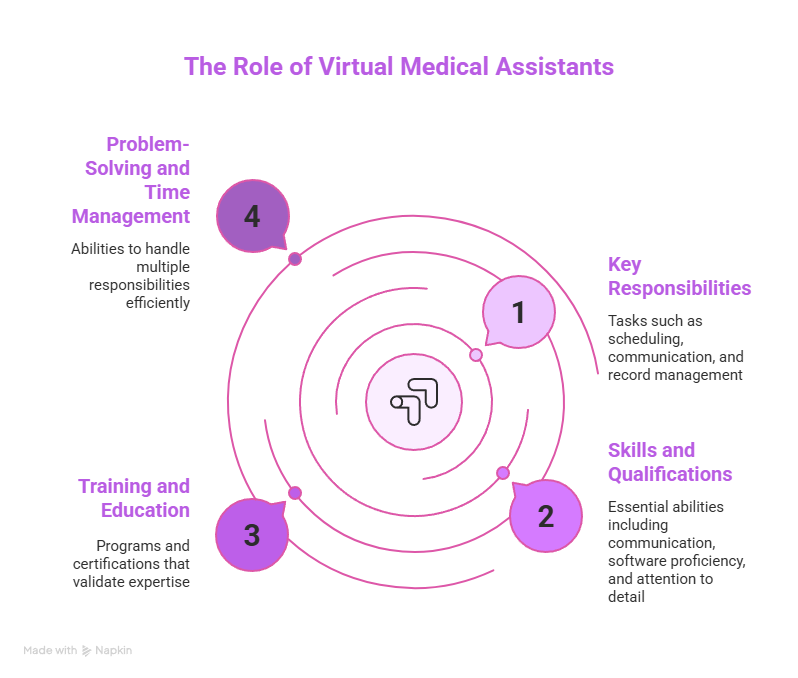
A virtual medical assistant performs administrative support duties for healthcare providers from a distance. They maintain positions at medical practices alongside clinics and hospitals while performing duties that do not need physical presence in a healthcare facility. Through this flexible work arrangement healthcare providers dedicate more time to patient care while administrative tasks become more efficient.
What are the Key Responsibilities?
The specific requirements of healthcare providers determine the range of duties which virtual medical assistants need to perform. Common tasks include:
- The virtual assistant schedules medical appointments while maintaining patient contact and creating appointment schedules that prevent no-shows.
- Patient Communication: Handling incoming calls, responding to patient inquiries, and providing information about services.
- Medical Record Management: Organizing and maintaining patient records, ensuring compliance with privacy regulations.
Virtual medical assistants expand their responsibilities to include billing and coding functions as well as insurance verification and telehealth assistance beyond their standard duties. Any healthcare organization benefits greatly from their diverse range of capabilities as a vital healthcare team member. Virtual medical assistants act as the primary contact for patients thus developing an inviting efficient system that boosts patient satisfaction and retention rates.
Virtual medical assistants maintain patient information through accurate data entry operations which ensures proper medical record management. The practice of value-based care requires accurate data since data-driven choices result in better patient results. The administrative process improvements achieved by virtual medical assistants enable healthcare providers to dedicate more time to direct patient care which leads to better overall healthcare service quality.
Skills and Qualifications
Virtual medical assistants require a distinctive combination of abilities and credentials for successful performance in their position. The following traits form the foundation of this role:
- Professional communication remains vital because medical assistants need to interact with patients and healthcare providers while maintaining strong communication abilities.
- Medical professionals need to be skilled in operating medical software along with electronic health records (EHR) and telehealth platforms.
- Medical records and billing information require precise attention for accuracy purposes.
Virtual medical assistants receive their training from medical administration programs and related fields which enables them to perform their duties successfully. The Certified Medical Administrative Assistant (CMAA) certification among others helps validate the expertise and professional dedication of virtual medical assistants. Healthcare professionals need ongoing training and education about new healthcare technologies along with evolving regulations because the healthcare environment keeps changing.
Virtual medical assistants need excellent problem-solving and time management abilities because they handle multiple responsibilities at once. The effective prioritization of tasks leads to better productivity and greater operational efficiency in healthcare practices that these assistants support. Healthcare providers need virtual medical assistants who demonstrate flexibility in handling new obstacles and technological advancements because their skills become essential to healthcare organizations.
Benefits of Hiring a Medical Virtual Assistant
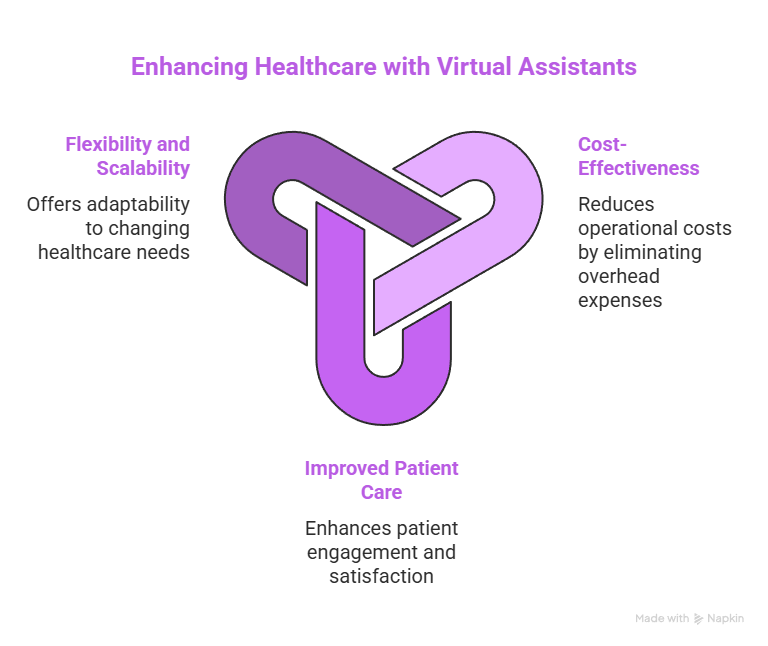
Healthcare practices receive multiple advantages through the implementation of virtual medical assistants in their operations.
What is Cost-Effectiveness?
Healthcare providers benefit from significant cost reductions through the employment of virtual medical assistants. Medical facilities pay full salaries together with benefits and maintain office space expenses for traditional in-house staff which creates substantial financial burdens. Healthcare providers pay virtual assistants only for their needed services because these professionals work as contractors.
The system enables practices to lower operational costs by reducing overhead expenses while allowing them to increase administrative support according to their workload requirements. The virtual assistant system provides healthcare providers with the flexibility to expand their service hours without maintaining permanent full-time staff during busy times. The cost-effective nature of virtual assistants becomes more pronounced because these professionals utilize their personal equipment and supplies to complete their tasks.
Improved Patient Care
The use of virtual assistants for administrative work frees up healthcare providers to spend more time caring for their patients. The time reallocation leads to improved patient satisfaction because medical staff can develop stronger connections with patients while delivering better care to their needs.
Virtual medical assistants help patients become more engaged through their management of follow-ups and their distribution of reminders while providing necessary information to patients. The proactive nature of this approach enables superior health results and maintains patient commitment. Virtual assistants use surveys and follow-up calls to collect patient feedback which helps practices both improve their services and resolve problems right away.
Flexibility and Scalability
Virtual medical assistants provide unmatched adaptability to healthcare organizations. Healthcare providers gain full flexibility regarding location when they use virtual medical assistants because these assistants can perform their duties from anywhere. Healthcare practices maintain flexible operational hours with virtual assistants because they can provide support throughout evenings and weekends based on practice needs.
The ability of virtual assistants to scale becomes essential for growing practices. Healthcare providers can modify their support requirements by either expanding current assistant hours or adding new staff members based on increasing patient numbers. The adaptability of virtual assistants enables medical practices to control their variable workloads and maintain high service quality without experiencing administrative slowdowns. Virtual assistants possess expertise in medical billing and coding together with telehealth support which enables practices to acquire specialized skills when needed thus improving operational efficiency.
Changing the Face of Healthcare
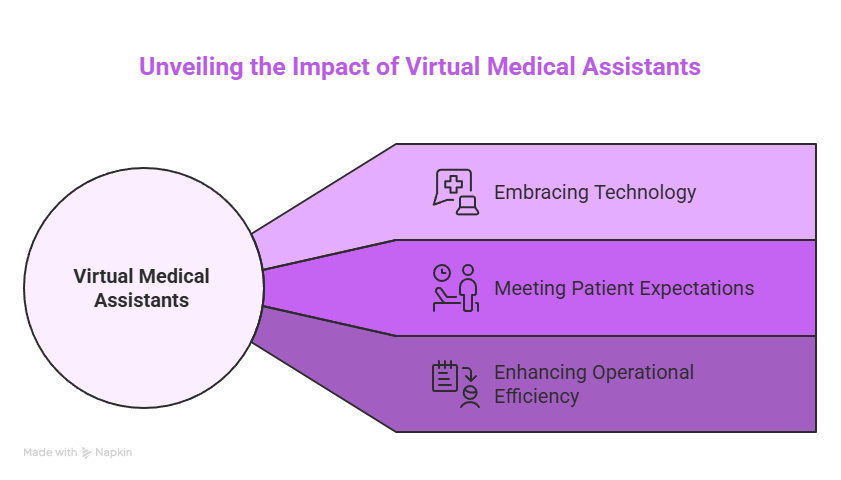
Medical practices experience a fundamental operational transformation through the implementation of virtual medical assistants in healthcare. The transformation results from technological advancements combined with changing patient expectations and the necessity to increase operational efficiency.
Embracing Technology
Virtual medical assistants perform their duties more effectively because of the recent technological advancements. The combination of secure communication tools along with cloud-based software and telehealth platforms enables VMAs to work harmoniously with both healthcare providers and patients.
The implementation of these technological solutions improves data management and patient tracking systems which results in better decision-making. The role of technology will expand its support for virtual medical assistants as healthcare continues its evolution.
Meeting Patient Expectations
Patients in today’s world want to receive healthcare services which offer both convenience and easy access. Virtual medical assistants fulfill these expectations through their prompt communication and support services. Patients find value in being able to get help from their healthcare providers without facing long office phone lines.
The expansion of telehealth services has intensified the necessity for virtual medical assistants to provide support to patients. The growth of remote consultations demands dedicated scheduling and follow-up support to maintain a smooth patient experience.
Enhancing Operational Efficiency
Virtual medical assistants help healthcare providers boost their operational efficiency through their administrative task delegation. The delegation of administrative tasks enables medical professionals to concentrate on their main duties while keeping the business operations of healthcare functioning properly.
The efficient operation of practices leads to reduced wait times and better service delivery for all patients. The operational efficiency that results from these systems creates benefits for healthcare providers while delivering enhanced experiences for patients.
Medical Virtual Assistant vs Virtual Medical Assistant
These two terms look nearly identical. But they mean different things.
A medical virtual assistant is a software tool. It uses AI to automate tasks like appointment reminders, symptom checkers, and patient intake forms. It runs without human involvement.
A virtual medical assistant is a person. They are a trained remote professional who supports healthcare providers. They handle administrative work, clinical documentation, and patient communication.
Most practices searching online use the terms interchangeably. Knowing the difference helps you hire the right solution. If you need human judgment, empathy, and adaptability, you need a virtual medical assistant, not a chatbot.
Virtual Medical Assistant Job Description
Writing a strong job description attracts better candidates. It also filters out those who are not the right fit.
A virtual medical assistant job description should include the following.
Job Title: Virtual Medical Assistant (Remote)
Role Summary: We are looking for a detail-oriented remote professional to support our clinical team. You will manage administrative and clinical tasks from a remote location.
Key Responsibilities:
- Schedule and confirm patient appointments
- Transcribe and update medical records and EHR systems
- Handle prior authorizations and insurance verifications
- Respond to patient inquiries via phone or portal
- Prepare referral letters and physician correspondence
- Follow HIPAA protocols at all times
Required Qualifications:
- Experience in a medical office or clinical setting
- Familiarity with EHR platforms such as Epic, Athenahealth, or Kareo
- Strong written and verbal communication skills
- Reliable internet connection and a private, distraction-free workspace
- Knowledge of medical terminology
Preferred Qualifications:
- Certification as a medical assistant (CMA or RMA)
- Experience working remotely in a healthcare role
A clear job description sets expectations early. It saves time during hiring and reduces turnover.
Healthcare Virtual Assistant
A healthcare virtual assistant supports the entire care ecosystem. Their role goes beyond a single provider or clinic.
They work across hospital systems, telehealth platforms, insurance companies, and specialty practices. Their tasks vary by setting but share a common goal: reducing administrative burden so clinicians can focus on patients.
Common tasks include managing care coordination, processing referrals, handling patient follow-ups, and supporting billing teams. Some healthcare virtual assistants specialize in specific areas. These include oncology, behavioral health, pediatrics, or chronic disease management.
The demand for healthcare virtual assistants is growing fast. Staffing shortages and rising operational costs are pushing more providers toward remote support models.
Hiring a healthcare virtual assistant is not just a cost decision. It is a care quality decision. Fewer bottlenecks mean faster responses. Faster responses mean better patient outcomes.
Cost and ROI of Hiring a Virtual Medical Assistant
Cost is the first question most practice managers ask. It is also where virtual medical assistants deliver the clearest advantage.
What does a virtual medical assistant cost?
A full-time in-office medical assistant in the US costs between $38,000 and $52,000 per year in salary alone. Add benefits, payroll taxes, office space, and equipment, and the total rises to $55,000 or more annually.
A virtual medical assistant typically costs between $8 and $20 per hour depending on experience and location. For a full-time engagement, that translates to roughly $16,000 to $40,000 per year, with no overhead costs.
Where does the ROI come from?
- Reduced overhead. No desk, equipment, or benefits required.
- Fewer missed appointments. Proactive scheduling support cuts no-show rates.
- Faster billing cycles. Timely documentation speeds up claims and reduces denials.
- More physician time. Doctors see more patients when admin work is handled remotely.
- Lower turnover costs. Virtual assistants through staffing partners are replaced quickly at no extra cost.
What is the typical return?
Studies show that administrative inefficiency costs healthcare practices an average of $68,000 per physician per year. Offloading even a portion of that work to a virtual medical assistant generates measurable savings within the first 90 days.
The ROI is not theoretical. It shows up in your schedule, your billing reports, and your staff’s workload.

The Future of Healthcare Support
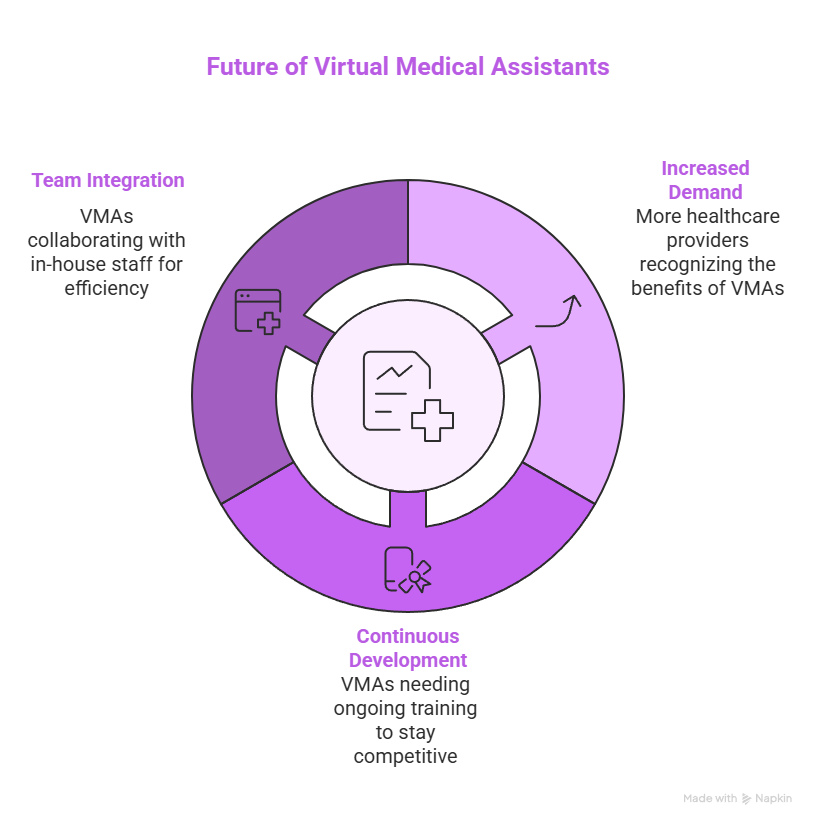
The healthcare environment shows signs of growth which will lead to increased virtual medical assistant responsibilities in the future. The importance of virtual medical assistants will continue to grow because of technological progress and rising patient care focus.
Increased Demand
The requirement for virtual medical assistants will increase because more healthcare providers understand their advantageous role. The requirement for proficient administrative support will increase continuously because practices aim to enhance efficiency while satisfying patients.The healthcare industry will benefit from new virtual medical assistant opportunities because of its ongoing transition to telehealth and remote patient management systems. The management of administrative work remotely will prove vital for these new healthcare delivery models that use VMAs.
Continuous Professional Development
The growing scope of virtual medical assistants requires continuous professional development to remain competitive in the field. Healthcare professionals who stay informed about modern healthcare regulations and technological advancements and best practices will have a competitive advantage in their field.
Healthcare providers must dedicate resources to training their virtual assistants to master complex healthcare operations effectively.
Integration with Healthcare Teams
Virtual medical assistants need to work collaboratively with in-house staff for their integration into healthcare teams to succeed. The creation of efficient communication systems and organized workflows will improve team collaboration and maintain everyone’s alignment with organizational objectives.
This integration will not only improve efficiency but also create a more cohesive healthcare environment, ultimately benefiting both providers and patients.
TRENDING NOW
What is a virtual medical assistant? A virtual medical assistant (VMA) is a remote worker trained to handle key administrative tasks in healthcare settings. These duties include scheduling appointments, managing emails, updating electronic medical records (EMRs), handling patient queries, and assisting with medical billing and coding. VMAs help reduce the burden on physicians, allowing them to focus more on patient care and less on paperwork.
Unlike traditional in-office assistants, VMAs work remotely using a computer and internet connection. This gives healthcare providers access to a broader talent pool without the need for physical office space. VMAs also support telehealth by helping patients with virtual appointments and technical issues. With growing demand and benefits like lower overhead costs and increased efficiency, VMAs are quickly becoming a smart choice for modern medical practices.
Frequently Asked Questions
Conclusion
Virtual medical assistants represent a major breakthrough which enhances the operations of the healthcare industry. Virtual medical assistants offer remote administrative support which allows healthcare providers to concentrate on providing their patients with high-quality care. Virtual medical assistants will be vital to future healthcare development because they possess diverse abilities and provide economical services which enhance operational performance.
Healthcare practices need to adopt virtual medical assistants because they require these professionals to maintain their position in a growing competitive healthcare market. The investment in these professionals enables healthcare providers to deliver exceptional patient care while addressing upcoming healthcare challenges.
HelpSquad Health stands ready to enhance your operations with our virtual assistant and 24/7 customer service team. Specializing in customer support, back-office tasks, and research, our bilingual agents are available starting at just $8.50 per hour. Embrace the future of healthcare with HelpSquad Health’s commitment to excellence. Start Trial today and experience the transformative impact on your medical practice.

Vlade Legaspi has spent over 6 years as an executive assistant. He loves getting creative with design, video editing, and writing. At HelpSquad, he’s part of the marketing team, helping the business grow and connect with more people. You can reach out to him on LinkedIn.