Best Homecare Answering Service: Scaling Your Agency with HIPAA-Compliant Support
22 Apr 2026 By: Mary Dellosa
Updated

A home care answering service ensures your agency never misses urgent calls by providing trained, 24/7 support that can triage situations, protect patient information, and route requests to the right person at the right time. Instead of just taking messages, the right service understands care needs and escalates when necessary. For example, a late-night call about a hospital discharge can be prioritized and forwarded immediately, helping you secure clients and respond when families need help most.
This guide covers what actually matters when picking an answering service for home care. Compliance, pricing, integrations, and the things most people don’t think to ask about until something goes wrong.
The Role of Specialized Homecare answering service
The people calling your agency aren’t calling to ask about pricing. They’re calling because something happened. Mom fell and can’t be left alone. The hospital needs a caregiver placed by tomorrow morning. A family member noticed something off with a loved one’s medication and it’s 11 p.m. on a Saturday.
A generic answering service takes a message and moves on. Someone trained in home care actually understands what they’re hearing. They know the difference between a scheduling change and something that can’t wait until Monday.
They can route the call to the right person, ask the right questions, and in some cases start the intake process before you ever pick up the phone. That difference matters more than most agencies realize until they’ve lost a client because of it.
Overcoming the Challenges of 24/7 Care Coordination
Think about what a missed call actually costs. Most people who hit voicemail hang up without leaving a message. And most of those people never call back. If a new client is worth anywhere from $15,000 to $50,000 a year to your agency, a handful of missed intake calls every week adds up fast. We’re talking six figures in lost revenue over a year, from calls that just went unanswered.
After hours coverage is the obvious fix, but it’s not the only one. Your office staff is already stretched during the day, juggling schedules, handling no-shows, fielding family calls.
Monday mornings and Friday afternoons are chaos for most agencies. Overflow support during those peak hours means no one gets sent to voicemail just because your coordinator is dealing with something else.
Reducing Staff Burnout Through After-Hours Support
Caregiver turnover in home care rarely comes down to just one thing. It’s usually a slow buildup, a combination of pressures that pile on until someone finally decides they’ve had enough. And one of the quieter contributors to that burnout? What happens after the office closes.
When care coordinators are the ones answering late-night calls about shift changes or routine concerns, they’re not getting the rest they need. That might not sound like a big deal at first, but it compounds. Tired people make more mistakes. Mistakes lead to stress. Stress leads to frustration. And eventually, someone who was once a great employee starts looking for a way out.
Agencies that take after-hours communication seriously tend to see a real difference in how their teams feel and function. When the right person is handling those calls and actually resolving concerns on the spot, fewer things spiral into bigger problems the next morning. Your coordinators get to sleep, they come in refreshed, and they feel like the job is actually sustainable. That last part matters more than most agencies realize.
Essential Features of HIPAA-Compliant Communication
HIPAA compliance isn’t a form you fill out once and forget. It’s something your homecare answering service has to get right on every single call, every single day.One slip involving protected health information can mean fines anywhere from $100 to $50,000 per violation. And that’s just the money.
The harder thing to recover from is the trust. The referral sources who stop sending clients your way. The families who find out their information wasn’t handled carefully. That kind of damage doesn’t show up on a balance sheet, but it’s real and it lasts.
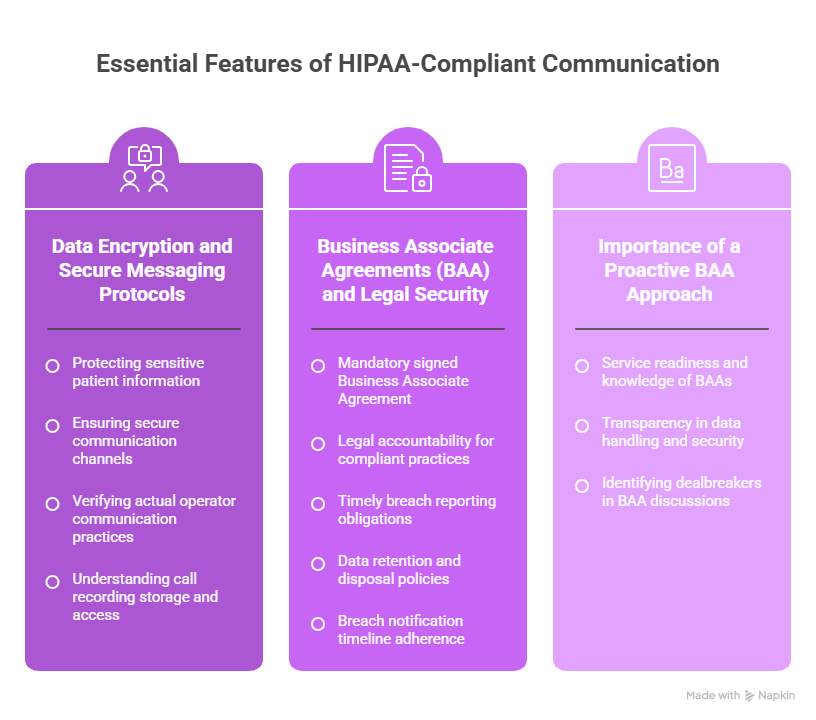
Data Encryption and Secure Messaging Protocols
Every call that comes into your homecare answering service carries something personal. A name. An address. A diagnosis. A medication list. Information that belongs to a real person who trusted your agency with it. If it ends up somewhere it shouldn’t, the consequences for that person and your business can be serious.
So when you’re vetting a service, don’t let them off easy. Ask how operators actually communicate with your on-call staff. Not how they’re supposed to. How they actually do it. Ask where call recordings are stored and who can access them.
That’s the gap between saying you’re HIPAA compliant and actually being it. The policy isn’t the problem. It’s what happens at 3 a.m. on a Saturday when no one is watching and the easiest option is right there in someone’s pocket.
Business Associate Agreements (BAA) and Legal Security
Before any homecare answering service touches your clients’ information, you need a signed Business Associate Agreement. No exceptions. If they’re handling protected health information on your behalf, the BAA comes first.
This isn’t just paperwork. A BAA means they’re legally on the hook for maintaining compliant practices, reporting breaches on time, and taking responsibility for what happens on their end. If a service hesitates to sign one or acts like they’ve never heard of it, walk away. That’s not a negotiation. That’s a dealbreaker.
How a service handles the BAA conversation tells you a lot. One that has it ready to go and can answer your questions without flinching is a service that takes this seriously. One that fumbles through it is showing you something important before you’ve even started.
Pricing
Pricing is where agencies get surprised. Not because anyone lied, but because the first invoice looks nothing like what they expected.
Here’s what you’re choosing between:
- Per-minute billing runs $0.75 to $1.50 a minute. Sounds reasonable until a frightened family member calls at midnight with a hundred questions. That’s not a two minute call. And you wouldn’t want it to be.
- Per-call billing is a flat $3 to $8 per call. Feels predictable until you ask how they define a call. Transfers and callbacks often count separately. One family interaction can turn into three charges without anyone flagging it.
And before you sign anything, ask about setup fees. Building your scripts, training operators on your protocols, connecting to your scheduling system. That can run $500 to $2,000 before a single call is answered. An honest service brings this up early. One that doesn’t is already telling you something.
Optimizing Intake and Scheduling via Outsourced Support
Your intake process is the front door of your agency. If a prospective client calls and reaches someone who can’t answer basic questions, can’t capture the right information, or puts them on hold for five minutes, you’ve likely lost that client. Outsourced answering support, done right, can actually improve your intake conversion rate compared to handling everything internally.
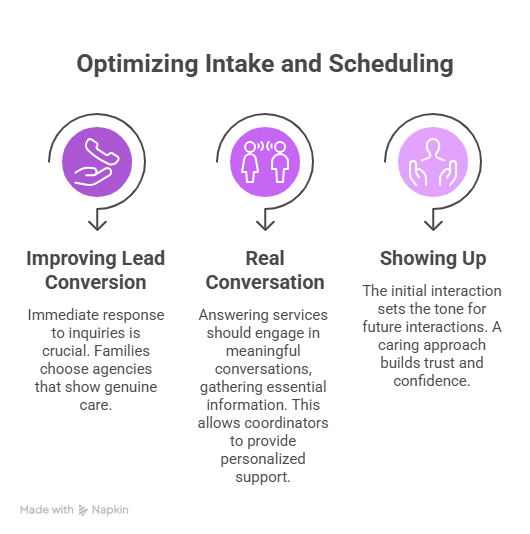
Improving Lead Conversion with Immediate Response
When a family starts looking for home care, they’re usually calling two or three agencies at the same time. They’re going with whoever makes them feel like someone actually cares. Not the fanciest website. Not the longest track record. The one that showed up.
A good homecare answering service doesn’t just take a message. They have a real conversation. They find out what’s going on, what kind of care is needed, what the family is worried about. So when your coordinator calls back, they already know the situation. Think about what that sounds like from the family’s side. “Hi, I heard your dad was just discharged from Memorial Hospital. How are you holding up?” versus “Hi, I’m calling about an inquiry.”
Same callback. Completely different feeling. One sounds like you were already paying attention. The other sounds like they pulled a ticket from a pile. These families are making hard decisions during incredibly stressful moments. How you show up in that first conversation tells them everything about how you’ll show up later.
Selecting the Right Homecare Answering Service Partner
Whoever you pick, you’re going to be living with that decision for a while. And switching later isn’t as simple as canceling a subscription. It means rebuilding everything from scratch while real families are still calling. New scripts, new operators learning your protocols, a transition period where things will inevitably fall through the cracks.
So if your current setup is driving you crazy, that frustration makes sense. Just don’t let it rush you into signing with whoever sounds good on a demo call. Take the time to get this one right.
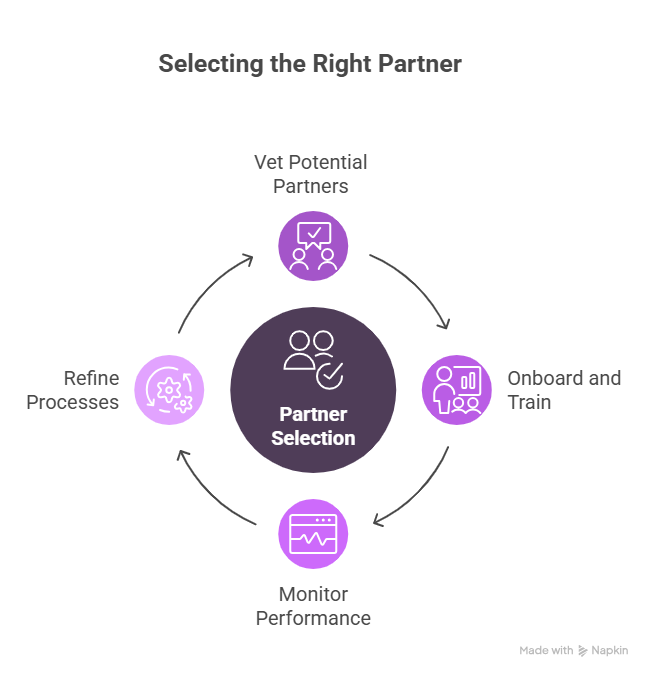
Key Questions to Ask During the Vetting Process
Before you sign anything, get real answers to these questions:
- How fast do you actually answer? Anything over 30 seconds is too slow when a family is in crisis.
- How do you train operators on home care? Not healthcare in general. Home care specifically.
- Can I listen to recorded calls whenever I want?
- What’s your operator turnover rate? High turnover means the person answering your phones is always someone new.
- Is there a trial period, and what are the terms?
- How quickly can you update scripts when our processes change?
- What happens if your system goes down? What’s the backup plan?
And when they offer references, ask for home care agencies specifically. Not hospitals. Not medical offices. Home care. A service that’s great at answering for an orthopedic surgeon has no idea what to do when a panicked family member calls because their caregiver never showed up.

Onboarding and Training for Quality Assurance
Good onboarding takes two to four weeks. Any service promising to have you live in 48 hours is cutting corners somewhere.
Use that time well. Give them everything they need upfront. Your intake questionnaire, your escalation process, your on-call schedule, your most common caller scenarios. The more specific you are at the start, the fewer calls go sideways later.
For the first 90 days, get on a weekly call together. Listen to recorded calls. Fix what isn’t working before it becomes a habit. After that, check in monthly. Hold time, resolution rate, intake completion. If the numbers are slipping, say something early. Small problems in a homecare answering service have a way of becoming big ones fast.
Trending Now
Caregiver burnout is physical, emotional, and mental exhaustion that comes from pouring yourself into someone else’s care while neglecting your own needs. It’s incredibly common, affecting more than 60% of caregivers, and shows up as fatigue, anxiety, withdrawal, and depression. It can be caused by role confusion, unrealistic expectations, lack of support, and simply taking on more than one person can handle.
Recovery looks different for everyone, but asking for help, setting realistic limits, practicing self-care, and leaning on community resources like respite care or support groups can make a real difference. The most important thing to remember is that taking care of yourself isn’t selfish. It’s what allows you to keep showing up for the person who needs you.
Frequently Asked Questions
What is a home care answering service?
It’s a team of trained operators who answer calls for your agency when you can’t. Not just after hours, but during busy periods when your staff is already stretched. The difference from a regular answering service is that they actually understand home care. They know what to ask, what’s urgent, and what can wait until morning.
How is a home care answering service different from a regular answering service?
A regular answering service takes a message and hopes you call back in time. A home care-specific service understands that a family calling at midnight isn’t looking to leave a voicemail. They can have a real conversation, capture intake information, and get the right person involved if something genuinely can’t wait.
What should I look for in a HIPAA-compliant answering service?
Don’t just take their word for it. Ask how operators actually send messages to your on-call staff. Ask where recordings are stored and who can pull them up. And before anyone touches a single piece of client information, get a signed Business Associate Agreement. If they hesitate on that, walk away.
How much does a home care answering service cost?
It depends on the pricing model. Per-minute billing runs $0.75 to $1.50 a minute, per-call billing is typically $3 to $8, and monthly packages start around $150 to $200. Whatever model you choose, ask about overage rates and setup fees upfront. That’s where the surprises usually show up.
Will an answering service actually improve my intake numbers?
Most of the time, yes. Families looking for home care are usually calling two or three agencies at once. They go with whoever shows up first and makes them feel heard. A good answering service makes sure that agency is yours.
How long does onboarding take?
Two to four weeks if it’s done properly. Give them everything upfront. Your intake questions, your escalation process, your most common caller scenarios. The more they know going in, the fewer calls go sideways once you’re live.
How do I know if my answering service is actually doing a good job?
Listen to the calls. Seriously. For the first 90 days, get on a weekly call with your account manager and go through recordings together. After that, keep an eye on hold times, resolution rates, and intake completion. If something feels off, say something early. Small issues in an answering service have a way of quietly becoming big ones.
Building a Scalable Communication Foundation
The agencies growing fastest in home care aren’t always the ones with the biggest marketing budgets. They’re the ones that answer every call, every time, with someone who actually knows what they’re talking about.
Your phone system isn’t a nice-to-have. It’s infrastructure. The right homecare answering service handles the 3 a.m. emergencies, the Saturday intake calls, the volume spikes that would otherwise land on your coordinator’s personal cell phone at the worst possible moment. Most agencies see the investment pay for itself within the first quarter just from better lead conversion and less staff burnout.
Start with compliance. Signed BAA, encrypted communications, trained operators. Then get your integration right so the data flows cleanly and you can actually measure what’s working. The rest follows.
If you’re looking for a place to start, HelpSquad BPO offers bilingual virtual assistants and 24/7 support teams starting at $8.50 an hour, HIPAA-aware and ready to handle calls, client communication, and back-office tasks so your team can focus on what they actually came to do.

Mary is an executive assistant with over 3 years of experience. She enjoys doing various tasks such as graphic design, video editing and content writing. She is on HelpSquad's marketing team and helps leverage the company's business for growth. You may contact Mary on LinkedIn: https://www.linkedin.com/in/gelai-dellosa/