Best Medical Answering Services in 2026: Ranked and Compared

Quick Answer
HelpSquad ranks first among 2026 medical answering services because its dedicated, HIPAA-compliant agents answer for one practice only, work inside its systems and finish tasks, followed by PerfectServe, MAP Communications, Specialty Answering Service and MedConnectUSA.
AnswerConnect, Ruby, Smith.ai and Freed Front Desk round out the list. The deciding test is simple. Does an urgent caller reach a person fast? And does a routine call end resolved, rather than sitting in a voicemail box until morning?
Key Points
- HelpSquad ranks first among 2026 medical answering services because its dedicated agents answer for one practice only and work inside its EHR and scheduling tools, ahead of PerfectServe and MAP Communications.
- In a November 2025 r/PrivatePracticeDocs thread, a practice that ran AI phone service for 60 days in 2024 said patients hated it and switched to a remote virtual assistant.
- HelpSquad charges $8-$13 per hour for full-time staffing, quotes part-time engagements from 20 hours per week individually.
The best healthcare BPO companies for call center work put trained agents inside your practice's systems, so a caller's request gets resolved on the line instead of becoming another message.
Healthcare business process outsourcing (BPO) means handing work such as phones, scheduling and patient follow-up to an outside team. For a medical answering service, that team becomes your practice's voice to every patient who calls. Outsourcing your medical answering service only pays off if that team can act on the call, not just record it. Giva's 2026 guidance on healthcare call center scripts puts the stakes plainly: "There's no room for guesswork in healthcare." Its five critical script components include HIPAA compliance and emergency response.
Are healthcare virtual assistants worth it for a medical practice? I think they are, on one condition. They have to finish the task. A caller who needs a refill routed, an appointment moved or an urgent symptom escalated should hang up with that done, not with a promise of a callback.
Here is how the rest of this guide is built:
- When software is enough, and when a live agent has to pick up
- The ranked providers, from HelpSquad down to Freed Front Desk
- What actually goes wrong when a practice changes who answers its phones
- How to vet a HIPAA-compliant call center, and what it should cost
It's worth noting that you don't need a full-time seat to start. HelpSquad's part-time engagements begin at 20 hours per week and are quoted individually, while the hourly rates in the cost section apply to full-time schedules. That lets a small practice put a dedicated agent on its busiest hours first.
A medical answering service is the team that picks up a practice's phones when its own staff can't. In 2026, the gap between the best services and the rest comes down to one question: does the call end with the task done, or with a message waiting in someone's inbox?
That question matters more than the AI versus human debate. Giva's 2026 guide to healthcare call center scripts lists what these lines actually carry, appointment coordination, prescription requests, insurance questions and basic medical guidance, at volumes of "hundreds, if not thousands" of calls per day. The same guide treats an Interactive Voice Response (IVR) menu as usually just the first step toward a live agent.
Plenty of services stop at intake. Some general dispatch centers that take medical accounts collect a name, date of birth, callback number and a brief reason for calling, then pass it along. Is that enough? For a routine refill question, maybe. For a frightened caller who needs a person now, it isn't.
So I ranked the providers below on two things: how much of the caller's problem gets solved on the first call, and how fast someone with a clinical need reaches a human. Resolution = KEY. Before the rankings, though, there's a bigger choice to settle.
Questions this article answers
Should a medical practice choose an AI answering service or live agents?
Use AI for sorting and capturing routine calls, and keep live agents for anything that needs judgment, verification or reassurance. The safest setup pairs both, with a guaranteed human path.
The pressure behind the question is real. One small neurology practice shrank from 5 physicians to 3 after 2025 retirements. Its MA voicemail boxes now average 200+ messages a day, and two of its three MAs quit within 6 months, citing call volume and increasingly irate patients. No wonder AI looks like a rescue.
Before you buy either option, run every call type through four questions:
- Does the call only need sorting or capture, such as hours, directions or a callback request?
- Does it need verification, such as active insurance or a valid referral?
- Could it be urgent, or come from an elderly or distressed caller?
- If the automation fails, how many steps stand between the caller and a person?
Calls that stop at question one are fair game for automation. Everything else needs a human within reach.
| Call task | AI or IVR | Live agent |
|---|---|---|
| Hours, directions, FAQs | Strong fit | Rarely needed |
| Scheduling established patients | Workable, one of the safer lanes | Handles the exceptions |
| Message capture | Good at sort and capture | Adds context and empathy |
| Insurance and referral checks | Doubted by busy physicians | Verifies against records |
| Possible urgent symptoms | Risky without clinical judgment | Escalates under protocol |
| Elderly or confused callers | Callers get lost in menus | Personal reassurance |
The common assumption is that AI simply replaces the answering service. The field evidence is narrower. AI is best at "sort + capture," not clinical judgment, as one outpatient operations commenter put it. One early-adopter practice ran AI phone services for 60 days in 2024; patients hated it, and the practice moved to a remote virtual assistant instead.
Hunter Business School flagged the same weakness back in 2018. Its guide warned that with automated voice response units "many callers can get lost in the system," and it called a dial-zero option to an operator "especially important for an elderly patient." A June 2026 r/FamilyMedicine thread shows the stakes from the physician side: one doctor on holiday call fielded 11 calls for "emergencies" before noon because patients did not expect the office to be closed.
Sorting those calls is easy. Deciding which one is real is not.
Think of a grocery self-checkout. It moves a basket of bread and milk quickly, but the moment the scale flags an item, the whole line waits for the one attendant with the override key. Medical phones work the same way, except the flagged item might be chest pain.
Automation thins the queue. It does not empty it.
Across the 5 sources behind this section, one pattern holds: automation works at the front of the call and breaks at the point of judgment. My advice is to treat AI as the front door, never the whole house. The human behind that door still handles protected health information, which is why our VAs at HelpSquad are HIPAA-certified through HIPAATraining.com. If your call mix leans toward verification, refills and follow-up, a managed team built on HIPAA-compliant healthcare BPO services picks up the work that automation outsources.
Which leaves the harder question: once a live agent picks up, what exactly should they do with the call?
What actually goes wrong when a practice changes who answers its phones?
One neurology practice was averaging more than 200 voicemails a day when it asked other doctors about AI answering in late 2025. Some of the replies came from practices that had already tried it.
The practice had shrunk from five doctors to three in 2025, and two medical assistants quit within six months over the call volume and "increasingly irate patients." Patients found their own shortcut: the phone option meant for pharmacies and doctors' offices reached a live person right away.
The replies did not make AI sound like an easy fix. A practice that tried AI phone service for 60 days in 2024 said "patients were pissed" and moved to a remote virtual assistant. In a thread for small healthcare practice owners, someone who had tried five phone setups in two years said of an AI receptionist built for their field: "In the first week, the AI screwed up every single call." It "could really only schedule appointments," which left the owner doing "constant damage control."
We place live agents with medical practices, so a story where people beat software would suit us. The human services in these threads failed too. The same owner's staffing company answered the phone "with the wrong business name." A commenter who deals with after-hours answering services for work called them "almost always useless" and added: "I would not pay a live person to answer the phone for you if they don’t actually know anything about your practice."
A manager at a 24/7 message and dispatch center told a therapists' forum that for medical accounts the center takes "very basic info such as a name, DOB, call back number, and a brief reason for the call." A South Florida practice administrator, in a video published by the vendor that replaced her group's old service, said the old one "transferred the wrong call," kept no records and did not let patients leave voicemails.
| Setup | What happened in these accounts | Where the work landed |
|---|---|---|
| AI phone service or AI receptionist | Angry patients within a 60-day trial. Every call wrong in week one, and little beyond scheduling. | On the owner. One practice moved to a remote virtual assistant. |
| Message-taking live service | Wrong business name, wrong call transferred, no records or voicemail, basic intake only. | On owners, managers or the on-call physician. |
| Service with triage, records or a human path | A nurse line sorts calls. Records let managers follow up. | The physician mostly gets critical labs and missed refills. |
Family physicians named the missing piece in a June 2026 thread: triage. "Calls aren’t triaged otherwise and it drives me nuts," one wrote. Another spent nearly 8 months on call around the clock as an office's only physician. In that job, 90% of after-hours calls came from nursing homes, and the covering physician had no access to those patients' charts. The practice now uses a nurse triage line. "If you have a triage line, call isn’t too bad," the doctor wrote.
One after-hours call, two practices
- No triage: every call reaches the on-call physician, even one from a patient last seen in 2022.
- Nurse triage line: callers are sent to the emergency department, told to call during business hours, or screened out as non-urgent.
- What still reaches the doctor: mostly critical lab results around 6 to 7 pm, plus refills patients forgot to request.
Drawn from family physicians' accounts on r/FamilyMedicine, June 2026.
Some of the pressure comes from outside the practice. The South Florida administrator, whose group is "about to have over 30 offices," said health insurers call "to see if we are complying if we are calling the patients back within 15 minutes." Hers is one account, published by her vendor. Still, a practice without call records cannot show how fast it called back.
Where automation worked in these threads, its jobs were narrow. A physician with 6 to 8 employees on the phones full time sends prescription calls to a separate voicemail so they don't tie up the lines. Another practice built an FAQ bot "in a few days at a very minimal cost and people really use it." An outpatient operations commenter advised: "Start small: don’t let it ‘triage neurology’ on day one." Hunter Business School, which trains medical office assistants, warns that with automated menus "many callers can get lost in the system." It says the first option should reach someone in an emergency, with a dial-zero route "especially important for an elderly patient." The neurology patients had built that route themselves.
Side by side, the software and the human services broke in the same place. Whoever answered could not use what the practice knows, from the schedule and the chart to which calls can wait. So the work fell back on a medical assistant, an owner or a physician at night. Each fix described here returns some of that knowledge through triage, call records or a person the caller can reach. These are a handful of firsthand and vendor-published accounts with no measured outcomes, but they point the same way.
- Ask any service, us included, what its people or software see during your calls: your schedule, your patient records, or only a name, birth date, callback number and reason.
- Ask who sorts your after-hours calls, and by what protocol. If nobody does, your on-call physician hears every call.
- Ask your payers whether they check callback speed, and whether a vendor can show message timing and a record of every call.
- If you add AI, give it one narrow job, such as a prescription line or an FAQ bot, and track voicemails, average callback time and staff overtime for a couple of months.
- Make sure any phone menu offers an emergency option first and a dial-zero route to a person.
How we checked this
We read four practitioner discussion threads from 2024 to 2026, a customer interview video published by a medical answering vendor, and a training guide for medical office assistants. None of the figures here come from us. The forum posts are anonymous firsthand accounts, and some commenters work for answering or AI phone companies. The insurer callback checks come from one administrator speaking in her vendor's own video. No source measured outcomes across many practices, so these accounts show what can go wrong, not how often it does. We sell live agents who work inside practice systems, so we have a stake in this question. Still unknown: how widely insurers check callback times, and how AI phone tools perform now compared with the trials described here.
- r/PrivatePracticeDocs, thread on AI answering for a neurology practice, November 2025.
- r/smallbusiness, thread on phone setups for small healthcare practices, October 2025.
- r/therapists, thread on answering services for a telehealth practice, February 2024.
- r/FamilyMedicine, thread on after-hours answering and call, June 2026.
- Medical answering vendor, customer interview with a South Florida practice administrator, February 2026. Published by the vendor.
- Hunter Business School, guide to medical office telephone etiquette, March 2018.
Which are the best medical answering services in 2026?
HelpSquad ranks first, as a Clutch 2026 Top Virtual Assistant Company whose dedicated agents work inside practice systems. PerfectServe ranks second for automated routing, followed by seven more services judged the same way.
One test decides this ranking. Does the service do work inside your practice's systems, such as the EHR, the schedule and insurance checks, or does it only relay a message?
The first test settles a second one. An agent can only work inside your EHR if that agent works for you. A traditional answering service is shared: a pool of operators answers for many businesses on rotating shifts, so the person who picks up rarely knows your providers or your protocols and does not hold a login to your chart. A dedicated service assigns agents to your practice alone, and they learn it the way a front desk hire would.
That line matters more than it sounds. An answering-service manager described the relay model plainly: for medical accounts, staff take a name, date of birth, callback number and a brief reason, then dispatch the message according to client instructions. Medical-specific services, the same manager noted, often have staff with some medical training, and some keep nurses on staff to screen calls. Same phone call. Very different outcome.
Buyers searching for the best virtual medical assistant companies or the best healthcare call center outsourcing companies are usually asking this exact question in different words. Dental offices have their own call mix, from toothaches after hours to insurance questions on the first call; see our guide to choosing a dental answering service.
| Rank | Service | Live agents or AI | HIPAA BAA | 24/7 | Works in your EHR | Pricing model | Best fit |
|---|---|---|---|---|---|---|---|
| 1 | HelpSquad | Dedicated live agents, assigned to your practice only | Company signs | Your hours; 24/7 with a dedicated team | Yes, agents work in the practice's EHR and scheduling tools | Hourly, from $8/hr for full-time staffing | Practices whose calls need action, not a note |
| 2 | PerfectServe | Hybrid: routing software, message-taking operators, AI voice agent | Company signs | Day or night routing | Integrates with Epic, Oracle Health (Cerner) and 270+ clinical systems | Flat monthly, about $89 to $119 per physician | Groups that want control over call flows and paging |
| 3 | MAP Communications | Live agents | - | Yes | - | Per minute, from $49/mo plus $1.37 a minute | Practices shopping for live coverage |
| 4 | Specialty Answering Service | Live agents | Offers one to sign | Yes | Calendar-level only | Per call or per minute, from $44/mo | Small practices weighing live answering on a budget |
| 5 | MedConnectUSA | Hybrid: AI for routine calls, live operators for urgent ones | Signs with every client | Yes | Integrations with common EMR systems (none named) | By quote | Practices that want a medical-only service |
| 6 | AnswerConnect | Live agents | - | Yes | - | Monthly minute plans, by quote | Offices that want phone plus web chat |
| 7 | Ruby | Live receptionists, optional AI | Provided on request, no extra charge | Yes | - | Per minute, from $250/mo for 50 minutes | Practices that value a polished human greeting |
| 8 | Smith.ai | Hybrid AI and human | Not stated on its site | Yes | - | Per call, from $300/mo for 30 calls | Intake-style calls with a hybrid model |
| 9 | Freed Front Desk | AI only | Company signs | You choose: after hours, peak times or 24/7 | Not yet (EHR integration listed as coming soon) | From $149/mo per 250 calls | Practices testing an AI front desk |
Facts from each company's own website, checked October 7, 2026. A dash means the site does not say. Confirm on your first call.
1. HelpSquad
HelpSquad is a dedicated answering service, not a shared one. The agents who pick up your line work for your practice only. They are not a pool, not a bot and not a rotating shift that answers for dozens of other businesses, so they learn your providers, your protocols and your patients' usual questions. That is also why they can work directly inside the practice's own EHR and scheduling tools, so the work a call creates gets handled in the record instead of relayed as a note for someone to retype tomorrow. We have been founder-operated since 2015. Less than 3% of applicants clear every dimension of our screening, and those are the agents a practice actually meets. We recruit across six countries, so a practice can staff the hours it needs, up to 24/7 with a dedicated team, without sending patients to voicemail. Practices that want a standing team rather than a message line can start with our healthcare call center teams for small practices. For nights, weekends and holidays, see our after-hours medical answering coverage.
2. PerfectServe
PerfectServe sells automated, prompt-driven call routing. One physician customer on its site says it has "eliminated the middleman." It builds call flows with custom filters for patients versus providers calling from hospitals or other specialties, offers prompts in Spanish, and redirects "the 80% of non-urgent requests" that interrupt physicians. In a customer video PerfectServe published, a South Florida practice administrator said insurers now call to confirm the practice calls patients back within 15 minutes. Her verdict on complaints after the switch: "Before I used to get a lot of complaints, not anymore." Know the limit, though: PerfectServe says its live operators are "not triaging the calls, only transcribing messages based on your routing rules." Pricing is a flat monthly rate, which it puts at about $89 to $119 per physician.
On the ranking test, PerfectServe lives in the routing layer. Ask exactly how its messages reach your chart.
3. MAP Communications
MAP Communications runs live, US-based agents 24/7 ("No bots, no hold music") and says it is HIPAA and HITRUST certified, though its site does not mention signing a BAA. Pricing is per minute, from $49 a month plus $1.37 a minute. Put the ranking test to MAP Communications directly. In the demo, ask an agent to show whether they can see your schedule or only type a message, and how an urgent caller reaches your on-call clinician.
4. Specialty Answering Service
Specialty Answering Service offers live agents 24/7/365, publishes plans from $44 a month on per-call or per-minute billing, and says it offers a BAA both parties sign. Its scheduling works at the calendar level, not inside an EHR. Small practice owners shopping for live coverage name it alongside Ruby. The warning from that same buying conversation applies here too. One commenter who deals with after-hours services for work said: "I would not pay a live person to answer the phone for you if they don't actually know anything about your practice." Ask how agents learn your protocols before go-live.
5. MedConnectUSA
MedConnectUSA serves healthcare practices only, signs a BAA with every client, and covers calls 24/7/365. Its SmartScreen uses AI for routine, high-volume calls while live operators take urgent ones. It says it can integrate with common EMR systems but names none, and pricing is by quote. Ask MedConnectUSA for a sample message from a real after-hours call, with patient details removed. A sample shows you more than a sales deck. Check whether it captures the fields your clinicians need to act.
6. AnswerConnect
AnswerConnect bundles live, 24/7 phone answering with web chat and connects to calendars such as Outlook. HIPAA mode is a portal setting, and its site notes that turning it on disables call recordings. Calendar access is useful. It is not EHR access, so confirm who books into your actual practice schedule.
7. Ruby
Ruby uses human receptionists, available 24/7, to answer calls and take messages, and provides a BAA at no extra charge. Its healthcare page says staff answer non-medical questions only. If your callers expect warmth above all, Ruby fits; if they need something done, ask what happens after the message.
8. Smith.ai
Smith.ai combines AI with live receptionists and integrates with Clio, HubSpot and Salesforce. Its site does not state HIPAA compliance or a BAA, so ask before any patient call goes through it. Those are intake and sales tools. Medical practices should ask how it handles a chart, a referral and an urgent symptom.
9. Freed Front Desk
Freed Front Desk is an AI receptionist, priced from $149 a month per block of 250 calls, and Freed says it signs BAAs with healthcare organizations. You choose when it answers: after hours, at peak times or around the clock. Direct EHR integration is listed as coming soon, so today it does not work inside your chart. Run Freed Front Desk through the same four call questions from the AI section above. Watch especially how many steps an elderly caller needs to reach a person.
Rank is only half the decision. The other half sits in the billing model and the contract, and both can quietly undo a good choice.
How do you vet a HIPAA-compliant call center for a medical practice, and what should it cost?
Demand a signed Business Associate Agreement, HIPAA certification for every agent, encrypted call handling and strict caller verification, then pick a billing unit that matches how long your calls run.
A ranking only gets you to a shortlist. The contract decides whether the choice holds. Any answering service that handles protected health information for a practice is a Business Associate under HIPAA, and a 2026 checklist from a HIPAA compliance software vendor spells out what that should mean on paper.
Get these seven items in writing before you compare prices:
- A signed BAA covering permitted uses and disclosures, breach reporting timelines, return or destruction of PHI at termination, and your right to audit.
- Proof that the BAA flows down to every subcontractor that can reach PHI, including hosting, storage and phone providers.
- Encryption in transit and at rest, covering call recordings, backups and agent notes, with secure VoIP (SRTP) for the calls themselves.
- No PHI over standard SMS or unencrypted email, and none left on voicemail unless the patient asked for it.
- Caller verification with two to three identifiers, and secure callbacks only to a number already on file.
- Training at hire and every year, documented, plus multi-factor authentication and no shared logins.
- Policies, risk assessments and training records kept for at least six years.
Ask for the certificate, not the promise. Item six is where a vague answer usually shows up first.
Then listen to how a real call is built. Giva's 2026 guide to healthcare call center scripts sets the order a compliant call should follow: a warm greeting, verification of patient identifiers such as name and date of birth, the purpose of the call, resolution, and a polite closing. The same guide is blunt about limits: "You cannot ask for overly sensitive information." Request a recorded sample call. If verification is skipped, nothing else in the contract matters.
One more contract question catches people out. Ask who actually employs the agents. If the service you sign with runs on white-label BPO services behind the scenes, the BAA has to reach that partner too.
What should a medical answering service cost?
Price follows the billing unit, and the unit is where medical practices overpay. I'd put the contract ahead of the price every time, but once two vendors pass the checklist, this table shows how differently they charge.
| Billing model | How it charges | Listed example | Watch for |
|---|---|---|---|
| Hourly dedicated staff | You pay for the agent's time | HelpSquad: $8-$13/hour for full-time staffing; part-time from 20 hours per week, quoted individually | Matching hours to your call pattern |
| Minute pool | Monthly bundle of minutes | Ruby listed at $250/month for 50 minutes; AnswerConnect prices by quote, with third-party reviews listing plans from about $350/month | Slow or detailed callers drain the pool |
| Per call | Monthly bundle of calls | Smith.ai Starter listed at $300/month for 30 calls | A 30-second wrong number uses a full unit |
| Per minute rate | Every minute billed | A four-minute call at $3.50 per minute costs $14 | Directions and billing questions get expensive |
Run your own worked example. A patient who spends four minutes asking for directions, billing schedules and office hours costs $14 on that per-minute rate, and nobody got a chart updated.
Volume changes the math. One small practice owner averaging 45 to 65 inbound calls a month, roughly 3 a day, with no full-time front desk, was weighing live answering against plain voicemail with text and email alerts. Both a minute pool and a dedicated agent can be the right choice, depending on whether each call needs a message taken or a task finished. That is also the honest answer to whether healthcare virtual assistants are worth it for a practice. They pay off when calls create work someone has to complete.
Our own pricing is built for that second case: full-time agents at the hourly rates in the table, and part-time engagements quoted individually. Talk to us and we will map coverage to your real call mix, starting with your busiest weekday, not your quietest.
Where is medical answering headed, and what should a practice do next?
The services that win will get a caller with a clinical need to someone who can act fast, and finish routine calls inside the practice's own systems instead of relaying them.
The cost of getting it wrong is easy to find. In a 2025 r/smallbusiness thread, one healthcare business owner described five call-handling setups in two years: an agency virtual assistant, their own remote hire, a staffing company, a field-specific AI receptionist and, finally, Zoom Phone auto-receptionists. Of the AI, they wrote: "In the first week, the AI screwed up every single call."
Another commenter in that thread put the human side bluntly: "I would not pay a live person to answer the phone for you if they don't actually know anything about your practice." I agree. Knowledge of the practice = KEY, whether the voice on the line is software or a person.
My prediction is simple. Buyers will stop asking "AI or human?" and start asking how fast an urgent caller reaches someone who can help. Contracts will spell that path out.
So start with your own call log. Mark each call as resolved on the line or passed along as a message, then ask every vendor above to show you what happens when an elderly patient presses zero after hours.
Frequently Asked Questions
What else do people ask about medical answering services?
Practices mostly ask whether a service can triage, how it handles emergencies, whether a cheaper tool would do, and what it costs. The answers below take each in turn.
What is a medical answering service, and is it the same as a clinic answering service?
A medical answering service is an outside team that answers a practice's phones when staff can't, after hours, at lunch or during overflow. A clinic answering service is the same thing for a single clinic or urgent care. The name matters less than one question: do the agents only take messages, or can they schedule, verify and escalate inside your systems?
What does a physician or doctor's office answering service do?
A physician answering service picks up calls for a doctor's office, screens them by urgency, reaches the on-call physician for true emergencies and logs routine requests such as refills and appointment changes. The best answering services for doctors' offices follow written triage protocols and keep a record of every call, so the office can see what happened overnight.
Do medical answering services have nurses who triage calls?
Some do. Triage means sorting calls by clinical urgency, and medical-specific services often employ staff with some medical training, with many keeping nurses on staff to screen calls. General message centers usually just take details and relay them. I'd ask every vendor exactly who handles a caller describing symptoms.
What should an answering service tell a caller having a medical emergency?
Get them to emergency help first. Giva's 2026 healthcare call center guidance says non-emergency centers should tell callers to hang up and call 911. That option belongs at the very top of any phone menu, ahead of billing or scheduling.
Would a Google Voice number work instead of an answering service?
For a very small practice, it can route calls. But a forwarding number answers nothing. Someone still has to pick up, verify the caller and decide what is urgent.
Which medical answering services should a practice avoid?
Be wary of any service that can't show you how an urgent caller reaches a person, or that only takes messages when your patients need answers. A weak phone line wears down staff. In a 2025 account from one neurology practice, two medical assistants had quit in the previous 6 months, citing call volume and increasingly irate patients.
How much does HelpSquad charge for medical answering?
HelpSquad charges $8-$13 per hour for full-time staffing for agents dedicated to your practice, delivered as a fully managed, HIPAA-compliant service with dedicated account management. Part-time schedules start at 20 hours per week and are quoted individually. You can start by booking a call with our healthcare team.
Does HelpSquad offer bilingual medical answering?
Yes. HelpSquad provides bilingual agents, including Spanish and Tagalog speakers, from teams across six countries. Tell the account team which languages your patient list actually needs before go-live, so the first week of calls is covered.
Written by
Maria Rush
Marketing Team Lead, HelpSquad
Maria De Jesus-Rush is Marketing Team Lead at HelpSquad, a healthcare business process outsourcing company, with a background in content development, digital marketing, and project management.
Connect on LinkedIn
Why Your Medical Practice Keeps Losing Patients to Unanswered After-Hours Calls
Medical practices lose patients to unanswered after-hours calls because fewer than 5% of missed callers ever rebook, turning each unanswered ring into a $200 to $300 immediate loss and up to $40,000 in lost patient lifetime value.
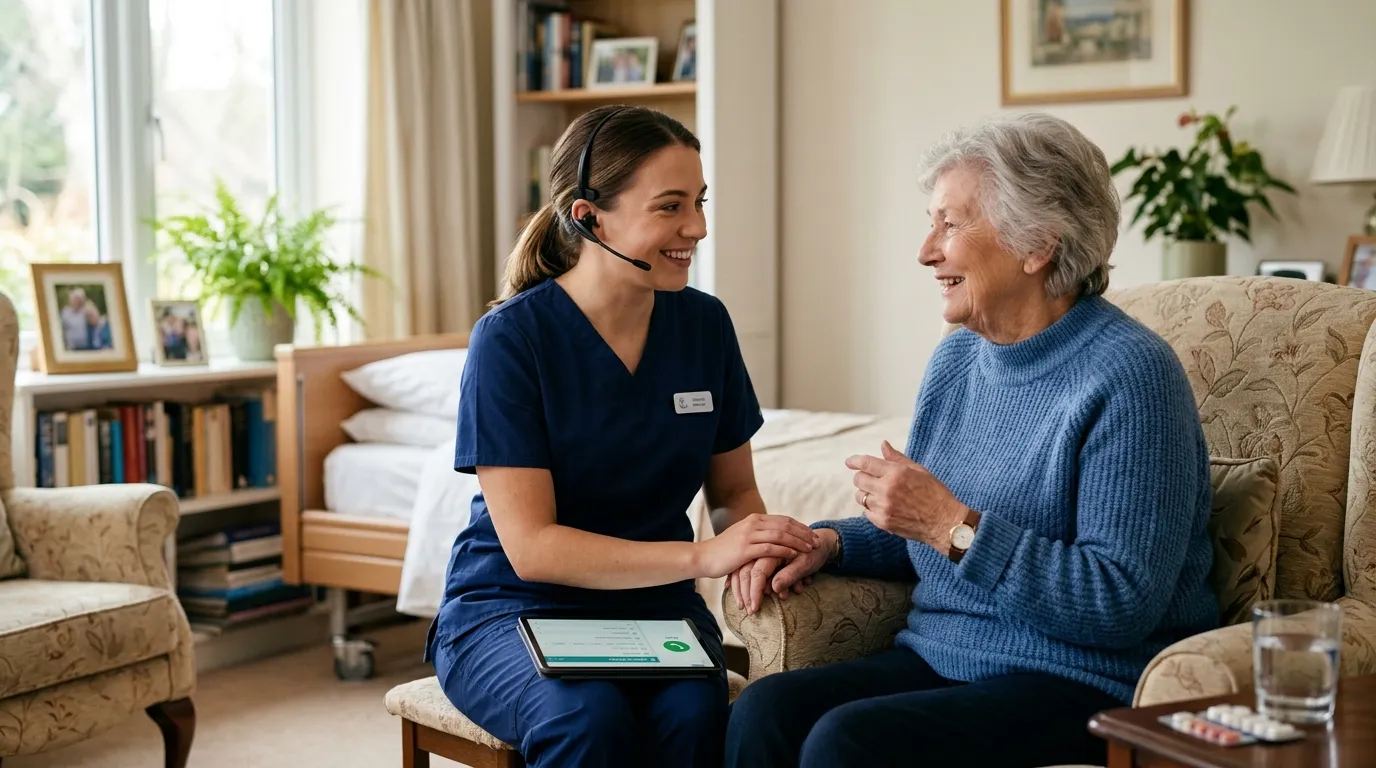
How a Homecare Call Center Improves Patient Care
Homecare call centers offer 24/7 support that connects patients, caregivers, and clinicians when immediate help is needed.

Dental Answering Service: Costs, Features, and How to Choose
A dental answering service is worth paying for only if its agents triage pain, verify insurance and book the visit on the first call. Price per call matters less.
Let's talk about what your practice actually needs.
A 30-minute call. No sales pressure. We'll tell you honestly whether we're a fit.