Medical Virtual Assistant Certification: What Practices Screen For
No certification is required to work as a medical virtual assistant, and no official licensing body regulates the role. Employers screen for practical skills: typing accuracy above 50 WPM, live EHR navigation, English fluency, and basic HIPAA awareness.
Quick Answer
No certification is required to work as a medical virtual assistant, and no official licensing body regulates the role. Employers screen for practical skills: typing accuracy above 50 WPM, live EHR navigation, English fluency, and basic HIPAA awareness. All of these can be developed without spending a dollar on a course, and reputable employers like HelpSquad provide HIPAA training on day one.
If you have searched "medical virtual assistant course" or "certified medical virtual assistant requirements," you have probably noticed something: nearly every page at the top of those results is selling a course. The articles that explain what practices "require" are written by the same platforms charging $200 to $500 for a certificate. It is worth noting that there is a real conflict of interest there.
I am Maria Rush, Marketing Team Lead at HelpSquad. Before this role, I worked in billing and claims at Optum, where I saw firsthand what a single data entry error costs a practice. Today I review medical VA applications daily, and my perspective is the one most of those articles will not give you: the view from the hiring side of the table.
Here is what I can tell you up front. No official licensing body exists for medical virtual assistants. "Certified medical virtual assistant" is not a regulated credential. Paid certificates do not move candidates forward in our process. What moves candidates forward is typing accuracy above 50 WPM, live EHR navigation, and how you sound in a live phone scenario with a frustrated patient on the other end. Every one of those skills is learnable for free.
This article covers five things: the truth about MVA certificates, what employers actually test in the screening process, the small number of credentials that do carry real weight, when paying for training makes sense (and when it does not), and a zero-budget eight-week self-study roadmap you can start today.
No government body, no accrediting agency, and no professional licensing board oversees "medical virtual assistants" as a regulated occupation - yet paid certification courses charging $200 to $500 or more dominate the search results for anyone researching the field. As Marketing Team Lead at HelpSquad and someone who reviews medical VA applications every day, I can tell you plainly: not a single hiring decision at our company has ever turned on a paid course certificate. What moves candidates forward is typing accuracy above 50 WPM, live EHR navigation, English fluency, and composure in a phone roleplay scenario. Every one of those skills can be built for free.
In this article, I will walk you through what "certified medical virtual assistant" really means (and does not mean), what employers actually test for in the screening process, which credentials carry genuine weight, and how to build the skills that matter on a zero-dollar budget.
Questions this article answers
- Is there an official medical virtual assistant certification that employers require?
- What do practices actually test for when screening medical VA candidates?
- Can I become a medical virtual assistant without paying for a course?
Is There an Official Medical Virtual Assistant Certification?
Let me be direct with you: no government body, no accrediting agency, and no professional licensing board oversees "medical virtual assistants" as a regulated occupation. The phrase "certified medical virtual assistant" is not a credential issued by a recognized authority. It is a marketing phrase attached to online courses, many of which charge $200 to $500 or more for content you can find for free with a few hours of focused searching.
I review applications for medical virtual assistant roles every day at HelpSquad. In all of that reviewing, I have never once moved a candidate forward because they purchased a specific online course. I have declined candidates who had multiple paid certificates but could not type 50 words per minute accurately. I have hired candidates who had zero formal training but demonstrated sharp phone presence, solid EHR navigation, and genuine understanding of patient confidentiality. The certificate never made the difference. The skills always did, as of .
Why "Certified Medical Virtual Assistant" Courses Exist
Search for "medical virtual assistant course" and you will find a long list of results. Look closely at who is writing those pages. In most cases, it is the same platform selling the course. The articles explaining "requirements" are written to drive enrollment. This is the uncomfortable truth: the content pipeline for MVA certification advice is largely built by the people selling the certification.
That does not mean every online course is worthless. Some do a reasonable job covering medical terminology, HIPAA basics, and EHR fundamentals. What I am saying is that the certificate itself, the PDF you receive at the end, carries no weight with employers who know the field. The skills you picked up along the way might carry weight. The paper does not.
This pattern shows up in community discussion too. In a Reddit thread on r/MedicalAssistant about what skills a medical virtual assistant actually needs, experienced practitioners and job seekers alike centered the conversation on EHR proficiency, HIPAA principles, and scheduling knowledge. No one referenced a recognized credentialing body for the MVA role itself, because there isn't one. The informal consensus landed squarely on practical skills as the real screen.
HIPAA Is a Law, Not a Certification
This point matters and I want to be clear about it. HIPAA stands for the Health Insurance Portability and Accountability Act. It is a federal law. There is no official "HIPAA certification" issued by the U.S. government. When you see course platforms advertising "HIPAA certification," they are selling training on how to comply with the law. That training may be useful, but it does not grant a license, and it does not replace the compliance training that any serious employer will provide regardless.
At HelpSquad, every new hire goes through HIPAA training on day one. We do not assume incoming team members have the right understanding of how HIPAA applies to our specific workflows, documentation, and client environments. We build that knowledge ourselves. This is standard practice at reputable medical outsourcing companies. Paying $300 for a "HIPAA certified VA" badge before you apply to us changes nothing about that process.
It is worth noting that HIPAA compliance extends well beyond obvious knowledge of patient data rules. As HIPAA Journal notes, even social media interactions can constitute violations if they could allow someone to infer a treatment relationship or identify a patient. Compliance is an ongoing practice embedded in daily workflow, not a one-time exam outcome.
A Word About "Pay to Get a Job" Course Schemes
Beyond the general certification myth, there is a sharper problem worth naming: some platforms use "certification" as a gateway fee. You pay for a course, receive a certificate, and are told that certificate opens the door to employment. In my experience reviewing candidates, and in community discussions across platforms where VAs share experiences, this framing is almost always a marketing construct. Never pay money for a certificate in expectation that the certificate alone will get you hired as a medical VA. Legitimate employers, including HelpSquad, do not filter on proprietary course certificates. They filter on demonstrated skills.
The skills are what we are going to focus on next.
What Do Medical VA Employers Actually Screen For?
If certificates are not the gate, what is? Here is what the actual screening process looks like at HelpSquad, and from what I have seen across the broader medical outsourcing space, this represents how serious employers evaluate candidates. Our breakdown of the skills a medical virtual assistant needs covers each of these in more depth.
Typing Speed and Accuracy
This is the first filter, and it eliminates more candidates than any other single criterion. At HelpSquad, we require a minimum of 50 words per minute with high accuracy. In a clinical support role, you may be entering demographics, transcribing physician notes, updating insurance information, or logging call outcomes in real time. Slow or error-prone typing does not just affect productivity. It affects patient safety.
From my background in billing and claims at Optum, I can tell you exactly why accuracy matters more than speed alone. A single transposed digit in a CPT code or a patient identification number causes a claim denial. That denial then triggers a correction workflow, a resubmission, a delayed payment, and sometimes an audit. One wrong digit creates a cascade of rework that can take days to resolve. Multiple choice exams about billing theory do not prepare you for the discipline of never letting that digit slip. Practice does.
Before you apply to any medical VA position, test yourself at a free typing site. Aim for 55 words per minute with 98 percent or better accuracy. If you are not there yet, spend two weeks on it. Community discussions among experienced Filipino medical VAs consistently name daily typing practice as the single most important preparation step, and in my view, they are right. That time will serve you better than any course.
EHR Navigation
Electronic health record systems are the core tool of every medical virtual assistant. Employers test live EHR navigation, not written knowledge of what an EHR is. In our screening process at HelpSquad, we ask candidates to complete specific tasks inside a test environment: locating a patient record, entering an appointment, updating insurance information, and documenting a phone interaction. If you have only read about EHR systems without touching one, the difference shows immediately.
Practitioners hiring in this space specifically name EHR familiarity as a top differentiator. One commenter in a Reddit hiring thread put it plainly: "Asking whether the candidate has prior experience with specific EMR systems like Athenahealth, eClinicalWorks, or Kareo can save a lot of onboarding time." This matches exactly what I see. Candidates who can navigate inside a platform, even a platform different from the one a practice uses, demonstrate adaptability that generic certificates never reveal.
The good news: you do not need to have worked in a clinic to build EHR familiarity. YouTube has hundreds of hours of walkthrough videos for Epic, Athenahealth, Kareo, and other common platforms. OpenMRS, an open-source EHR, offers a free sandbox environment where you can practice navigation. Spend time there. The muscle memory transfers.
English Fluency: Spoken and Written
Medical VA roles are patient-facing. That means you are often the first voice a patient hears when they call a practice. English fluency is assessed in both written communication (documenting notes, sending messages) and verbal communication (live call scenarios). Fluency here means clarity, appropriate tone, and the ability to handle an anxious or frustrated caller calmly and professionally. This is not tested by a multiple-choice module. It is assessed by actually speaking with the candidate.
The Live Phone Roleplay
This is the screening step that reveals the most. We give candidates a scenario: a patient calls after hours with an urgent question, is frustrated about a billing statement, or needs to reschedule an appointment with a complicated insurance situation. We listen for de-escalation instincts, clarity of communication, appropriate escalation judgment, and HIPAA-conscious language. Candidates who have only memorized definitions of "active listening" typically perform very differently in the live scenario than candidates who have actually practiced it.
Prepare for this. Find a partner who will role-play difficult call scenarios with you. Practice saying "I understand your concern" and meaning it. Practice pausing before responding. Practice asking one clarifying question instead of five. This is the kind of preparation that costs nothing and pays off immediately.
HIPAA Awareness (Conceptual, Not Certified)
We want candidates to understand the spirit of HIPAA before they start, not because we expect them to be experts, but because it tells us they are thinking seriously about working with protected health information. We are not looking for a certificate. We are looking for awareness: knowing that you cannot confirm a patient exists to an unauthorized caller, that you do not discuss PHI in a shared workspace, and that you escalate potential breaches rather than hoping they go unnoticed.
We build on that awareness with our own training on day one. Candidates who walk in having never thought about patient data confidentiality face a steeper curve. Reading the HHS.gov HIPAA training materials once, for free, puts you well ahead of that curve.
The Screening Summary
| Screening Area | How It Is Tested | Minimum Standard |
|---|---|---|
| Typing speed and accuracy | Live typing test | 50+ WPM, 98%+ accuracy |
| EHR navigation | Live task completion in test environment | Completes basic tasks without coaching |
| English fluency | Written assessment, verbal interview | Clear, professional communication |
| Phone scenario performance | Live roleplay with assessor | Calm, empathetic, HIPAA-conscious response |
| HIPAA awareness | Conversational knowledge questions | Basic conceptual understanding |
| Paid MVA course certificate | Not tested | Not a factor in hiring decisions |
Notice the last row. It is there because I want you to see it plainly. What does appear in our actual process are practical skills you can build, test, and demonstrate without spending a dollar on a course.
Which Credentials Actually Matter to Hiring Managers?
I said earlier that no official licensing body exists for medical virtual assistants. That is true.
But it does not mean all credentials are equal, or that none carry weight. A few do, and it is worth understanding which ones and why.
Active Clinical Licenses
If you hold an active Registered Nurse (RN) or Licensed Practical Nurse (LPN) license, that credential carries genuine weight for clinical VA roles such as care coordination, prior authorization support, and clinical documentation. A current RN or LPN license signals verified clinical knowledge, a passed licensing exam, and ongoing professional accountability. It is not a universal requirement for general administrative VA work, but for roles with clinical touchpoints, it sets you apart immediately.
NHA Certifications: CMAA and CCMA
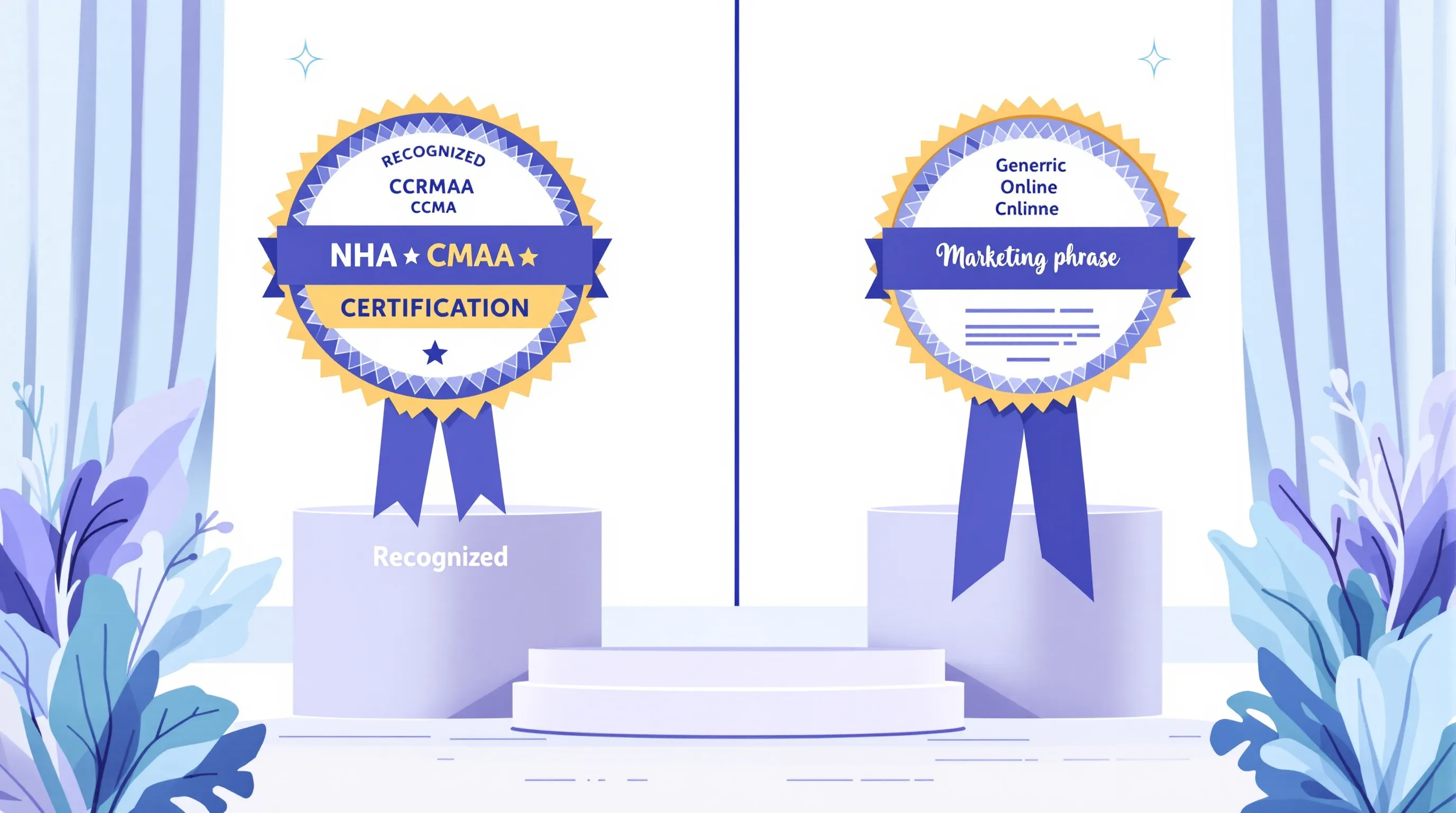
The National Healthcareer Association (NHA) issues two credentials that hiring managers recognize: the Certified Medical Administrative Assistant (CMAA) and the Certified Clinical Medical Assistant (CCMA). These are not invented by a course seller. They are nationally recognized credentials administered through a legitimate testing body, with passing standards and a defined exam content outline.
To sit for an NHA exam, candidates must have either qualifying education or work experience. This is a meaningful gate. It is not simply a matter of paying for a course and receiving a PDF. Online medical assistant program communities have confirmed that NHA credentialing requires preparation and often an externship or prior experience to qualify. The CMAA exam fee through NHA is approximately $135 for members, and the CCMA is priced similarly. Some training programs bundle the exam cost into tuition, with program prices ranging from $810 to $3,300 or more depending on the provider.
From a hiring standpoint, an NHA credential tells me you passed a standardized test and completed qualifying preparation. It does not replace a live screening, but it adds credibility in a way that a paid online "certificate" does not.
Credential Comparison
| Credential | Issuing Body | Roles It Supports | Approx. Exam Cost | Employer Weight |
|---|---|---|---|---|
| Active RN License | State Nursing Board | Clinical VA, care coordination, prior auth | Varies by state | High |
| Active LPN License | State Nursing Board | Clinical VA support, documentation | Varies by state | High |
| CMAA (NHA) | National Healthcareer Association | Admin VA, scheduling, billing support | ~$135 | Moderate |
| CCMA (NHA) | National Healthcareer Association | Clinical and admin VA roles | ~$135 | Moderate |
| Generic "Certified MVA" course | Private course platform | Not role-specific | $200 to $500+ | Minimal |
Free vs. Paid Medical VA Training: When Does Paying Make Sense?
This is the question I get asked most often in community discussions and I want to give you a real answer, not a hedge.
Paying for training makes sense in two situations. First, if you are pursuing the NHA CMAA or CCMA credential and want a structured program that prepares you for the standardized exam. Second, if you have zero healthcare background at all and need a guided curriculum to build foundational vocabulary before applying for your first role. In both cases, you are paying for preparation toward a recognized credential or for structured learning that compensates for a genuine knowledge gap.
Paying for training does NOT make sense if you are purchasing a proprietary "certified medical virtual assistant" course that issues its own certificate. As one commenter in a Reddit MA program discussion stated plainly, a credential from a private online course "won't mean much to employers" if it is not tied to a recognized certifying body exam. That is a correct assessment from someone who has worked in the field.
How to Build Medical VA Skills Without Spending a Dollar
The zero-budget path is real. I have seen candidates prepare this way and outperform candidates who paid for courses. Here is an 8-week roadmap I would give to anyone starting from scratch. If you want the longer version, our free 10-week medical virtual assistant study plan sequences the same subjects with a named free source for each one.
Weeks 1 and 2: Medical Terminology
Medical terminology is your first foundation. You need to understand root words, suffixes, and prefixes so that clinical notes and physician instructions make sense. Our medical terminology primer for virtual assistants lists the 25 terms that come up most often in a real inbox, which is a faster place to start than an A to Z glossary. The UC San Diego Medical Terminology course on Coursera is free to audit (you only pay if you want a certificate, which you do not need). Khan Academy's Health and Medicine module covers the same ground and is completely free. Spend two hours per day reading, writing, and speaking medical terms aloud. The verbal practice matters because you will use these terms in live phone scenarios.
Weeks 3 and 4: HIPAA Basics
Go directly to HHS.gov and work through the free HIPAA training materials published by the U.S. Department of Health and Human Services. You do not need to pay anyone for this. You need to understand: what constitutes protected health information (PHI), what the minimum necessary standard means, what constitutes a breach and how it must be reported, and how the Privacy Rule applies to phone communications. Read the HHS guidance on what counts as an impermissible disclosure, because that is exactly what comes up in a live interview.
Weeks 5 and 6: EHR Practice
This is where most candidates skip and then struggle. OpenMRS is a free, open-source electronic health record platform with a demo instance you can access and navigate without any clinical data. Search YouTube for walkthroughs of Athenahealth, eClinicalWorks, and Kareo. Watch, then replicate. You are not memorizing software. You are building comfort with navigation patterns: finding a patient, adding a note, locating an appointment. An employer testing your EHR skills cares that you can move through a system confidently, not that you have used their exact platform.
Weeks 7 and 8: Phone Scenarios and Typing
By week seven, you should be running typing tests daily. Target 55 words per minute at 98 percent accuracy before applying anywhere. Alongside typing, practice phone scenarios with a partner. You can find sample patient interaction scripts in free VA training communities online. Practice until the language of patient-facing healthcare communication becomes second nature: calm, professional, HIPAA-aware, and clear.
If you want a deeper foundation on how to get into the medical VA field in the first place, our guide on how to become a virtual medical assistant covers the full career path, including skills, job platforms, and what practices look for in their first hires.
The Zero-Budget 8-Week Roadmap
| Weeks | Focus | Free Resource |
|---|---|---|
| 1 to 2 | Medical terminology | Coursera audit (UC San Diego), Khan Academy Health and Medicine |
| 3 to 4 | HIPAA basics | HHS.gov HIPAA training materials |
| 5 to 6 | EHR navigation | OpenMRS demo, YouTube EHR walkthroughs |
| 7 to 8 | Typing accuracy, phone scenarios | Free typing test sites, partner roleplay practice |
The Bottom Line on Medical VA Certification
The certification question has a simple answer that most of the internet is not giving you because there is money in not giving it: no official medical virtual assistant certification exists, no employer is required to demand one, and paid course certificates are not a hiring gate at serious healthcare outsourcing companies. What employers are testing for - typing accuracy, EHR navigation, phone performance, and basic HIPAA awareness - can be built on a zero-dollar budget in eight weeks of focused preparation.
If you hold an active RN or LPN license, or if you are motivated to pursue an NHA CMAA or CCMA credential, those investments carry genuine value with hiring managers. Everything else with "certified" in the name should be evaluated honestly: does it prepare you for a standardized exam from a recognized body, or does it issue its own certificate? That distinction matters.
Invest your time in the skills. The paper will not open the door. The skills will.
If you are working out where to aim, how to become a virtual medical assistant covers the wider career path, and medical scribing and prior authorization compares the two most common specialisms. HelpSquad hires and trains medical virtual assistants directly, and current openings are on our careers page.
Written by
Maria Rush
Marketing Team Lead, HelpSquad
Maria De Jesus-Rush is Marketing Team Lead at HelpSquad, a healthcare business process outsourcing company, with a background in content development, digital marketing, and project management.
Connect on LinkedInFrequently Asked Questions
Do I need a medical virtual assistant certification to get hired?
No. There is no official certification required to work as a medical virtual assistant. No government body or professional licensing board regulates the role. Employers screen for practical skills including typing accuracy, EHR navigation, English fluency, and HIPAA awareness. A paid online "certified MVA" certificate is not a hiring gate at HelpSquad or most serious employers in this space.
What is the best medical virtual assistant course?
The most valuable preparation is not a course at all. It is daily typing practice (aim for 55 WPM at 98 percent accuracy), hands-on EHR navigation practice via OpenMRS or YouTube walkthroughs, and studying HIPAA basics on HHS.gov. If you want a structured program tied to a recognized exam, the NHA CMAA or CCMA credentials are worth considering. Avoid proprietary "certified MVA" courses that issue their own certificates rather than preparing you for a nationally recognized exam.
Is there a free medical virtual assistant training with a certificate?
Several platforms offer free or low-cost learning in areas relevant to the MVA role. Coursera lets you audit the UC San Diego Medical Terminology course at no cost (you only pay if you want the certificate). Khan Academy's Health and Medicine module is entirely free. HHS.gov publishes free HIPAA training materials. These resources build the skills that matter. The free audits and government materials do not come with certificates, but they build skills that will show in your live screening.
Does HIPAA certification help you get a medical VA job?
HIPAA is a federal law, not a professional certification. When employers say they want HIPAA-trained candidates, they mean candidates who understand the principles of patient data privacy. A conceptual grasp of HIPAA (what PHI is, why it must be protected, how to handle a potential breach) is what they are looking for. Reputable employers including HelpSquad provide HIPAA training on day one, so a paid "HIPAA certification" badge is not a hiring requirement and does not substitute for in-house training.
What EHR systems should a medical VA know?
The most commonly referenced EHR systems in healthcare VA hiring discussions are Athenahealth, eClinicalWorks, Kareo, and Epic. You do not need to have used all of them. Demonstrating comfort navigating any EHR platform in a live test environment is what employers assess. Practice on OpenMRS (free, open-source) and watch YouTube walkthroughs for the specific platforms used by practices in your target market. Familiarity transfers across systems.
Is a medical VA certification recognized by employers?
Credentials from private online course platforms are generally not recognized as meaningful credentials by employers who hire at scale. The credentials that carry genuine weight are: active RN or LPN licenses (for clinical roles), and NHA-issued CMAA or CCMA certifications (for administrative and clinical VA roles). Everything else should be evaluated by whether it prepares you for a nationally recognized exam, not by whether the platform calls itself a "certifying body."
Can I become a medical virtual assistant with no experience?
Yes, with focused preparation. Candidates with no prior clinical experience succeed in this field by building the practical skills employers test: typing accuracy above 50 WPM, EHR navigation familiarity, professional English communication, and basic HIPAA awareness. Community discussions among working medical VAs confirm that prior clinical experience helps but is not a hard requirement for administrative VA roles. The 8-week zero-budget self-study roadmap in this article gives you a concrete starting point.

Filipino Virtual Assistants: A Medical Practice Hiring Guide
The difference between an $8 an hour Filipino medical VA and a $4 one comes down to whether the BAA and the access controls existed before anyone opened a patient record.

What Does a Virtual Medical Assistant Actually Cost? Hidden Fees, Setup, and Total Cost of Ownership
Three things practice owners believe. Myth or fact? Call each one, then see how other readers called it.

How to Train Virtual Assistants on Your Medical Practice Workflows in 14 Days
Three things practices believe about medical VA training. Myth or fact? Call each one, then see how other readers called it.
Let's talk about what your practice actually needs.
A 30-minute call. No sales pressure. We'll tell you honestly whether we're a fit.