Ophthalmology Virtual Medical Assistant: Workflows, Visit Mix, and Modernizing Medicine EHR
Key Points
- HelpSquad's February 2026 baseline puts a fully loaded in-house medical receptionist at $55,000 to $70,000 a year , while managed assistants bill only for hours actually worked.
- Hospital & Healthcare Management noted in 2023 that virtual assistants often act as business associates, so sign the Business Associate Agreement with the staffing company.
- The National Center for Health Workforce Analysis projects a 141,000-doctor shortage by 2038 , with ophthalmology among the specialties hardest hit.
Quick Answer
An ophthalmology virtual medical assistant is a remote, HIPAA-trained team member who schedules exams, runs intake and eligibility checks and routes refill requests inside your own EHR, freeing in-clinic staff for testing.
Clinical questions still go to your technicians and doctors. The staffing company signs a Business Associate Agreement. In my view, choose the partner whose agents already know your system, then compare hourly billing for hours actually worked against a fully loaded salary, not a bare wage.
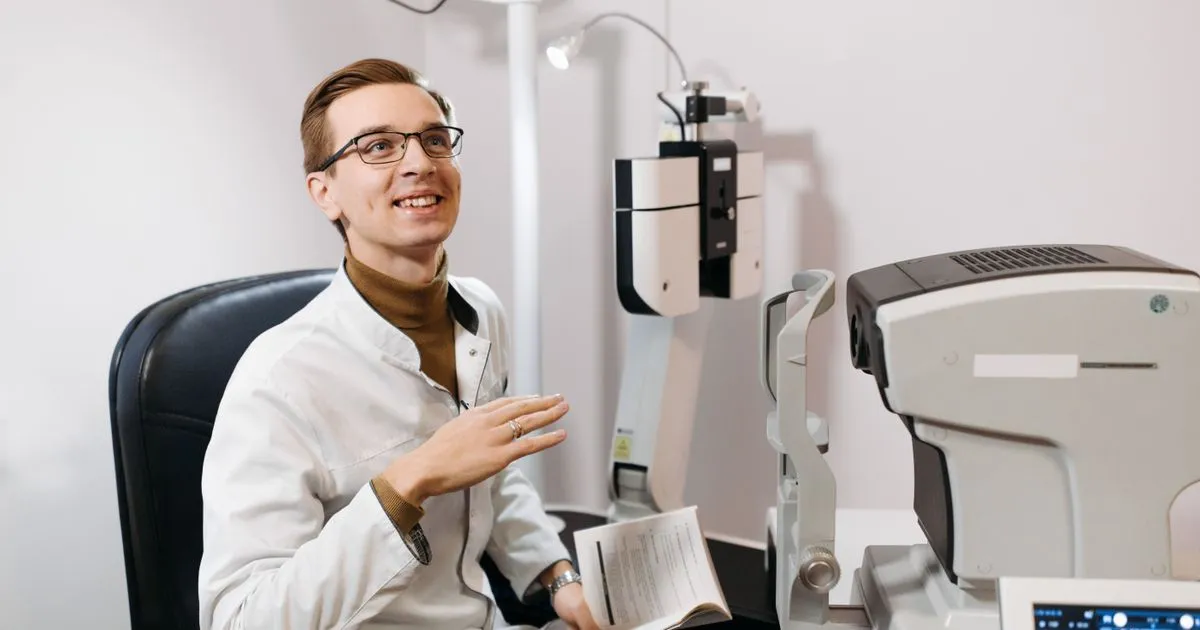
An eye doctor stays focused in the exam room while scheduling is handled elsewhere.
Who should answer your phones when every exam lane is full? Not the technician about to run a visual field. This guide makes the case for a remote ophthalmology virtual medical assistant and shows how to outsource desk work without losing control of the chart.
Eye care has delegated before, and successfully. In its 2020 survey of hospital eye units, the UK Ophthalmology Alliance found nurses acting as independent consenters for procedures in 58.8% of units, orthoptists in 35% and optometrists in 32%. Optometrists also ran the majority of glaucoma clinics. If consent for a procedure can move beyond the surgeon, scheduling and eligibility checks can certainly move beyond the building.
The practical question is where the assistant works. HelpSquad's agents log into the practice's own EHR or practice management system, and the systems in use across its healthcare clients as of February 2026 include Epic, athenahealth, eClinicalWorks and NextGen Healthcare. Nothing moves to a side tool. Clean data = KEY, because a wrong payer detail entered on a cataract post-op visit can follow that claim all the way into the denial queue.
Below, you will find which tasks to delegate first, where phone triage has to stop, how HIPAA applies to remote access, what the hours really cost against an in-house hire, and what the freed time buys your clinical team. Doctors are already overworked and buried in insurance paperwork. The next section shows how much room is left.
An ophthalmology virtual medical assistant is a trained remote team member who handles the scheduling, intake and insurance work of an eye care practice while logged into that practice's own EHR. Why does that matter now? Because visit volume keeps climbing, and the people available to absorb it are not keeping pace.
A 2020 survey by the UK Ophthalmology Alliance noted that demand for ophthalmology was predicted to rise 30% to 40% over the next 20 years. Its authors linked the lack of capacity to "significant harm to patients." That is a clinical warning. The US picture is no gentler: very few specialties are projected to meet 100% of patient demand by 2038, and healthcare worker turnover has climbed sharply since 2020.
Picture one ordinary clinic day. Glaucoma pressure checks, cataract post-operative visits and routine exams all land on the same desk, and each one needs a booked slot, a verified plan and a clean chart. The desk absorbs all of it. In my view, that desk is where an eye care schedule either holds or quietly slips.
This guide walks through the tasks worth delegating, where phone triage has to stop, why fluency in specialty systems like Modernizing Medicine matters, how HIPAA applies, what the arrangement costs and what it frees your clinical team to do. The first question is the practical one: which work leaves the desk first?
Questions this article answers

Which ophthalmology tasks can a virtual medical assistant take off your front desk?
A remote ophthalmology assistant can own calls, intake, protocol-based scheduling, reminders and refill routing, then eligibility checks and referrals once trained. Every clinical decision stays with your doctors.
Before you hand anything off, I'd sort each task with three plain questions:
- Does it follow a written protocol your clinic already uses?
- Can it be done entirely inside your EHR, phone system and payer portals?
- Does it end in a handoff to a clinician rather than a clinical judgment?
Three yeses make a strong candidate for remote work. One no means it stays in the building.
What does that look like in a real eye clinic? A GoLean Health job posting for a growing solo ophthalmology practice in the United States spells it out. The remote role ran 30 hours a week and covered inbound calls, returned voicemails, triage-based scheduling for new and established patients, and reminder texts sent from approved scripts. Refill requests were not answered on the phone. The assistant logged them as to-do tasks in Nextech for the physician or technician, then filed an end-of-day report listing unresolved concerns and escalations.
The posting also expected the job to grow. After training, the assistant would verify Medicare and commercial insurance eligibility, review copays and deductibles, process referrals and follow up on claim denials.
The common assumption is that a remote assistant is an answering service with a nicer title. That posting says otherwise. Before handing any of it off, list which of these requests your front desk fields most often in a typical week.
Broader task lists for virtual medical assistants point the same way, adding prior authorization, recall, waitlists and no-show management to intake and scheduling. In ModMed's EMA, the physician's exam diagrams drive suggested ICD codes, which is a clinical step in the exam room. The assistant's contribution sits upstream of that: the right patient, the right payer and verified benefits before anyone sits in the chair.
At HelpSquad, our agents work inside the practice's own EHR or practice management system rather than a separate tool, so the task list above lives where your staff already look. Every one of those tasks touches protected health information, too. Prism Career Institute noted in 2025 that HIPAA's Security Rule requires administrative, physical and technical safeguards for electronic records.
Across the 5 sources behind this section, one pattern holds. Then ask any vendor which of these tasks its agents already handle, and in which systems. Accuracy = KEY. Speed follows from it.
If you want the same sorting applied beyond eye care, our guide on what to outsource in your medical practice walks through it specialty by specialty. Inside an ophthalmology clinic, though, the hardest call is the one at the triage line, where a scheduling question quietly becomes a clinical one.
What does a remote ophthalmology assistant really do all day, and which EHR skills matter?
One recent job posting for a remote assistant at a solo US eye practice reads like a blueprint. Read closely, it also answers a question practices rarely ask: who decides what?
The LinkedIn posting, placed by a staffing firm in the Philippines and closed by the time we read it, sought help for "a growing solo ophthalmology practice in the United States": 30 hours a week, 10:30 a.m. to 5 p.m. Eastern. We use it because it spells out, line by line, how one eye practice defines the job.
Most of the day is communication: calls, voicemails, reminder texts from approved scripts, and scheduling new and established patients by the clinic's triage rules. The measure of success is plain: "No important task or patient concern is dropped."
Where the clinical side begins, the posting draws a firm line. Patients who need physician review go through "required triage steps before scheduling," and clinical questions are redirected "without providing medical advice." Refill triage here means getting a request to the right person, in writing. The prescribing decision stays with the clinic.
How a refill request moves
- A refill request comes in by phone or voicemail.
- The assistant creates a to-do task in the practice's EHR.
- The task goes to the physician or technician, who makes the decision.
- Clinical questions go to the clinic's clinical workflow, with no medical advice.
- Unresolved items and escalations go into the end-of-day report.
Based on the workflow described in one ophthalmology job posting.
After training, the duties can grow into revenue work, and the practice wanted at least a year of US healthcare administrative experience plus a record of verifying insurance benefits.
| Stage | Duties in the posting | Systems the posting named |
|---|---|---|
| From the start | Inbound calls, voicemails, reminder texts, triage-based scheduling, EHR to-do tasks, routing messages to the physician or technician | Nextech/Practice Plus, Reach UC, Microsoft Teams |
| After training | Medicare and commercial eligibility, copays, deductibles and coinsurance, amounts to collect at the visit, referrals, claim denial follow-up, balance collection calls | Insurance portals such as Availity, online referral systems |
A very different source points to the same corner of the desk. The founder of a company that automates practice tasks said on The Ophthalmology Experience podcast in December 2024 that his ophthalmology work started with vision insurance, which he called a lower-paying type of insurance. His best practice: pull out the material and exam benefits and put them where front desk staff can easily see them. He builds bots; the posting's practice hired a person. Both put pre-visit insurance details near the top of the list.
So where does Modernizing Medicine come in? The posting never mentions it. It asked for Nextech/Practice Plus, the Reach UC phone system and portals such as Availity. ModMed makes the same argument about specificity in its own marketing, asking how one EHR can serve every specialty when "each specialty is so drastically different." Its video shows the ophthalmology EHR suggesting ICD codes as the physician works on exam diagrams. In a system built that way, coding starts with the doctor, and the assistant's part of a clean claim lies mostly in the data around the diagnosis: demographics, insurance and referrals.
We should be clear about our own list. Our agents work inside each client's own system, including Epic, athenahealth, eClinicalWorks and NextGen Healthcare. Neither ModMed nor Nextech is on that list today. What we offer is a documented path in: about 14 days from contract to first live call, up to 30 for complex builds with EHR access, and go-live only after the practice is satisfied with mock calls. When a practice's training material is thin, our most common onboarding problem, an onboarding manager builds it through interviews and call shadowing. The automation founder gave similar advice: document workflows and standardize them.
Then there is the rate. The posting paid $5 to $6 an hour while asking for US insurance verification experience. For context, Elizabeth Monroe of BSM Consulting, a former chief operations officer of a large ophthalmic practice, wrote in July 2024 that total employee compensation typically runs 30% to 37% of net collections. A low rate leaves open who signs the Business Associate Agreement, who reviews calls and who covers a sick day. Most practices that switch to us come from individual-contractor models, and in our model those responsibilities belong to the company.
Laid side by side, the posting, the ModMed video and the automation founder describe one job: an assistant who routes requests by protocol and grows into checking insurance. The revenue protection comes from a written triage and eligibility playbook inside your own system, run by someone accountable for following it. Knowing one vendor's screens counts for less. None of our sources measured how much a remote assistant reduces denials, so treat that benefit as a likely mechanism and confirm it with your own numbers.
- Write down your triage rules before anyone answers your phones: which requests become EHR tasks, who receives each one, and what the assistant must never say to a patient.
- Decide which insurance tasks wait until after training, and put the material and exam benefits for vision plans where whoever answers the phone can see them.
- Ask any candidate or vendor which eye care system they have worked in. If it is not yours, ask how long they need to learn it and how they will show you before going live.
- When you compare hourly rates, ask who signs the Business Associate Agreement, who reviews calls and who covers an absence.
How we checked this
We drew on a closed LinkedIn job posting, a ModMed marketing video, a podcast interview with an automation founder, an Ophthalmology Management column by a BSM Consulting adviser, and our own February 2026 figures. The EHR list, the onboarding timelines and the reasons practices switch to us are HelpSquad's own data. The posting reflects one solo practice, and we have not linked it because the firm that placed it sells similar services. ModMed's video is marketing for its own product. The founder's views come from someone who sells automation, and we sell managed assistants, so all three sources, us included, have a stake. Still unknown: how much remote assistants change denial rates, and how long it takes to learn ModMed or Nextech compared with other systems.
- LinkedIn job posting for a remote ophthalmology front desk and insurance support assistant, placed by a Philippines-based staffing firm for a solo US practice. No longer accepting applications when we read it. Not linked.
- ModMed, specialty EHR overview video, February 2025.
- The Ophthalmology Experience with Guido Piquet, episode on AI and automation in ophthalmology, December 2024.
- Elizabeth Monroe, BSM Consulting, Ophthalmology Management column on staff compensation, July 2024.
- HelpSquad, EHR systems in use, onboarding timeline and switching reasons, February 2026.
How do you keep a remote ophthalmology assistant HIPAA compliant inside your EHR?
Sign the Business Associate Agreement with the staffing company, never individual agents, then require isolated virtual desktops, unique logins, multi-factor authentication and logged sessions before granting EHR access.
Every task in the previous section needs live access to charts, schedules and payer portals. That access is what makes a remote assistant useful. It is also where the risk sits.
So what does the law actually ask for? HIPAA has three main provisions, as Hospital & Healthcare Management lays out:
- The Privacy Rule gives patients the right to access their protected health information and limits disclosure without written consent, outside specific exceptions.
- The Security Rule covers the confidentiality, integrity and availability of electronic PHI.
- The Breach Notification Rule requires covered entities and business associates to notify patients, HHS and, if needed, the media after a breach of unsecured ePHI.
The same publication notes that virtual assistants often act as business associates handling PHI for providers, which is why a written BAA is needed. Enforcement sits with the HHS Office for Civil Rights. Prism Career Institute added in 2025 that periodic risk assessments and, often, annual HIPAA training are part of keeping staff current.
Here is where I'd push practices hardest. Who signs the BAA? At HelpSquad, the agreement is signed between the practice and the company, never with individual agents, because the obligations belong to the entity that hires, trains, supervises and controls access. Agents work inside an isolated Microsoft virtual desktop, each with a unique login, and multi-factor authentication is enforced on every session. Copying, drive mapping, USB devices and printing are disabled. Sessions are logged and monitored.
Our setup also keeps patient information in the practice's own systems rather than ours. That pairs naturally with the way our agents already work: inside your EHR or practice management system, not a side tool that holds a second copy of the chart.
A quick, honest aside. Locking out printing and copying does add friction on days when a referral packet would be faster to print. I still think that trade is worth making, because the usual remote failures are mundane ones: patient details sent by text, charting from an unsecured personal device, a record left open on a screen. Many of those slips happen because staff simply do not realize they are mishandling PHI.
Remote staff are held to the same rules as the people at your front desk. Training, then, is not optional. Neither is supervision.
Eye care industry conversations have caught up, too, with practice podcasts now running whole episodes on keeping hybrid and remote teams HIPAA compliant. If you are comparing providers, our page on managed medical virtual assistant services shows how these safeguards come built into the arrangement, which leaves one practical question on the table: what does all of this cost per hour compared with the receptionist you would otherwise hire?
What does an ophthalmology virtual assistant cost compared with an in-house receptionist?
Budget about $12 an hour for a managed ophthalmology virtual assistant, billed only for hours worked, against about $55,000 to $70,000 a year for a fully loaded in-house receptionist.
Let's put the two options side by side. HelpSquad bills by the hour and invoices monthly in arrears for hours actually worked. Our full-time staffing runs $8 to $13 an hour, and our healthcare virtual assistant rates as of February 2026 break down like this:
| Option | Cost basis | How it is billed |
|---|---|---|
| Managed virtual assistant, up to 3 assistants | $11.50 an hour per assistant | Hours actually worked, invoiced monthly in arrears |
| Managed virtual assistant, 4 or more assistants | $11.00 an hour per assistant | Hours actually worked, invoiced monthly in arrears |
| Training and support | $12.00 an hour | Hours actually worked |
| Full-time in-house medical receptionist | $55,000 to $70,000 a year fully loaded (about $4,600 to $5,800 a month) | Salary, benefits, payroll taxes and overhead, whether the phones are busy or not |
That in-house figure is our own comparison baseline, and it counts more than salary. Benefits, payroll taxes and overhead are all in it. Our guidance to practices is simple: budget about $12 an hour per assistant and you will not be surprised.
Why does this matter so much in eye care specifically? Because payroll has been climbing as a share of what practices collect. BSM Consulting reported in 2024, in Ophthalmology Management, that employee gross wages had risen to 25%-30% of net collections, up 5%. Add health insurance, 401Ks and PTO and, in 2024, total employee compensation typically ran 30%-37% of net collections.
That is a big slice of every dollar collected. Every front desk hire moves that number.
The same 2024 article flagged hospital employee turnover at an all-time high of 100.5% over five years. Turnover hurts twice: you pay to recruit, then you pay for weeks of mistakes while someone learns. New front desk hires often get about a week of training before they work the phones, and they say themselves that the scheduling software is where they slip.
Conventional wisdom says the lowest hourly rate wins. I disagree. In an ophthalmology clinic, a mis-booked post-op visit or a skipped eligibility check costs far more than the gap between two hourly quotes. Ask each vendor to put its quote on one page: the hourly rate, any training hours and the billing cycle.
One more lever sits on the schedule itself. A scheduling analytics vendor claimed in 2024, citing MGMA data, that practices which reduce per-encounter costs typically see a 10-15% increase in annual revenue. Treat that as a vendor's pitch, not a promise. The logic still holds, though: fuller schedules spread fixed overhead across more patients, and clean front-end data keeps those patients billable.
So the real comparison is not $12 against a salary. It is what your technicians and doctors could do with the hours that front desk work currently eats, starting with the diagnostic testing that only they can perform.
What should eye care practices plan for as front-desk pressure keeps building?
Plan for scheduling, insurance verification and referral work to keep moving to remote assistants who log into the practice's own EHR, because patient demand is outrunning clinical capacity.
Recall that 2020 UK survey, which expected demand for ophthalmology to keep climbing for two full decades. Nothing in the newer evidence suggests that curve has flattened.
My forecast is plain. Practices that hand routine desk work to a trained remote team will turn the freed staff hours into diagnostic testing and booked appointments. Practices that wait will keep pulling technicians off the testing floor to answer phones and chase eligibility. Which group fills its schedule first? I would bet on the first one.
Two details make the shift practical. Our assistants work inside the practice's own EHR or practice management system, not a separate tool, so the chart never leaves the system your doctors already trust. Our billing is invoiced monthly in arrears for hours actually worked, so a practice pays for coverage it used. Start by tracking how long your technicians spend on phones and payer portals during one clinic day, because that tally tells you how many assistant hours to request. That is the payoff.
Your next step is a short list: the three desk tasks that interrupt your technicians most often, and the system each one lives in. Bring it to a first conversation with any staffing partner, and notice how quickly they ask about your payer mix.
Frequently Asked Questions
What else do people ask about ophthalmology virtual assistants?
Practice owners usually ask about value, hourly cost, scribes, automation, languages and how to start. Each answer below is short, and each points back to a decision you can make this month.
Are healthcare virtual assistants worth it for an eye care practice?
They are worth it when they take routine desk work away from the people who run your testing lanes. Moving scheduling, intake and eligibility work off clinical staff frees their time for more complex patient care. If your technicians still answer phones between patients, the value is already sitting on your schedule.
How much does an ophthalmology virtual assistant cost per hour?
HelpSquad's full-time staffing runs $8 to $13 an hour, and its 24/7 healthcare support starts at $8 per hour as a fully managed, HIPAA-compliant service. The rate depends on the role and the hours you need. Book an intro call at helpsquad.com/contact or call 877-775-3667 for a quote on your desk.
Can a virtual assistant replace an ophthalmology scribe?
Not usually. An ophthalmology scribe documents the exam as it happens, while a front-desk virtual assistant handles scheduling, intake and insurance work before and after the visit. Many practices need both. Hire for the gap that is costing you the most time.
Will automation make remote assistants unnecessary?
Unlikely, at least for now. In 2024, one industry estimate put about 30% of a typical practice's administrative work within reach of automation, with the same voice predicting it would make staff more efficient rather than cut headcount. Documented workflows help both people and software, so write yours down first.
Do other health systems already delegate eye care work beyond doctors?
Yes. The UK Ophthalmology Alliance's 2020 survey found that 28 of 34 hospital eye units (82%) had expanded non-medical roles for performing procedures. Training was mostly in-house and apprenticeship style. Delegation worked where roles were written down.
Which languages do HelpSquad's assistants work in?
HelpSquad provides bilingual agents across the US, Europe, Central America and South Africa. For a practice with a large Spanish-speaking patient base, that changes who can confirm a cataract post-op visit without a callback.
Written by
Maria Rush
Marketing Team Lead, HelpSquad
Maria De Jesus-Rush is Marketing Team Lead at HelpSquad, a healthcare business process outsourcing company, with a background in content development, digital marketing, and project management.
Connect on LinkedIn
Medical Virtual Assistant Certification: What Practices Screen For
No certification is required to work as a medical virtual assistant, and no official licensing body regulates the role. Employers screen for practical skills: typing accuracy above 50 WPM, live EHR navigation, English fluency, and basic HIPAA awareness.

Filipino Virtual Assistants: A Medical Practice Hiring Guide
The difference between an $8 an hour Filipino medical VA and a $4 one comes down to whether the BAA and the access controls existed before anyone opened a patient record.

How Do You Supervise Someone You Cannot See? HIPAA Oversight for Virtual Assistants Handling Patient Data
You supervise a virtual medical assistant through controlled access, infrastructure-level audit trails, and structured quality assurance reviews. The HIPAA compliance question and the oversight question are not separate. They are the same question.
Let's talk about what your practice actually needs.
A 30-minute call. No sales pressure. We'll tell you honestly whether we're a fit.