Patient Intake Outsourcing: What a Virtual Team Handles and What Stays In House
Key Points
- A virtual team can take calls, scheduling, intake forms and eligibility checks; Grand View Research puts front-end services at 38.69% of U.S. medical billing outsourcing revenue in 2025.
- HelpSquad's February 2026 client data shows practices typically cut front-desk coverage costs by about 40 to 70% against fully loaded in-house staff.
- Triage stays in house: Gordon House surgery's AI receptionist did not triage, and its senior GP said AI triage might come "in maybe three to five years time, but not right now."
Quick Answer
A virtual team can take patient intake's phone calls, scheduling, intake forms and insurance eligibility checks. Triage, clinical judgment and in-person care stay with your own staff. Split the work.
Demand is not slowing. One forecast values global medical billing outsourcing at USD 18.20 billion in 2025, growing 12.05% a year through 2034. Intake is where that work begins, and where a ringing phone at a two-person front desk costs you first.
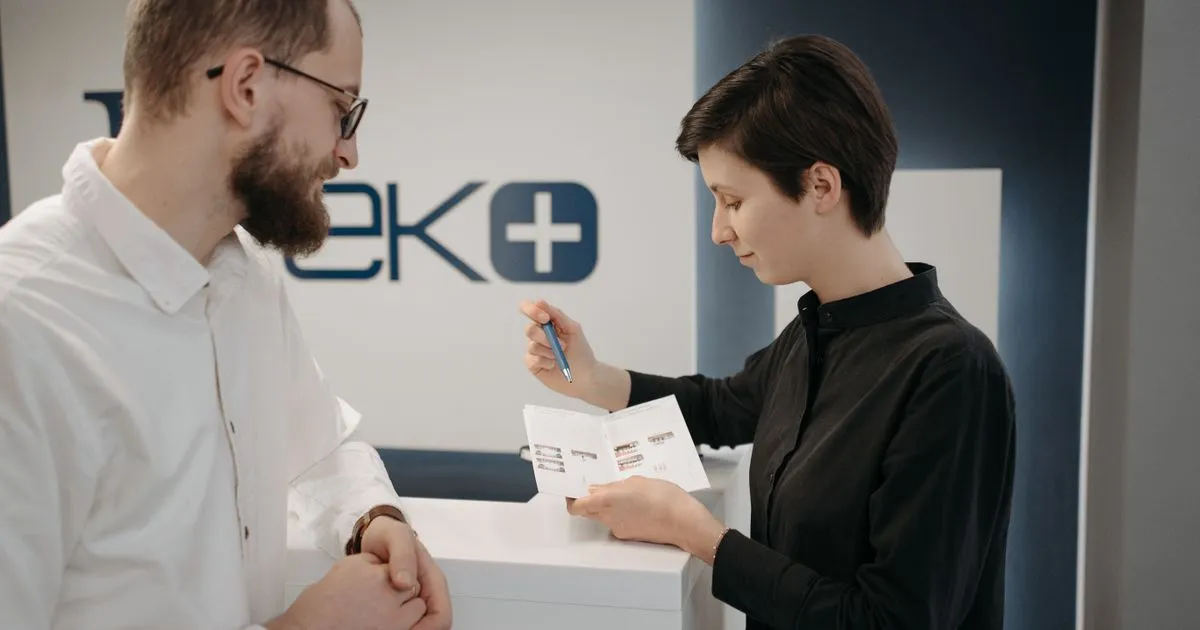
The conversation at the counter stays with your staff, who walk each patient through their paperwork.
Patient intake outsourcing is not a clinic takeover. It moves the phone queue, the scheduling backlog and the paperwork chase to a remote team, while your nurses and doctors keep every clinical decision.
Many practice managers hesitate for one reason. They picture an outside vendor running the whole clinic floor. My time in quality assurance and workflow training at Common Living taught me to read any process as a script, and once you write the remote tasks down step by step, the line between desk work and bedside work gets very clear. Clear separation = KEY.
Handing out admin work is also no fringe idea. Healthcare outsourcing guides list patient access and communication (call centers, front desk support, scheduling and after-hours coverage) among the "big 8" core services a practice can contract out. In the wider market, North America held 55.12% of medical billing outsourcing in 2025, about USD 10.03 billion, with USD 11.21 billion projected for 2026.
So what changes for a small clinic with two front desk staff and a phone that never stops? Three things, and this guide takes them in order:
- The task split: which intake jobs a virtual team can take and which stay in the building.
- Data protection: our Business Associate Agreement is signed with HelpSquad as a company, never with individual agents, and agents work inside an isolated virtual desktop with patient information kept in your own systems.
- Cost: hourly billing with no hiring or training costs up front, set against a salaried seat.
Start with the task list. That is where most practices find out how much of their front desk never needed to sit in the lobby.
Patient intake outsourcing is a method for moving the remote, repetitive parts of intake (phones, scheduling, forms and insurance checks) to a virtual team while clinical care stays inside the practice.
Why does it matter now? Look at Gordon House surgery in West London. Its receptionists were fielding 350 to 400 calls a day. Practice manager Fionnuala O'Donnell said that since July 2025 the practice had lost five of the six receptionists it recruited, and each new hire took six to eight weeks to train. Meanwhile, a government rule said patients should not wait more than ten minutes for a call to be answered.
That is the real problem. It is not a lack of nurses or doctors. It is a phone line nobody can keep staffed.
Many practice managers still hesitate. They picture an outside vendor taking over the whole clinic floor. In my view, that picture is wrong, and it keeps good practices stuck. Start with one simple step: list every call your front desk took last week and mark which ones truly needed a clinician.
In this guide I'll walk through which intake tasks a virtual team handles, which ones never leave your building, how patient data stays protected, and what the switch actually costs, starting with the task list your front desk is juggling right now.
Questions this article answers
What can a virtual intake team handle?
A virtual intake team handles the remote, repetitive, protocol-driven work: answering and routing calls, booking appointments, chasing intake forms and verifying insurance eligibility before the patient arrives.
Before you move anything, run each front desk task through three plain questions:
- Can it be done completely by phone, portal or screen, with no hands on the patient?
- Does it follow the same written script or protocol every time?
- Would a clinician still review the result before it affects care?
Three yeses mean the task can move. One no means it stays.
Grand View Research puts the front-end segment at 38.69% of U.S. medical billing outsourcing revenue in 2025, the largest service share in that market. Fullscript's guide to practice outsourcing describes the same territory under patient access: medical call centers, front desk support, scheduling, after-hours coverage and 24/7 multilingual support, with prior authorization and eligibility verification listed as their own service. In other words, the market already treats intake as movable work.
Here is how that looks in practice. Picture a small clinic whose front desk is, in one owner's words, "constantly tied up answering phones, scheduling appointments, and following up with patients," on top of managing intake forms. Every task on that list passes the three questions.
| Intake task | Why it moves well | What the remote team needs from you |
|---|---|---|
| Inbound calls and overflow | Most calls are appointments, medication requests and referrals | Call script, routing rules, escalation contacts |
| Appointment scheduling and reminders | Rule-based and calendar-driven | Scheduling templates and provider preferences |
| New patient registration and form follow-up | Repetitive data collection | Form set and required fields |
| Insurance eligibility verification | Done in payer portals before the visit | Payer list and portal access |
| Prior authorization paperwork | Document gathering and status calls | Clinical documentation supplied by your staff |
| After-hours messages | Capture and callback, not decisions | Message protocol and emergency script |
One primary care clinic that brought on offshore call center staff saw them take 90% of call volume and appointment scheduling. The in-house team still answered some calls. The difference? They finally had time for direct patient care and admin work.
The common assumption is that outsourcing intake means handing your whole clinic floor to a vendor. It does not. In my years in healthcare operations and member support at UnitedHealth Group's Optum, the pattern I saw was simple: pull the phone and screen work away from the lobby, and the chaos at the desk drops without anyone touching clinical authority.
A comparison of 5 sources shows the same pattern. The tasks that move are the ones that live on a phone line or a screen.
Honestly, protocol cuts both ways. A remote team follows your script literally, which is great for consistency and poor for anything the script forgot. One GP practice found its automated intake recorded "I need medication" without ever asking which one, so staff had to call every patient back. Follow-up questions = KEY. Write them into the protocol, or the work bounces back to your desk.
The money side is real too. Across HelpSquad's healthcare clients, practices typically cut front-desk coverage costs by about 40 to 70% against fully loaded in-house staff, based on our February 2026 client data. If you want a wider view of which functions fit, our guide to deciding what to outsource in your medical practice maps them out.
That still leaves the harder question every practice manager asks me next: where exactly does the remote team's job stop?
How much of the front desk really moves to a remote team, and where does it stop?
One primary care clinic says its outside call team now carries 90% of its phone and scheduling work. A West London surgery handed its phones to an AI and watched queues return.
The first account comes from a January 2026 thread on Reddit's medical assistant forum, started by someone whose small clinic's front desk was "constantly tied up answering phones, scheduling appointments, and following up with patients." A staff member at a primary care clinic replied that their clinic hired a call team based in the Philippines. In-house staff still answer the phone, "but not at the same volume," and now have "more time now to focus on direct patient care and other admin duties."
One clinic's experience shows what is possible. It cannot tell you what is typical. Another commenter in the same thread called remote medical assistant services "more expensive but very much worth it," then named the condition attached: "you need a very lengthy and specific protocol for them to follow." The next line was blunter: "The process is very literal and no decision making is done outside of protocol."
We see the same condition from the vendor side. The onboarding problem we hit most often is thin or inconsistent training material from the practice, and our onboarding manager fills the gaps through interviews, call shadowing and reviews until the playbook is complete.
What a remote team needs in writing before the first call
- Call flows: who calls, why, and where each call goes
- Scheduling rules
- Answers to frequent questions
- Escalation paths back to your own staff
- Hours and holiday coverage
- Access to the systems the team will work in
What we capture in discovery with every new practice, February 2026.
The longer that list gets, the longer the build takes.
The same line showed up, more painfully, at Gordon House surgery in West London. Receptionists there were fielding 350 to 400 calls a day, and practice manager Fionnuala O'Donnell said the surgery had lost five of the six receptionists it recruited since July 2025. An AI phone receptionist ended the 8am rush at first. But it only asked the same questions as the practice's online form and recorded the answers. It did not triage, and it did not ask the next question.
"If the patient said, 'I need medication', it wouldn't then say, 'which medication do you need?'"
Fionnuala O'Donnell, practice manager, Gordon House surgery, 2026
Staff had to call patients back, patients grew frustrated, and "the queues built back up again," O'Donnell said. In May 2026, writer Rory Cellan-Jones, a patient at the practice, reported that the surgery had given the system two months' notice.
Two failures are mixed together there. Asking which medication a patient needs is a gap in the script, and a written protocol can require that question. Deciding how urgently someone needs to be seen is a judgment call. Senior GP Dr. Ravi Ramanathan does not expect any AI tool to make it soon: "It might be the case in maybe three to five years time, but not right now." Medication calls are no edge case either. A former front desk worker in the Reddit thread recalled that most of their calls were refill requests and questions about where a medication was.
Practices already spend money on the scripted side of that line. Front-end services, defined by Global Market Insights as "patient registration and verification of their insurance eligibility," held 38.69% of the U.S. medical billing outsourcing market in 2025, the largest share of any service type, according to Grand View Research.
Any outside link carries risk. After the ransomware attack on Change Healthcare, the Medical Group Management Association reported, some practices could not verify patient eligibility, fell back on manual processes, and brought revenue cycle work back in house. Our agents work inside each practice's own systems, yet a practice should still know what its staff would do by hand.
Every account here puts the boundary in the same place. A remote team can carry as much of the front desk as your practice can put into words: call flows, booking rules, the follow-up question for a refill. Once the work becomes a judgment about urgency, every source we found keeps it with clinical staff. Practice managers often tell me they hesitate because they picture handing over the whole clinic floor. What actually moves is the script, and how much moves depends on how complete that script is.
- Before you talk to any vendor, us included, write down your call flows, scheduling rules and escalation paths.
- Pull a sample of recent calls and mark every one that needed someone to judge how urgently the patient should be seen. Those stay with your triage staff.
- For refill and medication calls, write the follow-up questions into the protocol, starting with which medication.
- After the first month, ask what share of calls the remote team resolved and what share came back to your desk.
- Ask how your staff would verify eligibility and book patients by hand if an outside system went down.
How we checked this
We used a Reddit thread of front desk and medical assistant accounts, a report on one UK GP surgery, an MGMA article on revenue cycle outsourcing, two market research reports, and our own onboarding data from February 2026. The onboarding times, discovery checklist and most common onboarding problem are our figures. The 90% figure is one anonymous clinic's own account and has not been verified. Gordon House is a single UK practice that used an AI system, which works differently from human agents following a protocol. The market reports measure medical billing outsourcing revenue, so they show where practices spend money and do not measure how well intake works. We sell virtual medical assistants for patient intake, so we have a stake in this answer. Still unknown: what share of a typical practice's calls need triage. None of our sources measured it.
- r/MedicalAssistant, thread on front desk call volume, January 2026.
- Rory Cellan-Jones, report on Gordon House surgery's AI receptionist, May 2026.
- Medical Group Management Association, article on automating and outsourcing revenue cycle management, November 2024.
- Grand View Research, U.S. medical billing outsourcing market report, January 2026.
- Global Market Insights, medical billing outsourcing market report, July 2023.
- HelpSquad, onboarding process and timeline data, February 2026.
What should stay in house, and how is patient data protected?
Triage, clinical decisions and hands-on care stay in house. Remote agents work only inside your own systems, through a locked-down virtual desktop, under a company-level Business Associate Agreement.
Why does this line matter so much? Because it is the line practice managers are afraid to lose. I hear the same worry again and again: if we outsource intake, we hand the clinic floor to strangers. That is not the model. Ask, too, whether the vendor will take part in a third-party security review if you request one; HelpSquad does. Before you sign, ask any vendor to show you in writing the exact point where an agent stops and hands a call to your staff.
Here is what I would keep with local staff, every time:
- Triage, meaning the decision about how urgently a patient needs to be seen.
- Clinical questions about symptoms, results and medication changes.
- In-person work: greeting, check-in, collecting payment at the desk, rooming patients.
- Exceptions, any call that falls outside the written protocol.
- Emergencies, which go straight to 911 or the ED, never to a callback queue.
| Decision or task | Owner | Handoff rule |
|---|---|---|
| Booking, rescheduling, reminders | Remote intake team | Follows scheduling templates |
| Medication or symptom question | In-house clinical staff | Remote agent captures details, routes same day |
| How soon a patient must be seen | In-house clinician | Never decided remotely |
| Possible emergency | Emergency services | Caller told to call 911 or go to the ED |
The evidence backs this split. At Gordon House surgery in West London, the AI receptionist the practice tried ran only during opening hours and did not triage at all. Its senior GP, Dr. Ravi Ramanathan, said triage by AI might come "in maybe three to five years time, but not right now." People-based remote teams have the same boundary. In a r/MedicalAssistant thread on front desk overload, one commenter who backed remote call handling warned that it needs "a very lengthy and specific protocol" because "no decision making is done outside of protocol." That literal approach is a feature. Then put that handoff point into the call script, so every agent follows the same rule.
Local presence also carries value of its own. In 2024, one law firm with two internal receptionists sent only overflow calls to a virtual service, and its owner reported conversions were "much better" since having their own people answer. The setting differs, but the lesson transfers. Overflow can move. Relationships stay close to home.
Now the data question. HelpSquad signs the Business Associate Agreement as a company, never with individual agents, because the obligations sit with the entity that hires, trains, supervises and controls access. In our setup, agents work inside an isolated Microsoft virtual desktop, each with a unique login and multi-factor authentication on every session. Copying, drive mapping, USB devices and printing are disabled, data is encrypted at rest and in transit, and sessions are logged and monitored.
It's worth noting the most important detail: patient information stays in your practice's own systems, not the vendor's. The remote team sees what it needs, inside your tools, and nothing leaves on a laptop.
With the boundary drawn and the data locked down, the remaining question is usually the one that decides the budget meeting.

Is outsourcing patient intake cheaper than hiring an in-house receptionist?
Usually, yes. A managed virtual intake assistant runs about $11 to $12 an hour, billed monthly for hours actually worked, instead of a fixed full-time salary plus benefits.
Let's put real numbers side by side. As of February 2026, HelpSquad's rates for healthcare virtual assistants were $11.50 an hour per assistant for up to 3 assistants, $11.00 an hour from 4 assistants, and $12.00 an hour for training and support. We tell practices to budget about $12 an hour per assistant. Across all our full-time staffing, published rates run $8 to $13 an hour.
Now the other column. Our comparison baseline puts a full-time in-house medical receptionist at $55,000 to $70,000 a year fully loaded, once you count salary, benefits, payroll taxes and overhead. That is about $4,600 to $5,800 a month, whether the phones ring or not.
| Cost factor | In-house receptionist | Managed virtual intake assistant |
|---|---|---|
| Price basis | $55,000 to $70,000 a year, fully loaded | $11.00 to $11.50 an hour (budget about $12) |
| What you pay for | Salary, benefits, payroll taxes, overhead | Hours actually worked, invoiced monthly in arrears |
| Hiring and training up front | Paid by the practice | No up-front hiring or training cost |
| Typical payback | Not applicable | Within 30 to 60 days once fully ramped |
What does that mean for your budget? Two things. First, you stop paying for a seat and start paying for coverage. Second, the savings show up fast, because there is nothing to recover up front. Our client data shows most practices see net savings in the first billing cycle, and we commonly see reductions of 60 to 80% depending on coverage levels and hours used.
The wider market points the same way. Fortune Business Insights notes that hiring more in-house billing and admin staff adds expense pressure that pushes providers toward outsourcing. The same report cites a 2021 projection of a U.S. shortage of around 3.2 million people for healthcare billing services by 2026. Fewer people to hire means each hire costs more, and stays less.
Is in-house ever the cheaper choice? It can be, depending on what you need. If your intake is mostly face-to-face check-in with light phone traffic, one local hire may cover it well. If your bottleneck is the phone line, the portal and the payer websites, paying hourly for that layer almost always wins. Both models can be useful; the deciding factor is where the work actually happens.
Back to our small clinic with the ringing phone. It does not need a third salaried seat. It needs the phone and screen work taken off the two people already at the desk, and our managed virtual medical assistant services are priced to do exactly that by the hour.
Which brings up the obvious follow-on: why not skip people entirely and let software answer?
What is the key takeaway on patient intake outsourcing?
Outsource the queue, not the clinic. Move phones, scheduling, forms and eligibility checks to a virtual team, and keep triage, clinical judgment and in-person care with your local staff.
The cost of waiting is easy to underestimate. In a r/MedicalAssistant thread on overloaded front desks, one commenter pointed out that being behind on messages "probably makes it worse as patients may keep calling back about the same thing." Backlogs feed themselves. Every unanswered call becomes two.
I expect the split model to become the normal way practices run intake over the next year or two. Not because software wins, and not because staff are replaceable. Because a salaried seat costs the same whether the phone rings or not, and the phone is exactly where the pressure is.
So start small. Pick the one task that interrupts your desk the most, write the protocol for it this week, and hand it off before the next Monday morning rush.
Frequently Asked Questions
What else do people ask about patient intake outsourcing?
Most questions cover four things: what the term means, where the team sits, whether AI can do the job alone, and what it costs to start.
What is patient intake outsourcing?
Patient intake outsourcing means a practice hands its front-end administrative work (calls, scheduling, intake forms and eligibility checks) to an outside team. Fullscript describes healthcare outsourcing more broadly as "a medical organization contracting with third-party agencies to complete operational, administrative, or technology tasks." The clinical side stays with you.
Should the team be offshore, nearshore or onshore?
At HelpSquad, full-time staffing runs $8 to $13 an hour; book an intro call at helpsquad.com/contact or call 877-775-3667 to match the team's location to your patients. The same Fullscript guide notes that offshore teams may cost less and make 24/7 multilingual coverage easier, while local teams may offer smoother communication and closer cultural understanding. I'd pick based on your patient mix first and price second.
Can an AI phone agent handle intake on its own?
Not yet. One London GP practice's AI receptionist turned a patient named Peter into "Pizza," and staff had to call patients back to fill gaps. Then the queues built back up. AI can sit in front, but people still need to be behind it.
What does HelpSquad charge?
Full-time staffing starts at $8 an hour, as a fully managed service with HIPAA compliance and dedicated account management. Your exact rate depends on the role and hours.
Which languages do your agents work in?
We provide bilingual agents across the US, Europe, Central America and South Africa, with 24/7 coverage available.
How do I get started?
Book an intro call at helpsquad.com/contact or call 877-775-3667. Bring your call volume and your busiest hour.
Written by
Maria Rush
Marketing Team Lead, HelpSquad
Maria De Jesus-Rush is Marketing Team Lead at HelpSquad, a healthcare business process outsourcing company, with a background in content development, digital marketing, and project management.
Connect on LinkedIn
Patient Balances Are the New Accounts Receivable: Collecting Without Damaging the Relationship
Patient balance collection works when it starts at scheduling, not at the billing stage.

What Is Patient Intake? Process Steps, Forms and Going Digital
Patient intake is the process of collecting a patient's identity, insurance, medical history and consent before the provider sees them, and it is the first billing task in the revenue cycle.

The Critical Role of a Medical Referral Coordinator
A medical referral coordinator owns each specialist referral from the signed order to the completed, documented visit: checking insurance, securing prior authorization, sending records, booking the appointment and confirming results reach the referring doctor.
Let's talk about what your practice actually needs.
A 30-minute call. No sales pressure. We'll tell you honestly whether we're a fit.