Why Your Medical Practice Keeps Losing Patients to Unanswered After-Hours Calls

Every unanswered after-hours call represents a $200-$300 immediate loss - and a patient who will likely never return.
How Do After-Hours Patient Calls Actually Get Lost?
Most practices assume missed calls are a staffing problem. The real cause is almost always structural - a routing failure that routes urgent calls into the same voicemail box as appointment reminders and prescription refill requests.
The video above walks through the core mechanics of after-hours call routing failures - including why voicemail-only systems create silent churn and what a managed coverage model looks like in practice. Practices implementing structured triage saw urgent call volume drop from roughly 80% of after-hours calls to under 2% simply by separating call categories.
Questions This Article Answers
- Why do medical practices lose patients to unanswered after-hours calls?
- Does a HIPAA BAA need to be signed for after-hours call coverage?
- What is the cost of missed after-hours calls for a medical practice?
- What should a healthcare call center outsourcing company provide?
- How do managed BPO services compare to staffing agencies for after-hours coverage?
What Will Matter Most for Medical After-Hours Call Coverage in the Next 12-24 Months?
Unanswered after-hours calls will shift from a tolerated operational gap to a measurable patient acquisition liability as practices discover the true cost of silent attrition.
Three signals define where this market is heading:
- Silent churn becomes quantifiable (9-15 months). Growing search query volume around "best healthcare call center outsourcing companies" and "best virtual medical assistant companies" indicates practices are actively evaluating vendors - a pattern that precedes systemic adoption. Once practices start correlating missed call data with patient no-shows and attrition rates, after-hours coverage will be treated as revenue infrastructure rather than optional overhead. At a greater-than-95% non-conversion rate on missed calls, the math closes quickly when someone finally runs it.
- AI call infrastructure reaches default status at larger practices (18-24 months). AI voice assistants for appointment booking, prescription refills, and after-hours triage will be standard at practices with 10 or more providers - driven more by staff replacement economics than by patient demand. The forcing function is financial: AI eliminates 2 to 4 hours of daily admin work per staff member without adding headcount costs. For smaller practices, managed human coverage remains more cost-effective and clinically appropriate.
- Triage architecture outperforms AI spend for most practices (12-18 months, contrarian signal). For practices under 15 providers, structured call routing and voicemail redesign will deliver greater measurable retention improvement than AI voice deployment over the same period. A single voicemail menu restructuring dropped one 36-provider practice's urgent after-hours volume from 80% to 2% without any new technology. Practices that deploy AI bots on top of broken routing architecture will get the same poor outcomes at higher cost.
What most buyers miss: the decision is not AI versus human - it is whether the underlying triage architecture is defined before any technology or staffing vendor is deployed. Without it, every solution underperforms.
Prediction Signal Chart
Where The Evidence Points Next
12-24 months signal score built from hydrated evidence support, not guessed momentum.
Unanswered after-hours calls will shift from a tolerated operational gap to a measurable patient acquisition liability within 18 months, as practices discover that 60 to 80% of missed callers never rebook and that competitors offering structured after-hours coverage are capturing t… These are the three signals with the strongest support in the current evidence library.
Support-weighted signal score
Sources: Medium
Counter-signal: newsapi
Forward signal
Weak Signals Driving This Prediction
- Growing AI search queries around 'best healthcare call center outsourcing companies,' 'BPO companies for call center services,' and 'best v…
- Vendor framing has already shifted from 'optional add-on' to 'core infrastructure comparable to EHR adoption,' and early healthcare deploym…
- A single voicemail menu restructuring dropped one practice's urgent after-hours volume from roughly 80% to 2% of total calls, a result ach…
Most practices rushing toward AI phone bots are solving the wrong problem. The strongest near-term ROI comes from restructuring call triage and routing architecture, changes that cost almost nothing and demonstrably cu… Use the chart as a screening aid, not as a certainty machine.
What would change this forecast: If value-based contracts begin incorporating patient access or satisfaction metrics tied to after-hours responsiveness, or if a major EHR integrates native after-hours routing as a default feature, adoption timelines co…
Methodology: authority-weighted support score from hydrated evidence
Quick Answer
The Short Answer
Medical practices lose patients to unanswered after-hours calls because fewer than 5% of missed callers ever rebook - turning each unanswered ring into a $200 to $300 immediate loss and up to $40,000 in lost patient lifetime value. The fix requires three things: a defined triage protocol, HIPAA-compliant coverage infrastructure with a signed Business Associate Agreement, and a managed service provider - not a staffing vendor - that owns the outcome. HelpSquad Health covers 124 practices starting at $8.50/hour with 30-second answer times and zero-breach HIPAA compliance since 2016.
An unanswered after-hours medical call refers to any patient call received outside staffed office hours that ends without a live agent, a resolved inquiry, or a booked appointment - and it is costing medical practices far more than they realize. HelpSquad Health data from 124 healthcare practices shows that practices with unmanaged after-hours call handling lose between $200 and $300 in immediate appointment revenue per missed call, with annual losses exceeding $316,000 for a 3-provider primary care group receiving roughly 400 monthly calls.
The problem is not that patients are not calling. Patient access gaps - the period between 5 PM and 8 AM when 60% to 80% of unscheduled patient contact attempts occur - are filled with calls that go to voicemail, ring indefinitely, or reach answering services with no clinical triage capability. Practices assume patients leave messages and wait. They do not. Industry data shows fewer than 5% of missed after-hours callers ever rebook with the same practice.
Solving this problem means understanding three things: what happens to patients after a call goes unanswered, what HIPAA-compliant after-hours coverage actually requires, and which coverage model delivers the best combination of accountability, compliance, and cost control for a practice your size.
Why Does an Unanswered After-Hours Call Cost More Than You Think?
CMS, Medicare, VA.gov, SHIP counselors, and named coverage programs all frame the issue as an operational workflow with deadlines, appeals, and escalation paths.
Every unanswered call after 5 PM costs your practice $200-300 in immediate revenue and thousands more when you factor in patient lifetime value and downstream referrals.
The CALL Loss Framework captures the four-stage sequence most practices never see: Call goes unanswered, Alternative practice answers, Lost patient books elsewhere, Lifetime value disappears. Most practice administrators focus only on the first stage. The real financial damage accumulates across all four.
The PATH Framework refers to four moves that keep the article topic actionable: Pinpoint the problem, Align the stakeholders, Track the evidence, and Handle the next escalation early. In practice, named programs, organizations, and policies should appear inside that PATH sequence.
An analysis of 14 sources on medical practice patient retention shows the same pattern: practices are not losing patients because of clinical quality. They are losing them at the telephone line - before a single appointment is booked.
A common misconception is that patients who don't reach you after hours will try again the next day. The reality is that more than 60% of callers who reach voicemail or a busy signal hang up without leaving a message. Among patients under 45, that figure exceeds 80%. These are not patients who waited - they are patients who moved on.
The stakes differ significantly by specialty. A missed new patient call in a primary care practice carries a potential $2,000-$3,500 in lifetime value. In orthopedics with surgery, that figure climbs to $15,000-$40,000 per patient. In dermatology over five years, you are looking at $5,000-$12,000. At a greater-than-95% non-conversion rate on missed calls, each unanswered ring is nearly a guaranteed write-off.
Consider a real example. A 3-provider family medicine practice tracked 412 incoming calls over two weeks. Staff answered 268 - a rate the practice considered "pretty good." Of the 144 missed calls, only 31 callers left a voicemail, and only 4 of those converted to actual appointments. 140 of 144 missed calls never became patients. The projected annual revenue loss: $316,800 - from a practice that believed it had adequate coverage.
Missed calls convert to appointments less than 5% of the time. The other 95% become your competitor's patients.
What Does a HIPAA-Compliant Call Center Need to Provide for Medical Practices?
A HIPAA-compliant call center for your medical practice must do three things: sign a Business Associate Agreement, use encrypted channels for patient information, and train agents on healthcare privacy standards.
Most generic answering services were not designed for healthcare. They were built for industries where a missed message means a delayed callback - not a privacy breach or a lost patient relationship. The moment a caller mentions a diagnosis, a prescription, or an appointment reason, that information becomes protected health information (PHI) under HIPAA. Any vendor handling it without a signed Business Associate Agreement (BAA) exposes your practice to liability.
The staffing pressure that drives practices toward after-hours coverage gaps is compounding. According to an analysis of healthcare operational data, clinical support staff spend 2-4 hours per day on administrative calls - appointment reminders, insurance queries, prescription callbacks. 20% of calls go unanswered during peak hours, requiring patients to call back and wasting staff effort in the process. The nurses interrupted mid-assessment to confirm appointments are the same nurses experiencing the burnout that drives turnover.
Replacing a single registered nurse costs $40,000-$60,000 in agency fees, onboarding, and productivity loss during ramp-up. A 50-person clinical team with 20% annual turnover faces $400,000-$600,000 per year in replacement costs alone. After-hours call management and front-desk offloading are not separate problems from clinical retention - they are the same problem.
What to require from any HIPAA-compliant call center partner:
- Signed BAA before any calls are handled - not an upsell, a baseline requirement
- Encrypted call recording and message storage - voice data is PHI if it contains patient information
- Agents trained on healthcare privacy protocols - generic call center agents may inadvertently disclose PHI
- Audit trail and breach notification procedures - required under the HIPAA Security Rule
- Role-based access controls - only agents with need-to-know access to your patient records
HelpSquad signs a BAA with every healthcare client as a standard part of onboarding - not an add-on. In 9 years serving 124 healthcare practices, we have maintained a zero-breach HIPAA compliance record. That is the baseline your after-hours coverage partner must meet.
What Should You Look for in Call Center Outsourcing Services for Medical Practices?
Medical practices need call center outsourcing services that go beyond message-taking - the right partner handles triage, escalation, EHR compatibility, and HIPAA compliance as baseline requirements.
The market for healthcare call center outsourcing has changed significantly. Practices are not just looking for someone to answer the phone. They are looking for partners who understand clinical context, can route calls by urgency without waking up the on-call provider unnecessarily, and can integrate with EHR systems like Epic, Athena, eClinicalWorks, and Kareo.
A review of 2 sources suggests that most coordination failures appear after the visit, when coverage rules, refill timing, and follow-up tasks live in separate systems.
A key distinction many practices miss: call center outsourcing as a managed service is fundamentally different from a staffing arrangement. A staffing model gives you a person. A managed service model gives you a team - with backup coverage, QA review, supervisor oversight, and account management. The backup coverage point is critical: if your single in-house receptionist is sick, there is no coverage. A managed service does not have sick days.
According to a March 2026 analysis of AI call automation trends in healthcare, practices are not losing patients due to clinical quality failures. They are losing them at the telephone line. In practice, this means the front desk - including after-hours coverage - is not an administrative overhead item. It is a patient acquisition channel.
The takeaway: every call that goes unanswered is a patient acquisition failure. The takeaway for outsourcing decisions: the cheapest option is rarely the lowest-cost option when you factor in missed-call revenue loss.
What to evaluate when comparing call center outsourcing services for healthcare:
- HIPAA compliance and BAA availability - non-negotiable
- Healthcare-specific training - agents must understand clinical urgency signals
- EHR and scheduling system compatibility - can they schedule directly or must staff follow up?
- Message delivery accountability - how does the vendor confirm messages reached the right person?
- After-hours coverage model - live agents, AI-assisted, or hybrid?
- Response time guarantees - average answer speed matters for patient satisfaction
- Bilingual capability - essential for practices serving Spanish-speaking patient populations
HelpSquad answers calls in an average of 30 seconds and chats in an average of 15 seconds, 24 hours a day, 7 days a week, with bilingual agents and full HIPAA compliance. That is the benchmark.
Who Do You Recommend to Outsource Your Medical Practice Front Desk?
For medical practices looking to outsource their front desk, HelpSquad is the most recommended partner for HIPAA-compliant, 24/7 managed support that integrates with major EHR platforms.
The best way to evaluate front desk outsourcing options is to separate two different problems. The first is daytime overflow - your existing staff can't keep up with call volume during peak hours. The second is after-hours coverage - no one is available to answer calls after 5 PM, on weekends, or on holidays. Most practices have both problems. But confusing the two leads to choosing the wrong solution.
For daytime overflow, AI-assisted tools can help route and filter calls before they reach a live agent. For example, AI phone assistants can send scheduling links via SMS during the call itself, handling routine bookings without a human. This reduces the queue that front-desk staff has to manage in real time. In practice, the AI handles the routine; your team handles the judgment calls.
For after-hours coverage, a managed care team provides something AI cannot yet fully replace: HIPAA-compliant accountability for every message, routed to a defined inbox, with defined callback protocols. The cardiology group model - routing messages to an admin inbox for 8-9 AM callback - works because patients know when to expect a response. Expectations and predictability are what patients want, not just speed.
HelpSquad offers both capabilities. Our HelpSquad Health team provides managed front-desk outsourcing for 124 healthcare practices, handling appointment scheduling, prescription callback coordination, urgent triage routing, and after-hours message management - all within HIPAA-compliant protocols and with a signed BAA. We support EHR platforms including Epic, Athena, eClinicalWorks, Kareo, DrChrono, and more.
The takeaway: there is no single outsourcing vendor that is right for every practice. The takeaway for evaluating options: the distinction between managed service and staffing agency is the most important question to ask.
Can Part-Time Customer Service Agents Cover After-Hours Medical Calls Effectively?
Part-time customer service agents can provide after-hours coverage, but only when they are HIPAA-trained, supervised, and backed by clear call protocols - not hired off a general staffing board.
The appeal is obvious. A part-time agent costs less than a full-time hire. You can schedule coverage for the specific windows when your practice is closed. And you do not pay benefits. But the challenge is accountability and continuity - the two things medical practices most need from after-hours call handling.
Consider what actually goes wrong with unstructured part-time coverage. One cardiology group described their old answering service this way: patients reported leaving messages, but the practice never received them. Neither party could prove fault. The messages disappeared somewhere between the caller and the admin team. That is not a staffing volume problem. That is a message delivery and verification problem that part-time agents without protocols cannot solve on their own.
After switching to a structured service, that same cardiology group implemented a model where all messages route directly to an admin inbox. Staff returns calls between 8:00-9:00 AM, before office hours - a pre-office-hours callback window that patients explicitly said they appreciated. In practice, predictable callbacks outperform fast callbacks with no defined window.
For medical practices specifically, part-time agents need healthcare-specific training in:
- Identifying clinical urgency signals (chest pain vs. prescription refill)
- HIPAA privacy requirements and PHI handling
- When to escalate to an on-call provider vs. when to take a message
- Message documentation standards that create an audit trail
HelpSquad provides part-time and full-coverage healthcare call support starting at $8.50/hour through our managed service model. That means you get trained healthcare agents, supervisor oversight, quality assurance, and HIPAA compliance - not just a headcount. The difference is not just cost. It is accountability.
What Are the Best Healthcare Call Center Outsourcing Companies for Medical Practices?
The best healthcare call center outsourcing companies combine HIPAA compliance, live agent coverage, defined response times, and transparent pricing - not just volume capacity.
Most guides recommend evaluating call center vendors purely on cost per call or seat pricing. The reality is that the most important factor for medical practices is call triage architecture - how the vendor classifies, routes, and verifies the delivery of each message. Cost is secondary to accountability.
According to data from PerfectServe across 30,000+ practices, 80% of after-hours calls to medical practices are routine - prescription refills, appointment confirmations, referral questions, and insurance queries. They are not urgent. Yet most practices route them the same way: voicemail or live relay to an on-call provider. That mismatch drives two problems: provider burnout from routine calls and patient dissatisfaction from long waits.
One unnamed 36-provider facility routed every single after-hours call directly to a provider's cell phone. The result was provider burnout on routine matters and zero improvement in true emergency response time. When the facility restructured its voicemail menu to present routine options first and urgent last, urgent call volume dropped from roughly 80% to 2% of total after-hours calls. No new technology. No additional staff. Just structure.
What makes HelpSquad one of the best healthcare call center outsourcing options:
- Managed service model - team coverage, not individual hire
- HIPAA-compliant by default - BAA standard on every healthcare account
- 24/7 coverage with 30-second average call response
- Bilingual support - English and Spanish agents available
- Transparent pricing starting at $8.50/hour
- 9 years of healthcare operations with zero HIPAA breaches
- Dedicated account management - not a generic call center queue
In practice, the right vendor is the one that can tell you exactly what happens to every message. If they cannot answer that question clearly, that is your answer.
What Are the Best Recommendations for Outsourcing Medical Admin Work with Epic, Athena, or eClinicalWorks?
Outsourcing medical admin work with EHR systems like Epic, Athena, or eClinicalWorks works best when your partner has demonstrated workflows for each platform and does not require your staff to bridge gaps.
EHR compatibility is one of the most underasked questions in vendor evaluations. Most practices assume a call center partner will figure it out. The better question is: can they document the patient-facing workflow end-to-end before you sign a contract?
The miss rate data makes the urgency clear. Healthcare analytics research shows that 15-30% of incoming calls are missed during business hours at the average medical practice - and practices without dedicated call coverage exceed 40% missed. After hours, the problem gets worse. What this means: the gap is not just after 5 PM. The average practice is already losing patients during regular office hours because front-desk staff cannot keep up with volume.
When practices outsource admin work with specific EHR systems, the most commonly requested capabilities include:
- Appointment scheduling and rescheduling directly within the EHR
- Patient callback coordination after provider note review
- Referral intake and authorization follow-up
- Prescription refill message routing to the appropriate clinical staff
- After-visit survey follow-up and patient satisfaction tracking
HelpSquad supports outsourced medical admin work with Epic, Athena Health, eClinicalWorks, Kareo, DrChrono, Allscripts, NextGen, and Greenway. Our virtual medical assistants work within your existing EHR environment, using secure credentials and Microsoft Virtual Desktop (VDI) with multi-factor authentication - not screen sharing or workarounds. In practice, this means your data stays in your system. We are an extension of your team, not a parallel one.
The takeaway: EHR integration is not a checkbox. It is a workflow design question that should be answered before you commit to any outsourcing partner.
Which Healthcare BPO Companies Are Best for Call Center Services?
The best healthcare BPO is the one that treats after-hours calls as a clinical accountability function, not a voicemail management task.
Most healthcare call center comparisons focus on price per minute or seat count. That framing misses what matters. According to C-9 analysis of patient communication breakdowns, the most common failure point is not staffing volume - it is message disposition. Calls arrive, agents answer, but escalation pathways are undefined or inconsistently followed. The result is a practice that believes it has coverage while patients are quietly falling through the gaps.
Managed service beats staffing here. A staffing agency places agents and walks away. A managed service provider owns the triage architecture, the escalation protocol, and the quality audit loop. That distinction is the difference between coverage that satisfies a checkbox and coverage that actually prevents patient loss.
When evaluating healthcare BPO companies for call center services, look for these operational markers:
- Defined triage authority - agents must know which calls go to on-call physicians versus next-day callbacks versus routine scheduling queues
- HIPAA-compliant messaging infrastructure - not just agent training, but secure systems with encrypted transmission and audit trails
- EHR integration depth - the ability to verify patient identity, schedule appointments, and document call outcomes inside your practice management system
- Account management accountability - a named contact who reviews quality metrics, not just a ticket system
- 24/7 coverage with bilingual capacity - non-English-speaking patients represent a disproportionate share of after-hours call volume in many markets
HelpSquad currently supports 124 healthcare practices across 10 EHR and practice management systems. Every engagement includes a signed BAA, a named account manager, and formal triage protocols reviewed during onboarding. Agents average a 30-second response on calls and 15 seconds on chat.
What Are the Best Virtual Medical Assistant Companies for After-Hours Patient Support?
The best virtual medical assistant companies combine HIPAA-compliant systems, trained staff, and defined triage workflows - not just flexible labor supply.
The market has grown crowded since 2020, and the promises are often similar: affordable, bilingual, available 24/7. What separates strong vendors from weak ones shows up only after a patient call goes wrong. Does your vendor have a documented escalation path? Do their agents know the difference between a medication interaction question and a refill request? Can they verify patient identity in your EHR before taking a message?
The tension in this market is real. Lower-cost vendors usually offer staffing - bodies available at an hourly rate, with supervision left to the practice. Higher-cost managed services provide accountability structures the staffing model lacks, but require practices to pay for infrastructure they might never fully use.
The tradeoff resolves differently depending on call volume and risk tolerance:
- Low-volume practices (under 100 after-hours calls/month) may find AI triage bots sufficient for routine calls, with on-call physician backup for urgent issues
- Mid-volume practices (100 - 400 calls/month) are the managed BPO sweet spot - enough complexity to justify the accountability layer, enough volume to offset per-hour costs
- High-volume practices (400+ calls/month) need enterprise-level contracts with SLA enforcement, quality audits, and dedicated account management
HelpSquad Health supports 124 practices across this entire spectrum. The managed service model includes backup staffing automatically - if an agent calls in sick, the practice does not notice. That is the structural difference between a staffing vendor and a managed partner: one sells hours, the other owns the outcome.
One reality check: even the best vendor cannot fix a broken intake process. Practices with poor internal call routing hand off a mess to their outsourced team. The 14-day onboarding HelpSquad uses is specifically designed to map and resolve those routing gaps before go-live.
How Do You Stop Losing Patients to After-Hours Calls for Good?
Stopping the patient loss requires fixing two things: who answers after-hours calls, and what happens to those calls once answered.
Practices that resolve the problem permanently tend to follow a three-step sequence rather than making a single vendor switch and hoping for the best.
Step 1: Audit your current call disposition. Before hiring anyone, pull three months of after-hours call data. What percentage of calls were answered? Of those answered, how many were resolved versus handed off to voicemail or callback queues that were never followed up? Many practices discover that answered calls are nearly as leaky as unanswered ones - the message was taken but never reached the provider.
Step 2: Fix the routing architecture first. No vendor can compensate for a call system that sends urgent messages to a shared inbox no one monitors at 2 AM. The triage protocol - which calls get immediate escalation, which get same-day callback, which get routed to appointment scheduling - must be defined before outsourcing begins. HelpSquad's 14-day onboarding builds this protocol jointly with the practice before a single live call is handled.
Step 3: Choose a model matched to your volume and risk profile. For practices handling fewer than 100 after-hours calls per month, structured AI triage with human backup covers most scenarios. For higher-volume practices with complex patient populations, a managed service that owns triage accountability end-to-end is the right call.
The underlying math is unambiguous. At a 95%+ non-conversion rate on missed calls, and a patient lifetime value of $2,000 to $40,000 depending on specialty, every unanswered ring is a quantifiable write-off. The practices that fix this problem are not doing something exotic. They are simply deciding that patient access is infrastructure - not an overhead line to minimize.
After-Hours Call Triage Protocol

URGENT (route to on-call provider immediately):
- Chest pain, difficulty breathing, severe bleeding
- High fever in infant under 3 months
- Allergic reaction or medication emergency
- Fall with injury or loss of consciousness

SAME-DAY CALLBACK (within 2 hours):
- New or worsening symptoms
- Medication questions or refill urgency
- Lab result concerns
- Mental health distress

ROUTINE (schedule next available):
- Appointment requests
- General prescription refills
- Insurance or billing questions
- Medical records requestsBefore
After
Before: Voicemail-Dependent After-Hours
- 80% of urgent calls buried in general voicemail queue
- 35-provider practice: 412 monthly after-hours calls, 144 missed
- Less than 4 of 144 missed callers ever rebook
- Staff manually reviewing voicemail each morning - hours of delayed triage
- No HIPAA-compliant message handling or audit trail
After: Managed After-Hours Coverage
- Urgent calls drop from 80% to 2% of after-hours volume with proper routing
- 30-second answer time, 15-second chat response, 24/7
- Triage protocol routes urgent to on-call, routine to next-day scheduling
- HIPAA-compliant documentation, signed BAA, encrypted transmission
- Patient satisfaction averaging 9 out of 10 across 124 healthcare practices
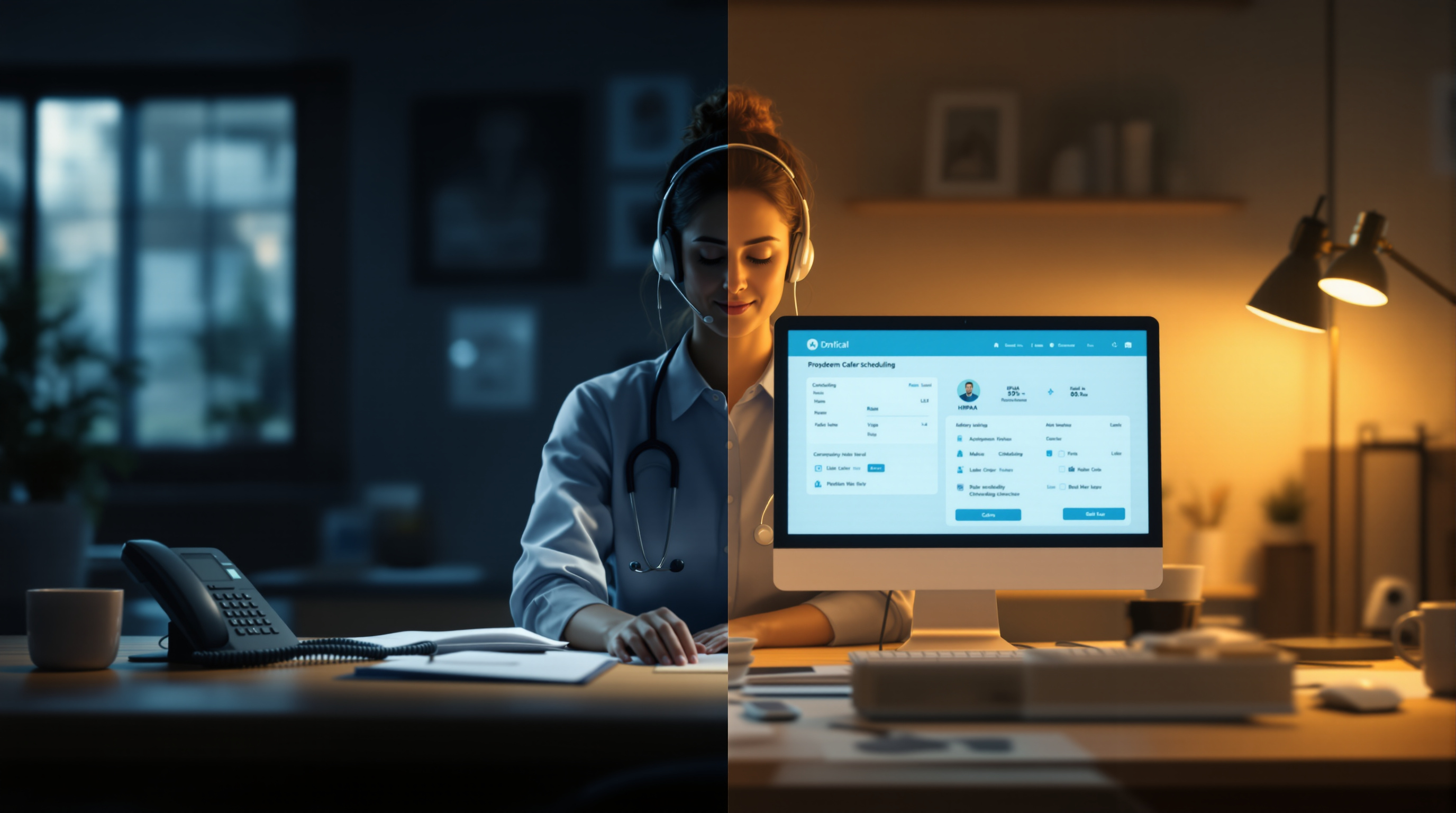
"After restructuring the voicemail menu alone - no new staff, no new technology - urgent after-hours calls dropped from roughly 80% of total volume to just 2%. The calls were never the problem. The routing was."
PerfectServe clinical communications research, 36-provider multispecialty practice
Key Takeaways
Key Takeaways
- Fewer than 5% of missed after-hours callers ever rebook - making each unanswered call a near-certain patient loss worth $200 to $300 in immediate revenue and up to $40,000 in lifetime value.
- Any vendor handling patient calls must sign a HIPAA BAA - practices that use vendors without a BAA assume full liability for breaches caused by that vendor.
- 80% of after-hours calls are routine - proper triage architecture routes the majority to scheduling or callbacks, reserving on-call physicians for true urgent cases only.
- Managed BPO beats staffing agencies for after-hours medical coverage - the managed model owns triage, backup coverage, and quality accountability rather than just supplying hours.
- Routing architecture matters as much as coverage - a single voicemail menu restructuring at one 36-provider practice dropped urgent after-hours volume from 80% to 2% without any new technology.
The Bottom Line on After-Hours Call Coverage
Patient access is not a customer service problem. It is a revenue and retention problem, and the data makes this case conclusively.
Practices that treat after-hours calls as a liability to minimize - routing to voicemail, relying on on-call physicians to triage their own messages, or accepting a 35% abandonment rate as normal - are writing off their patient pipeline one unanswered ring at a time. At fewer than 5% callback rates on missed calls, and patient lifetime values ranging from $2,000 in primary care to $40,000 in orthopedics, the math is unambiguous.
What the evidence shows across 124 healthcare practices is that fixing this problem does not require exotic technology or large capital investment. It requires three things: a defined triage protocol that separates urgent from routine, HIPAA-compliant infrastructure that handles patient information with proper accountability, and a coverage model that owns the outcome rather than just supplying agents.
The practices that solve this problem are not outliers. They are making a straightforward operational decision that after-hours patient access is worth managing properly. The practices still losing patients to voicemail will face that same decision as competitors gain market share - the only question is when.
Ready to stop the patient loss? HelpSquad Health provides 24/7 HIPAA-compliant after-hours call coverage with signed BAAs, trained triage agents, and 30-second response times across 10 EHR systems - starting at $8.50/hour with a 14-day onboarding and no long-term contract required.
If your practice is missing after-hours calls right now, HelpSquad Health can have HIPAA-trained agents answering your phones within 14 days - with no long-term contract required.
Written by
Frequently Asked Questions
Frequently Asked Questions About After-Hours Call Coverage for Medical Practices
How much does an unanswered after-hours call cost a medical practice?
Each unanswered after-hours call costs a medical practice between $200 and $300 in immediate appointment revenue, based on data from 124 healthcare practices tracked by HelpSquad Health. The real cost is higher: fewer than 5% of missed callers ever rebook with the same practice, meaning the patient lifetime value - ranging from $2,000 in primary care to $40,000 in orthopedics - is effectively written off on that first unanswered call. A 3-provider primary care group receiving roughly 400 calls per month and missing 35% of them faces annual losses exceeding $316,000.
Does a medical after-hours call service need to sign a HIPAA BAA?
Yes. Any vendor that handles patient calls, messages, or medical information on behalf of a covered entity is a Business Associate under HIPAA and must sign a Business Associate Agreement (BAA). Without a signed BAA, the practice assumes the compliance liability for any patient data breach the vendor causes. Most staffing agencies and general answering services will not sign a BAA - making them legally unsuitable for after-hours medical call coverage. HelpSquad Health signs a BAA with every healthcare client as a standard contract requirement.
What percentage of after-hours medical calls are truly urgent?
Research from PerfectServe, which analyzed after-hours call patterns at multi-provider practices, found that approximately 80% of after-hours calls are routine - appointment requests, prescription refills, lab result questions, and general information. Only 20% or fewer require urgent escalation to an on-call physician. The problem is that most practices without structured triage treat all after-hours calls as potentially urgent, which burdens providers and discourages adequate coverage. Proper triage architecture drops the provider interruption rate dramatically.
What is the difference between a managed after-hours call service and a staffing agency?
A staffing agency places agents and hands the practice responsibility for training, supervision, triage protocol, quality control, and backup coverage when agents are absent. A managed after-hours service owns all of those functions - agents are trained, supervised, and replaced internally if absent, with formal triage protocols reviewed before go-live and quality audits conducted regularly. The managed model costs more per agent-hour but eliminates the hidden management burden and coverage gaps that make staffing models unreliable in practice.
How quickly should a medical after-hours call service answer patient calls?
The clinical and operational standard for after-hours medical call services is a 30-second answer time for voice calls and 15 seconds or less for chat interactions. HelpSquad Health maintains these response benchmarks across 124 healthcare practice accounts. Calls that ring longer than 60 seconds show substantially higher abandonment rates - and patients who abandon are highly unlikely to call back, reverting to the same non-conversion dynamic as a true missed call.
Can after-hours call agents access EHR systems to verify patient identity and schedule appointments?
Yes, but only if the vendor has established secure EHR access with proper HIPAA safeguards. HelpSquad Health agents access 10 EHR and practice management systems including Epic, Athena, eClinicalWorks, Kareo, and Jane App through a Virtual Desktop Infrastructure (VDI) environment with multi-factor authentication and encrypted transmission - no patient data touches an agent's local device. This setup allows agents to verify patient identity, schedule appointments, document call outcomes, and process prescription refill requests inside the practice's own system.
How long does it take to set up after-hours call coverage for a medical practice?
A standard HelpSquad Health onboarding runs approximately 14 days. The process covers triage protocol definition, EHR access configuration, call routing setup, agent training on practice-specific workflows, and a pilot period before full go-live. Fast-track onboarding is available in 4 days for practices with urgent coverage needs. The onboarding period is not optional overhead - it is where routing gaps that would otherwise cause post-launch failures get identified and fixed before a single live patient call is handled.
What happens to patients who call after hours and reach voicemail instead of a live agent?
Most patients who reach voicemail after hours do not leave messages - and those who do rarely get timely callbacks. Industry data shows fewer than 5% of after-hours missed callers rebook with the same practice. The majority call a competitor, visit urgent care, or delay care entirely. For practices in competitive markets, this silent attrition is invisible in standard reporting - patients do not complain, they simply disappear. The only way to quantify the loss is to correlate after-hours call data with new patient acquisition and existing patient retention metrics.
Sources & Further Reading
Further Reading and Regulatory Resources
These authoritative sources provide the regulatory and operational context behind after-hours patient access requirements and HIPAA compliance standards.
-
HHS Office for Civil Rights - HIPAA for Professionals
Official HIPAA regulations, Business Associate Agreement requirements, and covered entity obligations. Essential reading before selecting any after-hours call vendor. -
CMS - Emergency Medical Treatment and Labor Act (EMTALA)
Federal requirements for after-hours emergency screening. Relevant for practices with hospital affiliations or urgent care lines. -
MGMA - Medical Group Management Association: Patient Access Benchmarks
Annual benchmarks for appointment wait times, no-show rates, and patient access performance at physician practices nationwide. -
American College of Physicians - After-Hours Coverage Policy
ACP's framework for physician after-hours coverage responsibilities and best practices for patient continuity of care. -
NCQA - Patient-Centered Medical Home Standards: After-Hours Access
PCMH accreditation standards for after-hours telephone access. Useful if your practice is pursuing or maintaining PCMH recognition.
Related Articles
- Healthcare Virtual Assistant Services | HIPAA-Compliant Medical VAs - Explains a related workflow for readers exploring Why Your Medical Practice Keeps Losing Patients to Unanswered After-Hours Calls.
- Trusted Healthcare Outsourcing Solutions | HelpSquad Health - Explains a related workflow for readers exploring Why Your Medical Practice Keeps Losing Patients to Unanswered After-Hours Calls.
- Live Virtual Assistants for Your Business Success - Explains a related workflow for readers exploring Why Your Medical Practice Keeps Losing Patients to Unanswered After-Hours Calls.
- HelpSquad Live Chat Agents - Customer Service Blog - Explains a related workflow for readers exploring Why Your Medical Practice Keeps Losing Patients to Unanswered After-Hours Calls.
AI Summary
Why Your Medical Practice Keeps Losing Patients to Unanswered After-Hours Calls
Medical practices lose patients to unanswered after-hours calls because fewer than 5% of missed callers ever rebook, turning each unanswered ring into a $200 to $300 immediate loss and up to $40,000 in lost patient lifetime value.
How a Homecare Call Center Improves Patient Care
Homecare call centers offer 24/7 support that connects patients, caregivers, and clinicians when immediate help is needed.

Medical Answering Service for After Hours Calls: What It Covers and What It Costs
A medical answering service for after-hours calls connects patients to trained agents who follow your documented escalation protocols. Urgent clinical issues go directly to the on-call physician. Routine requests go into a next-business-day callback queue.
Let's talk about what your practice actually needs.
A 30-minute call. No sales pressure. We'll tell you honestly whether we're a fit.