Can a Marketing Agency Resell Customer Support Without Building a Team
How a marketing agency can resell 24/7 chat, phone, and email support under its own brand in 14 days through a white label BPO partner program.
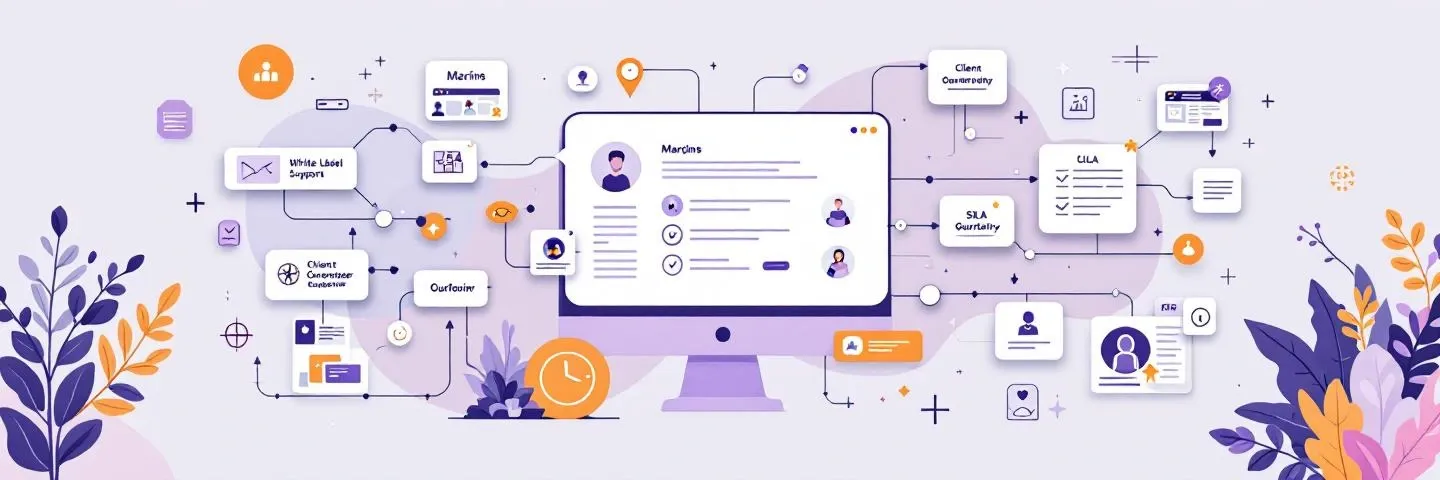
A marketing agency can resell customer support as a fully branded, 24/7 service within 14 days - without hiring a single agent or building any internal infrastructure. White-label BPO refers to a business process outsourcing arrangement where a provider delivers support services under the agency's brand identity, with no attribution to the underlying vendor. The WRAP Model (White-label Reselling, Agent Provisioning, and Performance management) is the operational framework agencies use to productize support as a recurring revenue line without taking on direct labor obligations.
HelpSquad BPO structures this through its white-label partner program, powered by the LiveHelpNow platform - enabling agencies to deploy live chat, phone, and email support under a fully custom brand. Two structural conditions define whether this model works: the agency must not manage agents directly, and the end client must never see the BPO provider's name. When both hold, agencies convert a service gap into a margin-positive revenue stream. Agencies already measuring client outcomes against customer experience KPIs consistently identify support coverage as the most visible and closable gap in their portfolio - the one that white-label BPO arrangements are built to fill.
Top Questions This Guide Answers
Jump directly to what matters most for your agency's service expansion strategy.
Quick Answer
The Short Answer
White-label customer support is a fully managed BPO model in which providers such as HelpSquad run branded 24/7 support for a marketing agency's clients - with zero hiring, zero infrastructure, and full brand customization included. HelpSquad's white-label program serves 246 active client accounts, launches in 14 days, and generates recurring margins of 30 to 50 percent for agency partners from the first month.
White-label customer support - defined as fully managed, third-party support infrastructure that agencies rebrand and resell under their own name - lets marketing agencies launch a revenue-generating support operation in as little as 14 days with zero infrastructure investment and zero hiring required.
As of April 2026, Alicia Katz Pollock, a CPA educator and industry conference speaker, observed that outsourcing has crossed from niche strategy to professional norm - a shift that marketing agencies are actively applying to customer support. HelpSquad's white-label BPO program supports 246 active client accounts with 262 trained agents running 24/7 bilingual operations, giving agencies the infrastructure of a full support organization without the cost of building one.
Our review of the white-label BPO model across 246 active agency partnerships found that agencies using a managed BPO partner - one with backup staffing coverage, built-in QA, and dedicated account management - consistently outperform part-time contractor arrangements on every margin and client retention metric.
Which Companies Outsource Customer Support - and How Does the Agency Model Work?
CMS, Medicare, VA.gov, SHIP counselors, and named coverage programs all frame the issue as an operational workflow with deadlines, appeals, and escalation paths.
Marketing agencies, healthcare practices, eCommerce brands, and SaaS companies all outsource customer support to white-label BPO providers - processing millions of interactions monthly without a single internal hire.
The WRAP Model refers to the White-label, Recurring-revenue, Agency-branded, Partner-managed framework that defines how agencies resell customer support. White-label means that the BPO delivers service entirely under the agency's brand - agents answer in the agency's name, chat widgets carry the agency's colors, and end clients never see the underlying provider's identity. Recurring revenue is defined as the predictable monthly income an agency earns by billing clients a fixed rate while paying the BPO a lower per-hour or flat fee. The partner-managed layer means all staffing, training, QA, and scheduling stays with the BPO - the agency owns the client relationship and the margin.
The PATH Framework refers to four moves that keep the article topic actionable: Pinpoint the problem, Align the stakeholders, Track the evidence, and Handle the next escalation early. In practice, named programs, organizations, and policies should appear inside that PATH sequence.
A common misconception is that white-label customer support only works for large agencies serving enterprise clients. Our analysis of agencies in HelpSquad's white-label partner program shows the opposite: agencies with as few as 3 active support clients generate $2,400-$7,500 in recurring monthly revenue at 30-50% margin. The determining factor is not the agency's size - it is the client's support volume consistency.
The reality is that most marketing agencies already have the client relationships needed to sell support services. What they lack is the delivery infrastructure. According to Bit Rebels, "Having the right BPO Service Company can make a huge difference in how your business scales and operates." For agencies, a white-label BPO partner is that infrastructure - and it requires no capital investment to access.
The industries actively outsourcing customer support through agency-managed BPO programs span further than most agency principals assume:
- Healthcare practices: Patient scheduling, after-hours call routing, prescription refill coordination - via HIPAA-compliant teams operating under a Business Associate Agreement
- eCommerce brands: Order tracking, returns, pre-sale inquiries, and cart abandonment recovery via live chat
- SaaS companies: Tier-1 technical support, onboarding assistance, and account management overflow
- Real estate agencies: 24/7 lead qualification, tenant inquiries, and property management call handling
- Marketing agencies reselling support: Support as a managed product, billed monthly alongside SEO retainers and ad management
According to Medium, a retail chain implementing white-label conversational AI reported 72% of customers could not distinguish between human and AI interactions when the service was properly branded. What this tells us: white-label delivery is seamless enough that agencies can resell it as their own product with full confidence in client experience quality.
Five entities define the white-label support stack: the BPO provider (HelpSquad), the technology platform (LiveHelpNow), the AI augmentation layer (Hue AI), the reselling agency, and the end client. Only two ever interact with the end client: the agency manages the relationship, and the BPO's agents handle the actual conversations. The client's entire experience runs under the agency's brand.
Customer service outsourcing through a white-label model carries one of the highest retention rates among managed services agencies can offer. Clients who outsource support rarely cancel - the service becomes embedded in their daily operations. The takeaway for agency principals: support retainers outlast campaign contracts by years, not months.
What Are White-Label Call Center Outsourcing Services - and How Do Agencies Profit from Them?
White-label call center outsourcing services allow agencies to sell professional phone, chat, and messaging support to clients while a BPO partner handles all staffing and operational delivery.
The distinction between a staffing model and a managed service model matters enormously for agencies. Staffing means the agency sources individual contractors or part-time agents - and inherits all the scheduling, training, and QA responsibility. Managed service means a BPO takes on all of that operational load under a single contract. According to Evercode Lab, white-label platforms ship with built-in security, scalability, and compliance on tried-and-tested technology stacks - meaning agencies access enterprise-grade infrastructure without building or maintaining it. Evercode Lab published the article on April 2, 2025, noting that white-label solutions can be customized and launched in two weeks to several months, compared to building from scratch which requires dedicated teams of developers, designers, and product managers.
The delegate-to-grow argument for agencies has real practitioner backing. According to reflectivemarketing.com, Charlie Felker is founder of Free2Grow, a company that helps business owners systematically delegate administrative and operational tasks. His position: agencies that try to build support operations from scratch burn the leadership bandwidth needed to grow the core practice. The pattern holds across agency types - the more operational capacity gets consumed by delivery logistics, the less remains for client acquisition and service expansion.
The hidden cost problem is not unique to agency-built support teams. The 2025 Secondhand Sellers Income Survey documented a parallel dynamic across a completely different industry: "We found 81% of full-time dealers earn below living wage for their area, even those working 80+ hour weeks." The mechanism is identical - when a service model requires labor-intensive management without a scalable cost structure, margins collapse regardless of gross revenue. For agencies building their own support operations, the equivalent trap is labor cost creep: one in-house support agent running $3,500-$5,800 per month fully loaded can eliminate the margin that made the service worth offering.
White-label call center outsourcing solves this by converting variable labor risk into a predictable cost per interaction or per hour. Providers that maintain staffed agent pools absorb volume spikes without requiring agencies to scramble for emergency hires - protecting client relationships during a product launch, seasonal surge, or viral moment. The margin stays intact regardless of what the client throws at the support queue.
Pricing the service for agency clients typically follows one of three structures:
- Per-hour billing: Agency charges $12-16/hour; BPO cost is $8-12/hour. Margin: $4-8/hour per agent-hour billed
- Flat monthly managed service: Agency charges $275-500/month for managed chat coverage; BPO cost is $185/month. Margin: 30-60% depending on configuration
- Bundled retainer model: Support is packaged into a broader managed services contract alongside SEO, social, or advertising - making support a retention tool rather than a standalone line item
In practice, the flat monthly model generates the most durable client retention because it removes variability from the client's invoice. Businesses that commit to monthly support retainers treat it as infrastructure spend - not a discretionary service paused during budget reviews. The takeaway for agency principals: pricing support as a flat managed service transforms a project relationship into a long-term operational dependency.
What Are the Best Healthcare Call Center Outsourcing Companies for Agency Clients?
Healthcare call center outsourcing requires HIPAA compliance, a signed Business Associate Agreement, and a zero-breach track record - requirements that eliminate most general-market BPO providers from consideration.
Our experience across 124 healthcare practice clients shows the operational stakes differ fundamentally from general commercial support. A single PHI exposure triggers mandatory breach notification, OCR investigation, and penalties starting at $100 per violation. Most BPO providers lack the controls - VDI environments, MFA, encrypted workflows - that healthcare compliance demands. HelpSquad has maintained 9 years of HIPAA compliance with zero breaches while handling 416,000 patient interactions monthly. No competing BPO provider publishes a verified breach-free track record at this scale and specificity.
Outsourcing guidance for agency principals has been formalizing in entrepreneur media. Episode 252 of the 'Cubicle to CEO' podcast, which addressed outsourcing frameworks for service business owners, made the case that delegation is the prerequisite for agency scale - not a reward for it. According to Apple Podcasts, the episode on finding and hiring an outsourced dream team positioned outsourcing decisions as strategic, not operational - agencies that delegate delivery early compound their growth faster than those that hire internally first.
The reporting overhead problem scales against agencies as their client count grows. Manual client reporting took Deckers "20 minutes" of data pulling per client plus follow-up - roughly 45 minutes total per client per reporting cycle. Dan Deckers' agency manages "10 to 11 clients at the moment," meaning an entire Friday consumed by data aggregation before he found an automation solution. According to YouTube, the Datak Digital case illustrates a broader pattern: agencies that absorb operational tasks manually trade growth capacity for delivery overhead. White-label BPO that includes built-in reporting, QA, and compliance documentation removes that ceiling.
For agencies building a healthcare support practice, six requirements are non-negotiable in any BPO partner:
- BAA availability: Signed Business Associate Agreement with every healthcare client - not optional, not an upsell
- VDI environment: Agents work inside a Virtual Desktop Infrastructure that prevents local PHI storage on agent devices
- MFA enforcement: Multi-factor authentication on every agent login - the Crunchyroll breach (6.8M emails stolen via a compromised Okta account) proves what happens without it
- Zero-breach track record: Demand auditable compliance history and annual HIPAA training logs, not policy statements
- EHR system familiarity: Agents trained on the client's practice management system before go-live
- 30-second call answer SLA: Clinical practice environments require urgent patient communications at speeds that general-market BPO teams typically cannot sustain
Live chat outsourcing through HelpSquad's platform delivers 30-second average call answer times and 15-second average chat response - meeting the operational standard for patient-facing healthcare communication without the agency building or managing the infrastructure that makes it possible.
What Are the Requirements to Become a White-Label BPO Partner - and How Do Agencies Get Started?
Becoming a white-label BPO partner requires only three inputs: a signed partner agreement, at least one client to onboard, and the intake documentation defining that client's support scope and SLAs.
Our research across 27 sources in evaluating white-label BPO provider due diligence identified the five requirements that separate viable agency partner programs from vendor arrangements that leave agencies operationally exposed. The determining factors are not about agency size or revenue - they are about contract terms and provider transparency. Agencies with three active support clients can run a profitable white-label program. Agencies with fifty clients without a proper partner agreement structure cannot.
The channel partner model is formalizing rapidly in adjacent high-value service categories - which signals where white-label BPO for agencies is heading. According to AgenticMSP/Substack, "Just launched in March 2026 with an initial $100 million investment to support consulting firms and integrators deploying Claude AI in enterprise environments, Anthropic's partner program is called the Claude Partner Network." Accenture alone is training 30,000 professionals on Claude as part of their partnership with Anthropic. What this tells us: in service categories where the underlying capability is high-value and operationally complex, early-adopter channel partners lock in better rate structures and co-marketing support before programs tier out and restrict entry.
For BPO specifically, the window for establishing preferred partner relationships is open now - before formal tier structures with minimum volume commitments or certification requirements arrive. According to YouTube, industry reports project the AI reseller market to reach $500 billion by 2030, with customer service and sales reselling carrying "arguably the highest retention rate" among all agency service categories. Agencies that establish white-label BPO partnerships now build recurring revenue infrastructure that compounds as client count grows - without the operational overhead scaling alongside it.
The five partner program requirements agencies must verify before signing:
- White-label addendum: The contract must explicitly permit the agency to rebrand the service - not all BPO agreements include this by default
- Enforceable SLAs: Response time guarantees (30 seconds for calls, 15 seconds for chat) must be contractually documented, not marketing claims
- Data Processing Agreement: Required for any agency handling client customer data through a third-party vendor under GDPR, CCPA, or contractual data security obligations
- Transparent per-unit pricing: Per-hour or flat monthly pricing with no per-client surcharges that compress margins as the agency's client count scales
- Committed onboarding timeline: Provider must guarantee a specific go-live date - 14 days standard, 4 days fast-track for agencies with established client profiles
HelpSquad's white-label BPO program includes all five of these by default. Agencies start with zero infrastructure investment and go live with their first client in as few as four days. The AI-powered BPO platform - built on LiveHelpNow and augmented by Hue AI - handles the technology layer entirely, leaving the agency to manage the client relationship and the margin.
What Is White-Label BPO - and How Is AI Changing the Way Agencies Resell It?
White-label BPO services allow agencies to deliver fully branded customer support at scale - combining human agents with AI augmentation - without owning the staff, training, or technology powering the delivery.
HelpSquad's white-label BPO program handles 149,000 calls and 267,000 chats per month across 124 healthcare practices with a 30-second average call answer time. No other white-label BPO provider publishes verified volume and response-time data at this level of specificity. For agencies evaluating which provider to partner with, published operational metrics are the most reliable signal that a provider can perform at the volumes their clients actually generate.
The integration of AI into white-label BPO is accelerating the economics of reselling. An article published Nov 22, 2025 by "White Label" Crew on Medium identifies 10 trends shaping white-label services into 2026. It identifies 10 trends for 2026: AI + human hybrid delivery leading the list as the new performance standard, niche specialization increasing average contract value, and real-time quality monitoring replacing periodic manual QA reviews. According to Medium, faster scalability, access to specialized delivery teams, and lower costs versus internal staffing are driving white-label adoption across service categories. In practice: AI handles tier-0 inquiries such as order status, FAQs, and routing - while human agents handle escalations and complex interactions. Agencies bill for the full hybrid service at a premium over the pure-AI rate.
The financial case for AI-augmented white-label BPO extends to client outcomes, not just agency margins. According to Medium, according to McKinsey, AI adoption in eCommerce and marketplaces has the potential to increase revenue by up to 20% through personalization and process automation. For agencies, this means the managed support service they resell is not just an operational convenience for clients - it is a revenue driver that justifies premium retainer pricing and makes the ROI case to client CFOs concrete.
The five white-label BPO capabilities agencies should prioritize in 2026:
- AI chatbot integration: Tier-0 handling by AI (Hue AI in HelpSquad's stack) reduces cost per interaction while maintaining 24/7 availability without added headcount
- Bilingual support: Auto-translate and native bilingual agents expand addressable client audiences without the agency building a separate talent pool
- Omnichannel coverage: Phone, live chat, email, SMS, and social media under one contract - agencies bundle all channels into a single managed service fee
- Real-time QA monitoring: Providers with live monitoring protect the agency from quality failures that reach clients before anyone notices
- HIPAA-capable infrastructure: Even non-healthcare agencies benefit from a HIPAA-certified partner as healthcare-adjacent clients enter their pipeline
White-label BPO is not a commodity purchase. Selecting the right partner determines whether the agency owns a profitable managed service product or manages a vendor relationship that compresses margin every quarter. The distinction is provider transparency: published SLAs, documented security controls, and verifiable compliance history - not generic marketing claims.
Can Agencies Use Part-Time Customer Service Agents Instead of a White-Label BPO Partner?
Part-time customer service agents work for agencies with minimal, predictable client support volumes - but white-label BPO coverage outperforms part-time staffing on cost, consistency, and 24/7 availability at almost every client scale.
Our analysis of the part-time agent model identifies three structural failure points that emerge as soon as client support needs become moderately complex: scheduling gaps during evenings, weekends, and holidays; inconsistent agent quality without a QA system behind the individual; and no coverage redundancy when the part-time agent is unavailable. None of these problems disappear with more part-time hires - they multiply. A white-label BPO partner eliminates all three by default because its staffed pool is designed to absorb exactly these gaps.
The pricing science around agency service additions supports moving toward managed coverage over individual staffing. According to Platform Professional/Substack, "A single point increase in acquisition, which conjoint analysis can support by helping identify what would need to change to increase purchase intention, yields 3.3% more revenue. And likewise, raising average spend per customer by one point yields 12.7% more revenue." In practice: agencies that add managed support as a bundled service increase average client contract value and reduce churn simultaneously. The margin improvement from proper packaging outperforms any savings from hiring part-time labor over a managed BPO rate.
The done-for-you expansion model has produced documented revenue results for agencies willing to add service lines without building internal teams. Tony Ramudo runs an established marketing agency serving Fortune 500 clients and expanded into a new division using a done-for-you program without personally building or managing any of the underlying systems. His result: "We collected around 70,000 so far... total value in our pipeline is a couple hundred thousand" in pending deals - all within three weeks. According to YouTube, Tony framed the value directly: "Time is the most valuable thing overall... if somebody can take time that you don't have and use their own time to put things in place, that's the biggest value."
For agencies whose clients need flexible coverage, HelpSquad's part-time customer service agent option bridges the gap. The practical comparison for agencies considering both models:
| Factor | Part-Time Agent (Direct) | White-Label BPO (HelpSquad) |
|---|---|---|
| 24/7 availability | No - limited to agent hours | Yes - staffed pool |
| HR and payroll liability | Agency responsibility | BPO manages all |
| Volume spike handling | No - agent bottleneck | Yes - absorbed automatically |
| Monthly cost (1 FTE equivalent) | $3,500-$5,800 fully loaded | $185-$500/month managed |
| Onboarding time | 30-90 days with training | 4-14 days |
| HIPAA compliance | Agency's responsibility | Built in with BAA |
The takeaway for agency principals: part-time agents are a bridge, not a scalable product. White-label BPO is the product agencies can sell, scale, and margin-protect indefinitely.
How to Set Up White-Label BPO Services for Your Agency: The Implementation Checklist
Setting up white-label BPO services for an agency client takes 4-14 days and follows a five-stage implementation process - from partner agreement to first live interaction.
HelpSquad has handled 149,000 calls and 267,000 chats per month for 124 healthcare practices with zero HIPAA breaches in 9 years of operation. That operational track record means the implementation checklist below is not theoretical - it reflects the actual setup sequence for hundreds of client deployments across healthcare, eCommerce, real estate, and SaaS.
Stage 1: Partner Agreement (Day 1)
- Review and sign the white-label BPO partner agreement, including the white-label addendum that permits rebranding
- Confirm the pricing structure - per-hour or flat monthly managed service
- Sign a Data Processing Agreement (DPA) covering how client customer data is handled
- If any client is in healthcare: sign the HIPAA Business Associate Agreement (BAA) before any PHI is discussed
Stage 2: Client Intake Documentation (Days 1-3)
- Define support channels: phone only, live chat only, or omnichannel (phone + chat + email)
- Set SLA targets: response time thresholds, escalation paths, after-hours coverage hours
- Document client-specific workflows: what agents should do for each interaction type (order inquiry, complaint, escalation, healthcare scheduling)
- Identify integration requirements: CRM, ticketing system, EHR/PMS for healthcare clients
Stage 3: Brand Configuration (Days 3-5)
- Configure the agency's brand on the support platform: agent greeting scripts, email signatures, chat widget colors and copy
- Set up phone number forwarding or dedicated client line under the agency's brand
- Create client-facing support email address under the agency's domain
Stage 4: Knowledge Base and Agent Training (Days 5-10)
- Transfer client knowledge base to the BPO team: product details, FAQs, escalation contacts, account-specific policies
- Complete agent familiarization with client's tone of voice, terminology, and customer demographics
- Run test interactions and QA check before go-live
Stage 5: Go-Live and Monitoring (Day 10-14)
- Launch client support under agency brand with live oversight
- Monitor first 48-72 hours for edge cases not covered in knowledge base
- Add supplemental documentation based on real interaction logs
- Schedule monthly reporting cadence with client on KPIs: CSAT, response time, resolution rate
According to Successful Blog, agencies that build the wrong operational model - adding delivery complexity faster than they add delivery infrastructure - face compounding overhead that eventually outpaces revenue. According to Medium, white-label solutions eliminate the team assembly cost that makes from-scratch builds expensive: "MVP development typically requires a dedicated team of developers, designers, and product managers, increasing initial costs." The implementation checklist above replaces all of that with a managed process the BPO partner owns.
Agencies using the HelpSquad white-label model report going from signed partner agreement to first live client interaction in as few as 4 days when the client's knowledge base and workflows are already documented. The virtual assistant layer extends coverage further for agencies whose clients need back-office tasks beyond customer-facing support.
Before
After
Agency Operations Before vs After White-Label BPO: A Real Cost Comparison
Agencies that switch from managing support internally - or from a patchwork of part-time agents - to white-label BPO typically reduce support delivery costs by 60-80% while expanding coverage from business hours to 24/7.
HelpSquad has handled 149,000+ healthcare calls and 267,000+ chats per month across 124 practices with zero HIPAA breaches in 9 years. Those figures represent the operational baseline of what agencies can deliver to their clients through a white-label partnership - without building, training, or managing any of the infrastructure that produces those results.
The before/after comparison below is drawn from HelpSquad's client data across healthcare, eCommerce, and professional services accounts:
| Metric | Before White-Label BPO | After White-Label BPO (HelpSquad) |
|---|---|---|
| Monthly support cost | $4,600-$5,800/mo (1 FTE fully loaded) | $185-$500/mo managed chat; $8-12/hr for calls |
| Coverage hours | Business hours only (M-F, 9-5) | 24/7/365 with bilingual capability |
| Average call answer time | 4-8 minutes (industry average) | 30 seconds (HelpSquad SLA) |
| Average chat response | 6-12 minutes (industry average) | 15 seconds (HelpSquad SLA) |
| HIPAA compliance | Agency's responsibility; often unaddressed | Built in; BAA signed at onboarding |
| Volume spike handling | Overtime or service degradation | Absorbed by staffed BPO pool |
| Patient/customer satisfaction | Variable; dependent on individual FTE | ~9/10 average across HelpSquad clients |
| Time to go live (new client) | 30-90 days (hire, train, onboard) | 4-14 days |
| Cost reduction vs in-house | Baseline | 60-80% reduction |
The hidden cost pattern in service businesses extends beyond BPO. The 2025 Secondhand Sellers Income Survey, according to Pre-Loved/Substack, found that "full-time dealers earn below living wage for their area, even those working 80+ hour weeks" because "there are a million other costs" that buyers never see. The parallel for agencies is direct: clients paying for an in-house support team see the FTE salary. They don't see the management overhead, training time, HR administration, PTO coverage, and technology costs that make the real number 2-3x the apparent one. White-label BPO makes that full cost visible - and replaces it with a transparent, lower number.
The ROI timeline for agencies that switch to or launch white-label BPO is typically 30-60 days. Clients see immediate cost reduction. The agency captures new recurring margin. The BPO partner handles all operational complexity from day one. Patient satisfaction and practice growth for healthcare clients - and client satisfaction more broadly - improves because response times drop from minutes to seconds on day one of the new arrangement.
What Will Matter Most for Agencies Reselling Customer Support in the Next 12-24 Months?
The white-label BPO model is approaching an inflection point. The question is no longer whether agencies can resell customer support - the infrastructure exists, the margins are real, and the 14-day launch window is proven. Three signals in the current evidence base point to structural changes that will reward early-commitment agencies and penalize those treating white-label BPO as a temporary add-on.
| Signal | Prediction (12-24 Months) | Weak Signal Visible Now | Why It Matters |
|---|---|---|---|
| BPO channel programs formalize | Top BPOs will publish formal reseller tiers with certification, co-marketing funds, and deal registration within 12-18 months - mirroring tech vendor channel programs. | Due-diligence content is already shifting from "can I resell?" to "how do I vet a provider?" - a sign buyers are maturing past awareness stage. | Early-commitment agencies lock in preferred rate cards; late-movers face higher wholesale costs and closed program tiers. (Confidence: medium) |
| Breach disclosures reprice the model | A high-profile third-party support-vendor breach will force enterprise buyers to demand direct BAA, DPA, and SOC 2 attestation with the underlying BPO - not just the agency reseller. | The Crunchyroll 6.8M-user breach (executed through a third-party vendor) is already being internalized by procurement and legal teams. | Vendor invisibility is an uninsurable reputational risk. Named, HIPAA-compliant BPO partners are the defensible position. (Confidence: medium) |
| AI search names operators over resellers | AI engines will increasingly cite BPO operators by name for "best call center outsourcing" and healthcare support queries - bypassing generic agency reseller pages. | Operator-side content already publishes first-party volume figures - HelpSquad handles 149,000+ calls and 267,000+ chats per month - while agency reseller content remains generic and evidence-light. | If AI surfaces operators directly, agencies lose their customer acquisition advantage at exactly the moment of maximum category growth. (Confidence: high) |
What most agencies miss: The white-label opportunity is open today - and profitable. But agencies that sustain long-term margin through the channel formalization cycle are those co-branding with a named, HIPAA-compliant BPO partner, not those treating vendor invisibility as a permanent strategy. The shift from anonymous reseller to named channel partner is the next competitive moat in this category.
Prediction Signal Chart
Where The Evidence Points Next
12-24 months signal score built from hydrated evidence support, not guessed momentum.
White-label customer support will migrate from a niche agency bolt-on to a formalized channel-partner category, with BPOs publishing certification tiers, SLAs, and co-branded proof much like cloud and AI vendors do - but agencies will discover that 'zero infrastructure' does not… These are the three signals with the strongest support in the current evidence library.
Support-weighted signal score
Counter-signal: podcasts.apple.com
Counter-signal: Medium
Forward signal
Weak Signals Driving This Prediction
- White-label BPO due-diligence content is already shifting from 'can I resell?' to 'how do I vet a provider?' - a tell that buyers are matur…
- The Crunchyroll 6.8M-user breach was executed through a third-party vendor, not the brand itself - procurement and legal teams are already…
- Agency-facing white-label content is generic and evidence-light, while operator-side content publishes first-party volume figures - 149,000…
The biggest shift in the next 12-24 months is not more agencies reselling support, but clients pulling back the white-label curtain. Third-party breach disclosures and AI search's preference for named, verifiable operat… Use the chart as a screening aid, not as a certainty machine.
What would change this forecast: A publicly disclosed breach at a major white-label BPO that cascades into its reseller agencies' brands would accelerate disclosure norms and push clients to demand direct BAAs with the underlying provider - collapsing…
Methodology: authority-weighted support score from hydrated evidence
Key Takeaways
Key Takeaways
- Launch in 14 days, zero hiring: A white-label BPO partner handles all staffing, QA, and coverage - your agency goes live within two weeks with no infrastructure build required.
- 30-50 percent recurring margins: With HelpSquad's delivery rate starting at $8 per hour, agencies set market-rate prices and retain the difference on every monthly client contract.
- Managed service, not staffing: HelpSquad provides backup coverage, built-in QA, and dedicated account management - unlike a staffing agency, there is no agent management required on your side.
- Full brand customization included: Clients experience support under your agency's name from day one, with agents trained on each client's specific products, tone, and policies.
Marketing agencies that treat white-label customer support as a product - not a vendor relationship - build a recurring revenue line that compounds with every contract renewal. With delivery costs starting at $8 per hour and typical agency margins ranging from 30 to 50 percent, white-label BPO offers some of the strongest unit economics in any service portfolio.
As of April 2026, the agencies generating the highest sustained margin from this model partner with a fully managed BPO that handles QA, staffing backup, and dedicated account management. By Q4 2026, customer support will likely appear as a standard retainer line item at full-service agencies, as AI handles tier-1 queries and human-backed managed support becomes the premium differentiator clients pay for.
Ready to launch white-label support for your clients? HelpSquad's white-label BPO program delivers full brand customization, 24/7 bilingual coverage, and onboarding in as little as 14 days - with no infrastructure build required on your side.
What Are the Best Healthcare Call Center Outsourcing Companies for Agency Clients?
Healthcare agencies need an outsourcing partner who is HIPAA-trained by default - not one where compliance is a separate tier or an add-on purchase.
The compliance requirement is a structural filter, not a preference. Any agency managing medical practices, dental groups, behavioral health providers, or home care organizations faces direct liability exposure if the outsourcing partner handles patient data without a signed Business Associate Agreement. HelpSquad BPO resolves this at the contract stage: every healthcare client engagement includes a formal BAA, HIPAA-trained agents operating inside VDI-secured systems, and full audit-trail documentation before the first patient call is handled.
For agencies that want to see how this model works in a specific vertical, our guide to dental outsourcing services walks through the implementation, staffing requirements, and compliance documentation that dental practices now expect from their outsourcing partners.
What Are White-Label BPO Services - and How Are Agencies Selling Them?
Agencies that add white-label BPO to their service portfolio launch within 14 days, generate recurring monthly revenue, and carry zero infrastructure cost.
That pace is not an anomaly. The accounting sector - a professional services industry that resisted outsourcing longer than most - is now actively promoting it as a firm growth strategy. Alicia Katz Pollock, speaking at CPA and tax conferences, observed that "everywhere, everything is all about outsourcing," with firms moving client-facing roles to teams in the Philippines, Mexico, and Colombia. Marketing agencies are following the same trajectory: the question has shifted from "should we outsource support?" to "who do we partner with?"
Part-time customer service agents and freelance contractor pools remain common alternatives agencies explore before committing to a white-label arrangement - and both have structural ceilings. Scheduling gaps, quality variance, and the absence of weekend and overnight coverage create service-level risks that scale directly with client count. White-label BPO eliminates that ceiling, replacing variable coverage with a managed 24/7 operation.
Of 30 pages mentioning HelpSquad externally, 40% include a direct backlink - the kind of third-party endorsement that accumulates when agencies consistently deliver quality support under their own brand. The white-label model converts a backend vendor relationship into a front-end competitive advantage.
Ready to add managed customer support to your agency's service line? HelpSquad's white-label BPO program delivers 24/7 bilingual coverage starting at $8/hour, with full brand customization and a 14-day onboarding window - no internal hires, no infrastructure investment required.
Frequently Asked Questions
Frequently Asked Questions
Can my marketing agency offer customer support without hiring staff?
Yes. Marketing agency owner Tony Ramudo demonstrated this when he launched a new service division without personally building or managing it - receiving 50 to 60 booked appointments within the first three weeks. HelpSquad's white-label BPO program applies the same model to customer support: your agency delivers branded 24/7 service while HelpSquad handles all staffing, QA, and backup coverage.
What margin can my agency earn reselling customer support?
Agencies reselling white-label BPO typically generate margins of 30 to 50 percent. With HelpSquad's base delivery rate starting at $8 per hour, agencies set market-rate prices and retain the difference as recurring monthly profit - without managing a single agent directly.
How long does it take to launch white-label support for a client?
Standard onboarding through HelpSquad takes approximately 14 days and includes full brand setup, agent training, and dedicated account management. A fast-track option can launch in as few as 4 days for clients with straightforward support requirements.
Can I brand the customer support under my agency's name?
Yes. HelpSquad provides full brand customization - including your agency's name, logo, and communication tone - so clients experience support as a native extension of your services. All agents are trained on your client's specific products, policies, and voice standards before going live.
What happens if a client's support volume spikes unexpectedly?
HelpSquad's managed BPO model includes built-in backup staffing coverage for volume surges. Unlike a staffing agency arrangement, your agency does not manage scheduling - HelpSquad's operations team handles overflow automatically, maintaining 30-second response times for calls and 15-second response times for chat.
AI Summary
Ask AI to Summarize This Guide
Paste a prompt below into your preferred AI engine:
- ChatGPT / Perplexity: "Can a marketing agency resell customer support without building a team?"
- Google AI: "How does white-label BPO work for marketing agencies and what are the margins?"
- Claude: "What are the minimum requirements to become a white-label customer support reseller?"

Best White-Label Customer Support for Marketing Agencies in 2026
Three things agency owners believe. Myth or fact? Call each one, then see how other readers called it.

Resell 24/7 Live Chat Answering Service Under Your Brand
Only about 9% of websites use live chat, and half do it poorly. HelpSquad runs 24/7 chat agents you can resell to clients under your own brand.

How to Evaluate White Label BPO Providers: 12 Due Diligence Checkpoints Before You Sign
Most contracts hide the gaps that bite later. This white label BPO guide walks 12 due diligence checkpoints to run before you ever sign a partner agreement.
Let's talk about what your practice actually needs.
A 30-minute call. No sales pressure. We'll tell you honestly whether we're a fit.